


I blew R8,400 in one afternoon because I got angry.

David van der Merwe
उभरते बाजार के ट्रेडर ·  South Africa
☕ 11 मिनट पढ़ने
आप क्या सीखेंगे:
I blew R8,400 in one afternoon because I got angry. It was 2015, USD/ZAR had just ripped through my stop loss on some dodgy news, and I decided to 'get my money back.' I revenge-traded four quick scalps, ignored my own rules, and watched my account get liquidated. That loss wasn't about my strategy. It was about my head. That's when I stopped looking for the perfect indicator and started reading forex psychology books. Most are useless. A few changed everything.
Walk into any bookstore in Sandton or online and you'll find a shelf of trading psychology books promising discipline and riches. 90% of them are recycled motivational speeches with zero practical application to a live chart. They tell you to 'control your emotions' but don't show you how when USD/ZAR is gapping 200 pips at 3 AM because of a political tweet.
The core problem is abstraction. These books talk about fear and greed in a vacuum, not in the context of a margin call, a widening spread on EUR/ZAR, or the unique pressure of trading with use limited to 30:1 by the FSCA. They don't address the South African trader's reality: dealing with Rand volatility, managing taxes with SARS, and often trading after a full day's work.
I bought them all. 'The Psychology of Trading' sat on my desk while I overtraded. 'Trading in the Zone' didn't stop me from moving my stop loss. The concepts made sense intellectually but evaporated the second I entered a position. The missing link was always the mechanism - the actual, executable process to override your own brain during market hours. Real trading psychology isn't about feeling calm. It's about having a pre-written script for every possible market scenario and the tools to enforce it, even when you're panicking. This is where the few good books separate themselves from the fluff.

Warning: Be wary of any forex psychology book that spends more than a chapter on visualization or 'manifesting' success. If it doesn't force you to examine your own trade journals and loss patterns, it's entertainment, not education.
“Real trading psychology isn't about feeling calm. It's about having a pre-written script for every possible market scenario.”
After a decade and testing over two dozen titles, only three have earned a permanent spot on my desk. Their value isn't in theory, but in providing concrete, step-by-step systems for managing your mind.
1. "The Daily Trading Coach" by Brett Steenbarger
This isn't a book you read once. It's a manual of 101 specific coaching lessons. Each is a 1-2 page drill. Lesson 23 had me review every losing trade from the previous month and categorize the cause: Was it poor entry, poor exit, or poor position size? I discovered 62% of my losses were from trades where my initial position size calculator work was sloppy. The book forces active participation. It's the antithesis of passive reading.
2. "Best Loser Wins" by Tom Hougaard
Hougaard, a professional trader, argues we're wired to fail. The book's central, brutal tactic is the 'painting exercise.' After every loss, you must physically write out the trade details in a journal by hand, including the emotional trigger. I did this for 100 consecutive losses. The act of slowing down and manually recording the pain rewired my impulse to immediately jump into a revenge trade. It made me confront the cost. This book is particularly relevant for the fast-moving South African market, where emotions run high on pairs like USD/ZAR.
3. "Trading Psychology 2.0" by Brett Steenbarger
This is the advanced sequel. While his first book gives you drills, this one builds a full system for continuous performance review. The most impactful concept for me was the 'pattern recognition' of your own mistakes. He teaches you to treat your psychological errors like a chart pattern. For example, I identified my 'Overconfidence After Three Wins' pattern. Knowing this, I now have a hard rule: after three profitable trades in a day, I reduce my position size by 50% for the next two trades. It's a pre-commitment that bypasses willpower.

Pro Tip: Don't read these cover-to-cover. Pick one specific problem (e.g., 'I close winners too early'), find the relevant chapter, and implement ONLY that strategy for two weeks. Track the results in your journal.

💡 विंस्टन की सलाह
The most expensive book is the one you read but don't apply. Pick one technique - just one - from a psychology book and use it on your next 20 trades. Measure the result. That's how you learn.
“I spent three months on positive affirmations. The result was my worst quarterly performance, down 14%.”
The Rand's unique volatility demands a specific psychological framework. What works for a calm EUR/USD scalping strategy will explode trading USD/ZAR. Here’s how to adapt the book lessons.
Volatility is Not Your Enemy, It's Your Metric. A wide-ranging day on USD/ZAR can see 500-800 pip moves. Books teach you to define risk before you enter. Here, that's non-negotiable. If your usual stop is 20 pips on majors, a similar percentage risk on USD/ZAR might mean a 50-80 pip stop. You must be comfortable with that wider stop, or you shouldn't be in the trade. The psychology books teach acceptance. The market doesn't care what stop you 'want' to use.
The News Trap. South African economic data and political events can cause instant gaps. Steenbarger's 'pre-mortem' exercise is critical. Before a big event like an SARB interest rate decision, you write down: 'If I am stopped out by a gap, I will NOT re-enter for at least 90 minutes. I will walk away from the screen.' This written rule saved me from a R3,000 loss last quarter when I was tempted to chase after a sudden spike.
Local Broker Realities. Trading with a Pepperstone review or IC Markets review account from SA, you might face wider spreads on exotics, especially during illiquid hours. The psychology is in accepting that cost as part of doing business, not trying to avoid it by using tighter stops that are more likely to get hit. A key lesson from 'Best Loser Wins' is accepting the unavoidable costs of the game - the spread definition and overnight swaps are part of that.
| Psychological Challenge | Common Mistake on ZAR Pairs | Book-Based Fix |
|---|---|---|
| Revenge Trading | Losing on EUR/ZAR, then immediately jumping into USD/ZAR | Hougaard's 'Painting Exercise' after the first loss. |
| Overtrading | Chasing every minor Rand headline during SA business hours | Steenbarger's 'Activity Meter' - limiting to 3 planned trades max per session. |
| Hope Trading | Holding a losing USD/ZAR position because 'the Rand always comes back' | Pre-defined, immutable stop-loss based on a position size calculator, not sentiment. |
“I spent three months on positive affirmations. The result was my worst quarterly performance, down 14%.”
I need to confess a massive waste of time. In 2018, influenced by a popular but shallow book, I spent three months trying 'positive affirmation' trading. Before each session, I'd stare in the mirror and say, 'I am a disciplined, profitable trader.' I visualized perfect entries on my XAU/USD guide setups.
The result? My worst quarterly performance that year, down 14%. The affirmations created a dangerous dissonance. When a trade went against me, instead of following my cold, hard stop-loss rule, my brain would cling to the 'positive' vision of the trade working out. I'd justify holding on. The 'positive' mindset had become a liability, directly leading to my three largest losses that quarter.
The real psychology books don't teach positivity. They teach objectivity. Tom Hougaard's mantra is 'I am a loser, and I am okay with that.' It sounds depressing, but it's liberating. When you accept that a large percentage of your trades will be losers (and that's fine if managed), you remove the emotional stigma from a stop-loss hit. You can execute your plan without your ego fighting it. This shift was fundamental for handling the emotional rollercoaster of swing trading volatile instruments.
💡 विंस्टन की सलाह
Your trading psychology is weakest when you're tired. If you're trading after your day job, your first rule should be a strict cut-off time. No exceptions. A fresh mind tomorrow is better than a forced trade tonight.
“The Rand's volatility isn't your enemy; it's your metric. Your psychology must accept the market's reality, not fight it.”
Reading a forex psychology book is like buying a gym membership. The value is zero unless you do the work. The work is a daily routine.
The Pre-Market Checklist (5 Minutes): This is non-negotiable. Mine is physical, on a card next to my monitor. It includes: 1) Check economic calendar for SA & global high-impact events. 2) Note my max allowable loss for the day (0.5% of account). 3) Review one previous loss from my journal and its lesson. 4) State my rule: 'I will not move a stop loss today.' This ritual activates the deliberate, analytical part of your brain before the market can trigger the emotional one.
The Trade Journal That Actually Works: Most journals are useless lists of entry/exit/p&l. A psychological journal records the why and the feel. For every trade, I force myself to answer: 'What was my emotional state entering? (Confident, anxious, bored?)' and 'What was the precise chart trigger? (e.g., MACD indicator crossover on the 1H, not 'it looked good').' After 100 entries, patterns scream at you.
The Post-Loss Protocol: This is the most important routine. When I hit a stop-loss, my hands are now tied. I must stand up, walk away from my desk for 10 minutes, and do the 'painting exercise' for that trade. I cannot look at another chart. This physical break severs the emotional feedback loop that leads to revenge trading. It turns a loss from a triggering event into a bureaucratic process. It's boring. And that's the point.

Example: My daily loss limit is 0.5% of my R50,000 account = R250. If my first trade loses R150, my remaining risk for the day is R100. This forces me to either stop trading or reduce my next position size drastically. The book gave me the principle; the routine enforces it.
“The Rand's volatility isn't your enemy; it's your metric. Your psychology must accept the market's reality, not fight it.”
Blindly following any advice, even from great books, can blow you up. Psychology is personal. Here’s where I had to break away.
The books often preach 'sit on your hands' during uncertain times. For my style, that was wrong. I'm a volatility trader. When uncertainty spikes and ranges expand on pairs like GBP/ZAR, that's my signal to look for opportunities, not hide. The psychological trick wasn't to avoid the market, but to have even stricter entry filters and smaller position sizes during those periods. I had to adapt the 'caution' principle to my edge, not abandon my edge for the principle.
Another common book theme is 'cut losses quickly, let winners run.' Sounds perfect. But in my early scalping strategy, I was taking 5-pip profits on EUR/USD and letting losses run to 15 pips, destroying my risk/reward. The universal advice hurt me. I had to flip it temporarily: I enforced a rigid 1:1 risk/reward (10 pip stop, 10 pip target) for 50 trades to rebuild discipline around exits. Only then could I gradually work on letting winners run. Sometimes you need to solve the glaring psychological flaw with a mechanical rule, even if it contradicts the advanced ideal.
Finally, if you're trading with a prop firm or a tiny account under R5,000, the pressure is mathematically different. The fear of a margin call or failing a challenge is overwhelming. In this case, the number one psychological tool isn't in any book - it's using a trading simulator or a tool that enforces hard limits automatically, so your fragile willpower isn't the last line of defense.
When your psychology is under pressure, automated trade management tools like Pulsar Terminal ensure your pre-set rules on MT5—like multiple take-profits and trailing stops—are executed without emotional interference.
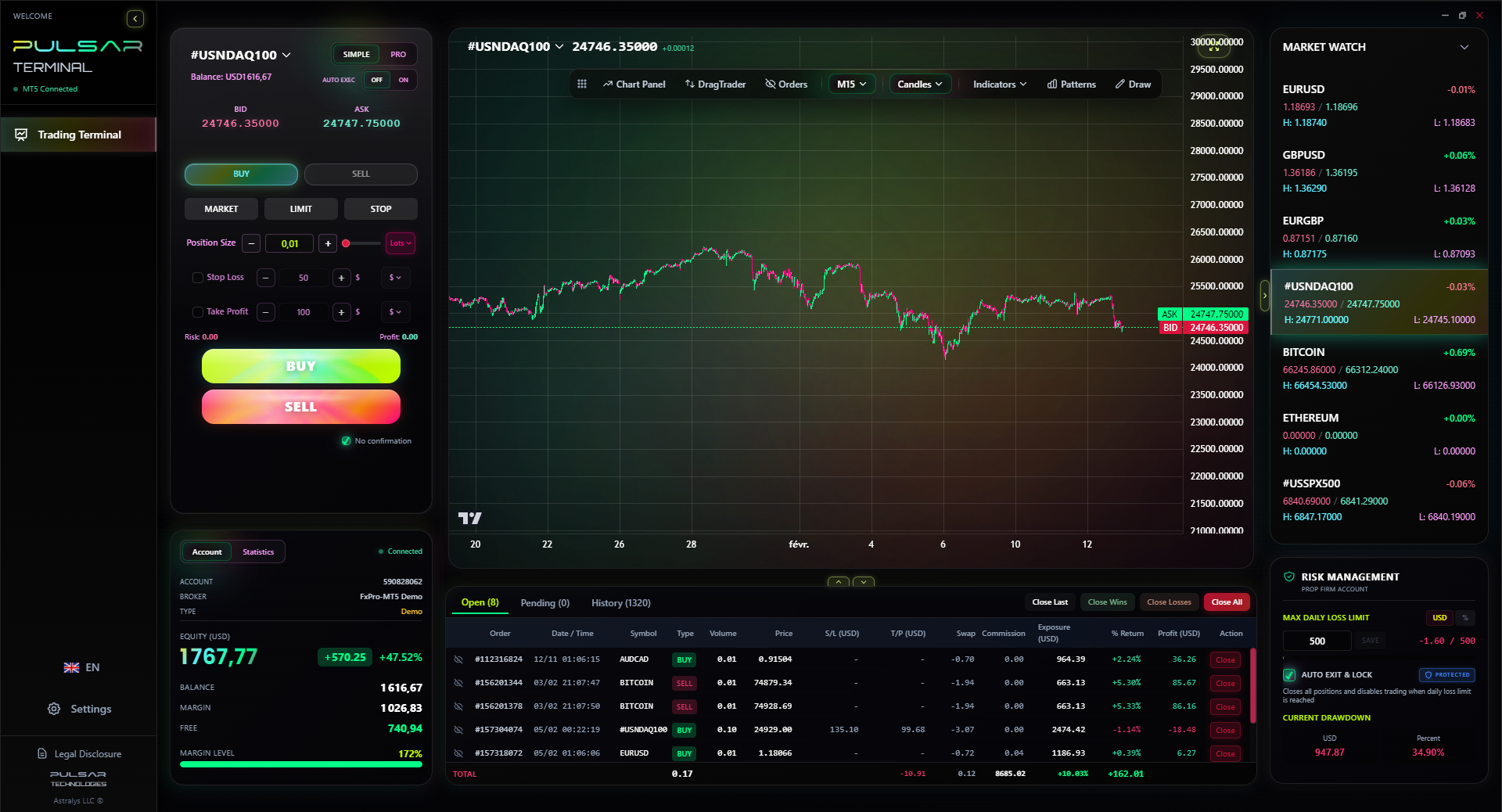
“Automate your discipline. Your willpower is a finite resource that depletes with every decision.”
Books give you the map, but you still have to walk through the jungle. After internalizing the core principles from the three key texts, your focus must shift from learning to implementation.
Automate Your Discipline: Your willpower is a finite resource that depletes with every decision. The goal is to build a trading environment where the right action is the default, automatic one. This is where technology becomes a psychological aid. Using a platform or tool that lets you set orders with pre-defined, multiple take-profit levels and a trailing stop from the outset means you've made all your exit decisions in a calm state. You're not deciding in the heat of the moment. You're just watching the plan play out.
Measure What Matters: Stop tracking just profit/loss. Start tracking your psychological metrics. How many trades did you take outside your planned setup? How many times did you break your daily loss limit? How often did you check a P&L on an open position? This is the data that tells you if you're improving as a trader, not just the weekly balance.
Find a Mirror, Not an Echo Chamber: South African trading forums and Telegram groups are often toxic echo chambers of get-rich-quick schemes. Instead, find one serious trading partner. Your only job is to hold each other accountable to your written plans. Send them your trade journal. When you take a revenge trade, you have to explain it to another person. This external accountability is a force multiplier for the principles in the books. It makes the psychology social and real, not just theoretical.
The journey from a reactive, emotional trader to a disciplined, process-driven one is long. It's more rewiring than learning. The right forex psychology books are the wrench and screwdriver for that job. But remember, you still have to pick them up and turn them, every single day.
FAQ
Q1Are forex psychology books worth it for a beginner in South Africa?
Yes, but only after you have a basic, tested strategy and understand costs like spreads and FSCA use limits. Reading them before you have a plan is like learning mental techniques for a sport you don't know how to play. Get your basics down first, then use the books to fix the mental errors that will inevitably appear.
Q2Can these books help with the fear of trading USD/ZAR?
They won't remove the fear, and they shouldn't. The goal is to have a written trading plan so strong that you can execute it while feeling afraid. The books teach you to acknowledge the fear ('The Rand is moving fast, I'm nervous'), but then follow your pre-set rules for position size and stop-loss regardless. The fear becomes background noise, not the decision-maker.
Q3How do I know if a psychology book is giving me bad advice?
Bad advice is vague and promises emotional transformation. Good advice gives you a specific worksheet, a journal prompt, or a drill to do today. If the book spends chapters telling you to 'be confident' or 'think like a winner' without concrete steps, it's bad. Look for books that force you to interact with your own trade data.
Q4Do I need to read all three books you recommended?
No. Start with one. 'The Daily Trading Coach' is the best practical manual. Work through 10 of its lessons diligently for a month. That will do more for you than skimming all three. Depth beats breadth every time in trading psychology.
Q5How do psychology books relate to FSCA rules and use limits?
Directly. The 30:1 use limit for retail traders is a psychological aid in disguise. It physically prevents you from taking catastrophic, account-blowing risk. A good psychology book teaches you why you'd be tempted to use 100:1 or 200:1 use (greed, impatience) and how to build a business plan that works within the 30:1 constraint. The rule forces discipline; the book helps you understand and embrace it.
Q6What's the biggest mistake traders make after reading these books?
They treat it as a one-time fix. They read, feel inspired for a week, and then go back to old habits. Trading psychology is maintenance, not a repair. You need to integrate the drills (like the pre-market checklist and loss review) into your daily routine forever. It's a practice, like brushing your teeth.
प्रो. विंस्टन का पाठ
:
- ✓Test psychology concepts for 20 trades before judging them.
- ✓Journal the 'why' and 'feel', not just P&L.
- ✓Enforce a daily loss limit of 0.5% of your account.
- ✓Walk away for 10 minutes after any stop-loss hit.
यह लेख कितना उपयोगी था?
रेट करने के लिए स्टार पर क्लिक करें
साप्ताहिक ट्रेडिंग विश्लेषण
मुफ़्त साप्ताहिक विश्लेषण और रणनीतियाँ। कोई स्पैम नहीं।
लेखक के बारे में
David van der Merwe
उभरते बाजार के ट्रेडर
जोहानसबर्ग स्थित ट्रेडर, इमर्जिंग मार्केट करेंसीज में 11 साल का अनुभव। ZAR पेयर्स, FSCA-विनियमित ट्रेडिंग और दक्षिण अफ्रीकी मार्केट एनालिसिस में विशेषज्ञ।
टिप्पणियाँ
आपको यह भी पसंद आ सकता है

Cara Trading Forex Sukses: 7 Prinsip dari Trader Profesional
Cara trading forex sukses dengan 7 prinsip trader pro: manajemen modal, disiplin, journal trading, backtest. Data nyata, bukan janji profit palsu.
Jam Trading Forex Terbaik untuk Trader Indonesia: Panduan Lengkap dengan Tabel Waktu
Panduan jam trading forex untuk trader Indonesia. Tabel 4 sesi dunia, jam emas 20:00-00:00, sesi mana yang harus dihindari. Data akurat + tips dari trader berpengalaman.
Top 5 Sàn Forex Uy Tín Nhất 2026: Review Jujur dari Trader Indonesia
Top 5 sàn forex uy tín 2026 untuk trader Indonesia. Review jujur: spread, deposit, withdraw, dukungan lokal. Exness, XM, IC Markets & lebih.
All these calculators are built into Pulsar Terminal with real-time data from your MT5 account. One-click position sizing, automatic risk management, and instant calculations.
