


I lost ₦450,000 in one week.

Olumide Adeyemi
पश्चिम अफ्रीकी ट्रेडिंग अग्रणी ·  Nigeria
☕ 11 मिनट पढ़ने
आप क्या सीखेंगे:
- 1What Are Forex Signals, Really?
- 2The Landscape: Types of Providers in Nigeria
- 3My 5-Step Checklist to Vet Any Provider
- 4How to Actually Use Signals (Without Losing Your Shirt)
- 5Red Flags & Common Scams in Nigeria
- 6Free Signals vs. Paid Signals: The Real Trade-Off
- 7The End Goal: Using Signals to Build YOUR Own Edge
- 8My Final Verdict for Nigerian Traders
I lost ₦450,000 in one week. Not from my own analysis, but from following a 'guru' on WhatsApp who promised 90% win rates. The signals came fast: 'BUY GBPUSD NOW, TP 50 pips!' I'd rush to my Exness review account, enter the trade, and watch it reverse instantly. No stop-loss was ever given. That week taught me the brutal truth about forex signals providers in Nigeria. They're not a magic bullet. They're a tool, and like any tool, you can hurt yourself badly if you don't know how to handle it. This guide is what I wish I'd known before I sent that first bank transfer.
At its core, a forex signal is just a suggestion. It's a recommendation to buy or sell a currency pair at a specific price and time, usually with suggested take-profit and stop-loss levels. They get delivered through Telegram, WhatsApp, email, or inside platforms like the MetaTrader signals market.
In Nigeria, the appeal is obvious. With high unemployment and a hunger for side income, the promise of someone else doing the hard work is magnetic. You see the screenshots of profits, the luxury cars, and you think, "Why not me?" I thought that too.
But here's the reality most providers won't show you: a signal is just an output. It doesn't show you the analysis, the risk calculation, or the market context. It's like being given a fish without learning how to fish. You might eat today, but you'll starve tomorrow unless you keep paying.

Warning: A signal without a stated stop-loss is not a trading recommendation. It's gambling advice. Any provider who does this is immediately disqualified in my book. I learned that the expensive way.

💡 विंस्टन की सलाह
A signal is an opinion, not an oracle. The moment you treat it as gospel is the moment you surrender your greatest asset: your own judgment.
Not all signal services are created equal. Over the years, I've sorted them into three broad categories, each with its own pros and cons.
The 'Guru' or Individual Trader
This is the most common type you'll find on Nigerian social media. A single person, often with a flashy profile, selling signals directly. Fees can range from ₦10,000 to ₦100,000 per month. The big problem? There's zero transparency. You have no way to verify their long-term track record. My ₦450,000 loss was to one of these. Their success is in marketing, not necessarily in trading.
The Automated/Signal Aggregator Platform
These are more structured. Websites like Signal Start or MQL5's signal service host hundreds of providers. You pay the platform a fee (say, $25/month), then an additional fee to follow a specific provider ($30-$100/month). The key advantage here is verified track records. You can see a provider's historical performance, drawdown, and profit factor before you pay a kobo. It's not perfect, but it's miles better than a WhatsApp screenshot.
The Broker-Integrated Service
Some brokers, especially those popular in Nigeria like XM review or IC Markets review, have built-in social or copy trading features. You can automatically copy the trades of selected strategy managers. The trades execute directly in your account. This removes the manual error of you having to enter the trade yourself, which is a huge plus. However, you still need to vet the person you're copying just as rigorously.
| Provider Type | Typical Cost (Monthly) | Transparency | Best For |
|---|---|---|---|
| Individual 'Guru' | ₦10k - ₦100k+ | Very Low | (Avoid, in my opinion) |
| Aggregator Platform | $25 + $30-$100 | High (Verified Stats) | Disciplined traders who will do their own vetting |
| Broker Copy Trading | Often Free + Performance Fee | Medium | Beginners wanting hands-off execution |
“A signal without a stated stop-loss is not a trading recommendation. It's gambling advice.”
After my disaster, I built a system. I won't even look at a provider's sales page until I've run them through this checklist. It's saved me countless times.
-
Demand a Verifiable, Long-Term Track Record. A one-month screenshot of wins is useless. I need to see at least 6-12 months of real, live trading history on a third-party platform like Myfxbook or the MQL5 community. Look for consistency, not just total profit.
-
Scrutinize the Risk Metrics. The profit number is a distraction. Focus on these:
- Maximum Drawdown: This is the biggest peak-to-trough loss in their history. If it's over 20%, it's a red flag. A 50% drawdown means they need a 100% return just to break even. I avoid anyone above 25%.
- Profit Factor: (Total Gross Profit / Total Gross Loss). Anything above 1.5 is decent. Above 2.0 is very good. My failed guru? His was probably below 0.5.
- Average Win vs. Average Loss: Their average winning trade should be larger than their average losing trade. This is the core of a positive expectancy system.
-
Analyze the Trade Details. Do they provide a clear pip definition target and stop-loss with every signal? Is their typical risk-reward ratio sensible? I'm wary of anyone constantly going for 10-pip profits with 50-pip stops. That's a losing math equation over time.
-
Test Their Responsiveness & Rationale. Before paying, ask a question. "What's your core trading strategy? Are you a scalping strategy trader or swing trading?" If they can't articulate a clear methodology, they're likely just guessing. A real pro can explain their edge.
-
Start Small & Mirror on a Demo. Never, ever go all-in on a new signal source with your live capital. If you decide to proceed, start with the smallest possible subscription. Then, mirror their signals on a demo account for at least one full month. Does the demo performance match their claimed live performance? This step alone filters out 90% of the frauds.

Pro Tip: Use a position size calculator independently, even when following signals. The provider's risk per trade might be 2% for their ₦10 million account, but 2% on your ₦200,000 account is a different story. Always calculate your own position based on your capital.
This is the most important part. Signals shouldn't replace your trading plan. They should feed into it. Here's my workflow.
I treat a signal as a high-probability alert, not an order. When I get one, I pull up my own charts. I check if the signal aligns with my own analysis. Is price at a key support or resistance level? What do my indicators like the RSI indicator or MACD indicator show? If my analysis conflicts with the signal, I skip it. No exceptions.
I also adjust the risk. A provider might set a 50-pip stop. But if I see a major support level 30 pips below the entry, I'll move my stop to just below that level. This improves my risk-reward. The signal gives me the direction and idea; I manage the trade based on my own chart reading.
Finally, I never let a signal service dictate my overall risk management. My daily loss limit is my sacred rule. If following signals hits that limit, I stop trading for the day, even if the provider is firing off more "sure deals." This discipline prevented a second major blow-up in 2021.

Example: A provider signals BUY EURUSD at 1.0850, SL 1.0800 (50 pips), TP 1.0950 (100 pips). I check my chart. I see strong support at 1.0820. I enter at 1.0850, but I place my SL at 1.0815 (35 pips). My TP stays at 1.0950. My risk-reward just improved from 1:2 to almost 1:3, all because I didn't follow blindly.
💡 विंस्टन की सलाह
The most valuable metric from any provider isn't their biggest win. It's their worst loss. Study the drawdown. That's their true character.
“The goal shouldn't be to follow signals forever. The goal should be to use them as a training wheel while you learn to ride.”
The Nigerian forex space is fertile ground for scams. You have to be a skeptic to survive. Here are the patterns I've seen repeatedly.
The Guaranteed Profit Scam: "Make 50% monthly guaranteed!" This is mathematically impossible in the long term. The market doesn't offer guarantees. Anyone who does is lying.
The Fake Track Record: Sophisticated scammers use 'demo' or 'simulated' performance disguised as live results. They use trade copiers to show a demo account making wild profits. Always ask for a live account statement that shows deposits and withdrawals.
The Pressure Tactics: "Offer expires in 2 hours!" "Only 5 slots left at this price!" This is pure marketing manipulation. A legitimate business doesn't need these tricks.
The Vague Signal: "GBPUSD looks bullish, get in!" No entry, no stop, no target. This is useless. It's designed so they can claim victory no matter what happens.
The Prop Firm Link-Up Scam: A newer twist. A signal provider claims they can help you pass a prop firm challenge for a huge fee (£350-£700). They often demand control of your account. What happens? They blow the account with reckless trading, and you're left paying the challenge fee again. Manage your own prop firm journey, or use tools that automate protection, but never give control to a stranger.
The biggest red flag of all? When you ask tough questions about drawdown or strategy, and they get defensive or block you. A real professional has nothing to hide.
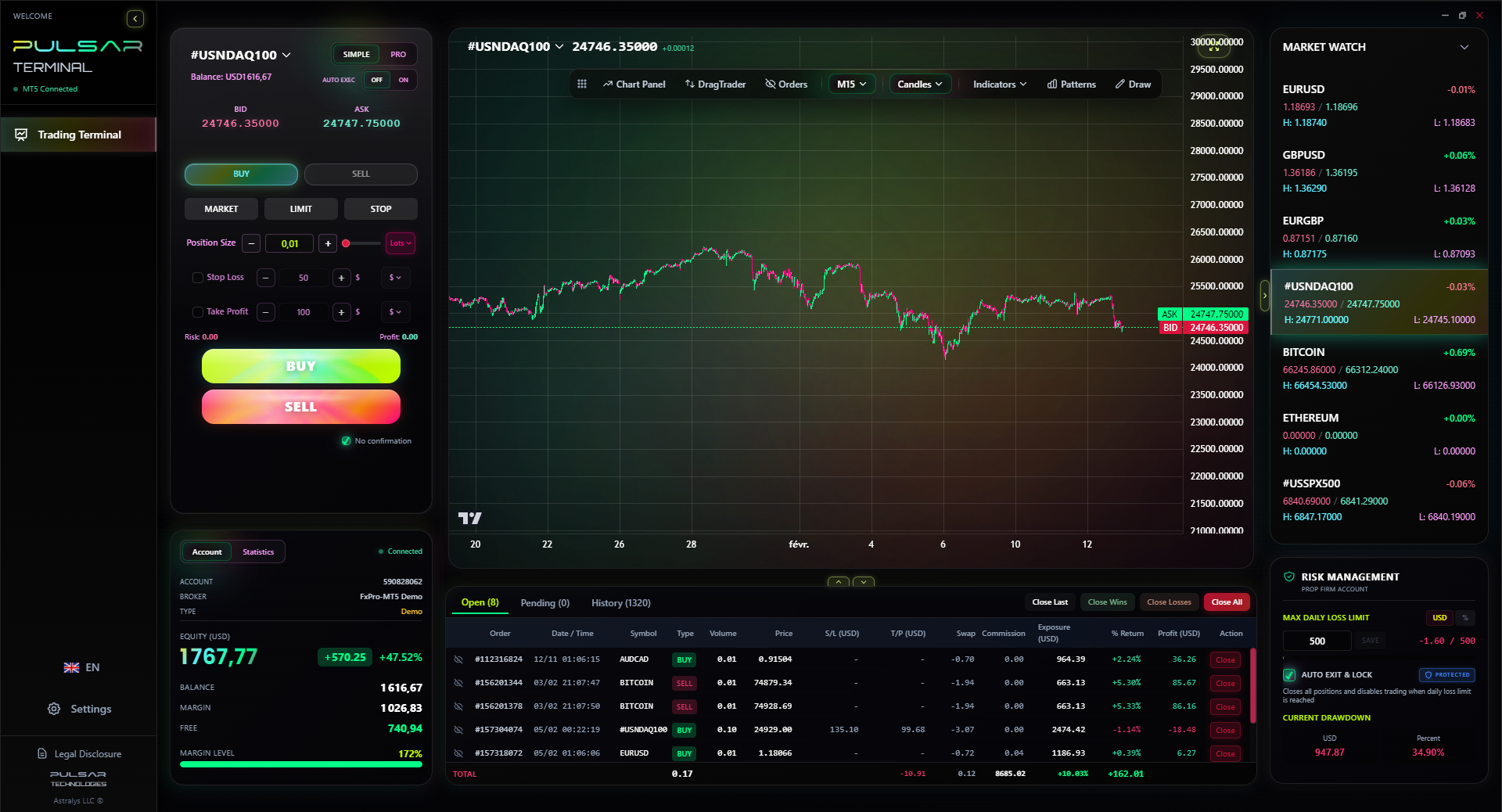
When testing signal providers or managing your own trades, precise order execution and risk management tools are non-negotiable, which is where a platform like Pulsar Terminal enhances your MT5 experience.
You'll find plenty of free signals in Telegram groups or from sites like FXLeaders. Are they worth it?
My experience with free signals has been mixed. The main issue isn't always quality (though it often is), it's consistency and rationale. Free signals are often broadcast to thousands. By the time you get them, the move might already be over. There's also zero accountability. If the signal loses, the provider just vanishes or posts another one.
I used a free EUR/USD guide channel for a month in 2022. Out of 20 signals, 11 were winners. Sounds okay, right? The problem was the losers. They were huge. The 9 losing trades wiped out all the profits from the 11 winners and then some. The provider was chasing losses, and we were the guinea pigs.
Paid signals, from a properly vetted provider, should offer more. You're paying for consistency, detailed analysis, risk management, and support. The provider's income depends on your success, so alignment is better.
But paid doesn't automatically mean good. A ₦50,000/month service from a flashy Instagram trader is almost certainly worse than a $50/month service on a verified aggregator platform. You're not paying for the signal itself; you're paying for the reliability and transparency behind it.
In short: free signals can be an educational tool to see how others think, but I would never risk real money on them. Paid signals are a business transaction - treat them like one, with contracts (terms of service) and due diligence.
“You're not paying for the signal itself; you're paying for the reliability and transparency behind it.”
Here's my final, most important lesson. The goal shouldn't be to follow signals forever. The goal should be to use them as a training wheel while you learn to ride.
When you follow a good provider, don't just copy. Reverse-engineer. After they send a BUY signal on XAU/USD guide, go to the chart. Why did they buy? Was it a bounce off the 200-day moving average? A breakout from a triangle pattern? A bullish divergence on the hourly RSI?
Keep a journal. Note the signal, the provider's rationale (if given), and your own chart observations. Over time, you'll start to see patterns. You'll notice that 80% of their winning trades involve a specific setup you can now identify yourself.
This is how you transition from dependent to independent. I did this with a swing trading provider I respected. After six months of studying his signals, I realized his core edge was trading pullbacks to key Fibonacci levels on the daily chart. I started spotting those setups myself. Now, I might take the same trade he does, but I found it on my own. That's empowerment.
Signals are a shortcut, but not to profits. They're a shortcut to education - if you use them correctly. The day you can look at a chart, make a decision, and have that decision align with a trusted provider's signal before you even see it, is the day you've graduated. You're no longer a customer; you're a colleague.
💡 विंस्टन की सलाह
If you wouldn't give the signal provider the login details to your bank account, why would you let them direct the trades inside it? Trust, but verify. Always.
Are forex signals providers worth it? Yes, but only under very specific conditions.
They are not a source of easy income. They are a potential source of structured learning and trade ideas. For a beginner drowning in information overload, a vetted signal service can provide a framework and prevent early, catastrophic mistakes born of pure ignorance.
For the intermediate trader, they can be a sounding board, a way to confirm or challenge your own analysis.
But you must go in with your eyes wide open. Assume everyone is selling a dream until they prove otherwise with cold, hard, verifiable data. Your number one job is capital preservation, and that means being a ruthless filter.
Start with the mindset of a student, not a follower. Use the signals, but dissect them. Question them. Most of all, never, ever outsource your risk management. Your stop-loss, your position size, your daily loss limit - these are yours to control. That ₦450,000 lesson burned that truth into me. Let my loss be your first, and only, free signal.
FAQ
Q1What is the success rate of forex signals providers in Nigeria?
There's no single "success rate." It varies wildly from scam artists (near 0% long-term) to legitimate professionals (55-65% is realistic). Focus on verified profit factors (above 1.5) and maximum drawdown (below 25%) instead of win rate. A 90% win rate with huge losses on the 10% is a disaster.
Q2Are free forex signals from WhatsApp/Telegram groups reliable?
In my experience, almost never. They lack accountability, often miss critical details like stop-losses, and are broadcast too late. They can be useful for seeing how others analyze, but I would never risk real money based solely on a free group signal.
Q3How much do forex signal services typically cost in Nigeria?
Costs are all over the place. Individual 'gurus' charge ₦10,000 to ₦100,000+ per month. Professional platforms like Signal Start charge about $25 platform fee plus $30-$100/month to follow a specific, verified provider. You often get what you pay for, but a high price doesn't guarantee quality.
Q4Can I get rich just by copying forex signals?
No. This is the most dangerous myth. Copying signals without understanding the underlying strategy or managing your own risk is a direct path to a margin call. Signals don't account for your personal financial situation, risk tolerance, or emotional state. They are a component of a strategy, not the strategy itself.
Q5What's the best way to receive and execute forex signals quickly?
Broker-integrated copy trading (like on XM or IC Markets) is fastest, as trades auto-execute. For manual entry, Telegram/MT4 alerts are quick. Speed matters for scalping, less so for swing trading. The real key is having a pre-defined plan so you're not scrambling when a signal hits.
Q6Do I need a VPS to follow forex signals?
If you're following signals for very short-term trades (like scalping) and the provider's entry timing is critical, then a Virtual Private Server (VPS) can help by keeping your trading platform running 24/7 with minimal latency. For daily or swing trade signals, it's usually not necessary.
Q7How are forex signals providers regulated in Nigeria?
The direct regulation of signal providers by the SEC or CBN is unclear and not well-defined. This is a major grey area. There is no specific "license" for giving trading advice. This lack of oversight is why vetting them yourself is your primary line of defense. You are your own regulator.
प्रो. विंस्टन का पाठ
:
- ✓Vet providers with 6+ months of verified track records.
- ✓Maximum drawdown over 25% is a major red flag.
- ✓Never let signals override your personal risk management.
- ✓Free signals are for education, not live trading.
- ✓Use signals to learn the setup, not just copy the trade.
यह लेख कितना उपयोगी था?
रेट करने के लिए स्टार पर क्लिक करें
साप्ताहिक ट्रेडिंग विश्लेषण
मुफ़्त साप्ताहिक विश्लेषण और रणनीतियाँ। कोई स्पैम नहीं।
लेखक के बारे में
Olumide Adeyemi
पश्चिम अफ्रीकी ट्रेडिंग अग्रणी
नाइजीरिया के सबसे सक्रिय फॉरेक्स ट्रेडिंग एजुकेटर्स में से एक। लागोस से 8 साल का ट्रेडिंग अनुभव। अफ्रीकी ट्रेडर्स के लिए लो-कैपिटल स्ट्रैटेजीज और प्रॉप फर्म चैलेंजेज में विशेषज्ञ।
टिप्पणियाँ
आपको यह भी पसंद आ सकता है

Cara Trading Forex Sukses: 7 Prinsip dari Trader Profesional
Cara trading forex sukses dengan 7 prinsip trader pro: manajemen modal, disiplin, journal trading, backtest. Data nyata, bukan janji profit palsu.
Jam Trading Forex Terbaik untuk Trader Indonesia: Panduan Lengkap dengan Tabel Waktu
Panduan jam trading forex untuk trader Indonesia. Tabel 4 sesi dunia, jam emas 20:00-00:00, sesi mana yang harus dihindari. Data akurat + tips dari trader berpengalaman.
Top 5 Sàn Forex Uy Tín Nhất 2026: Review Jujur dari Trader Indonesia
Top 5 sàn forex uy tín 2026 untuk trader Indonesia. Review jujur: spread, deposit, withdraw, dukungan lokal. Exness, XM, IC Markets & lebih.
All these calculators are built into Pulsar Terminal with real-time data from your MT5 account. One-click position sizing, automatic risk management, and instant calculations.
