


Thinking about letting someone else trade for you? You're not alone.

David van der Merwe
उभरते बाजार के ट्रेडर ·  South Africa
☕ 11 मिनट पढ़ने
आप क्या सीखेंगे:
- 1What Exactly Is Social Trading? (It's Not What You Think)
- 2The South African Social Trading Scene: Brokers, Rules & Rand
- 3The Brutal Maths: Costs & The Chances You'll Lose
- 4How to Vet a Trading 'Leader' (This is Your Job)
- 5Platforms & Brokers: A South African Comparison
- 6The Dark Side: Risks & Common Pitfalls I've Seen
- 7A Realistic Game Plan: How to Use Social Trading Wisely
Thinking about letting someone else trade for you? You're not alone. Every week, another South African asks me if forex social trading is the magic bullet they've been looking for. The ads make it look easy: find a guru, click 'copy,' and watch the money roll in. I've got 12 years in this game, and I've seen the reality. It's not that simple. Let's cut through the hype and look at what social trading really means for your ZAR, your risk, and your sanity.
At its core, forex social trading is copy trading. You find a trader (often called a 'Leader' or 'Strategy Provider'), allocate some capital, and your account automatically mirrors their trades. Platforms like eToro and ZuluTrade built entire ecosystems around this idea.
But here's the first misconception: it's not a hands-off retirement plan. It's delegation, not abdication. You're still the captain; you're just hiring a navigator. If the navigator steers you into an iceberg, it's your ship that sinks. I learned this the hard way back in 2018. I copied a 'Leader' on eToro who had a 6-month win streak trading gold. I put in $2,000. He then proceeded to take 12 losing trades in a row on XAU/USD, blowing through a 40% drawdown before I manually disconnected. My loss? R11,500 at the time. I was lazy. I didn't understand his scalping strategy or his risk parameters. I just saw green numbers and clicked.
The psychology is the real hook. It taps into our desire for community and our fear of missing out. You see someone else winning, and your brain says, 'I want that too.' But remember, in the markets, the crowd is often wrong at the most critical moments.

💡 विंस्टन की सलाह
A 'Leader' with a 90% win rate is almost always taking profits too early and letting losses run. Look for the Profit Factor, not the win rate.
The Regulatory Watchdog: FSCA
In South Africa, the Financial Sector Conduct Authority (FSCA) calls the shots. This is good news for you. It means any legit broker offering social trading here needs to play by a set of rules designed (in theory) to protect you. They've been cracking down hard on cowboys. In just the first half of 2025, they issued over a hundred warnings, many targeting fake 'signal sellers' on Instagram and Telegram. If you're looking at a platform, FSCA regulation is your first box to check. Brokers like AvaTrade, FP Markets, and Tickmill operate under this regime.
The use Squeeze is Coming
Pay attention here. Right now, under FSCA rules, use for majors might be around 1:30 at a broker like FxPro. But the word is, by early 2026, they intend to cap it at 1:200 for major pairs. This matters for social trading because your chosen 'Leader' might be using high use to generate those sexy returns. If the rules change, their strategy might stop working overnight, and your copied account will feel the pain.
Thinking in Rands
This is non-negotiable. If your brokerage account is in USD and you fund it with ZAR, you're taking on a hidden, silent trade: USD/ZAR. If the Rand weakens, your account balance in Rands looks better, even if your trades are flat. If it strengthens, you lose on conversion before you've even placed a trade. Always look for a broker that offers a ZAR-denominated account. It removes this unnecessary variable. Funding is easier too – use local EFTs, Ozow, or your Visa card without worrying about bank conversion fees.

Warning: That 'Leader' you're following in Europe? They aren't thinking about USD/ZAR volatility eating into your profits. You have to.
“Social trading is delegation, not abdication. If your navigator steers you into an iceberg, it's your ship that sinks.”
Let's talk numbers, because this is where the fantasy meets the road. The stats are ugly, and ignoring them is how you become one.
The Loss Rates: Multiple brokers are required to disclose this. Vantage, MultiBank Group, others... they report that 74-89% of retail CFD accounts lose money. A South African university study found 72% of new forex accounts blow up within six months. AvaTrade says 63%. Let that sink in. The majority lose. Now, eToro claims 78% of all copied trades ever opened have been in profit. Sounds great, right? But a trade being 'in profit' at some point isn't the same as a closed profit. It's a clever stat. I've had trades up 50 pips that I ended up closing at a 20-pip loss.
The Real Costs of Copying: It's never free. You're paying, even if you don't see a direct invoice.
- The Spread: This is the broker's cut. On a major pair, it could be as low as 0.6 pips with IG or start at 2 pips on eToro. Every time your Leader trades, you pay this.
- The Commission: Some brokers charge this on top. Think $5-$10 per standard lot. Tickmill, for example, charges 2 per side for Pro accounts.
- The Performance Fee: This is how the 'Leader' gets paid. The platform takes it from your account if the Leader is profitable. On ZuluTrade, Leaders are paid via a slightly wider spread (about 0.5 pip).
- The Hidden Killer – Currency Conversion: As mentioned, if you're not in a ZAR account, you're paying eToro or others to change your money.

Example: You copy a trade on EUR/USD. Leader's entry: 1.0850. Your actual fill, after the platform's markup: 1.0852. That's 2 pips gone before the trade moves. If the trade goes to 1.0862 and closes, the Leader made 12 pips. You made 10. Over hundreds of trades, that bleed is significant.
This is the most important skill in social trading: being a good boss. You wouldn't hire a CFO without checking their credentials. Don't hire a trader without doing the same.
Look Beyond the Pretty Graph: Every platform shows a sexy equity curve shooting up and to the right. Ignore it first. Dig into the stats that matter:
- Average Trade Duration: Is this a scalping strategy (minutes) or a swing trading one (days/weeks)? Does that match your psychology? Can your broker's execution handle scalps?
- Maximum Drawdown (MDD): This is the biggest peak-to-trough drop in their history. If it's 45%, ask yourself: can I watch my R20,000 account drop to R11,000 without panicking and quitting? If not, this Leader isn't for you.
- Win Rate & Profit Factor: A 40% win rate can be profitable if the average winner is much bigger than the average loser. The Profit Factor (Gross Profit / Gross Loss) tells you this. Look for something above 1.5, at least.
- Number of Trades & History: A 300% return over 3 months on 10 trades is luck. A 60% return over 3 years on 500 trades is a track record.
My Personal Checklist: I once found a Leader on a platform connected to IC Markets. His stats were solid: 2-year history, 1.8 Profit Factor, 22% Max DD. But I made one extra check: I looked at his individual trade history. I noticed all his massive profits came from two huge, lucky trades on GBP news events early in his history. Every other trade was a scratch or a small loss. He was a lottery ticket masquerading as a system. I passed.
You need to understand their edge. Do they use specific RSI divergences? Do they trade MACD crossovers on the 4-hour chart? If you can't identify their method, you're blindly following faith, not strategy.
💡 विंस्टन की सलाह
If you can't explain a Leader's strategy in two sentences after a week of watching, you shouldn't be copying it. Mystery is not an edge.
“The majority lose. 74-89% of retail CFD accounts lose money according to broker disclosures. Your first job is to not be part of that majority.”
Not all platforms are created equal. Your choice dictates your experience, costs, and available strategies. Here’s a quick, opinionated breakdown of the major players for South Africans.
| Platform / Broker | Min. Deposit (Approx.) | Key Social Feature | The Veteran's Take |
|---|---|---|---|
| eToro | $2,000 (First time) | Proprietary copy-trading environment. | The Facebook of trading. Incredibly user-friendly, great for beginners to see how it works. But all accounts are in USD (conversion fees), spreads are wider, and you're locked into their closed system. Good for dipping a toe in, expensive for serious capital. |
| ZuluTrade | $200 - $300 | Connects to multiple brokers (like FP Markets, IC Markets). | More of a professional's tool. You choose your broker separately, so you can shop for raw spreads from 0.0 pips. Vast universe of Strategies. Can be complex to set up. The 'free' copy trading is only with specific integrated brokers. |
| AvaTrade / AvaSocial | $100 | Built-in social copy tool. | FSCA regulated, offers ZAR accounts. AvaSocial is integrated into their platform. A solid, regulated middle-ground option. Fixed spreads can be higher than raw ECN models. |
| MetaTrader (MT4/MT5) via MQL5 | Varies by broker | Vast marketplace of signal providers. | The most flexible and potentially cheapest. You use your preferred FSCA broker (like Pepperstone or Exness) on MT5. Then, you subscribe to signals from the MQL5 marketplace. You control the broker, the costs, and the execution. Requires more technical know-how. |
My preference? For control and cost, the MT5/MQL5 route with a good broker is superior. For absolute simplicity as a beginner, eToro shows you the concept, but get out before you put serious money in.
The Performance Chaser
This is the biggest killer. You see Leader A up 15% this month. You switch to him. Next month, he's down 5% while Leader B is up 10%. You jump ship again. You're constantly buying high (after a good run) and selling low (after a drawdown). You end up with a portfolio of the worst moments of every strategy. Pick a Leader with a philosophy you understand, and stick with them through a planned drawdown. If their MDD is 25%, don't quit at 20%.
The Black Box Problem
If you don't know why a trade is placed, you cannot evaluate if the strategy is broken or just in a slump. When the Leader's MACD system stops working in a ranging market, will you know? Or will you just bail at the worst time?
Liquidity & Slippage
Your Leader might be trading a $500,000 account. Their market orders move price. You're copying with a R10,000 account. You get their entry price, in theory. But if 10,000 other people are also copying that same trade simultaneously, the broker's system can lag, and you get terrible slippage. This is especially true for scalping strategies around high-impact news.
The Survivorship Bias
You only see the Leaders who haven't blown up yet. The hundreds who blew up last year have been delisted. The platform naturally showcases the winners, creating a false impression that winning is easy.

Pro Tip: Never allocate all your capital to one Leader. Split it between 3-5 with different strategies (e.g., one forex trend follower, one gold mean-reverter, one index trader). Use a position size calculator for each to ensure a 2% risk per Leader doesn't become a 10% risk on your total account if they all coincidentally hit stop-losses.
💡 विंस्टन की सलाह
Run a parallel demo account copying your chosen Leaders for one full market cycle (at least 3 months) before risking a single cent. Your future self will thank you.
Managing multiple copied strategies with different risk profiles is a headache, which is why tools like Pulsar Terminal let you set individual stop-loss and take-profit rules for each position directly on your MT5 charts.
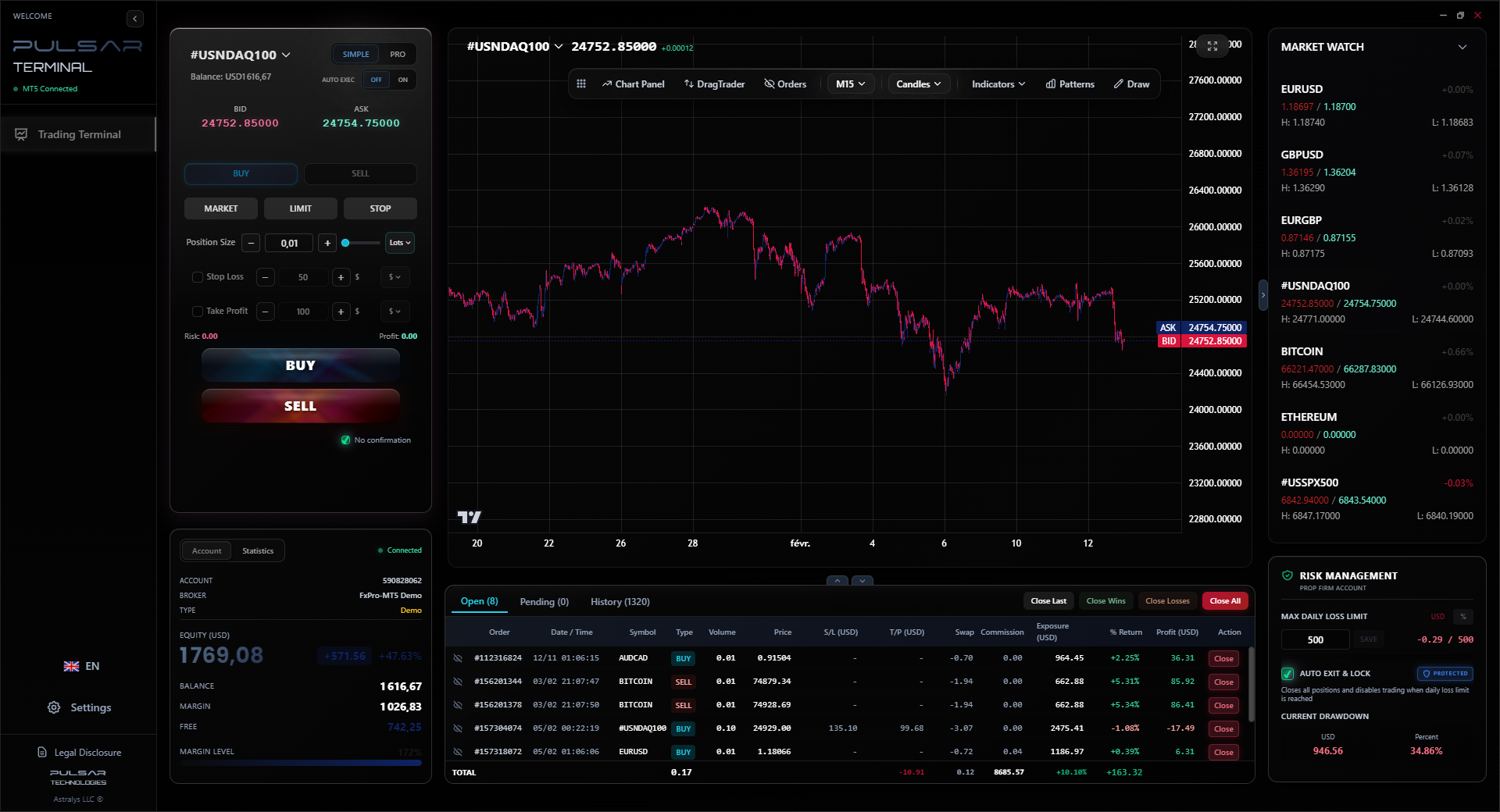
“Your primary skill in social trading isn't picking winners; it's being a ruthless risk manager and a good boss.”
So, is it all doom and gloom? No. Used correctly, social trading can be a powerful tool in your arsenal. Here's my prescribed method, forged from my own mistakes.
Step 1: The Education First Mandate. Before you copy a single trade, spend 3 months learning the basics. Understand what a pip is, what a spread is, what a margin call is. Paper trade your own ideas. You need this foundation to be an intelligent consumer of someone else's strategy. You wouldn't hire a builder if you didn't know what a foundation was.
Step 2: Start Small & Designated. Open a separate 'Social Trading' account. Fund it with money you can afford to lose completely - your 'tuition fee.' This is not your main investment portfolio. Start with a tiny allocation, maybe R5,000.
Step 3: The 90-Day Review. For three months, you do nothing but watch and analyze. Pick 3-5 Leaders you like. Paper-copy them in a spreadsheet. Track every trade they take against the live chart. See if you can deduce their rules. Note their drawdowns and how they behave. This vetting period is priceless.
Step 4: Allocate & Automate Risk Management. Once you fund for real, your primary job is risk manager. Set the copy-trading parameters to use a fixed monetary risk per trade (e.g., R100) or a fixed percentage of your allocated capital. Most platforms allow this. This is non-negotiable. It protects you from a Leader who suddenly decides to go 'all in.'
Step 5: The Quarterly Audit. Every three months, review. Is the Leader's behavior consistent with their history? Has their average trade duration changed? Has their drawdown exceeded historical norms? Be a ruthless CEO. Fire them if the strategy has clearly broken down.
Think of social trading not as a replacement for learning, but as an advanced form of learning. You are reverse-engineering the habits of other traders. The goal shouldn't be to outsource your thinking forever, but to eventually understand the markets well enough that you might not need to copy anyone at all.
FAQ
Q1Is forex social trading legal and safe in South Africa?
It's legal and regulated by the FSCA, which makes it safer than unregulated spaces. 'Safe' in trading is relative, though. The FSCA ensures brokers have certain standards, but it doesn't guarantee you won't lose money. The safety comes from your own due diligence in picking an FSCA-regulated broker and a vetted Leader.
Q2What's the minimum amount I need to start social trading in South Africa?
It varies wildly. eToro asks for around $2,000 for a first deposit. ZuluTrade can start at $200-$300 depending on the broker you connect. Some brokers like Vantage offer $0 minimum, and IFX Brokers has a R10 minimum. But remember, with a tiny account, fees and percentage-based risk become huge obstacles. I'd never recommend starting with less than R5,000 in a dedicated account.
Q3Do I pay tax on profits from copy trading in South Africa?
Yes. SARS views profits from trading (whether you click the button or a computer does it for you) as income, subject to your marginal income tax rate. It's not capital gains. You must declare this income. Keep careful records of all your statements from the broker.
Q4Can I lose more money than I deposit with social trading?
With a properly regulated South African broker under FSCA/ODP rules, you should have negative balance protection. This means you can't lose more than your account balance. However, if you're using an offshore broker without such protection (which I don't recommend), it is possible in extreme volatility. Always confirm your broker's policy on this.
Q5How do the 'Leaders' make money if I don't pay them directly?
They usually get a performance fee, which is a cut of the profits they make for their followers (e.g., 20%). The platform automatically deducts this from your profitable copied trades. Some, like on ZuluTrade, are paid via a small markup on the spread. So you are always paying; it's just built into the system.
Q6Is social trading good for complete beginners?
It's a double-edged sword. It's good because it lets you see real trading in action without knowing how to place a trade. It's terrible because it can build a passive, lazy mindset where you think you don't need to learn. I believe a beginner should use it only as a supplement to active learning, with very small capital, and with the explicit goal of understanding why the Leader is trading.
Q7What's the single biggest mistake South African social traders make?
Chasing past performance without understanding strategy. They see a 120% yearly return, allocate a big chunk of cash, and then panic-sell during the strategy's first inevitable 25% drawdown. They treat it like picking a winning lottery number instead of hiring a fund manager for a long-term approach.
प्रो. विंस्टन का पाठ
:
- ✓Vet Leaders on Max Drawdown, not just returns.
- ✓Always use a ZAR account to avoid hidden FX risk.
- ✓Allocate to multiple, uncorrelated strategies.
- ✓Never let a single trade risk more than 2% of your social trading capital.
यह लेख कितना उपयोगी था?
रेट करने के लिए स्टार पर क्लिक करें
साप्ताहिक ट्रेडिंग विश्लेषण
मुफ़्त साप्ताहिक विश्लेषण और रणनीतियाँ। कोई स्पैम नहीं।
लेखक के बारे में
David van der Merwe
उभरते बाजार के ट्रेडर
जोहानसबर्ग स्थित ट्रेडर, इमर्जिंग मार्केट करेंसीज में 11 साल का अनुभव। ZAR पेयर्स, FSCA-विनियमित ट्रेडिंग और दक्षिण अफ्रीकी मार्केट एनालिसिस में विशेषज्ञ।
टिप्पणियाँ
आपको यह भी पसंद आ सकता है

Cara Trading Forex Sukses: 7 Prinsip dari Trader Profesional
Cara trading forex sukses dengan 7 prinsip trader pro: manajemen modal, disiplin, journal trading, backtest. Data nyata, bukan janji profit palsu.
Jam Trading Forex Terbaik untuk Trader Indonesia: Panduan Lengkap dengan Tabel Waktu
Panduan jam trading forex untuk trader Indonesia. Tabel 4 sesi dunia, jam emas 20:00-00:00, sesi mana yang harus dihindari. Data akurat + tips dari trader berpengalaman.
Top 5 Sàn Forex Uy Tín Nhất 2026: Review Jujur dari Trader Indonesia
Top 5 sàn forex uy tín 2026 untuk trader Indonesia. Review jujur: spread, deposit, withdraw, dukungan lokal. Exness, XM, IC Markets & lebih.
All these calculators are built into Pulsar Terminal with real-time data from your MT5 account. One-click position sizing, automatic risk management, and instant calculations.
