


I lost $1,200 in three days back in 2018 trying to impress a local fund manager.

Olumide Adeyemi
पश्चिम अफ्रीकी ट्रेडिंग अग्रणी ·  Nigeria
☕ 8 मिनट पढ़ने
आप क्या सीखेंगे:
- 1Forget the Traditional Resume, Nobody's Hiring You
- 2The Three Core Components of Your Trading CV
- 3The Nigerian Context: Taxes, Trust, and Transfers
- 4Building That Track Record: A Brutally Honest Plan
- 5What NOT to Put on Your Trading CV (The Cringe List)
- 6From CV to Funded: The Application Process
- 7A Sample Structure for Your Trading CV Document
I lost $1,200 in three days back in 2018 trying to impress a local fund manager. I printed out fancy charts, wrote a 10-page 'market thesis,' and wore my best suit. He glanced at my P&L statement for about seven seconds, handed it back, and said, 'Your drawdown is a horror story. Come back when you have six months of consistent, documented wins.' That was it. No one cared about my economics degree or my 'passion for markets.' They cared about one thing: proof I could make money without blowing up. That's what a real forex trader CV is. It's not a piece of paper. It's your track record.
Let's get this straight. You're not applying for a bank job in Victoria Island. Sending a CV that lists your WAEC results and your NYSC posting is a complete waste of time for forex trading. The traditional hiring pipeline barely exists here for retail traders.
The real 'job' you're applying for is with a proprietary trading firm (prop firm) or a private investor. Their hiring manager is a risk algorithm and a compliance officer looking at a dashboard. Your 'interview' is their trading challenge. Your 'CV' is the verified performance data you generate during that challenge and afterward.
I see so many guys make this mistake. They spend days polishing a document that ends up in the trash. Focus your energy on what matters: creating a verifiable, profitable track record. That's the only currency that talks in this game. If you want to understand the kind of disciplined strategy needed to build that record, our guide on swing trading principles is a solid starting point.
Your trading CV is a living document. It has three non-negotiable parts. Miss one, and you look like an amateur.
1. The Verified Track Record
This is the headline act. It's not screenshots from your phone (easy to fake). It's a link to a verified myfxbook, fxblue, or cTrader copy-trading profile. These platforms connect directly to your broker's API and provide immutable proof of your trades. It shows everything: profit factor, drawdown, average win/loss, Sharpe ratio (if you're fancy).

Warning: A track record with 200% returns and a 60% drawdown is garbage. It shows you're a gambler. A 15% return with a 5% max drawdown over a year is infinitely more impressive to a funder.
2. Your Trading Plan & Journal
This is the 'experience' section. It proves your wins aren't luck. It should outline:
- Your core strategy (e.g., 'London session breakout on EUR/USD')
- Your risk management rules (e.g., 'Never risk more than 1% per trade')
- Your tools (platforms, indicators like the RSI indicator or MACD indicator)
- A sample of your trade journal. This is critical. Show 5-10 trades with your entry reasoning, position size, and post-trade analysis.
3. The Challenge Certificates
These are your 'qualifications.' Passing a prop firm evaluation (like FTMO, The5%ers, etc.) is a standardized test that proves you can trade under their rules. List them clearly: Firm name, account size passed, date, profit target achieved. It's an external audit of your skills.

💡 विंस्टन की सलाह
A trader once showed me a CV with a 2% monthly return for two years. I funded him on the spot. Consistency is the rarest commodity in the market.
“Your forex trader CV isn't a piece of paper. It's your verifiable track record.”
You're not trading from London. You have local realities that funders might question. Address them head-on in your narrative.
Taxes: Be upfront. Mention you understand your liability for the 10% Capital Gains Tax on profits and that you factor compliance into your financial planning. It shows maturity and operational awareness.
Broker & Banking: Use internationally reputable brokers that provide clear statements. I personally use and have been verified on IC Markets and Pepperstone for my track records. Their reports are globally recognized. If you're using a broker with a strong local presence like Exness, that's fine, but ensure their verification tools are strong. Be prepared to explain your deposit/withdrawal process. It builds trust.
The Trust Gap: There's a skepticism about 'Nigerian traders.' Overcome it with excessive transparency. Your verified track record is your shield. A prop firm based in Cyprus doesn't care where you're from if your myfxbook stats are rock solid.

Pro Tip: When you withdraw profits, keep the bank records. Being able to show a consistent flow of profits from your broker to your Nigerian bank account is powerful, tangible proof of success that goes beyond the chart.
You need a track record to get a track record. It's a chicken-and-egg problem. Here's how I did it, with real numbers and pain.
Phase 1: The Paid Lesson (3-6 Months) Start with a real, but small, cash account. I'm talking $100-$200. Not a demo. The psychological pressure is different. Your goal here isn't to get rich. It's to not lose it all while you learn. My first $200 account? I blew it in a month scalping EUR/JPY. I was over-leveraged and emotional. That loss was my best education.
Phase 2: Consistency Hunting (6-12 Months) Fund another account, maybe $500 this time. Your sole focus is consistency. Aim for a 1:2 risk-reward ratio. Risk 0.5% per trade. Your goal is a smooth equity curve, not a vertical line. I turned $500 into $680 over 8 months. Boring? Yes. Impressive to a funder? More than you think.
Phase 3: The Verification & Challenge (Month 12+) Once you have 6+ months of modest, consistent gains on your personal account, connect it to myfxbook. Now you have a 'CV.' Use that confidence to tackle a prop firm challenge. This is where you 'monetize' your CV. Passing a $10,000 challenge can get you a funded account where you keep 70-90% of the profits.
I learned the hard way that understanding the cost of each move is foundational. Never place a trade without knowing exactly what each pip movement means for your bottom line.
💡 विंस्टन की सलाह
Your trading CV isn't written in Word. It's written in the immutable ledger of your broker's server. Focus on the data, not the decoration.
“A 15% return with a 5% drawdown is infinitely more impressive than 200% with 60% drawdown.”
I've reviewed dozens of these. Here's what makes me close the PDF immediately.
- 'I am a passionate and dedicated trader...' Empty fluff. Show, don't tell.
- Theoretical Certifications: 'Forex Trading Diploma from XYZ Online Academy.' Worthless unless it's from a recognized financial body.
- Demo Account Results: A 1000% gain on a demo account is a red flag, not an achievement. It shows you took insane risks because it wasn't real money.
- Vague Strategy Descriptions: 'I trade based on market feel and news.' This translates to 'I gamble.'
- Hiding Losses: Everyone has losing trades. A journal that shows only wins is obvious fiction. Include a few losses with your analysis of what went wrong. It shows integrity.
- Unverifiable Claims: 'I made 50% last month.' Where's the proof? Without a verified link, it's just a story.
Remember, a prop firm's first check is for consistency and risk management. A wild, unverifiable claim will get you filtered out before a human even looks at you. They are looking for reasons to say no. Don't give them one.
So you have your three core components. Now what?
1. Target the Right Firm: Don't just apply everywhere. Some firms specialize in high-frequency trading, others in swing strategies. Some, like many prop firms, have rules that require strict daily loss limits. If your strategy has occasional large drawdowns, you'll fail. Your trading CV must align with their risk model.
2. The Cover 'Message': This is usually an online form. Keep it short.
- Hook: 'Consistent EUR/USD swing trader with 14% annual return, 4.2% max drawdown over 18 months.'
- Proof: 'Verified track record: [Link to myfxbook]. Completed [Prop Firm] $10k challenge in 12 days.'
- Strategy Fit: 'My low-drawdown, medium-term strategy aligns with your firm's risk parameters.'
3. The Follow-Up: If you pass the evaluation and get funded, your trading CV evolves. Now it includes your live funded account performance. This is gold for attracting private investors or moving to larger firms.
Managing a funded account requires next-level discipline. The fear of a margin call is real. Every tool that helps you execute flawlessly under pressure is an advantage.
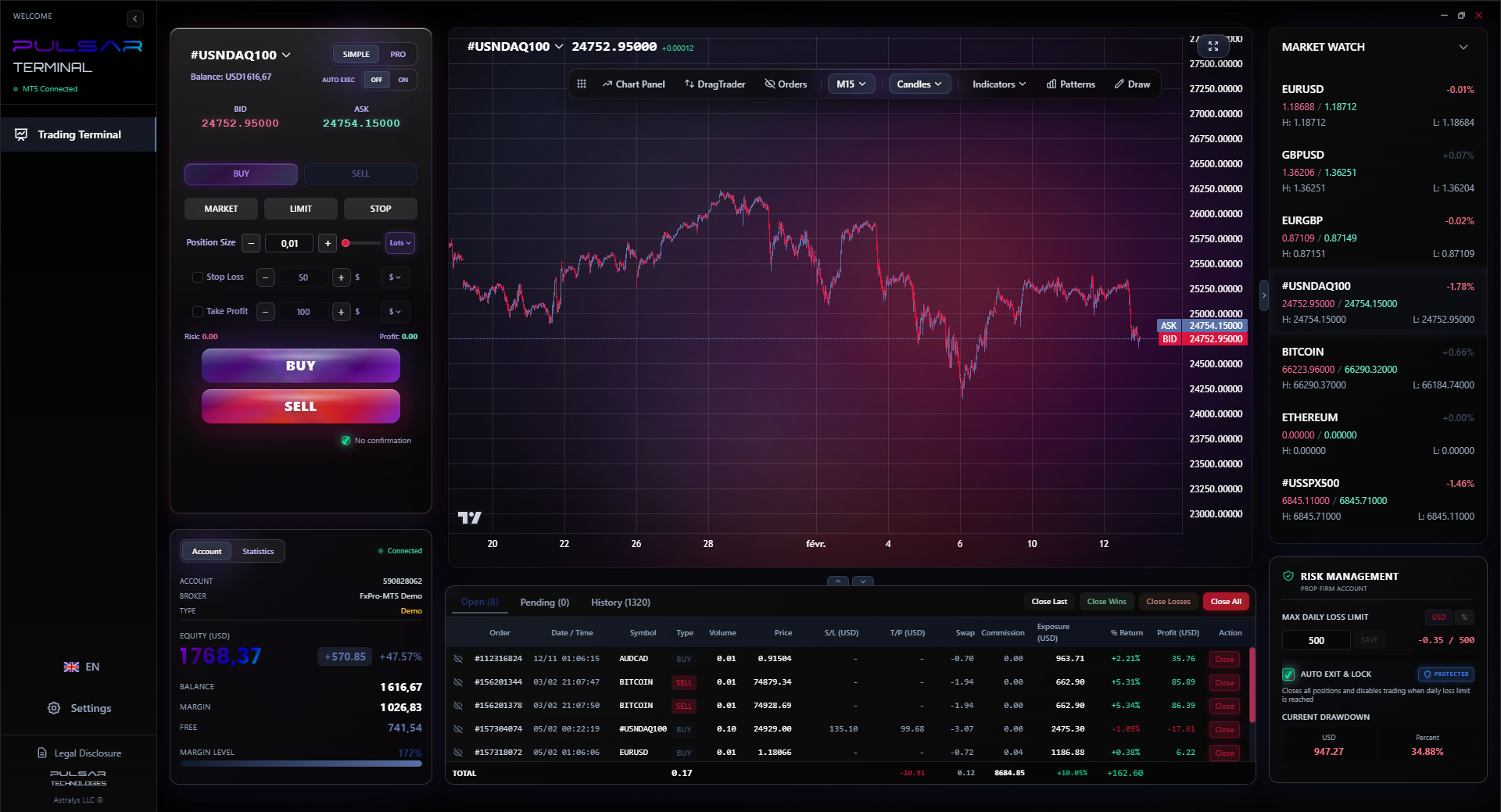
Building a flawless track record requires flawless execution; Pulsar Terminal's drag-and-drop orders and multi-TP/SL management on MT5 help eliminate costly manual errors during high-pressure trades.
“The real 'interview' for a funded account is a prop firm's trading challenge, not a conversation.”
Here’s how to physically structure the PDF you might send to a private investor. Keep it to 2 pages max.
Page 1: The Snapshot
- Name & Contact
- Headline Performance Metric: e.g., "18-Month Verified Return: 42.5% | Max Drawdown: 6.1%"
- Quick-Read Performance Table:
| Metric | Your Stat | Industry 'Good' Benchmark |
|---|---|---|
| Profit Factor | 1.8 | > 1.5 |
| Win Rate | 48% | 40-60% |
| Avg. Win / Avg. Loss | 2.5 | > 2.0 |
| Max Drawdown | 6.1% | < 10% |
| Sharpe Ratio | 1.4 | > 1.0 |
- Links: Bold, clickable links to your LIVE verified profiles.
- Funding Achievements: "Funded Trader, The5%ers, $25k Account (May 2025 - Present)"
Page 2: The Depth
- Trading Philosophy: 3-4 sentences on your edge (e.g., 'Momentum continuation in liquid majors').
- Risk Management Protocol: Your non-negotiable rules. This is what investors love.
- Instrument & Timeframe Focus: e.g., 'EUR/USD, XAU/USD, 4H and Daily charts.' You can refine your approach to gold by studying our XAU/USD guide.
- Trade Journal Excerpt: 3-5 annotated trades (win and loss).
- Brokerage & Tools: List your primary broker (e.g., XM for raw spreads) and platforms (MT5, TradingView).
FAQ
Q1I have a B.Sc. in Accounting. Should I include it on my trading CV?
Sure, put it at the bottom in one line. It shows basic numeracy and discipline, which is good. But understand it's a minor footnote. The funder cares 90% about your verified track record and 10% about everything else combined. That degree won't save you from a bad drawdown stat.
Q2How long does my track record need to be before I apply for funding?
Absolute minimum: 6 months of consistent, verified trading. One year is better. It needs to cover different market conditions (ranging, trending, volatile). Three months of a bull market doesn't prove anything. Patience here is what separates the serious from the desperate.
Q3Is it okay that I trade with a broker not regulated by SEC Nigeria?
It's not just okay, it's standard. The local regulatory framework for online retail forex isn't fully developed. You should be using a broker with strong international regulation (like ASIC, FCA, CySEC). This is actually a positive on your CV, as it shows you understand global best practices for security and transparency.
Q4I failed a prop firm challenge twice. Should I mention this?
No. Your CV is for successes. However, in your trading journal (which is part of your CV), you should analyze why you failed. Did you violate your risk rules? Did the strategy not fit the time limit? That shows growth. Just don't lead with 'I failed FTMO twice.' Lead with 'I passed MFF after refining my risk approach based on previous challenge experiences.'
Q5What's more important, high profit or low drawdown?
Low drawdown, 100 times out of 100. A funder's nightmare is a trader who loses a huge chunk of capital. A 15% return with a 3% drawdown is a dream client. A 50% return with a 25% drawdown is a heart attack waiting to happen. Risk management is your most marketable skill.
Q6Can I use a track record from a prop firm account as my main CV?
Yes, absolutely. A live funded prop firm account is excellent proof. It shows you can trade real capital under strict rules. Combine that with your personal account track record to show a longer history of discipline. It's all about building a chain of evidence.
प्रो. विंस्टन का पाठ
:
- ✓A trading CV is proof of profit, not a list of qualifications.
- ✓6 months minimum verified track record is non-negotiable.
- ✓Prioritize low drawdown over high returns every time.
- ✓Use myfxbook/fxblue for immutable, trusted verification.
यह लेख कितना उपयोगी था?
रेट करने के लिए स्टार पर क्लिक करें
साप्ताहिक ट्रेडिंग विश्लेषण
मुफ़्त साप्ताहिक विश्लेषण और रणनीतियाँ। कोई स्पैम नहीं।
लेखक के बारे में
Olumide Adeyemi
पश्चिम अफ्रीकी ट्रेडिंग अग्रणी
नाइजीरिया के सबसे सक्रिय फॉरेक्स ट्रेडिंग एजुकेटर्स में से एक। लागोस से 8 साल का ट्रेडिंग अनुभव। अफ्रीकी ट्रेडर्स के लिए लो-कैपिटल स्ट्रैटेजीज और प्रॉप फर्म चैलेंजेज में विशेषज्ञ।
टिप्पणियाँ
आपको यह भी पसंद आ सकता है

Cara Trading Forex Sukses: 7 Prinsip dari Trader Profesional
Cara trading forex sukses dengan 7 prinsip trader pro: manajemen modal, disiplin, journal trading, backtest. Data nyata, bukan janji profit palsu.
Jam Trading Forex Terbaik untuk Trader Indonesia: Panduan Lengkap dengan Tabel Waktu
Panduan jam trading forex untuk trader Indonesia. Tabel 4 sesi dunia, jam emas 20:00-00:00, sesi mana yang harus dihindari. Data akurat + tips dari trader berpengalaman.
Top 5 Sàn Forex Uy Tín Nhất 2026: Review Jujur dari Trader Indonesia
Top 5 sàn forex uy tín 2026 untuk trader Indonesia. Review jujur: spread, deposit, withdraw, dukungan lokal. Exness, XM, IC Markets & lebih.
All these calculators are built into Pulsar Terminal with real-time data from your MT5 account. One-click position sizing, automatic risk management, and instant calculations.
