


I remember watching the USD/ZAR chart in late 2023, right as it broke through R19.00.

David van der Merwe
उभरते बाजार के ट्रेडर ·  South Africa
☕ 11 मिनट पढ़ने
आप क्या सीखेंगे:
- 1What Exactly Is a Forex Trading Affiliate?
- 2The Rules of the Game: FSCA & Legal Stuff You Can't Ignore
- 3Show Me the Money: Real Commission Numbers in SA
- 4Choosing Your Broker Partner: It's Not Just About the Highest Payout
- 5How to Actually Find Traders: Building Your Audience in SA
- 6Pitfalls & How to Dodge Them: Lessons from My Mistakes
- 7Your First Steps: A Simple 30-Day Launch Plan
I remember watching the USD/ZAR chart in late 2023, right as it broke through R19.00. My phone started buzzing - not with trade alerts, but with notifications from my affiliate dashboard. Three new referred traders had just funded accounts during that volatility spike. That moment, more than any single trade, showed me the power of a well-built forex trading affiliate business. In South Africa, with over 1.2 million active online traders and a market that moves R1 trillion annually, the opportunity isn't just in trading the rand. It's in connecting people to the platforms where the action happens. Let's talk about how you can actually make money from it, without getting tangled in regulatory headaches.
Think of it as being a matchmaker, but for traders and brokers. You're not giving financial advice or managing anyone's money. Your job is to introduce potential traders to a regulated broker you've vetted. When someone signs up through your unique link and starts trading, you earn a commission. It's that simple.
In South Africa, you'll hear two main terms: 'Affiliate' and 'Introducing Broker' (IB). They're similar, but there's a legal distinction that matters. An affiliate typically runs digital marketing - blogs, social media, YouTube - and gets paid for referrals. An IB often has a more hands-on role, sometimes even helping clients with platform setup, and they need to be registered with the FSCA under the FAIS Act. For most people starting out, the affiliate route is the way to go. You avoid the licensing hassle while still building a revenue stream.
The real magic is in the scalability. One good trade you make pays you once. One good trader you refer can pay you for years, as long as they're active. I've had referrals from 2018 that still generate a small income every month, which is a feeling no single winning trade can match.

Warning: If you start giving specific trade signals or portfolio advice to your referrals, you're stepping into financial advisory territory. That requires an FSCA license. Stick to educating about concepts, platforms, and risk management - not telling people what to buy or sell.

💡 विंस्टन की सलाह
Your first 100 followers are worth more than your first 10 referrals. Build a community that trusts you, and the referrals will follow naturally. Don't rush to monetize before you provide value.
You can't play the game if you don't know the rules, and in South Africa, the Financial Sector Conduct Authority (FSCA) writes them. Getting this wrong isn't just a slap on the wrist; fines can go up to R1 million. The core principle is transparency. You must be crystal clear that you're earning a commission when someone signs up through your link. Hiding that is a fast track to trouble.
Your first and most important job is to only partner with FSCA-licensed brokers. This isn't just about compliance; it's about your reputation. If you send people to a shady offshore operation that disappears with their money, your audience will vanish too. I made this mistake early on, partnering with a broker that had slick marketing but questionable regulation. When they had withdrawal issues, I lost credibility and referrals. It took months to rebuild trust.
The use Cap & What It Means for You
Since 2021, the FSCA has capped use at 30:1 for retail traders. They're planning to tighten this further to 1:200 for major pairs by early 2026. This directly impacts your affiliate business. You need to understand and communicate this. A trader used to 500:1 use from an unregulated broker will need adjusting. Frame it positively: lower use means forced risk management, which protects your referrals from blowing up their accounts in seconds. Remember, a liquidated client earns you zero ongoing revenue.
Taxes on Your Earnings
Your affiliate income is just that: income. You must declare it to SARS. It gets added to your other income and taxed at your marginal rate (18% to 45%). Keep careful records of every commission payment. I use a simple spreadsheet logging the date, broker, referral ID, and commission amount in both USD and ZAR. When tax season comes, it's a 10-minute job instead of a nightmare.
“One serious trader you refer is worth ten who deposit R500 and never trade again.”
Let's cut through the hype. You won't get rich from one referral. But you can build a serious income. The numbers in the briefing are accurate, but here's what they look like in practice.
There are three main commission models:
- Cost Per Acquisition (CPA): A one-time flat fee for a qualified referral. This is usually a trader who makes a minimum deposit (often $100-$500) and might need to execute a minimum number of trades. In SA, these range from $400 to a whopping $1,000. I've personally received a $800 CPA from a referral to a broker like Exness who deposited over R10,000.
- Revenue Share: This is the long-term play. You earn a percentage of the broker's revenue generated by your referral - typically from the spreads they pay. Rates are usually 20-50%. If your referral trades lots and the broker makes R1,000 in spread revenue from them in a month, you could earn R200-R500 of that. This is where the real residual income builds.
- Hybrid: A mix of both. You might get a smaller CPA upfront (say $200) plus a 30% revenue share. This is often the best model.

Example: Let's say you refer 10 traders in a month. Five qualify for a $500 CPA each = $2,500 (roughly R45,000). The other five go onto a 30% revenue share. If each of them generates $200 in spread revenue per month for the broker, that's $1,000 in broker revenue. Your 30% cut is $300 (R5,400) per month, every month they're active.
The benchmark of $5,000 monthly from 50 active referrals is realistic for a dedicated affiliate. But start with a goal of your first 10. Focus on quality, not just quantity. One serious trader is worth ten who deposit R500 and never trade again.
Your earnings are also tied to your referrals' success. This is why the best affiliates don't just sell; they educate. Teaching solid risk management and how to use tools like a position size calculator helps your referrals last longer, which means you earn longer. It's a win-win.
The biggest mistake is chasing the highest advertised commission percentage. A broker offering 70% revenue share is useless if their platform crashes during London open or their spreads on EUR/USD are 3 pips. Your reputation is on the line.
Here’s what to vet, based on the brokers in our briefing:
| Feature | What to Look For | Why It Matters to You |
|---|---|---|
| FSCA License | A clear FSP number on their website. Verify it on the FSCA's portal. | Non-negotiable. Protects you and your referrals. |
| Local Support | A South African phone number, ZAR accounts, local payment methods (EFT). | Your referrals will have questions and need easy deposits. |
| Platform & Tools | MT4/MT5 are standard. Check for additional tools like advanced charting. | Happy traders are active traders. Tools like Pulsar Terminal's Volume Profile can be a selling point for serious traders. |
| Spreads & Fees | Competitive spreads on major pairs and USD/ZAR. Look for raw/ECN accounts. | Tight spreads (see our spread definition) mean lower costs for your referrals, helping them succeed. |
| Affiliate Dashboard | Real-time tracking, reliable payments, marketing materials. | You need transparency to run your business. |
From the list, brokers like XM, AvaTrade, and Exness have established, reliable affiliate programs with FSCA regulation. I've worked with both XM and Exness; their dashboards are professional and payments have always been on time. IC Markets is another solid, globally respected option with a strong presence here.

Pro Tip: Before you promote anyone, open a small live account with them yourself. Trade for a month. Test their execution speeds, customer service response time, and withdrawal process. If you wouldn't trade with them, don't recommend them.
💡 विंस्टन की सलाह
Treat your affiliate dashboard like your trading journal. Analyze it weekly. Which traffic source has the highest conversion rate? Double down on that. This is a business, not a hobby.
“Your reputation is your only real asset in this business. Protect it by only promoting brokers you'd trust with your own money.”
You can't refer traders you never meet. Building an audience is the real work. Forget spammy Facebook ads screaming "GET RICH QUICK." That attracts the wrong people - those who will deposit R500, lose it in a day, and never trade again. You want thoughtful, committed individuals.
Start with content. Share your genuine journey. Did you blow up an account? Talk about it. What did you learn about scalping versus swing trading? Explain it. Create content that helps: "How to Read an RSI Indicator Divergence on USD/ZAR," "A Beginner's Guide to Gold (XAU/USD) Trading."
YouTube and TikTok are huge here. Short videos explaining forex concepts, platform tutorials (how to set a stop-loss on MT5), or weekly market recaps in plain English work incredibly well. Remember, 70% of traders use mobile apps, so your content must look good on a phone screen.
Be brutally honest about the stats. Mention that studies show 72% of new accounts blow up within six months. Then, position yourself as the guide who helps people avoid that fate by choosing a good broker and learning proper technique. This builds immense trust.
Networking is also key. Engage in serious trading forums and local investment groups. Don't just drop your link. Answer questions, provide value first. The referrals will come naturally. My first five consistent referrals came from a WhatsApp group where I spent months just helping others understand chart patterns, never once pitching a broker until someone asked directly for a recommendation.
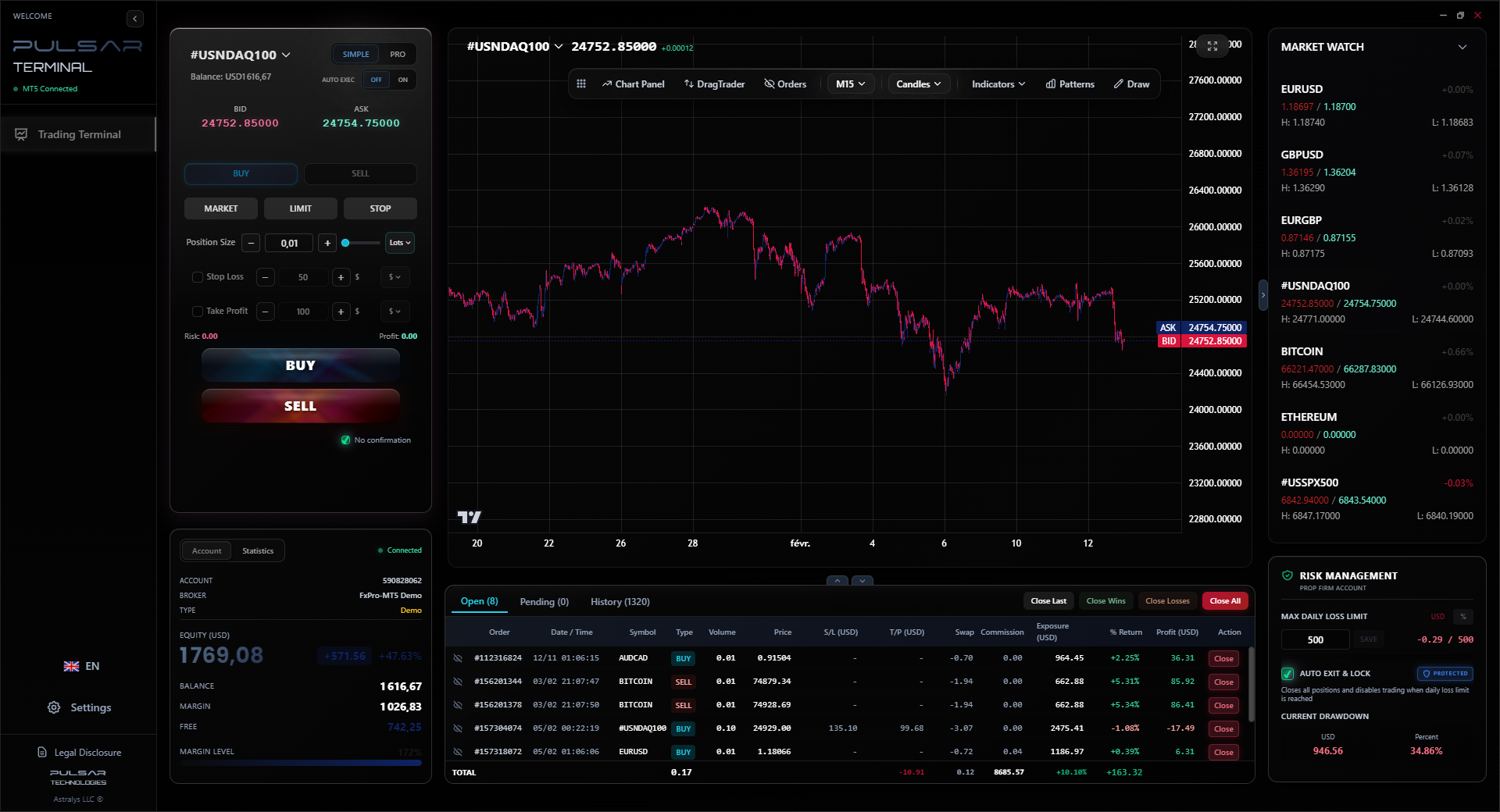
When creating educational content for your audience, showing them advanced tools like Pulsar Terminal's drag-and-drop orders and Volume Profile can set you apart as a serious resource.
I've messed up so you don't have to. Here are the big traps.
Pitfall 1: Overpromising Returns. Never, ever guarantee profits or suggest trading is easy money. It's not only unethical and illegal, but it also sets up your referrals for disappointment and failure. I once framed trading as a 'side hustle' in an early video. The people who signed up had the wrong mindset and washed out fast. Now I frame it as a skilled profession that requires study and discipline.
Pitfall 2: Neglecting Your Own Trading Education. You can't credibly talk about trading if you don't understand it. You don't need to be a pro, but you should know the basics of technical analysis, fundamental drivers of the rand, and risk management. Spend time on your own charts. Follow the MACD indicator on USD/ZAR. This genuine interest comes through in your content.
Pitfall 3: Chasing Every New Broker. Stick with 2-3 proven, regulated broker partners. Jumping to every new broker with a flashy promo dilutes your message and confuses your audience. Consistency builds trust.
Pitfall 4: Ignoring the Data. Your affiliate dashboard is a goldmine. Which content led to the most clicks? Which referral converted to a funded account? What's the lifetime value of a referral from YouTube vs. Instagram? Analyze this monthly and double down on what works.
The goal is to build a sustainable business, not a quick cash grab. That means putting your audience's long-term success ahead of a short-term commission. It sounds counterintuitive, but it's the only strategy that works for years, not months.
💡 विंस्टन की सलाह
The best affiliate content doesn't feel like an ad. It solves a specific, painful problem for a trader. 'How to avoid a margin call' will always outperform 'Sign up here for free money.'
“The goal is to build a system that brings in referrals consistently while you sleep. That's the real power.”
Overwhelmed? Don't be. Here's a straightforward plan for your first month.
Week 1: Research & Setup.
- Pick one broker from the regulated list (e.g., XM or AvaTrade). Sign up for their affiliate program.
- Open a demo account with them. Familiarize yourself with their platform.
- Set up a simple spreadsheet to track your efforts.
Week 2-3: Create Your Foundation.
- Choose one platform: start an Instagram page, a YouTube channel, or a Twitter/X account. Just one.
- Create 3 pieces of foundational content. For example: (1) "What is the FSCA and Why It Matters for SA Traders," (2) "MT5 vs. MT4: Which Should You Use?" (3) "My Top 3 Free Resources for Learning Forex."
- Be genuine. Use your own voice.
Week 4: Engage & Soft Launch.
- Start engaging in one online community. Don't promote. Just answer questions where you can.
- In your bio on your chosen social platform, add "I partner with regulated forex brokers." Link to your broker's general website, NOT your affiliate link yet.
- At the end of a helpful post or video, you can say: "I'm asked a lot about which brokers I use. I've compiled a list of FSCA-regulated options I've vetted. If you'd like it, DM me." This starts the conversation naturally.
Track everything. See what content gets engagement. Refine. This isn't a sprint. Your first referral might take 60 days. That's okay. The goal is to build a system that, once working, brings in referrals consistently while you sleep. That's the real power of the forex trading affiliate model.
FAQ
Q1Do I need an FSCA license to be a forex affiliate in South Africa?
If you are strictly an affiliate - promoting via content and links without giving personalized financial advice or handling client funds - you typically do not need your own FSCA license. However, you must partner with an FSCA-licensed broker. If you transition to an Introducing Broker (IB) model with more hands-on client management, licensing may be required. Always check with a legal professional.
Q2How and when do I get paid as an affiliate?
Payments are made by the broker according to their schedule, usually monthly. They are paid via bank transfer, PayPal, or other e-wallets. There's often a minimum payout threshold (e.g., $100). You'll receive a detailed statement from your affiliate dashboard showing exactly which referrals generated commission.
Q3Is forex affiliate marketing taxable in South Africa?
Yes. All commission income is considered ordinary income by SARS and must be declared on your annual tax return. It is taxed at your marginal income tax rate. Keep all your statements and records for at least five years.
Q4What's the difference between a CPA and a Revenue Share?
A CPA (Cost Per Acquisition) is a one-time payment for a qualified new client. A Revenue Share is an ongoing percentage of the trading revenue (like spreads) that the broker earns from that client for as long as they trade. Many successful affiliates prefer a hybrid model to get both upfront and long-term income.
Q5Can I promote multiple forex brokers?
Technically, yes. But it's often better to start with one or two trusted, FSCA-regulated partners. Promoting too many can confuse your audience and make you seem less genuine. It's better to be known as the expert who recommends Broker X than a generic promoter of everything.
Q6What if my referred trader loses all their money? Do I still get paid?
It depends on the commission model. For a CPA, you are usually paid once the referral qualifies (makes a deposit and sometimes a few trades), regardless of their subsequent profit or loss. For a Revenue Share, if they lose their money and stop trading, your ongoing commission from them will stop. This is why educating your referrals on risk management is in your own financial interest.
Q7What's the biggest challenge for new forex affiliates in SA?
Building trust and an audience from scratch. The market is skeptical of 'get rich quick' schemes. Overcoming that requires consistent, valuable, and honest content over time, not aggressive sales pitches. Patience is the most important asset in the beginning.
प्रो. विंस्टन का पाठ
:
- ✓Only partner with FSCA-licensed brokers; it's non-negotiable.
- ✓Revenue share beats CPA for long-term, sustainable income.
- ✓Build trust with content first, promotions second.
- ✓Analyze your affiliate dashboard data like a trading journal.
- ✓Declare all affiliate income to SARS to avoid penalties.
यह लेख कितना उपयोगी था?
रेट करने के लिए स्टार पर क्लिक करें
साप्ताहिक ट्रेडिंग विश्लेषण
मुफ़्त साप्ताहिक विश्लेषण और रणनीतियाँ। कोई स्पैम नहीं।
लेखक के बारे में
David van der Merwe
उभरते बाजार के ट्रेडर
जोहानसबर्ग स्थित ट्रेडर, इमर्जिंग मार्केट करेंसीज में 11 साल का अनुभव। ZAR पेयर्स, FSCA-विनियमित ट्रेडिंग और दक्षिण अफ्रीकी मार्केट एनालिसिस में विशेषज्ञ।
टिप्पणियाँ
आपको यह भी पसंद आ सकता है

Cara Trading Forex Sukses: 7 Prinsip dari Trader Profesional
Cara trading forex sukses dengan 7 prinsip trader pro: manajemen modal, disiplin, journal trading, backtest. Data nyata, bukan janji profit palsu.
Jam Trading Forex Terbaik untuk Trader Indonesia: Panduan Lengkap dengan Tabel Waktu
Panduan jam trading forex untuk trader Indonesia. Tabel 4 sesi dunia, jam emas 20:00-00:00, sesi mana yang harus dihindari. Data akurat + tips dari trader berpengalaman.
Top 5 Sàn Forex Uy Tín Nhất 2026: Review Jujur dari Trader Indonesia
Top 5 sàn forex uy tín 2026 untuk trader Indonesia. Review jujur: spread, deposit, withdraw, dukungan lokal. Exness, XM, IC Markets & lebih.
All these calculators are built into Pulsar Terminal with real-time data from your MT5 account. One-click position sizing, automatic risk management, and instant calculations.
