


Here's a number that should make you pause: only about 12% of South African retail forex traders are consistently profitable.

David van der Merwe
उभरते बाजार के ट्रेडर ·  South Africa
☕ 9 मिनट पढ़ने
आप क्या सीखेंगे:
Here's a number that should make you pause: only about 12% of South African retail forex traders are consistently profitable. That's roughly one in eight. The market here is booming, with daily volumes hitting $2.2 billion and hundreds of thousands trying their hand, but most are losing their shirts. Why? They skip the fundamentals. Think of this guide as the first few chapters of the only forex trading book for beginners you actually need. It's not about get-rich-quick schemes. It's about understanding the local rules, the real costs in Rands and cents, and building a foundation that keeps you in that profitable 12%.
Let's clear something up right away. You're not buying physical currency. When you trade EUR/USD, you're speculating on the value of one currency against another. It's a contract for difference (CFD) in most cases. The price you see is an exchange rate.
For us in South Africa, this adds a layer. You can't directly speculate against the Rand (ZAR) as a resident. Sounds odd, right? The FSCA rule is there to protect the local currency. So, you won't find a broker letting you short USD/ZAR from your SA ID. What you can do is trade major pairs like EUR/USD or GBP/USD, and your profit or loss gets converted back into your account currency, often USD or ZAR.
A pip is how we measure movement. For most pairs, it's 0.0001. If EUR/USD moves from 1.0850 to 1.0851, that's one pip. On a standard lot (100,000 units), one pip is worth about $10. This is why a position size calculator is non-negotiable before you place a single trade. Starting with a mini lot (10,000 units) makes that pip worth $1, which is far more manageable for a beginner.

Warning: Don't confuse a demo account with the real thing. The psychology is completely different. I once took a demo account from R10,000 to R50,000 in a month with reckless trades. I thought I was a genius. I lost 30% of my first real R5,000 deposit in two weeks making the same 'genius' moves. The money feels fake on demo. It feels very real when it's yours.
Trading here isn't the wild west. The Financial Sector Conduct Authority (FSCA) is your watchdog, and their rules are there for a reason.
The 30:1 use Cap
This is the big one. Since 2021, retail client use is capped at 30:1 for major forex pairs. That means with R1,000 in your account, a broker can lend you up to R30,000 in trading power. It sounds like free money, but it's a double-edged sword. It amplifies both gains and losses. A 1% move against you with 30:1 use wipes out 30% of your capital. I learned this the hard way early on with GBP/JPY. I used full use on a 'sure thing.' The pair moved 0.8% against me, and I got a margin call. I lost R2,400 in minutes.
Getting Your Money In and Out
You'll use your foreign capital allowance. Each year, you have a single discretionary allowance (R1 million) and a foreign capital allowance (R10 million) to send funds offshore. You do this through an Authorised Dealer (your bank) to your licensed offshore broker. Keep all the paperwork. Your bank will ask questions if you try moving large sums without the right docs from your broker.
The Tax Man Cometh
Here's a critical chapter many forget: SARS wants its share. Your net trading profits (profits minus losses and expenses) are considered income. It doesn't matter if your broker is in Cyprus or the Bahamas. If you're tax resident in SA, you must declare that income. I keep a simple spreadsheet: date, pair, profit/loss in ZAR. It saves a headache in February. If you're serious, chat to a tax consultant who understands trading income.

💡 विंस्टन की सलाह
Your first R10,000 in profits isn't money. It's tuition fees you've paid to the market. Reinvest it in your education, not a flashy car.
“Your stop loss is a promise to your future self. Don't break it.”
Your broker is your gateway. Picking the wrong one means higher costs, withdrawal hassles, and zero protection.
First, always verify FSCA licensing. Go to the FSCA website and type in the broker's Financial Services Provider (FSP) number. No FSCA license? Walk away. It's not worth the risk.
Costs Beyond the Spread
Everyone looks at the spread definition. It's the difference between the buy and sell price, your immediate cost. But you must look deeper.
| Broker Type | Typical EUR/USD Spread | Commission (per standard lot) | Best For... |
|---|---|---|---|
| Standard/No Commission | 1.0 - 1.5 pips | R0 | Beginners who trade small volumes infrequently |
| Raw/ECN Account | 0.0 - 0.2 pips | $6 - $10 total (round turn) | Active traders, scalping strategy users |
Then there's the swap fee (overnight financing). If you hold a trade past 10pm SA time, you pay or receive interest. For a long-term swing trading position, this can add up.
Local Payment Methods
You want a broker that accepts EFT from your SA bank account or cards like Visa/Mastercard. Even better if they offer a ZAR-denominated account. It saves you the 1-2% currency conversion fee on every deposit and withdrawal. Brokers like Exness review and XM review have strong local support.

Pro Tip: The minimum deposit is almost irrelevant. If R500 is all you have to start, fine. But your focus should be on low trading costs and reliable execution. A R50 minimum account with terrible spreads will cost you more in the long run than a R1,000 account with tight spreads.
Forget complex systems with 15 indicators. Your first strategy should be so simple you can explain it to a friend in 30 seconds. Here's a basic structure I used for my first profitable year.
The Instrument: Start with one pair. EUR/USD. It's the most liquid, has the tightest spreads, and moves in clear trends. Don't get distracted by exotic pairs yet. Master one. Our EUR/USD guide breaks down its unique behaviors.
The Chart: Use a daily chart for direction, and a 4-hour or 1-hour chart for your entry timing. Add two indicators: a simple 50-period and 200-period Moving Average (MA). When the price is above both MAs, I only look for buy signals. When it's below both, I only look for sell signals. This keeps you on the right side of the trend.
The Signal: I used the RSI indicator (set to 14) for confirmation. In an uptrend (price above MAs), I'd wait for the RSI to dip near 40 and start curling back up. That was my potential buy zone. For a sell in a downtrend, I'd wait for RSI to rally near 60 and turn down.
The Trade Execution: Let's say EUR/USD is at 1.0850, above both MAs, and RSI hits 41 and turns up. I'd buy at market.
- Stop Loss: I'd place it 20 pips below the recent swing low at 1.0830. That's a 20-pip risk.
- Take Profit: I'd aim for a 40-pip profit at 1.0890. A 1:2 risk-to-reward ratio. This means I only need to be right 34% of the time to break even.
Using a position size calculator, if my account is R10,000 and I only want to risk 1% (R100) on this trade, I can calculate my lot size. With a 20-pip stop loss, each pip is worth R5 (R100 risk / 20 pips). On EUR/USD, that means trading a 0.5 mini lot position.

Example: Entry: 1.0850 | SL: 1.0830 (20 pips) | TP: 1.0890 (40 pips). Risk: R100 (1% of R10k). Potential Reward: R200. You can be wrong more than you're right and still profit.
💡 विंस्टन की सलाह
The market doesn't care about your rent, your ego, or your 'sure thing.' Trade the price on the screen, not the story in your head.
“Starting with less than R2,000 often forces you to use dangerous use to see meaningful gains.”
The charts are easy. Your brain is the hard part. I've blown up accounts not because my strategy failed, but because I failed to follow it.
Mistake 1: Revenge Trading. You lose R500 on a trade. The anger kicks in. You double your lot size on the next trade to 'make it back fast.' This is how R500 losses become R2,000 losses in an hour. The rule? After two consecutive losses, walk away. Close the platform. Come back tomorrow.
Mistake 2: Moving Your Stop Loss. You buy EUR/USD at 1.0850 with a stop at 1.0830. It drops to 1.0835. 'It's just 5 pips away, it'll come back,' you think. You move the stop to 1.0820. It drops to 1.0815. Now you've lost 35 pips instead of 20. Your stop loss is a promise to your future self. Don't break it.
Mistake 3: Chasing the News. A high-impact news event like US Non-Farm Payrolls hits. The market spikes 50 pips in seconds. You FOMO (Fear Of Missing Out) and buy at the very top. It immediately retraces 40 pips. You're now in a losing trade born from panic. Either trade the news with a specific strategy (like waiting for the initial spike to settle) or stay out completely until the volatility dies down.
The single best thing I ever did was start a trading journal. Not just 'bought EUR/USD, won.' I wrote my emotional state: 'Felt impatient after missing the morning move. Entered a sloppy trade.' Seeing that pattern in writing forced me to fix it.
Once you've mastered a simple trend-following strategy and can manage your emotions for 3-6 months, you can explore. This is where the real forex trading book for beginners ends and your own advanced volume begins.
Diversify Your Strategies: Maybe you want to try a mean-reversion strategy using Bollinger Bands. Or learn about the MACD indicator for momentum divergences. Test these exclusively on a demo account first. Then, when you add one to your live trading, use the smallest position size possible.
Explore Other Instruments: Gold (XAU/USD) often moves inversely to the US dollar and can be a great hedge. Our XAU/USD guide details its quirks. Indices like the US30 (Dow Jones) offer different volatility patterns.
Consider Your Platform Tools: As you advance, manual order management gets cumbersome. Setting multiple take-profit levels, moving stops to breakeven, or running a grid strategy requires precision and speed. This is where dedicated trading software becomes useful.
Continuous Learning: The market changes. Read economic analyses, understand central bank policies (the SARB here at home is crucial), and never assume what worked last year will work forever. The 12% who stay profitable are the 12% who never stop learning.
💡 विंस्टन की सलाह
A 20-pip stop loss that you obey is infinitely better than a 5-pip stop loss you move three times. Discipline is a higher form of intelligence.
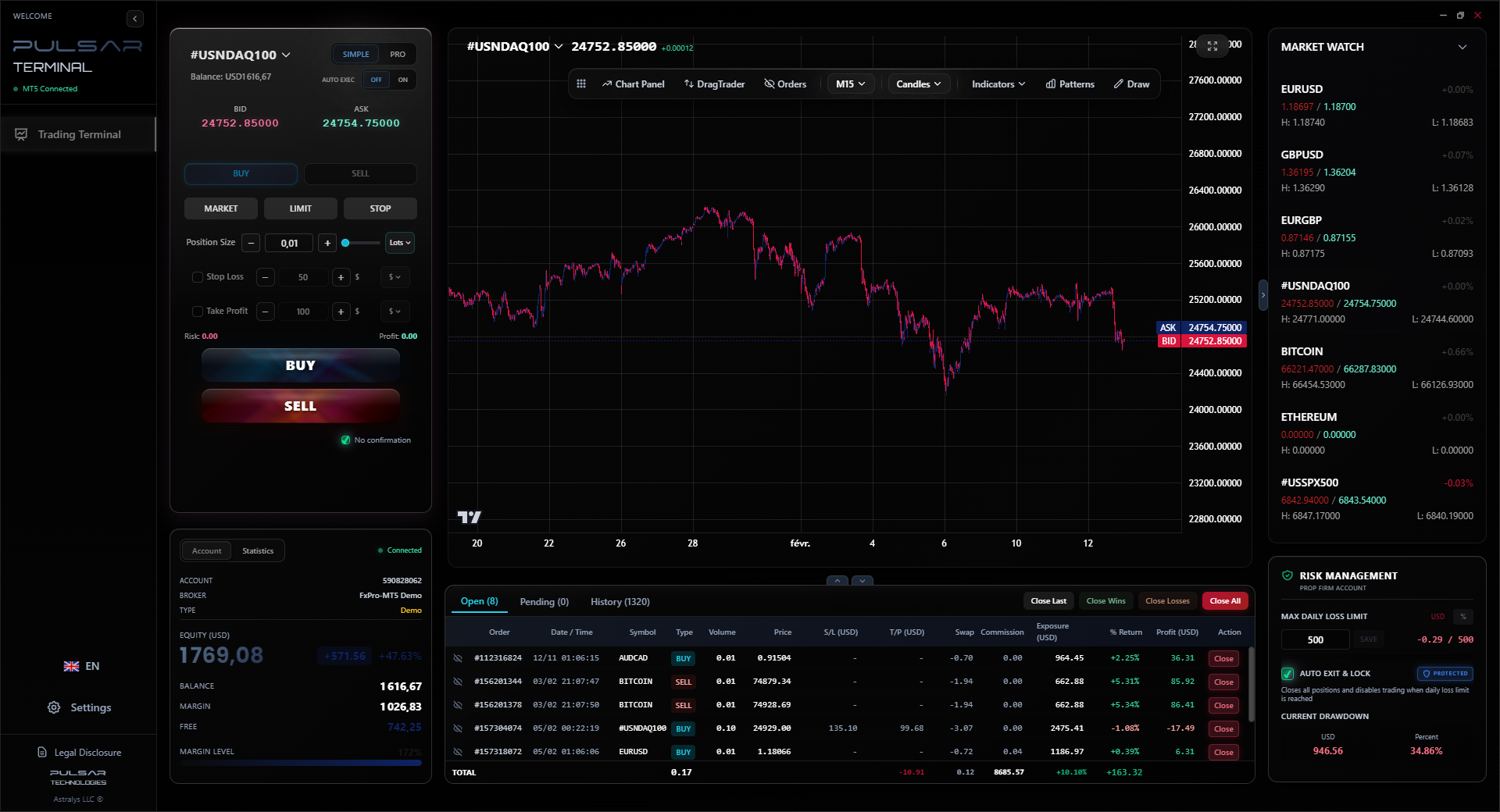
Managing multiple take-profit levels and strict prop firm loss limits manually is a headache; Pulsar Terminal automates these rules directly on your MT5 platform, letting you focus on your strategy.
FAQ
Q1What is the absolute minimum amount I need to start forex trading in South Africa?
Technically, some brokers like Exness let you start with about R15. But realistically, you need enough to survive losses and trade properly. I'd say R2,000 is a practical absolute minimum. This lets you risk R20 per trade (1%) with sensible stop losses, without being wiped out by a few bad trades. Starting with less often forces you to use dangerous use to see meaningful gains.
Q2Can I use my TFSA to trade forex?
No. Your Tax-Free Savings Account (TFSA) in South Africa is for approved investments like ETFs, shares, and unit trusts. Forex trading, especially via CFDs with use, is not a permitted investment within a TFSA. Your trading capital will come from your discretionary savings, using your foreign capital allowance to send funds to a licensed broker.
Q3Which is better for beginners, MT4 or MT5?
For pure forex, MT4 is simpler and has more custom indicators available from the community. MT5 is more powerful for stocks and futures, but its forex order handling is slightly different. I'd recommend starting with MT4. Its interface is cleaner, and almost every tutorial you find online will be for MT4. You can always graduate to MT5 later.
Q4How much time do I need to dedicate to trading as a beginner?
At the start, more time for learning than for trading. Expect 5-10 hours a week studying concepts, watching the markets, and reviewing your demo trades. Once you have a plan, active trading can be as little as 30 minutes a day to check your charts and manage positions if you're a swing trader. Don't quit your job. Treat it as a serious part-time business first.
Q5Are there any legit 'prop firms' for South African traders?
Yes, several international proprietary trading firms (like FTMO, The5%ers) accept South African traders. They give you a demo account challenge; if you pass their profit and risk rules, they give you larger capital to trade for a share of the profits. Be cautious. They have very strict rules on daily and overall loss limits. Managing these limits manually is stressful, which is why many use tools to automate the protection.
Q6Is forex trading gambling?
It is if you have no edge, no plan, and no risk management. A gambler relies on luck. A trader relies on a statistical edge from a tested strategy and strict money management. The difference is control. In gambling, you have none over the odds. In trading, you control your risk on every single trade. That's the line.
प्रो. विंस्टन का पाठ
:
- ✓Verify FSCA license before depositing any money.
- ✓Start with one major pair, like EUR/USD.
- ✓Never risk more than 1% of your capital per trade.
- ✓Use a 1:2 risk-to-reward ratio as a minimum target.
- ✓A trading journal is more important than any indicator.
यह लेख कितना उपयोगी था?
रेट करने के लिए स्टार पर क्लिक करें
साप्ताहिक ट्रेडिंग विश्लेषण
मुफ़्त साप्ताहिक विश्लेषण और रणनीतियाँ। कोई स्पैम नहीं।
लेखक के बारे में
David van der Merwe
उभरते बाजार के ट्रेडर
जोहानसबर्ग स्थित ट्रेडर, इमर्जिंग मार्केट करेंसीज में 11 साल का अनुभव। ZAR पेयर्स, FSCA-विनियमित ट्रेडिंग और दक्षिण अफ्रीकी मार्केट एनालिसिस में विशेषज्ञ।
टिप्पणियाँ
आपको यह भी पसंद आ सकता है

Cara Trading Forex Sukses: 7 Prinsip dari Trader Profesional
Cara trading forex sukses dengan 7 prinsip trader pro: manajemen modal, disiplin, journal trading, backtest. Data nyata, bukan janji profit palsu.
Jam Trading Forex Terbaik untuk Trader Indonesia: Panduan Lengkap dengan Tabel Waktu
Panduan jam trading forex untuk trader Indonesia. Tabel 4 sesi dunia, jam emas 20:00-00:00, sesi mana yang harus dihindari. Data akurat + tips dari trader berpengalaman.
Top 5 Sàn Forex Uy Tín Nhất 2026: Review Jujur dari Trader Indonesia
Top 5 sàn forex uy tín 2026 untuk trader Indonesia. Review jujur: spread, deposit, withdraw, dukungan lokal. Exness, XM, IC Markets & lebih.
All these calculators are built into Pulsar Terminal with real-time data from your MT5 account. One-click position sizing, automatic risk management, and instant calculations.
