


Here's a hard truth most new traders ignore: you can be right about the market direction and still lose money.

David van der Merwe
उभरते बाजार के ट्रेडर ·  South Africa
☕ 10 मिनट पढ़ने
आप क्या सीखेंगे:
Here's a hard truth most new traders ignore: you can be right about the market direction and still lose money. Volatility, spreads, and sudden news can wipe out a good trade in seconds. For us trading with ZAR-based accounts, where currency swings can eat into profits before we even see them, having a defensive plan isn't just smart, it's essential. That's where forex trading hedging strategies come in. They're not about making a killing, they're about staying alive long enough to let your good trades work.
Let's clear this up first. Hedging isn't a magic profit button. I learned that the expensive way early on. I once opened a buy and sell on EUR/USD simultaneously, thinking I'd just collect the swap differences or catch both sides of a move. All I did was pay double the spread and watch my account get nibbled away by fees. That's not hedging, that's just being confused.
A real hedge is an insurance policy. You have a primary trade you believe in - your 'investment.' The hedge is a smaller, opposing position meant to limit the damage if you're wrong. Think of it like car insurance. You don't buy it hoping to crash, you buy it so a crash doesn't bankrupt you.
In the South African context, this is crucial. Our market can be thin on some pairs, and ZAR volatility is its own beast. A hedge can protect you from a sudden shift in global risk sentiment that hits emerging market currencies like ours first and hardest. The goal is risk reduction, not elimination. You're smoothing out the equity curve, not trying to make it a straight line up.

Warning: Many local brokers have specific rules about hedging. Some don't allow direct 'lock' hedging (buying and selling the same pair). Always, always check your broker's policy on this before you plan a strategy. Getting your positions force-closed because you broke a rule is a preventable disaster.
This is the most straightforward method: opening opposite positions on the exact same currency pair. Say you're long 1 lot on USD/ZAR at R18.50, betting the rand will weaken. Then, some political news hits that could cause short-term ZAR strength. Instead of closing your trade and potentially missing your original trend, you open a sell order for 0.3 lots on USD/ZAR at R18.55.
How the Math Works
Your main position is 1 lot. Your hedge is 0.3 lots. If USD/ZAR drops (ZAR strengthens), your 1-lot buy loses, but your 0.3-lot sell profits, offsetting 30% of the loss. It caps your downside on that move. If your original thesis is right and USD/ZAR rallies, your hedge loses, but your main trade wins more. You then close the hedge for a small loss once the danger passes. The net effect? You reduced your effective exposure from 1 lot to 0.7 lots during the risky period.
I used this in 2020 during a major SARB announcement. I was long GBP/ZAR but nervous about the statement. I put on a 50% hedge 30 minutes before. The statement caused a 150-pip whipsaw against me, but my hedge covered half the paper loss. I removed the hedge 20 minutes later when things settled, and my original trade then ran for a 400-pip profit. The hedge cost me a 75-pip loss, but saved me from a 150-pip drawdown and, more importantly, from panicking and closing the main trade.

Example:
- Main Trade: Buy 1 lot USD/ZAR at 18.5000
- Hedge: Sell 0.3 lots USD/ZAR at 18.5050
- Scenario: Price drops to 18.4500.
- Main Trade Loss: (18.4500 - 18.5000) * 100,000 = -500 ZAR
- Hedge Profit: (18.5050 - 18.4500) * 30,000 = +165 ZAR
- Net Loss: -335 ZAR (vs. -500 ZAR without hedge)
The key is size. The hedge is smaller. If you hedge 100%, you're just locked in a loss minus the spread. You need a clear plan for when to remove it. This is where a tool with good order management helps immensely, letting you set a reminder or condition to close the hedge without emotion.

💡 विंस्टन की सलाह
A hedge is a seatbelt, not an airbag. You put it on *before* you think you'll need it, not during the crash.
“Hedging isn't about making a killing, it's about staying alive long enough to let your good trades work.”
This is my preferred method. Instead of trading the same pair, you use pairs that typically move together (positively correlated) or opposite (negatively correlated). It's less obvious to the market and often avoids broker restrictions on direct locks.
A classic for South Africans is the Gold (XAU/USD) and USD/ZAR relationship. Gold is priced in USD. When gold goes up, it often signals USD weakness or market fear, which can benefit the ZAR (a commodity currency). So, a long gold position can sometimes act as a partial hedge against a short ZAR trade.
Let's get practical. You're short AUD/USD (betting the Aussie dollar falls). You notice the AUD and NZD often move in sync. You could buy a small position in NZD/USD as a hedge. If your AUD/USD short starts losing because all 'risk' currencies are rallying, your NZD/USD buy will likely profit, softening the blow.
The critical part is knowing the correlation strength. Don't just guess. Look at a 100-day correlation coefficient. A number near +0.8 means they move together strongly. Near -0.8 means they move opposite strongly. A hedge with a +0.8 correlation means you'd take an opposite position (one buy, one sell).
I keep a simple spreadsheet. Here are a few relevant correlations (they change, but these are typical):
| Pair 1 | Pair 2 | Typical Correlation | Hedge Action |
|---|---|---|---|
| EUR/USD | GBP/USD | +0.75 | Opposite positions |
| USD/CHF | EUR/USD | -0.85 | Same direction |
| AUD/USD | NZD/USD | +0.82 | Opposite positions |
| USD/ZAR | XAU/USD | Varies (Often Negative) | Monitor closely |
This strategy requires more screen time and understanding of inter-market dynamics. It's not set-and-forget. But when done right, it feels less like you're fighting your own trade and more like you're managing a portfolio of related risks. For a deeper look at one of these instruments, our XAU/USD guide breaks down gold trading, which is vital for SA traders.
This is the advanced league, but it's worth understanding. A forex option gives you the right, but not the obligation, to buy or sell a currency at a set price before a certain date. For hedging, think of it as buying disaster insurance.
You have a large long position on EUR/ZAR ahead of an EU election. You're bullish, but a surprise result could crash it. Instead of opening a direct short spot position, you buy a put option on EUR/ZAR. You pay a premium upfront (your insurance cost).
If EUR/ZAR soars, your spot trade makes money. Your option expires worthless, and you're only out the premium. If EUR/ZAR crashes, your spot trade loses, but your put option's value skyrockets, offsetting the loss.
The beauty? Your maximum loss on the hedge is known upfront (the premium). Your downside on the main trade is protected. The downside? Options aren't as readily available on all ZAR pairs with every South African broker, and you need to understand Greeks like Delta and Theta. The premium cost can also feel like a drag in quiet markets.

Pro Tip: If you're trading major pairs like EUR/USD, consider using a broker that offers options on futures. The liquidity is better. For ZAR pairs, check with your local broker or international ones like IC Markets or Pepperstone to see what derivative products they offer for hedging.
💡 विंस्टन की सलाह
If your hedge is making more money than your main trade, your main trade is wrong. Close both and reassess.
“I once opened a buy and sell on EUR/USD simultaneously. All I did was pay double the spread. That's not hedging, that's just being confused.”
Hedging can backfire spectacularly if done poorly. Here's my hall of shame so you can skip it.
1. Hedging 100% (The 'Lock'). This is pointless. You're guaranteeing a loss equal to the spread on both trades. Your broker loves it. You shouldn't. Always hedge a fraction of your position.
2. Hedging Out of Fear, Not Planning. I once put on a hedge because a trade went 5 pips against me. I got scared. The hedge then went against my original trade as it recovered, so I closed the original trade... only to watch it then sail to my original target. I was left with just a losing hedge. A hedge should be a pre-meditated part of your risk management, not an emotional reaction.
3. Forgetting the Cost. Every hedge has a cost. A direct hedge costs the spread. A correlation hedge costs the spread and may have swap fees. An option costs a premium. If you hedge too often on tiny moves, these costs will bleed your account dry. It's like paying for complete insurance on a 1998 Toyota Tazz.
4. Not Having an Exit Plan. This is the big one. You must know when you will take the hedge off. Is it after a specific news event? After price reaches a certain level? After a set time? If you don't, you end up with two opposing trades running forever, slowly dying from swap fees. Define your hedge exit as clearly as your trade entry. Using a position size calculator can help you plan the exact size of your hedge relative to your main trade from the start.
Managing multiple opposing trades and their exits is complex, but tools like Pulsar Terminal let you set partial closures and conditional orders for your hedges directly on your MT5 chart, taking the emotion out of the process.
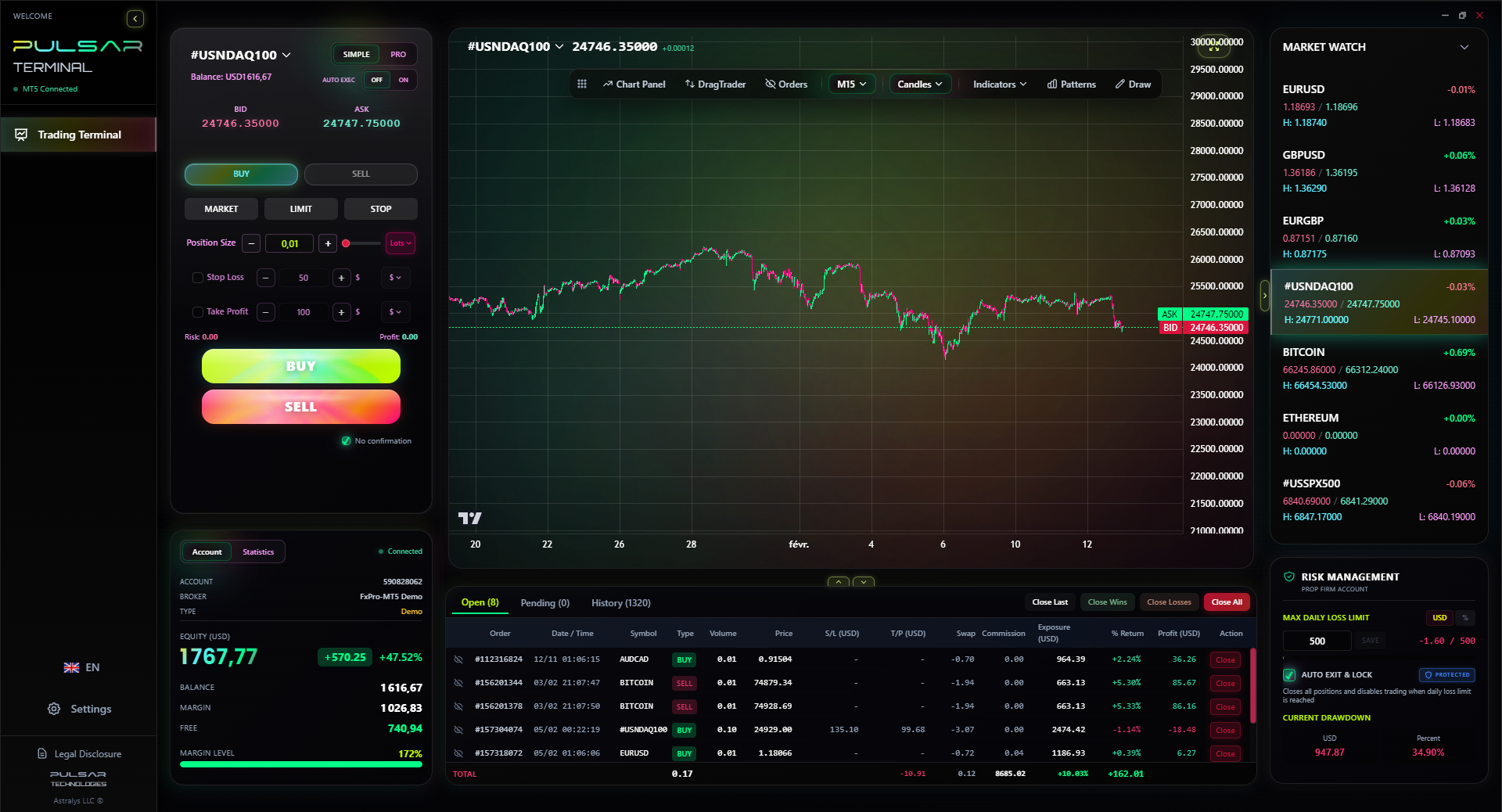
So how does a South African trader actually use this? Let's build a simple framework.
Step 1: Identify Your Hedge-able Risks.
- Event Risk: SARB meetings, budget speeches, major global data (US NFP) that triggers ZAR volatility.
- Portfolio Risk: You're heavily exposed to a single currency view (e.g., long USD across several pairs).
- Gap Risk: Holding positions over weekends or holidays when liquidity is low.
Step 2: Choose Your Tool.
- For Event/Gap Risk on a ZAR pair: A direct, partial hedge (if your broker allows) is often simplest. Open it 30-60 min before the event, plan to remove it 1-2 hours after.
- For Portfolio Risk: Look at correlation hedging. If you're long USD/JPY and long USD/ZAR, you're doubly long USD. A short hedge on a highly USD-correlated pair (like a small long position in EUR/USD) can balance your overall USD exposure.
- For Catastrophic 'Tail Risk': If you have a large, long-term trade you can't afford to lose on, explore buying a far-out-of-the-money put option (for a long trade) as insurance. The premium is your cost of sleep.
Step 3: Size and Execute. Never let your hedge turn your overall position into a direction you don't believe in. If you're 70% confident in a move, a 30% hedge makes sense. If you're only 51% confident, maybe you shouldn't be in the trade at all. Use a stop-loss on your main trade still. The hedge isn't a replacement for a stop; it's a buffer before the stop is hit.
Step 4: Review and Record. After you close a hedged trade, review it. Did the hedge help? Did it cost too much? Would you have been better off just reducing your position size? Your trading journal is your best friend here. This reflective practice is what separates a swing trading professional from an amateur.
💡 विंस्टन की सलाह
The cost of a good hedge should feel like a nuisance. The cost of no hedge can feel like a catastrophe.
“For most new traders, hedging is like learning to drift before you can parallel park.”
Honestly? For most new traders, the answer is no. Your energy is better spent on perfecting your entry, exit, and position size calculator discipline. Adding hedging into the mix is like learning to drift before you can parallel park. It complicates things.
Hedging becomes a powerful tool when:
- You're trading larger sizes where a 2% move hurts significantly.
- You're holding positions for weeks or months (like in swing trading) and can't monitor them constantly.
- You have a proven, profitable strategy and want to smooth its performance during high-volatility periods.
- You're trading ZAR pairs and need a tool to manage the unique liquidity and event risks.
Start simple. Maybe practice correlation hedging on a demo account with EUR/USD and GBP/USD first. See how it feels to manage two connected positions. Get a sense for the costs. The goal isn't to be fancy. The goal is to survive the Cape Town storms so you can enjoy the sunny days. Good hedging does that. It's the lifejacket in your trading boat, not the engine.
FAQ
Q1Is hedging legal with South African forex brokers?
It depends on the broker and the method. The FSCA doesn't prohibit hedging, but individual brokers set their own rules. Many international brokers serving SA clients allow all forms of hedging. Some local brokers may restrict direct 'locking' (buy and sell on same pair). Always check your specific broker's client agreement before relying on a hedging strategy.
Q2What's the main cost of hedging?
The primary cost is the spread, paid twice (on opening and closing the hedge). For direct hedges, you effectively pay the spread on your full position size. There's also opportunity cost if your hedge profits but limits gains on your main trade, and swap/rollover fees if positions are held overnight. With options, the cost is the non-refundable premium.
Q3Can I use hedging for scalping?
It's generally not practical for scalping strategy. Scalping aims for tiny, quick profits. The spread cost of opening two opposing positions would almost certainly wipe out any potential gain from the scalping move. Hedging is better suited for longer timeframes where the risk being insured against is larger than the transaction costs.
Q4How do I calculate the right size for my hedge?
There's no single formula, but a common approach is to hedge a percentage of your position equal to your uncertainty. If you're 80% confident, hedge 20%. More technically, you can size it based on the correlation coefficient or to limit your maximum acceptable loss on the trade. Using a position size calculator to model different hedge sizes against your stop-loss level is a great way to visualize the impact.
Q5Does hedging guarantee I won't get a margin call?
No, absolutely not. A hedge reduces net exposure, but both positions still require margin. A poorly sized hedge or extreme market moves can still lead to losses on both sides. Hedging manages risk; it doesn't eliminate it. You must still manage your overall margin usage to avoid a margin call.
Q6What's a simple first hedge I can try?
Try a correlation hedge on a demo account. Take a 1-lot long position on EUR/USD. Then, look at a highly correlated pair like GBP/USD. Because they often move together, open a small short position on GBP/USD (e.g., 0.2 lots). Watch how the P&L of the two positions interact during different market conditions. It teaches the core concept without the complexity of ZAR volatility initially.
प्रो. विंस्टन का पाठ
:
- ✓Hedge a fraction, never 100% of your position.
- ✓Know your broker's hedging rules before you trade.
- ✓Correlation hedging avoids direct 'lock' restrictions.
- ✓Always have a predefined exit plan for your hedge.
यह लेख कितना उपयोगी था?
रेट करने के लिए स्टार पर क्लिक करें
साप्ताहिक ट्रेडिंग विश्लेषण
मुफ़्त साप्ताहिक विश्लेषण और रणनीतियाँ। कोई स्पैम नहीं।
लेखक के बारे में
David van der Merwe
उभरते बाजार के ट्रेडर
जोहानसबर्ग स्थित ट्रेडर, इमर्जिंग मार्केट करेंसीज में 11 साल का अनुभव। ZAR पेयर्स, FSCA-विनियमित ट्रेडिंग और दक्षिण अफ्रीकी मार्केट एनालिसिस में विशेषज्ञ।
टिप्पणियाँ
आपको यह भी पसंद आ सकता है

Cara Trading Forex Sukses: 7 Prinsip dari Trader Profesional
Cara trading forex sukses dengan 7 prinsip trader pro: manajemen modal, disiplin, journal trading, backtest. Data nyata, bukan janji profit palsu.
Jam Trading Forex Terbaik untuk Trader Indonesia: Panduan Lengkap dengan Tabel Waktu
Panduan jam trading forex untuk trader Indonesia. Tabel 4 sesi dunia, jam emas 20:00-00:00, sesi mana yang harus dihindari. Data akurat + tips dari trader berpengalaman.
Top 5 Sàn Forex Uy Tín Nhất 2026: Review Jujur dari Trader Indonesia
Top 5 sàn forex uy tín 2026 untuk trader Indonesia. Review jujur: spread, deposit, withdraw, dukungan lokal. Exness, XM, IC Markets & lebih.
All these calculators are built into Pulsar Terminal with real-time data from your MT5 account. One-click position sizing, automatic risk management, and instant calculations.
