


I remember staring at my screen in 2018, watching the USD/LKR rate jump from 162 to 165 in a single afternoon.

Daniel Harrington
कंटेंट प्रमुख
☕ 12 मिनट पढ़ने
आप क्या सीखेंगे:
- 1What is Forex Trading? Breaking Down the Basics
- 2Key Trading Terms: From English to Practical Understanding
- 3How to Start Trading Forex from Sri Lanka
- 4Trading Strategies a Beginner Can Actually Use
- 5The Real Battle: Managing Risk and Your Emotions
- 6Brokers and Trading Platforms for Sri Lankan Traders
- 7Mistakes I Made (So You Don't Have To)
- 8Your Next Steps and Key Resources
I remember staring at my screen in 2018, watching the USD/LKR rate jump from 162 to 165 in a single afternoon. My aunt was panicking, trying to send money to my cousin abroad, and the cost just kept climbing. That's when it clicked for me - forex isn't just some abstract market for big banks. It's the price of your next phone import, your family's remittances, your holiday savings. For a Tamil-speaking trader in Sri Lanka, understanding the forex trading meaning in Tamil is the first step to navigating this global bazaar that touches our lives every single day. It's about seeing the connection between a chart on your screen and the real value of the rupee in your pocket.
So, what's the core forex trading meaning in Tamil? At its heart, it's simply the business of exchanging one currency for another, hoping the one you buy will become more valuable than the one you sold. The 'Forex' or 'FX' market is where this happens. It's the largest financial market in the world, with over $7 trillion traded daily. There's no central exchange like the Colombo Stock Exchange. Instead, it's a global network of banks, institutions, and individuals like us trading electronically.
Think of it like this: you're betting on the economic health of one country versus another. If you think the US economy will strengthen compared to Japan, you might buy US Dollars (USD) and sell Japanese Yen (JPY). That's a trade on the USD/JPY pair. The price you see is the exchange rate - how much of the second currency (the quote currency) you need to buy one unit of the first (the base currency).
For us in Sri Lanka, the most watched pair is often USD/LKR, but you can't directly trade that with most international brokers. Instead, we focus on major pairs like EUR/USD or GBP/USD, which are highly liquid and have tight spreads. Understanding a pip definition is crucial here - it's the smallest price move a pair can make, and it's how we measure profit and loss.

Pro Tip: Don't get hung up on trading exotic pairs just because they sound interesting. Stick to the majors (EUR/USD, GBP/USD, USD/JPY) and maybe one or two minors when you're starting. The liquidity is better, which means the spread definition (the broker's fee) is lower, and your orders get filled faster.
Let's translate some jargon into plain talk. Knowing the forex trading meaning in Tamil isn't about a direct word-for-word dictionary translation. It's about grasping the concept in a way you can use.
Lot Size: This is your trade size. A standard lot is 100,000 units of currency. That's huge for us. Thankfully, brokers offer mini (10,000), micro (1,000), and even nano lots. I started with micro lots - each pip move in EUR/USD was worth about $0.10. It let me learn without my heart racing.
use & Margin: This is a double-edged sword. use, like 100:1, lets you control a $10,000 position with only $100 of your own capital (your 'margin'). It amplifies both gains and losses. I learned this the hard way early on. A 50-pip move against you on a highly leveraged trade can wipe out your margin and trigger a margin call.
Long & Short: 'Long' means you buy first, hoping to sell later at a higher price. 'Short' means you sell first (even if you don't own it), hoping to buy it back later at a lower price. Forex is unique because you can just as easily profit from a currency falling as from it rising.
Bearish & Bullish: Bearish means you think the price will go down (like a bear swiping down). Bullish means you think it will go up (like a bull thrusting its horns up).
Here’s a quick table to keep these straight:
| Term | What It Means | Why It Matters to You |
|---|---|---|
| Spread | Difference between buy & sell price | Your primary trading cost. Look for low spreads. |
| Stop-Loss (SL) | Pre-set order to exit a losing trade | Your lifeline. Never trade without one. |
| Take-Profit (TP) | Pre-set order to exit a winning trade | Locks in profits. Greed is not a strategy. |
| Liquidity | How easily an asset can be bought/sold | High liquidity (like EUR/USD) means smoother trades. |

💡 विंस्टन की सलाह
A chart tells you what price did. Your job is to interpret what it might do next. The difference between those two thoughts is where both risk and reward live.
“For a Tamil-speaking trader, understanding forex is seeing the connection between a chart on your screen and the real value of the rupee in your pocket.”
Alright, let's get practical. How do you actually go from understanding the forex trading meaning in Tamil to placing your first trade?
Step 1: Education is Non-Negotiable
Don't deposit a single rupee yet. Spend weeks, even months, learning. Use demo accounts. I paper-traded for four months before going live, and I still felt unprepared. Understand charts, support/resistance, and basic economic indicators that move currencies. Resources are plentiful online, but focus on foundational knowledge first.
Step 2: Choosing a Broker
This is critical. You need a broker that accepts Sri Lankan clients, offers reliable deposits/withdrawals, and is regulated by a reputable authority (like ASIC or FCA). I've had good experiences with IC Markets for their raw spreads and Pepperstone for their platform stability. Always check their minimum deposit (often as low as $100) and their local bank transfer or e-wallet options.

Warning: Be extremely wary of unregulated 'bucket shops' or brokers offering insane bonuses. If it sounds too good to be true, it is. Your number one job is to protect your capital.
Step 3: Funding Your Account
Most international brokers won't hold LKR accounts. You'll fund in USD, EUR, or another major currency. This means you face a conversion cost from your LKR. Factor this in as a cost of doing business. Methods like bank wire transfers (slow, can have fees) or e-wallets like Skrill/Neteller (faster) are common.
Step 4: Develop a Simple Plan
Your plan must answer: What pairs will I trade? What's my strategy? How much will I risk per trade? I use a simple rule: never risk more than 1% of my account on a single trade. A position size calculator is your best friend here. If I have a $1,000 account, my max risk is $10. If my stop-loss is 20 pips away, I can only trade a position size where 20 pips = $10 loss.
Forget complex systems with 15 indicators. Start with price action. Here are two approaches that helped me find my feet.
1. Support & Resistance Trading: This is about finding price levels where the market has historically reversed. Draw horizontal lines where the price has bounced multiple times (support) or been rejected (resistance). Look for price to approach these levels again. If it looks like it's bouncing off support, that's a potential buy signal. I caught a nice 60-pip move on GBP/USD in early 2023 buying off a clear support level that had held for weeks.
2. Trend Following with a Simple Moving Average: Use a 50-period and a 200-period Simple Moving Average (SMA) on your chart. When the 50 SMA is above the 200 SMA, the trend is generally up - look for buying opportunities on pullbacks. When it's below, the trend is down - look for selling opportunities on rallies. This won't get you in at the exact top or bottom, but it can keep you on the right side of the market.
Combine these with an oscillator like the RSI indicator to spot overbought or oversold conditions within the trend. For example, in an uptrend, wait for the RSI to dip below 30 (oversold) and then rise back above it as a potential entry signal. This is more reliable than trying to pick tops and bottoms, a mistake I made constantly in my first year.
Whether you're more suited to fast-paced scalping strategy or holding trades for days with swing trading depends entirely on your personality and schedule.
“use is a tool, not a strategy. My first 'big' win was a fluke; the next week, a 30-pip move wiped out 40% of my account.”
This is where the game is won or lost. Understanding the forex trading meaning in Tamil is 20% of the work. Managing yourself is the other 80%.
Risk Management is Your Sacred Rule: I'll say it again: Use a stop-loss on EVERY trade. No exceptions. One of my worst losses came from a USD/CHF trade I was 'sure' would turn around. I didn't have a stop. It didn't turn around. I lost 3% of my account waiting for a miracle that never came. That single trade set me back weeks.
The Psychology Trap: Fear and greed are your enemies. Fear makes you close winning trades too early. Greed makes you let losers run. You need a mechanical plan to override these impulses. This is where tools that automate parts of your plan become useful. Setting a trailing stop, for instance, lets profits run while protecting them, which is psychologically very hard to do manually.
Keep a Trading Journal: Write down every trade: entry, exit, why you took it, your emotional state. Review it weekly. My journal showed me I lost money on 70% of my trades entered out of boredom or FOMO (Fear Of Missing Out). That was a brutal but necessary insight. My profitable trades came from patiently waiting for my specific setup.

Example: Let's say you're trading gold (XAU/USD). You have a $2,000 account and your 1% risk rule. Your max loss per trade is $20. You identify a trade setup where your stop-loss needs to be $15 away from your entry price. Using a position size calculator, you'd find you can trade roughly 0.13 lots. This precise calculation removes emotion before you even click 'buy'.
💡 विंस्टन की सलाह
The market doesn't know you exist. It doesn't care about your target, your margin, or your opinion. Trade the price you see, not the price you want.
Your broker and platform are your tools. You need reliable ones.
Popular Brokers Among Sri Lankans:
- Exness: Known for high use and often used by scalping strategy traders. They have local support, which is a big plus.
- XM: Offers lots of educational resources and webinars, which is great for beginners.
- IC Markets: My personal choice for active trading due to their consistently low spreads, especially on the Raw Spread account.
The Platform: MT4/MT5 is King MetaTrader 4 or 5 is the industry standard for a reason. It's stable, ubiquitous, and supports countless indicators and Expert Advisors (EAs). Most brokers offer it. However, the native MT5 platform has limitations for advanced order management.
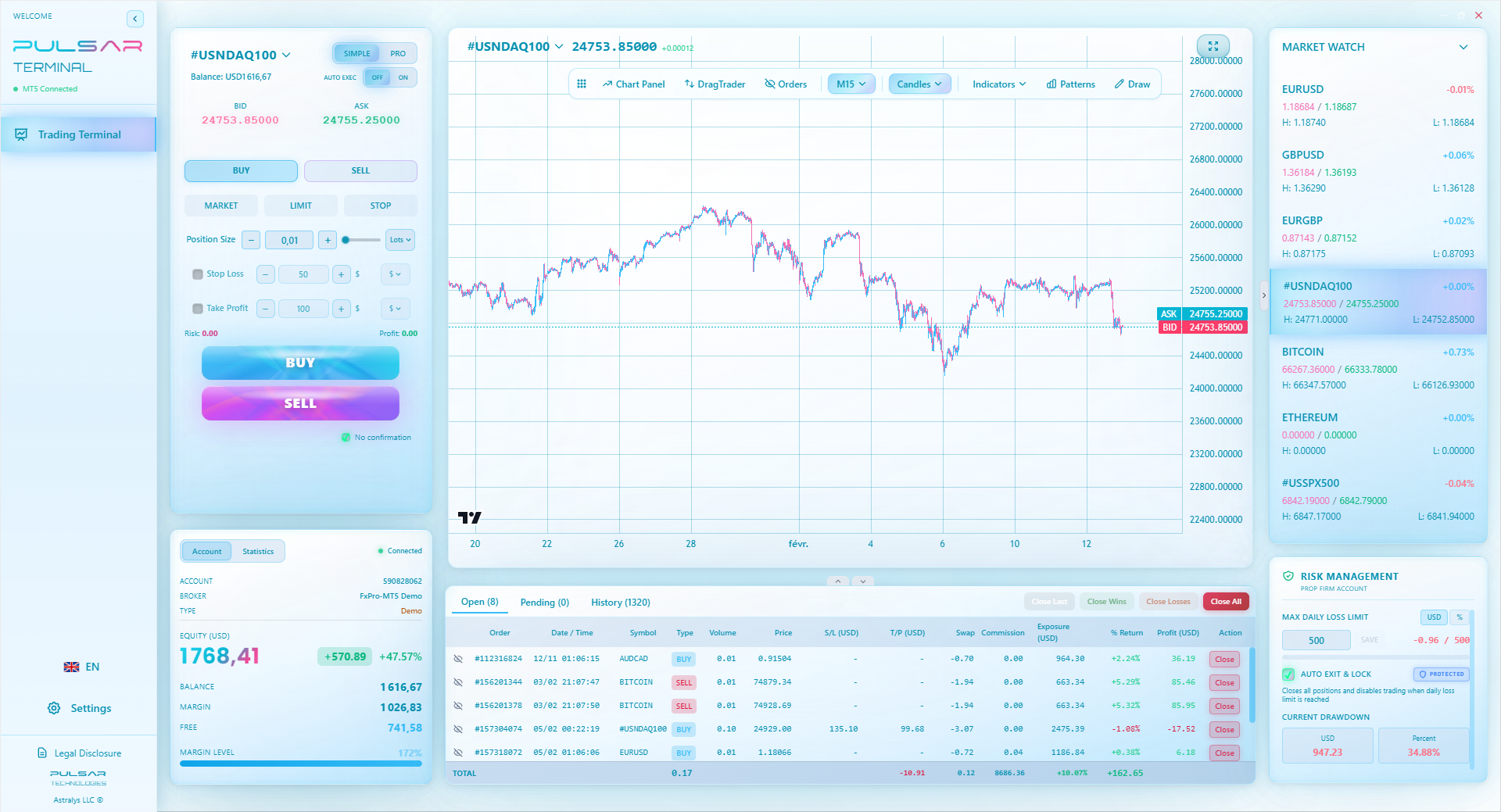
This is where companion tools come in. Imagine being able to drag and drop your take-profit and stop-loss levels directly onto the chart, set a trailing stop that automatically follows the price, or place a grid of 10 orders with one click to average into a position. Having a tool that manages these complex rules automatically, especially for prop firm challenges where daily loss limits are strict, can be the difference between passing and failing. It takes the emotion and the manual error out of executing your plan.
Executing complex risk management rules like trailing stops and multi-level take-profits manually on MT5 is error-prone, but tools like Pulsar Terminal automate this directly on your charts.
“Your goal for the first six months is survival and consistency, not getting rich. Trade micro lots and focus on following your plan.”
Let me be brutally honest about my blunders. This might save you real money.
1. Overleveraging: My first 'big' win was a fluke. I used 1:500 use on a micro lot, caught a 100-pip move, and felt like a genius. The next week, I used the same use on a mini lot, convinced I had the magic touch. A 30-pip move against me wiped out 40% of my account. use is a tool, not a strategy.
2. Chasing the News: I'd see a big Non-Farm Payroll (NFP) number come out, the market would spike, and I'd jump in late, trying to catch the 'move.' More often than not, I'd buy the very top just before a massive reversal. News trading is for pros with ultra-fast execution. For us, it's often a trap.
3. Not Accounting for Swap Rates: Holding a trade overnight? You'll pay or earn a small interest fee called a swap. I once held a sell position on AUD/JPY for two weeks for a 50-pip gain. The positive swap I earned actually added an extra 8 pips to my profit. On the flip side, holding certain pairs long-term can eat into your gains with negative swaps. Check your broker's swap sheet.
4. Ignoring the Higher Time Frame: I was so focused on the 5-minute chart, I didn't see I was trying to buy EUR/USD in the middle of a clear daily-chart downtrend. It's like trying to swim against a powerful river. Always check the daily chart direction first. Are you trading with the tide or against it? My EUR/USD guide goes deeper into analyzing this major pair.
You've got the basic forex trading meaning in Tamil and a roadmap. Here's how to proceed.
1. Open a Demo Account: Today. Pick a broker like Pepperstone or IC Markets and download MT5. Trade with virtual money for at least 3 months. Your goal is not to make fake profit, but to not lose fake money consistently.
2. Build a Watchlist: Focus on 3-5 pairs max. I watch EUR/USD, GBP/USD, XAU/USD (gold), and USD/JPY. Learn their personality. Does EUR/USD trend smoothly? Does GBP/USD make sharp, volatile moves? My XAU/USD guide can help you understand gold's unique drivers.
3. Study One Strategy: Pick one from earlier - say, support/resistance. Practice only that on your demo account for a month. Record your results.
4. Understand the Indicators: Don't use 10 at once. Learn two deeply. The MACD indicator is great for spotting momentum shifts and trend direction. The RSI indicator helps identify potential reversals. Know what they're telling you, not just what they look like.
5. Go Live Small: When you do go live, start with an amount you can afford to lose completely - maybe 20,000 LKR. Trade micro lots only. Your goal for the first six months is survival and consistency, not getting rich.
The journey to understand forex trading meaning in Tamil is the start of a longer journey in financial self-education. It's challenging, often frustrating, but incredibly rewarding when approached with discipline, patience, and a relentless focus on protecting what you have.
FAQ
Q1Is forex trading legal in Sri Lanka?
Trading with international, regulated forex brokers is generally accessible to Sri Lankan residents. However, it's your responsibility to ensure any profits are declared for tax purposes according to Sri Lankan law. Always check the latest Central Bank of Sri Lanka guidelines regarding foreign exchange transactions for residents.
Q2What is the minimum amount needed to start forex trading?
You can start with as little as $50-$100 with some brokers offering micro and nano lots. However, I strongly recommend starting with at least $200-$500 to give yourself a realistic buffer for risk management. Remember, with a 1% risk rule, a $100 account only allows a $1 risk per trade, which is extremely tight.
Q3Can I trade the Sri Lankan Rupee (LKR) on forex?
You cannot directly trade USD/LKR on major international retail forex platforms. The LKR is not a freely convertible currency on the global market. Sri Lankan traders typically trade major pairs like EUR/USD, which are highly liquid and have minimal spreads.
Q4What's the best time to trade forex from Sri Lanka?
The most volatile (and opportunity-rich) sessions are the London session (1:30 PM to 10:30 PM SLT) and the overlap with the New York session (7:30 PM to 12:30 AM SLT). This is when trading volume is highest. The Asian session (early morning SLT) is typically quieter.
Q5How do I withdraw profits to my Sri Lankan bank account?
You request a withdrawal in your broker account (usually in USD or EUR). The broker will wire the funds to your LKR account. Your bank will convert it at their buying rate, and you'll receive rupees. The process can take 2-5 business days and may involve a small fee from both the broker and your local bank.
Q6Is forex trading like gambling?
It can be if you treat it that way - entering trades based on hunches with no stop-loss. Professional trading is not gambling. It's a probability-based business with strict risk management. A gambler hopes to get lucky. A trader follows a plan that, over many trades, has a statistical edge.
प्रो. विंस्टन का पाठ
:
- ✓Never risk more than 1% of your account on a single trade.
- ✓A stop-loss is non-negotiable. Every trade, every time.
- ✓Stick to 3-5 major currency pairs when starting.
- ✓Demo trade for 3 months minimum before using real money.
- ✓The London-New York session overlap offers the best liquidity.
यह लेख कितना उपयोगी था?
रेट करने के लिए स्टार पर क्लिक करें
साप्ताहिक ट्रेडिंग विश्लेषण
मुफ़्त साप्ताहिक विश्लेषण और रणनीतियाँ। कोई स्पैम नहीं।
लेखक के बारे में
Daniel Harrington
कंटेंट प्रमुख
The Trading Mentor में कंटेंट प्रमुख। जटिल ट्रेडिंग कॉन्सेप्ट्स को सरल बनाने के जुनून वाले अनुभवी ट्रेडर। वैश्विक विषयों, रणनीतियों और प्लेटफॉर्म गाइड्स को कवर करते हैं।
टिप्पणियाँ
आपको यह भी पसंद आ सकता है

Cara Trading Forex Sukses: 7 Prinsip dari Trader Profesional
Cara trading forex sukses dengan 7 prinsip trader pro: manajemen modal, disiplin, journal trading, backtest. Data nyata, bukan janji profit palsu.
Jam Trading Forex Terbaik untuk Trader Indonesia: Panduan Lengkap dengan Tabel Waktu
Panduan jam trading forex untuk trader Indonesia. Tabel 4 sesi dunia, jam emas 20:00-00:00, sesi mana yang harus dihindari. Data akurat + tips dari trader berpengalaman.
Top 5 Sàn Forex Uy Tín Nhất 2026: Review Jujur dari Trader Indonesia
Top 5 sàn forex uy tín 2026 untuk trader Indonesia. Review jujur: spread, deposit, withdraw, dukungan lokal. Exness, XM, IC Markets & lebih.
All these calculators are built into Pulsar Terminal with real-time data from your MT5 account. One-click position sizing, automatic risk management, and instant calculations.
