


My screen was a sea of red.

David van der Merwe
उभरते बाजार के ट्रेडर ·  South Africa
☕ 11 मिनट पढ़ने
आप क्या सीखेंगे:
- 1Why a Practice App Isn't Optional (Especially in SA)
- 2What to Look For in a Forex Trading Practice App
- 3Top Practice App Picks for South African Traders
- 4My Demo Disasters (And What They Taught Me)
- 5A 30-Day Structured Practice Plan for Beginners
- 6The Scary Jump: Going From Demo to Live Trading
- 7Common Demo Trading Pitfalls (And How to Avoid Them)
- 8The Lifelong Practice Mindset
My screen was a sea of red. It was October 2022, and I’d just watched a 15,000 ZAR demo account position on USD/ZAR evaporate by nearly half in under an hour. I’d broken every rule: no stop-loss, trading on emotion after a news spike, and a position size that was pure insanity. That virtual loss stung more than some real ones. It was the moment I truly respected the power of a proper forex trading practice app. It’s not a game. It’s a flight simulator where you learn to crash without burning real money. For us in South Africa, with the Rand’s wild swings and unique regulations, choosing the right practice environment isn't just helpful, it's essential.
Let's be blunt. Jumping into live forex trading with your hard-earned Rands without practicing is like trying to surf at Muizenberg during a winter storm without ever touching a board. You will get wiped out. The South African market adds its own twists. The ZAR is notoriously volatile, reacting sharply to local politics, load-shedding news, and global commodity prices. A good forex trading practice app lets you experience that volatility in real-time, but with monopoly money.
I made my first real trade back in 2014. I'd 'practiced' for about a week, made a few hundred virtual dollars, and thought I had it figured out. I deposited R2,000. I was stopped out on my first three trades, losing about R450 in total. The spreads were wider than in the demo, my execution was slower because I was nervous, and the psychological weight of real money completely changed my decision-making. That R450 bought me a crucial lesson: demo trading and live trading are different sports. The practice app is where you build the muscle memory so that when real money is on the line, your process holds firm.

Warning: The biggest mistake is treating a demo account like a casino. If you're taking wild, oversized risks because 'it's not real,' you're training yourself for failure. Trade your demo account with the same respect and risk management (like using a position size calculator) as you would your live account.

💡 विंस्टन की सलाह
A demo account is a laboratory, not a playground. If you're not treating it with the same solemnity as a live account, you're just playing a video game and learning nothing.
Not all demo accounts are created equal. Some are stripped-down toys, others are near-perfect replicas of the live environment. Here’s what separates the good from the great for a South African trader.
Realistic Market Conditions
This is the big one. The app must simulate real spreads, commissions, slippage, and execution speeds. If your demo EUR/USD spread is constantly 0.2 pips but the live account is typically 1.2, you're learning bad habits. Look for brokers that offer a 'demo' version of their real, commission-based accounts. I learned this the hard way practicing on a basic demo, then opening a Raw Spread account with IC Markets. My scalping strategy that worked flawlessly in demo fell apart because I hadn't factored in the per-lot commission, which ate into my tiny profit targets.
Full Platform Access
You need access to the entire platform - all charting tools, indicators, order types (limit, stop, trailing stop), and timeframes. If you plan to trade using MetaTrader 4 or 5 (which most South Africans do), practice on the full MT4/MT5 app, not a broker's simplified version.
South African Rand (ZAR) Account Option
This is a local must-have. Practicing with a ZAR-denominated demo account helps you understand the direct impact of trades on your home currency. You get used to calculating pip values in Rands and understanding how your broker's currency conversion might work on deposits and withdrawals.
Reliable Data Feed
Nothing is worse than practicing on delayed or glitchy data. It creates a false sense of the market's rhythm. A top-tier app from a reputable, FSCA-regulated broker will have a reliable, real-time feed.
| Feature | Why It Matters for SA Traders |
|---|---|
| Realistic ZAR Pairs | Practice on USD/ZAR, EUR/ZAR with actual spread simulations. |
| Local Payment Method Simulation | Understand how funding/withdrawals might work. |
| FSCA-Compliant use | Demo should default to the 30:1 max use, so you learn to use it responsibly. |
| Mobile & Desktop Sync | Seamlessly switch between practicing on your phone and computer. |
“That virtual loss stung more than some real ones. It was the moment I truly respected the power of a proper practice environment.”
Based on my experience and the local regulatory landscape, here are my top recommendations. Remember, you want the demo of the broker you're likely to use live.
MetaTrader 4/5 (MT4/MT5) Demos: The gold standard. Nearly every major broker offers a full-featured MT4/5 demo. Download the MT5 app from your chosen broker (like XM or Pepperstone), and you'll get the complete trading environment. This is where I've spent 90% of my practice time. The charting, the indicators like RSI and MACD, the Expert Advisors (EAs) - it's all there. It’s the closest you'll get to the real thing.
cTrader Demo: If you prefer a more modern, intuitive interface with excellent charting, cTrader's demo is fantastic. Brokers like IC Markets offer it. Its visual order entry and clean design can help beginners focus on price action without clutter.
Broker-Specific Apps (The Good Ones): Some brokers have invested heavily in their own apps, and their demos are worth trying.
- Plus500 Demo: Incredibly user-friendly. Perfect for a complete beginner to grasp the absolute basics of buying and selling CFDs. It holds your hand, maybe a bit too much, but it's a gentle start.
- IG Trading Academy App: This is less a full trading demo and more an integrated education tool. It's brilliant for learning concepts, then applying them in a simple practice environment. I used it to teach my cousin the very basics of support and resistance.

Pro Tip: Open demo accounts at 2-3 different brokers. Compare the spreads on USD/ZAR during South African market hours (8am-5pm SAST). You'll see which broker offers the most consistent, tightest spreads, which is critical for any scalping strategy you might practice.
Let me share some real, cringe-worthy numbers from my practice history. These lessons were free, but useful.
The Overleveraging Catastrophe: On a 50,000 ZAR demo, I once put on a full 1-lot trade on GBP/JPY. I didn't even know what a pip was worth on that pair. The trade moved 20 pips against me, and my account showed a loss of over 8,000 ZAR. In a live account, that would have been a margin call and a blown account. The lesson? Practice calculating position size religiously. Never let a single trade risk more than 1-2% of your demo capital, just as you wouldn't live.
The News Trade That Worked (Once): I practiced trading the US Non-Farm Payrolls report for three months straight on demo. I'd lose virtual money 7 out of 10 times due to insane slippage and spread widening. But that process taught me where to place orders, how to manage them if I got filled, and when to just stay out. The one time I tried it live with a tiny position, I was prepared for the chaos and took a calm, small profit.
Swing Trading Practice That Paid Off: I used a demo account for 6 weeks to test a swing trading strategy on XAU/USD (Gold). I carefully logged every trade, my reasoning, and my emotional state. The virtual drawdown was about 12%. When I went live, I knew exactly how the strategy felt during a losing streak, and I stuck to it. That practice-run confidence was worth more than any indicator.
💡 विंस्टन की सलाह
The most valuable data from your practice isn't your final balance. It's your trading journal. The patterns in your mistakes are the map to your future success.
“Your practice journal is your most important tool. Review it weekly.”
Don't just randomly click buttons. Follow a plan.
Weeks 1-2: The Basics.
- Goal: Don't make money. Don't lose your virtual capital.
- Action: Learn to place market, limit, and stop orders. Set stop-losses and take-profits on EVERY trade. Practice calculating position size for a 1% risk per trade on your demo balance. Get comfortable with the charts. Watch USD/ZAR for a few days without trading.
Weeks 3-4: Strategy Testing.
- Goal: Test one simple strategy. I recommend starting with a basic price action or moving average crossover strategy.
- Action: Define your rules for entry, exit, and risk. Execute 20-30 trades strictly by these rules. Keep a journal. Note the win rate, average win/loss. This isn't about being profitable yet; it's about building discipline.
The Final Hurdle: The 'Live Simulation'.
- Reset your demo account to your planned live starting capital (e.g., R10,000).
- Trade for two weeks as if it were real. This means: no trades during work meetings if you wouldn't do it live, no massive overnight positions you can't monitor. If you blow this demo account, you are NOT ready. Start the plan over.

Example: Your planned live capital is R20,000. You risk 1% per trade = R200 risk. On a USD/ZAR trade where your stop-loss is 50 pips away, your position size must be calculated so that a 50-pip loss equals R200. A position size calculator is essential here. Practice this math on every single demo trade.
This is where most fail. The psychology shifts entirely. Here's how to soften the blow.
Start with a Micro Account. Many brokers offer accounts where a pip is worth cents, not Rands. Deposit a small, affordable amount - maybe R1,000 or R2,000. The goal of your first live trades is not to get rich. It is to make the psychological transition. The money should be an amount you can afford to lose, but you'd still feel the loss. That feeling is the teacher.
Halve Your Position Size. If you were trading 0.1 lots on demo with your virtual R100k, start with 0.05 lots live. The reduced financial pressure will help you think clearer.
Expect a Performance Dip. You will likely be worse live than you were on demo. Your reactions might be slower, you might hesitate. This is normal. It's why you practiced. The muscle memory you built should eventually kick in.
I remember my first successful live trade after that initial R450 loss. It was a simple EUR/USD buy on a pullback to a support level I'd practiced a hundred times. I risked R150 to make R200. When I hit take-profit, the relief and validation were immense. The practice had worked. The system held.
One tool that massively helped me bridge the gap was automating my risk management. Manually moving stops to breakeven or trailing a winner was where I'd often choke, either moving too early or too late.
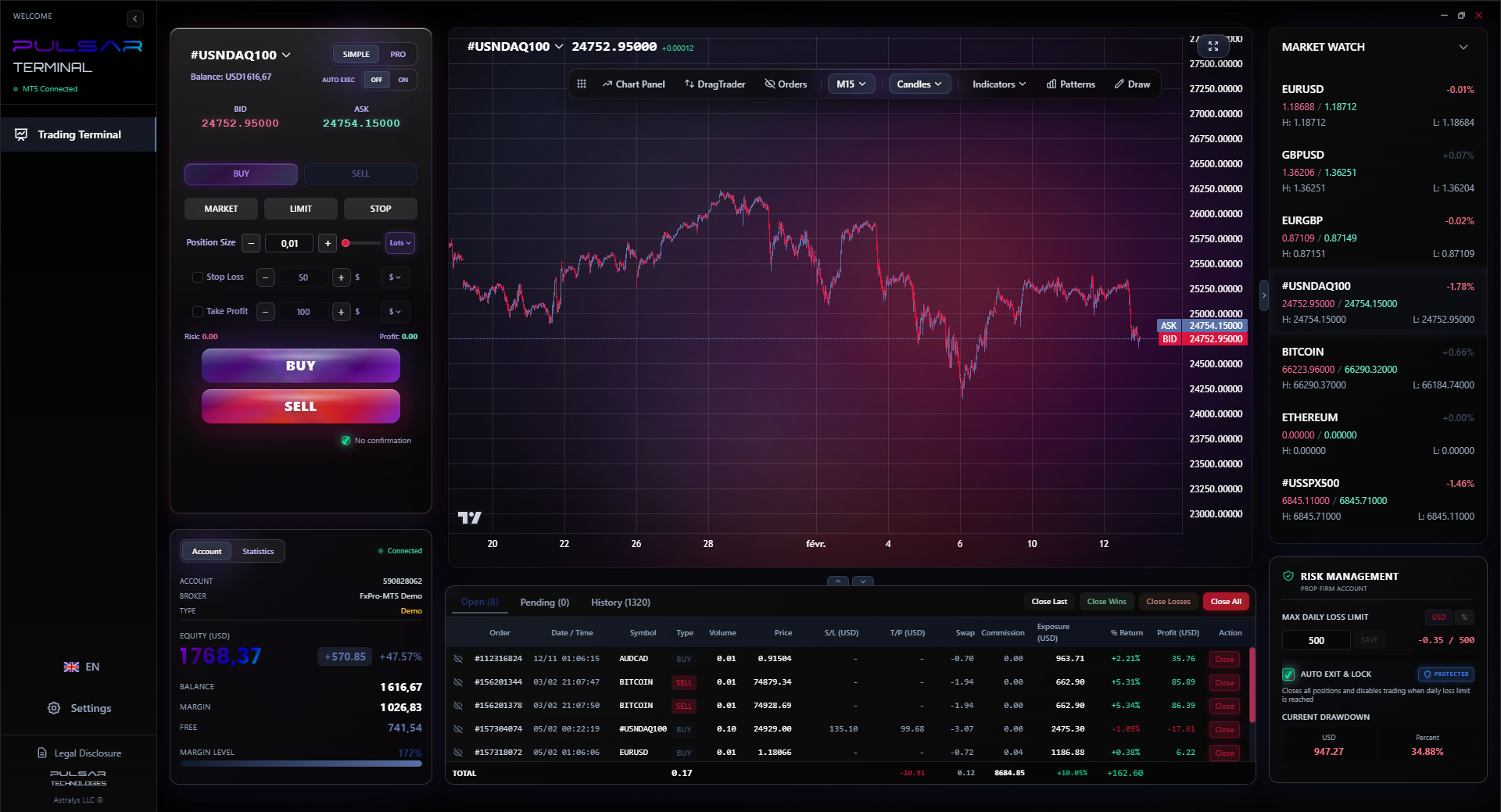
Bridging the gap between demo discipline and live execution is easier when you automate your risk rules, a core function of tools like Pulsar Terminal for MT5.
“The ultimate goal of practice isn't to become a demo account millionaire. It's to make all your expensive mistakes with virtual money.”
Pitfall 1: The Unlimited Demo Refill. You blow your 10k demo? Just click 'reset' for 100k. This destroys any concept of risk management. Fix: Give yourself one demo account. If you blow it, you must analyze every failed trade in a journal before you 'reset.' Make the reset painful in terms of time and reflection.
Pitfall 2: Ignoring Costs. Trading with zero spreads and no commissions builds a false reality. Fix: Practice on an account type that mirrors the costs of the live account you'll use. If your target broker charges a commission, use a demo that includes it.
Pitfall 3: Strategy Hopping. You try a new indicator every day after one losing trade. Fix: Commit to testing one strategy for a minimum of 50 trades in your practice app. You need a statistically significant sample, not just a gut feeling after three trades.
Pitfall 4: No Trading Journal. This is the death knell. Fix: Your practice journal is your most important tool. Record the asset, entry/exit price, time, reason for trade, emotional state, and screenshots. Review it weekly. I still have journals from 2017 that I look back on to see old mistakes creeping in.
💡 विंस्टन की सलाह
When you transition to live, cut your demo position size in half. The psychological weight of real money is a multiplier. Give yourself room to breathe and think.
A forex trading practice app isn't just for beginners. I still use one. Any time I want to test a new strategy, a new indicator setup, or trade a unfamiliar pair, I go straight to a demo. It's my trading laboratory.
For South Africans, the added layer is practicing with an awareness of our context. Practice trading around SARB interest rate announcements. Get a feel for how USD/ZAR moves when load-shedding hits Stage 6. See how your broker's platform behaves during these times of high volatility.
The ultimate goal of practice isn't to become a demo account millionaire. It's to make all your expensive mistakes with virtual money, so that when you commit your real Rands, you're not trading on hope, but on a hardened, tested process. The right app is the foundation of that process. Choose one that doesn't coddle you, but challenges you with reality. Your future live account will thank you for it.
FAQ
Q1Are forex trading practice apps really free in South Africa?
Yes, absolutely. Reputable, FSCA-regulated brokers offer their demo accounts completely free as a service to potential clients. You should never pay for a basic forex trading practice app. They are funded by the hope that you'll eventually open a live account with them.
Q2How much virtual money should I start with in a demo account?
Start with an amount that mirrors what you plan to trade with live. If you intend to start live trading with R20,000, fund your demo with R20,000 (or its equivalent in USD). Starting with a default $50,000 or $100,000 demo teaches bad habits and unrealistic position sizing.
Q3Can I practice trading the South African Rand (ZAR) on these apps?
You can and you should. Most major international brokers that accept South African clients, like XM or IC Markets, offer ZAR pairs like USD/ZAR and EUR/ZAR on their demo platforms. This is crucial for understanding the specific volatility of our local currency.
Q4How long should I practice on a demo before going live?
There's no set time, but a good benchmark is consistent profitability over 2-3 months of active, disciplined demo trading. More important than time is the number of trades and market conditions experienced. You should have traded through periods of high and low volatility and stuck to your rules.
Q5Why do I do well on demo but lose money when I go live?
This is the universal trader's rite of passage. On demo, there's no emotional attachment. Live trading introduces fear and greed, which cause hesitation, overtrading, and breaking your rules. The solution is to start live trading with a very small amount of risk capital to acclimatise to the psychology without facing financial ruin.
Q6Is the MetaTrader 4/5 demo app the best for practice?
For most South African traders, yes. MT4/5 are the industry standard platforms that most local brokers use. Practicing on the full MT4/5 app means you're learning the exact tools and interface you'll use live. It's the most direct transfer of skills from practice to real trading.
Q7Do demo accounts have the same spreads and execution as live accounts?
They should, but not always. Some brokers may provide slightly better conditions on demo to attract clients. This is why it's critical to practice with a reputable, well-regulated broker known for fair pricing, like those we've mentioned. Always check the live account specifications to ensure they match your demo experience.
प्रो. विंस्टन का पाठ
:
- ✓Practice with a ZAR-denominated demo to understand local volatility.
- ✓Test strategies for at least 50 trades, not just 3.
- ✓Always factor in real spreads and commissions during practice.
- ✓Start live with half your demo position size to manage psychology.
यह लेख कितना उपयोगी था?
रेट करने के लिए स्टार पर क्लिक करें
साप्ताहिक ट्रेडिंग विश्लेषण
मुफ़्त साप्ताहिक विश्लेषण और रणनीतियाँ। कोई स्पैम नहीं।
लेखक के बारे में
David van der Merwe
उभरते बाजार के ट्रेडर
जोहानसबर्ग स्थित ट्रेडर, इमर्जिंग मार्केट करेंसीज में 11 साल का अनुभव। ZAR पेयर्स, FSCA-विनियमित ट्रेडिंग और दक्षिण अफ्रीकी मार्केट एनालिसिस में विशेषज्ञ।
टिप्पणियाँ
आपको यह भी पसंद आ सकता है

Cara Trading Forex Sukses: 7 Prinsip dari Trader Profesional
Cara trading forex sukses dengan 7 prinsip trader pro: manajemen modal, disiplin, journal trading, backtest. Data nyata, bukan janji profit palsu.
Jam Trading Forex Terbaik untuk Trader Indonesia: Panduan Lengkap dengan Tabel Waktu
Panduan jam trading forex untuk trader Indonesia. Tabel 4 sesi dunia, jam emas 20:00-00:00, sesi mana yang harus dihindari. Data akurat + tips dari trader berpengalaman.
Top 5 Sàn Forex Uy Tín Nhất 2026: Review Jujur dari Trader Indonesia
Top 5 sàn forex uy tín 2026 untuk trader Indonesia. Review jujur: spread, deposit, withdraw, dukungan lokal. Exness, XM, IC Markets & lebih.
All these calculators are built into Pulsar Terminal with real-time data from your MT5 account. One-click position sizing, automatic risk management, and instant calculations.
