


You're probably wondering which forex trading strategies actually make money here in the Philippines, right? I've seen every 'secret system' and 'guaranteed method' over the last 12 years, and most are garbage.

Miguel Reyes
फॉरेक्स विश्लेषक ·  Philippines
☕ 11 मिनट पढ़ने
आप क्या सीखेंगे:
- 1The Philippine Forex Reality Check
- 2The Foundation: Money Management Isn't a Strategy, It's Survival
- 3Strategy 1: Price Action Swing Trading (The Filipino Favorite)
- 4Strategy 2: London Session Scalping (For the Disciplined)
- 5Strategy 3: The Carry Trade (And Why PHP Pairs Are Tricky)
- 6Strategy 4: The Indicator Combo Breakout
- 7What Doesn't Work (And Will Take Your Money)
- 8Putting It All Together: Your Philippine Trading Plan
You're probably wondering which forex trading strategies actually make money here in the Philippines, right? I've seen every 'secret system' and 'guaranteed method' over the last 12 years, and most are garbage. The truth is, making consistent profits comes down to a handful of proven approaches, adapted to our unique market conditions, costs, and psychology. Let's cut through the noise and talk about what works, what doesn't, and how much you can realistically expect.
Before we talk strategies, let's get real about trading from the Philippines. You're not trading in London or New York. You're trading from Manila, Cebu, or Davao, with different internet speeds, different psychology, and different rules.
The SEC Philippines doesn't license retail forex brokers. That means you're using international platforms like Exness or IC Markets. It's legal for you to trade, but you have zero local protection if a broker goes rogue. That's why regulation from bodies like the UK's FCA or Australia's ASIC isn't just a nice-to-have, it's your first line of defense.
Then there's the cost. That 6.59% market growth statistic sounds great until you realize you're paying for it. Every PHP 1,000 you convert might get hit with a 2.25% service fee. Your credit card might add another 3.5%. Those spreads? On a standard account, you're looking at 1.4 pips on EUR/USD before you even start. On a $10,000 account, that's $14 gone on entry. Your strategy needs to overcome that friction first.
I learned this the hard way in 2015. I was using a scalping strategy that needed 0.5 pip spreads to be profitable. My broker advertised 'low spreads,' but during Asian session hours on USD/JPY, they'd widen to 2.5 pips. I was losing money on winning trades. I didn't understand the concept of a spread well enough. That month, I lost PHP 42,000 not to bad analysis, but to hidden costs. Your strategy lives or dies by these numbers.
Why You'll Blow Up Without It
I don't care if you have the best entry signal in the world. If you risk 10% of your account per trade, you will lose everything. The math is brutal and unforgiving. Between 51% and 89% of retail accounts lose money trading CFDs. The single biggest reason? They have no plan for protecting their capital.
The 1% Rule (And Why I Break It)
The classic rule is to risk no more than 1% of your account on any single trade. On a PHP 50,000 account, that's PHP 500. It's a good starting point for beginners. But as you gain experience, you can adapt. For my main account, I use a 0.5% risk model. It sounds conservative, but it lets me sleep at night. It also means I need a 200-pip move against me to get a margin call. That's a lot of room for error.
Position Sizing is Your Secret Weapon
This is where most Filipinos fail. They think, 'I have PHP 20,000, I'll buy 2 lots of EUR/USD.' That's a ticket to disaster. Your position size should be calculated based on your stop-loss distance and your risk percentage.
Let's say your account is PHP 100,000. You're willing to risk 1% (PHP 1,000). You want to buy GBP/USD at 1.2600, with a stop loss at 1.2550. That's a 50-pip risk.
PHP 1,000 risk / 50 pips = PHP 20 per pip. On GBP/USD, 1 pip on a standard lot is roughly $10 (PHP ~550). So you'd need a position size of about 0.04 lots. Not 1 lot. Not 0.5 lots. 0.04. Use a position size calculator every single time. No exceptions.

Warning: High use (like 1:500) is a tool, not a goal. It magnifies your losses faster than your gains. I've seen more accounts blown up by misused use than by bad market calls.

💡 विंस्टन की सलाह
Your first 50 trades should be about learning discipline, not making money. Use a demo account or tiny live positions. The goal is to execute your plan perfectly, win or lose.
“Your strategy lives or dies by the hidden costs of spreads, fees, and conversions.”
This is the most common successful strategy I see among seasoned Filipino traders. Why? It fits our lifestyle. You don't need to stare at screens all day. You analyze the market in the evening (when London opens), place your orders, and check back in 24-48 hours.
The Core Idea
You're catching 'swings' within a larger trend. You're not trying to buy the absolute bottom or sell the absolute top. You're waiting for the market to pull back to a key level, show signs of exhaustion, and then re-enter in the direction of the main trend.
My Go-To Setup: The Pin Bar Rejection
I look for strong, clear support or resistance levels on the 4-hour or daily chart. When price approaches that level, I want to see a pin bar (a candle with a long wick and small body) rejecting it. That's my signal.
Real Trade Example (2023):
- Pair: AUD/USD
- Context: Strong uptrend on daily chart. Price pulling back to a previous resistance-turned-support level at 0.6520.
- Signal: A bullish pin bar formed on the 4-hour chart at 0.6525.
- Action: Buy order placed at 0.6530 (above the pin bar's high).
- Stop Loss: 0.6480 (below the pin bar's low). Risk: 50 pips.
- Take Profit: 0.6680 (near the next swing high). Reward: 150 pips.
- Result: 3:1 Risk/Reward. Hit target in 4 days. This is classic swing trading.
Why It Works Here
It's slow, methodical, and reduces your exposure to the crazy volatility of the Asian session where liquidity is thinner. It also minimizes the number of trades you take, which saves you on spread costs. You're paying that 1.4 pip spread 5 times a month, not 50 times.
This is the opposite of swing trading. It's fast, intense, and not for everyone. But if you have a few free hours around 4-7 PM Philippine Time (when London comes online), it can be very effective.
The Window of Opportunity
The first 2-3 hours of the London session (3 PM-6 PM PHT) see a massive influx of volume. Spreads tighten, and price moves with more conviction. This is when you can execute a scalping strategy with lower costs.
The 5-Minute Momentum Fade
My scalp setup is simple. I use the 5-minute chart. I wait for a very strong, almost vertical move in one direction. This is usually an overreaction to news or an order flow imbalance. When the RSI indicator goes above 70 or below 30 on that 5-minute chart, and the momentum starts to stall (the candles get smaller), I fade the move.
The Hard Lesson: In 2018, I got greedy. EUR/USD spiked down 25 pips in 10 minutes. RSI hit 25. I went long for a 10-pip scalp. But the move kept going. I didn't have a hard stop. I kept thinking 'it has to reverse.' It didn't. I lost 47 pips in 15 minutes. That was PHP 23,500. Scalping requires robotic discipline. Your stop loss is sacred. Aim for 5-10 pips, and get out.

Pro Tip: For scalping, your broker choice is critical. You need raw spread accounts. Look at brokers like Pepperstone or XM with commission-based accounts where the spread is 0.0 pips. You pay a $3.50 commission per lot, but your entry and exit are cleaner. On 10 scalps a day, that adds up.
💡 विंस्टन की सलाह
If you can't explain your strategy in one simple sentence, you don't have a strategy. You have a hope.
“A mediocre entry with excellent risk management will keep you in the game. A brilliant entry with poor risk management will blow up your account.”
The carry trade is about earning the interest rate differential (the 'swap'). You buy a currency with a high interest rate and sell one with a low interest rate. If you hold the position overnight, you earn a daily payment.
The Classic Play
A few years ago, buying AUD/JPY (high Australian rates vs. low Japanese rates) was a goldmine. You could earn 2-3 pips per day in swap just for holding.
The Philippine Peso Problem
Naturally, you might think, 'What about USD/PHP? The US has higher rates than the Philippines.'
Here's the catch: Most international brokers don't offer USD/PHP as a CFD for retail traders. It's an emerging market currency pair, and the liquidity for speculative trading is limited. The pairs you'll find are majors (EUR/USD, GBP/USD) and crosses (EUR/GBP, AUD/CAD).
So, a pure PHP-based carry trade is off the table for most. Your carry trade will involve other currencies. And remember, swap rates can be positive or negative. If you're wrong on the direction, you're paying interest daily, which eats into your capital. Always check the swap rate (the overnight fee) in your platform before putting on a long-term carry position. A losing trade with a negative swap is a double whammy.
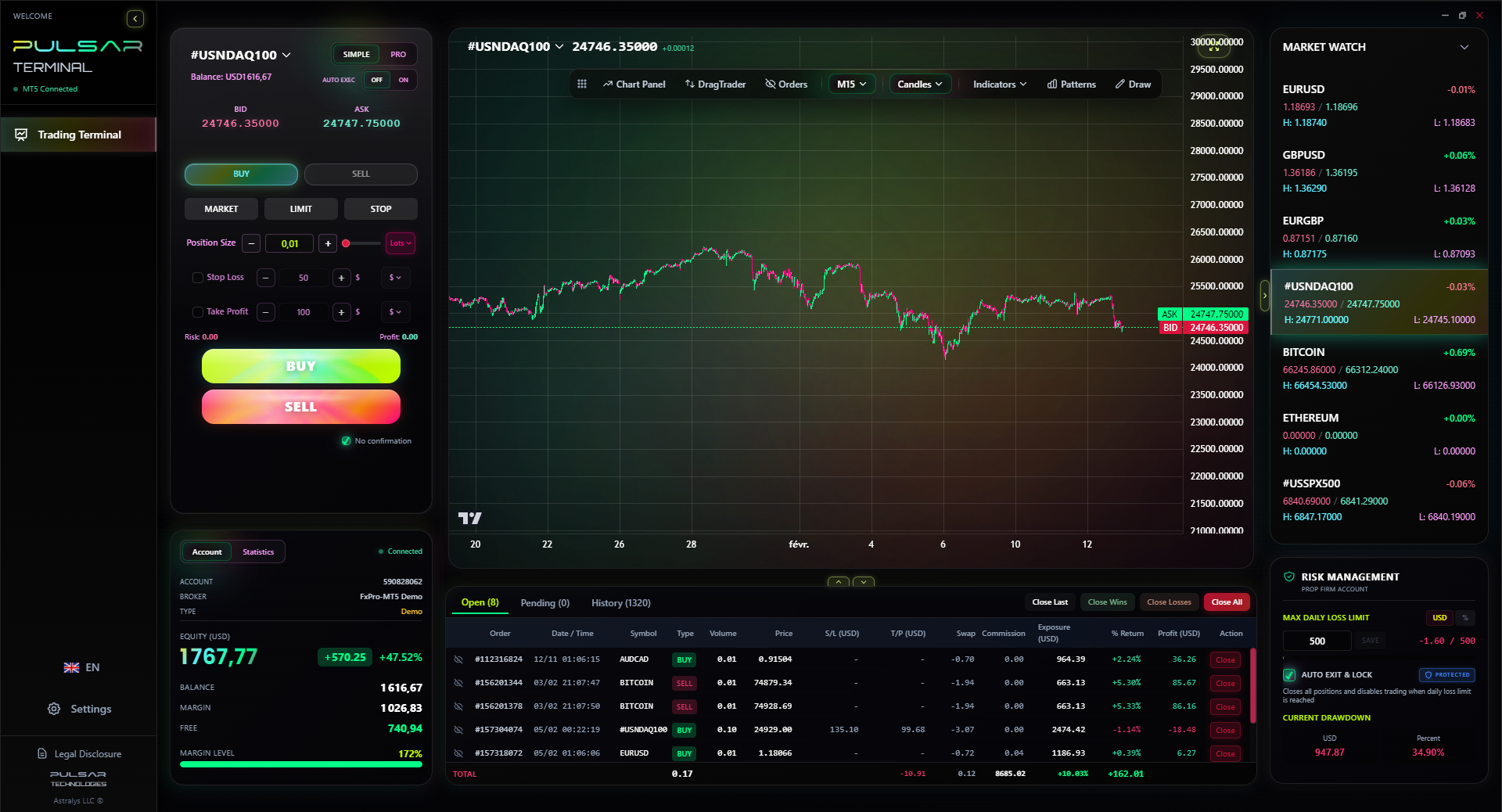
Managing multiple take-profit levels and trailing stops on complex trades like carry trades is where a tool like Pulsar Terminal shines, automating what MT5 makes tedious.
Pure price action isn't for everyone. Some people need the confirmation of indicators. That's fine. The key is to keep it stupidly simple.
The Two-Indicator Rule
I use two, max. My preference: The 20-period Exponential Moving Average (EMA) to define trend, and the MACD indicator (standard 12,26,9 settings) for momentum and crossover signals.
The Breakout Confirmation Setup
I apply this to the 1-hour chart for shorter-term trades.
- Trend Filter: Is price above (bullish) or below (bearish) the 20 EMA?
- Consolidation: I look for a tight range (a 'squeeze') where the price moves sideways.
- MACD Signal: As the range tightens, the MACD lines will converge near the zero line. I wait for the MACD histogram to start growing in the direction of the trend and for the fast line to cross the slow line.
- Entry: I enter on a candle close outside the consolidation range, in the direction of the MACD crossover and the main trend.
This isn't about predicting the breakout. It's about waiting for the breakout to happen and then jumping on with confirmation. Your stop loss goes just on the other side of the consolidation range.
This strategy works well on commodities like gold (XAU/USD) which often consolidate before big moves. The MACD helps filter out false breakouts, which are incredibly common.
“The goal isn't to get rich quick. The goal is to be a slightly better trader this month than you were last month.”
Let's save you some time and heartache.
- Martingale/Doubling Down: This is the 'I'll just double my lot size after a loss to recover' strategy. It's mathematically guaranteed to blow your account. All it takes is one extended losing streak - and they happen - to wipe you out. I tried a modified version early on. It worked for 11 trades in a row. The 12th trade cleaned out 8 months of profits.
- News Scalping Without a Pro Setup: Trying to trade the NFP (Non-Farm Payrolls) or CPI news release from your home internet in Quezon City is suicide. The spreads widen to 50 pips, the slippage is horrific, and the algos used by institutions will eat your retail order for breakfast. If you're not colocated in a New York data center with direct market access, don't do it.
- Following 'Signal' Groups Blindly: You pay PHP 3,000 a month for Telegram signals. The sender has no skin in the game. They get 100 people to follow a signal. 50 win, 50 lose. They post the screenshots of the winners. You're the one holding the bag on the losers. I've never met a consistently profitable trader who sells signals.
- Over-Optimizing Robots/EAs: Spending months tweaking an Expert Advisor (robot) to fit past data perfectly. This is called 'curve-fitting.' It will fail the moment market conditions change, which is always. The market has a habit of humbling the over-confident.
💡 विंस्टन की सलाह
The market doesn't know you exist. It doesn't care about your rent, your goals, or your previous losses. Trade the chart in front of you, not the story in your head.
A strategy is just one piece. You need a plan.
- Choose Your Lane: Are you a swing trader or a scalper? Don't mix them. The psychology is completely different. Start with swing trading.
- Pick Your Pairs: Focus on 1-2 major pairs. Master them. I trade 90% of my volume on EUR/USD and GBP/USD. I know their personality.
- Define Your Session: When will you trade? London session? Evening only? Stick to it.
- Broker & Costs: Choose a reputable international broker with tight spreads for your style. Factor in all conversion and deposit fees into your risk calculations.
- Journal Everything: Every trade. Entry, exit, reason, emotion. My losing streak in 2019 was solved by reviewing my journal. I saw I was overtrading on Tuesdays. I stopped trading Tuesdays. Problem solved.
- Taxes: Yes, you have to pay. Income from forex trading is taxable. Talk to an accountant. Keep records.
The goal isn't to get rich quick. The goal is to be a slightly better trader this month than you were last month. Consistency over time, with ruthless risk management, is the only real 'secret' there is.
FAQ
Q1Is forex trading legal in the Philippines?
Yes, it is legal for individuals to trade forex through internationally regulated brokers. However, the SEC Philippines does not license any local brokers to offer retail forex/CFD trading, so you are using offshore platforms. You are responsible for choosing a reputable, well-regulated broker.
Q2What is the best time to trade forex in the Philippines?
The most active and liquid sessions are the London session (3 PM - 12 AM PHT) and the overlap with the New York session (8 PM - 4 AM PHT). These times have tighter spreads and stronger trends. The Asian session (7 AM - 4 PM PHT) is generally slower and more range-bound for major pairs.
Q3How much money do I need to start forex trading?
You can start with very little - some brokers offer accounts with a $5 or $10 minimum deposit. However, to trade responsibly with proper risk management (e.g., risking 1% per trade), a more realistic starting capital is at least PHP 20,000-50,000. This allows for meaningful position sizing without being wiped out by a few small losses.
Q4What's more important, the entry strategy or money management?
Money management, 100 times over. A mediocre entry with excellent risk management will keep you in the game. A brilliant entry with poor risk management will blow up your account. Always calculate your position size before you enter a trade.
Q5Do I need to pay taxes on my forex trading profits?
Yes. The Bureau of Internal Revenue (BIR) considers trading profits as taxable income. You should register as a self-employed individual or professional, keep detailed records of all trades (profits and losses), and consult with a tax professional to ensure compliance.
Q6Can I trade the Philippine Peso (PHP) online?
Generally, no. Most major international forex brokers do not offer USD/PHP or other PHP pairs as tradable CFDs for retail clients. You will primarily be trading major currency pairs like EUR/USD, GBP/USD, and USD/JPY.
Q7What's the biggest mistake new Filipino traders make?
Using too much use. They see 1:500 or 1:1000 and think it's free money. use amplifies losses just as fast as gains. Starting with high use is the fastest way to turn a small account into a zero-balance account.
प्रो. विंस्टन का पाठ
:
- ✓Risk a maximum of 1% of your capital per trade.
- ✓Choose your trading session and stick to it (London is best).
- ✓Master 1-2 major pairs, don't chase 10.
- ✓Swing trading fits the Filipino lifestyle better than scalping.
- ✓Your broker's spread and regulation are part of your strategy.
यह लेख कितना उपयोगी था?
रेट करने के लिए स्टार पर क्लिक करें
साप्ताहिक ट्रेडिंग विश्लेषण
मुफ़्त साप्ताहिक विश्लेषण और रणनीतियाँ। कोई स्पैम नहीं।
लेखक के बारे में
Miguel Reyes
फॉरेक्स विश्लेषक
2020 से मनीला से पार्ट-टाइम फॉरेक्स ट्रेडिंग, अब फुल-टाइम। एशियाई सत्र में USD/PHP और प्रमुख जोड़ों पर ध्यान केंद्रित करते हैं। पूर्व BPO कर्मचारी जिन्होंने मुफ्त YouTube कोर्स और डेमो अकाउंट से ट्रेडिंग सीखी।
टिप्पणियाँ
आपको यह भी पसंद आ सकता है

Cara Trading Forex Sukses: 7 Prinsip dari Trader Profesional
Cara trading forex sukses dengan 7 prinsip trader pro: manajemen modal, disiplin, journal trading, backtest. Data nyata, bukan janji profit palsu.
Jam Trading Forex Terbaik untuk Trader Indonesia: Panduan Lengkap dengan Tabel Waktu
Panduan jam trading forex untuk trader Indonesia. Tabel 4 sesi dunia, jam emas 20:00-00:00, sesi mana yang harus dihindari. Data akurat + tips dari trader berpengalaman.
Top 5 Sàn Forex Uy Tín Nhất 2026: Review Jujur dari Trader Indonesia
Top 5 sàn forex uy tín 2026 untuk trader Indonesia. Review jujur: spread, deposit, withdraw, dukungan lokal. Exness, XM, IC Markets & lebih.
All these calculators are built into Pulsar Terminal with real-time data from your MT5 account. One-click position sizing, automatic risk management, and instant calculations.
