


I lost R1,850 on a single trade before I even saw a price move.

David van der Merwe
उभरते बाजार के ट्रेडर ·  South Africa
☕ 12 मिनट पढ़ने
आप क्या सीखेंगे:
- 1What Exactly Is a Forex ZAR Account?
- 2The Real-World FSCA Rules You Need to Know
- 3The True Cost Breakdown: Spreads, Fees & Hidden Charges
- 4Choosing Your Broker: A Practical Comparison
- 5Getting Money In & Out: The Practicalities
- 6What Can You Actually Trade? ZAR Pairs & More
- 7Mistakes I Made (So You Don't Have To)
- 8Your Action Plan: Getting Started in 2026
I lost R1,850 on a single trade before I even saw a price move. It wasn't a bad analysis. My USD-denominated account got hammered by a sudden spike in the USD/ZAR exchange rate when I deposited. That loss, right off the bat, taught me the hard way why a proper forex ZAR account isn't just convenient, it's a critical risk management tool for any South African trader. This guide is what I wish I'd known back then.
It's simpler than it sounds. A forex ZAR account is a trading account where your base currency is the South African Rand. Your deposits, withdrawals, profits, and losses are all calculated in Rands.
The big difference? It cuts out a hidden layer of risk. When you trade with a USD account, you're effectively making two bets: one on your chosen pair (like EUR/USD), and another, silent bet on the USD/ZAR rate. If the Rand weakens against the Dollar between your deposit and withdrawal, your profits shrink. If it strengthens, your losses grow. I learned this the expensive way.
With a ZAR account, your broker handles the conversion at their institutional rate when you open a trade on a foreign pair. Your profit and loss is then locked in Rands. It brings clarity. You see exactly what you're making or losing in the currency you pay your bills with. For a focused approach like scalping strategy, where every pip counts, this clarity is non-negotiable.

Warning: Not all 'ZAR accounts' are equal. Some offshore brokers offer them but aren't FSCA-regulated. This can complicate tax reporting and fund recovery if something goes wrong. Always verify the regulator first.

💡 विंस्टन की सलाह
A ZAR account turns forex from an abstract 'Dollar game' into a concrete South African business. Your P&L in Rands connects directly to your life, building better discipline than any indicator.
Trading is legal here, but the Financial Sector Conduct Authority (FSCA) sets the guardrails. Ignoring them is a sure way to get burned.
The License is Everything
Your first check for any broker should be their FSCA license number. It's not just a sticker on a website. A licensed broker must segregate client funds from their own operating money. This means if the broker goes under, your trading capital should be protected in a separate bank account. It's your first line of defence.
They also have strict rules on use disclosure and risk warnings. You'll see the warnings everywhere, and you should. The FSCA caps use for major forex pairs at 1:30 for retail clients. This feels restrictive if you've seen offshore offers of 1:500, but trust me, it's a blessing. That 1:500 use is a one-way ticket to a margin call. The 1:30 cap forces more sensible position size calculator use.
SARB and Your Money Moving
This is where it gets practical. The South African Reserve Bank (SARB) controls cross-border flows. When you fund an international broker (even an FSCA-licensed one with a ZAR account), you're doing an international transfer.
For amounts under R1 million, it's usually straightforward through your bank as an 'foreign investment allowance'. Over R1 million, you need a Tax Compliance Status (TCS) pin from SARS and an Approval of International Transfer (AIT). The paperwork is real. I keep all my deposit confirmations and broker statements in one folder for tax season. It saves headaches.
One critical rule: you cannot buy forex from a friend or on social media. It must be through an Authorised Dealer (your bank or a licensed broker). Breaking this is illegal and a great way to lose your money with zero recourse.
“That loss, right off the bat, taught me the hard way why a proper forex ZAR account isn't just convenient, it's a critical risk management tool.”
Let's talk numbers. The advertised 'spread' is just the entry fee. The real cost of a forex ZAR account has more layers.
Spreads & Commissions: You'll generally find two models. Spread-only accounts might show EUR/USD from 0.7 pips. Raw spread accounts with a commission can show 0.0 pips, but charge a commission per lot. That commission is usually quoted in USD. Here's the kicker for a ZAR account: your broker converts that USD commission to ZAR at their rate. Always ask for the all-in cost per round turn in Rands. On a standard lot (100,000 units), a 0.6 pip spread on EUR/USD costs you about R14.40 (at a USD/ZAR rate of 18.0). A $7 commission per lot is about R126. The raw spread account is cheaper on paper, but only if you're trading large volumes where the tight spread outweighs the commission.
Overnight Financing (Swap): This is the cost of holding a position past the daily cut-off time. It's based on the interest rate differential between the two currencies. For a ZAR account, these swap rates are calculated in the pair's currency but then converted and applied to your account in Rands. Long a high-interest currency against a low-one, you might earn a small credit. Do the opposite, and you pay. It can eat into profits on longer-term swing trading positions.
The Silent Killer: Inactivity Fees This one caught me. After a busy quarter away from trading, I logged in to find a $50 (about R900) deduction. Some brokers charge this after 3-6 months of no trading. If you're taking a break, either close the account or make sure you know the policy. Alfa Financials, for example, charges a hefty 1500 ZAR monthly fee after just one month of inactivity.

Example: Trading 2 standard lots of EUR/USD monthly.
- Spread-only account: 0.8 pip spread = ~R38.40 per trade, R76.80 monthly.
- Commission account: 0.1 pip spread + $7 commission = ~R2.40 (spread) + R126 (comm) = R128.40 per trade, R256.80 monthly. The 'cheaper' commission model costs over 3x more for this volume. Know your activity level.
Forget the flashy ads. Here’s a down-to-earth look at some major players offering forex ZAR accounts to South Africans, based on 2025/2026 realities. This isn't about who's 'best', but who might fit your style.
| Broker | FSCA Regulated? | Min Deposit (ZAR) | EUR/USD Spread (Typical) | My Note on ZAR Accounts |
|---|---|---|---|---|
| Exness | Yes | ~R1,800 | From 0.0 pips (Raw) | Popular for low minimums. Their ZAR account is straightforward, but watch the swap rates on carry trades. Read our full Exness review for deeper details. |
| IC Markets | Yes | ~R2,400 | From 0.0 pips (Raw) | A favourite for raw spreads and execution speed. Their ZAR account integrates well with cTrader and MT5. Their IC Markets review highlights their strong tech focus. |
| XM | Yes | ~R90 | From 0.6 pips (Standard) | Unbeatable for starting with almost nothing. The ZAR account works, but spreads on majors are generally higher than the raw spread brokers. |
| Pepperstone | Yes | ~R1,800 | From 0.0 pips (Razor) | Excellent execution and platform choice. Their ZAR account is solid, and they have a strong local presence. See the Pepperstone review for their specific tools. |
My mistake early on was picking a broker for their bonus, not their spreads or platform stability. I chose one with a 50% deposit bonus, but their spreads on XAU/USD guide were 45 pips when the market was volatile. The 'free' bonus money was gone in a few trades due to terrible execution costs. The platform also froze during major news events. Lesson learned: stability and transparent costs beat a sign-up bonus every time.
💡 विंस्टन की सलाह
The FSCA's 1:30 use cap isn't a limit on your potential. It's a governor on your greed. Forced smaller position sizing is the single best risk lesson a new trader can get.
“The 1:30 use cap forces more sensible position sizing. It's a blessing disguised as a restriction.”
This is where a local ZAR account shines, but you still need a process.
Depositing: Most FSCA brokers offer instant EFTs, SID (Secure Instant Deposit), or direct bank transfer into their South African trust account. The money typically reflects in your trading account in minutes to a few hours. Always use the unique reference number provided by the broker. I once forgot the reference and my deposit was stuck for three days while the broker's finance team figured out it was from me.
Withdrawing: This should be the reverse. You request a withdrawal to your verified South African bank account. FSCA-regulated brokers are generally good about this, processing within 24 hours on business days. The money then goes through the local banking system. The entire process, from request to cash in your account, can take 1-3 business days.
The Tax Question: I'm not an accountant, but here's what mine told me: Trading profits from a licensed broker are considered income from a business (if you trade regularly) or capital gains. You must declare it to SARS. The beautiful thing about a ZAR account? All your statements are in Rands. Your profit/loss for the tax year is clear, with no need to track fluctuating USD/ZAR conversions on every single trade. Keep every single statement and deposit/withdrawal confirmation.
Your forex ZAR account isn't limited to Rand pairs, but they are a key advantage.
Direct ZAR Pairs: This is your home-ground advantage. You can trade USD/ZAR, EUR/ZAR, GBP/ZAR directly. No conversion needed. The spreads on these can be wider than majors like EUR/USD guide, often 80-150 pips for USD/ZAR. The volatility is high, driven by local politics, commodity prices (like platinum), and global risk sentiment. It moves fast. Using an indicator like the RSI indicator can help spot overbought/oversold conditions in these choppy markets.
Everything Else: Your ZAR account gives you access to all the broker's instruments. You can trade Gold (XAU/USD), global indices, and major forex pairs. When you buy EUR/USD, your broker instantly converts your ZAR margin requirement to the needed currency (likely USD). Your profit/loss in USD is then converted back to ZAR and displayed in your account. The conversion happens seamlessly in the background at the broker's rate.
This means you can have a global portfolio from one Rand-based account. I might have a short on USD/ZAR (betting Rand strengthens) based on local CPI data, and a long on the NASDAQ index, all in the same account, with all risk calculated in Rands. It's powerful.
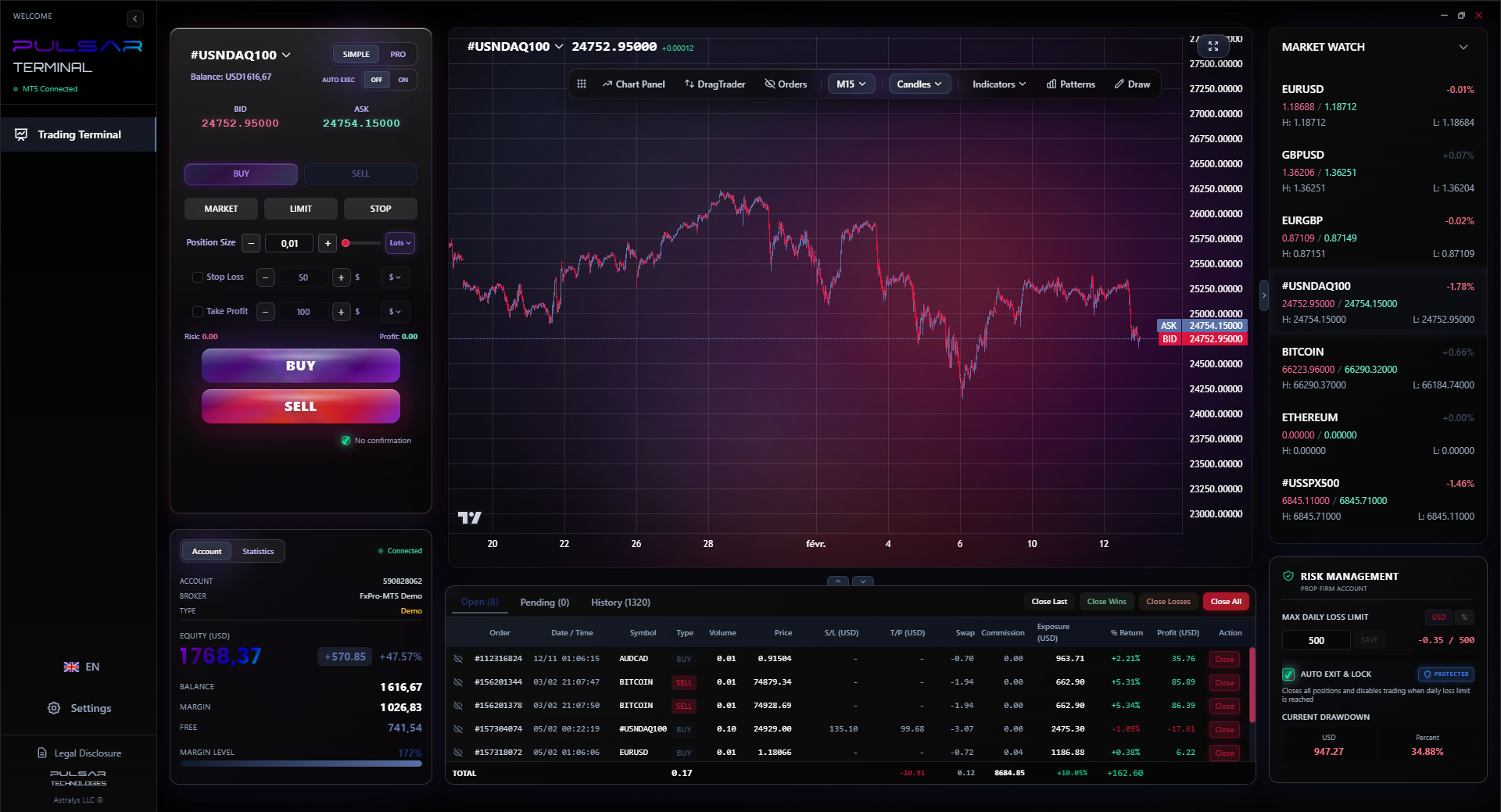
Managing multiple trades on volatile pairs like USD/ZAR requires precise tools, and Pulsar Terminal's drag-and-drop orders and multi-TP/SL features on MT5 give you that control directly on your charts.
“Your trading psychology changes when your P&L is in Rands. A R500 loss feels more real than a $27 loss. Use this to your advantage.”
Let's get honest. Here's where I messed up, complete with numbers.
1. Ignoring Swap on Long-Term Trades: In early 2024, I went long GBP/JPY for a swing trading play, expecting a 200-pip move over a few weeks. I made 180 pips, which was about R9,000 profit on my size. But I held it for 21 days. The daily swap charge, converted to ZAR, was about R45 per night. I paid nearly R945 in financing costs. My net profit was just over R8,000. I'd failed to factor that in, and it took a 10% bite out of my gain. Always check the swap rate before holding for more than a few days.
2. Chasing 'ZAR Hedged' Myths: Some brokers advertise 'ZAR-hedged' accounts that claim to remove currency risk on international pairs. They often come with much wider spreads or extra fees. I tried one. The effective spread on EUR/USD was over 2.5 pips. My usual strategy became unprofitable immediately. The 'protection' cost more than the risk it was mitigating. For most traders, a standard ZAR account with a reputable broker is protection enough.
3. Not Using a Demo First: This seems obvious, but with a ZAR account, you need to test the specific platform and execution. I deposited with a broker because their website promised 'lightning execution'. On demo, it was fine. On my live ZAR account, during the London open, the requotes on USD/ZAR were constant. The slippage was brutal. I lost R600 in two trades from bad execution alone. Always trade the demo in the market conditions you'll actually trade live.

Pro Tip: Your trading psychology changes when your P&L is in Rands. A R500 loss feels more real than a $27 loss. Use this to your advantage. It creates a healthier sense of risk because you're connected to the value in your local cost of living. Let that feeling enforce stricter discipline on your position size calculator.
💡 विंस्टन की सलाह
Test a broker's withdrawal process with a small profit before committing serious capital. A smooth exit tells you more about their integrity than any slick marketing ever will.
Ready to move? Follow this sequence to avoid early stumbles.
- Define Your Style: Are you a scalper needing ultra-tight spreads? A swing trader more concerned with swap rates? This dictates your broker choice (Raw spread vs. Spread-only).
- Shortlist FSCA Brokers: From the table above, pick 2-3 that match your style. Go to the FSCA website and verify their license number is current.
- Open a Demo ZAR Account: Not just any demo. Open a demo account specifically configured as a ZAR-base account with your shortlisted brokers. Trade it for at least two weeks. Test execution, platform stability, and get a feel for the costs in Rands.
- Prepare Your FICA Docs: Have your SA ID, proof of residence (not older than 3 months), and possibly a bank statement ready for verification.
- Start Small: When you go live, deposit the minimum or just above it. Your first goal isn't to make money, it's to test the live funding, trading, and withdrawal process end-to-end with a small amount. Make one trade, then try withdrawing your profit (or remaining balance). If that process is smooth, you have confidence in the broker.
- Plan Your Tax from Day One: Create a simple spreadsheet or folder. Record the date and amount of every deposit and withdrawal. Your broker's monthly statements will do the rest, but your own deposit trail is crucial for SARS if they ever ask.
The landscape is always shifting. New brokers get licensed, others leave. But the core principles here - regulation, cost awareness, and using a ZAR account to manage your home currency risk - will keep you on solid ground no matter what changes.
FAQ
Q1Is it illegal to use an international broker without an FSCA license?
No, it's not illegal for you as a South African resident to use an offshore broker. However, it is highly risky. You lose the protection of FSCA rules like client fund segregation and local dispute resolution. If the broker fails or disputes arise, getting your money back from a foreign jurisdiction is extremely difficult and expensive.
Q2What's the difference between a ZAR account and a USD account with a South African broker?
The currency of your account determines what you see and what you're exposed to. In a ZAR account, everything is in Rands - your balance, profit/loss, and margin. Your risk is solely on your trades. In a USD account, your balance is in Dollars. When you deposit Rands, they're converted to USD. Your profit/loss in USD is then subject to the USD/ZAR rate again when you withdraw back to Rands. You carry hidden exchange rate risk.
Q3Can I trade cryptocurrencies with a forex ZAR account?
Yes, most FSCA-regulated brokers that offer ZAR accounts also offer CFDs on major cryptocurrencies like Bitcoin and Ethereum. You trade these from your Rand-denominated account, with profits and losses calculated in ZAR. Remember, crypto CFDs are highly volatile and come with significant risk.
Q4How do I know if my broker's ZAR account is truly FSCA-regulated?
Go directly to the FSCA's official website (www.fsca.co.za) and use their 'Search for an authorised financial services provider' tool. Enter the broker's name or the FSP number they provide. If they are listed as authorised for 'Discretionary and/or Non-discretionary Mandates' or similar categories involving derivatives, they are regulated. Don't just trust a logo on their site.
Q5Are profits from a forex ZAR account taxable in South Africa?
Yes. SARS views consistent trading as generating income, which is taxable. The specific treatment (as revenue or capital gains) depends on the nature and frequency of your trading. The major advantage of a ZAR account is that all your records are already in Rands, simplifying reporting. You must declare this income. Consult a tax professional familiar with trading.
Q6What happens if my broker's FSCA license is suspended?
If the FSCA suspends a license, the broker must cease all regulated activities. For you, the client, the broker is obligated to return all segregated client funds. The FSCA would typically oversee this process to ensure an orderly return of money. This is a key reason to only use FSCA-licensed brokers - there is a formal process and regulator overseeing client protection.
Q7Can I have multiple ZAR accounts with different brokers?
Absolutely. Many serious traders do this to access different platforms, asset classes, or to take advantage of specific strengths. For example, you might use one broker for their tight spreads on majors and another for their range of local shares CFDs. Just remember to manage your total risk across all accounts.
प्रो. विंस्टन का पाठ
:
- ✓Verify the FSCA license first, before you even look at spreads.
- ✓A ZAR account eliminates hidden USD/ZAR conversion risk on every trade.
- ✓Factor in swap costs; they can take a 10% bite out of swing trade profits.
- ✓Test the full deposit-trade-withdraw cycle with a small amount first.
यह लेख कितना उपयोगी था?
रेट करने के लिए स्टार पर क्लिक करें
साप्ताहिक ट्रेडिंग विश्लेषण
मुफ़्त साप्ताहिक विश्लेषण और रणनीतियाँ। कोई स्पैम नहीं।
लेखक के बारे में
David van der Merwe
उभरते बाजार के ट्रेडर
जोहानसबर्ग स्थित ट्रेडर, इमर्जिंग मार्केट करेंसीज में 11 साल का अनुभव। ZAR पेयर्स, FSCA-विनियमित ट्रेडिंग और दक्षिण अफ्रीकी मार्केट एनालिसिस में विशेषज्ञ।
टिप्पणियाँ
आपको यह भी पसंद आ सकता है

Cara Trading Forex Sukses: 7 Prinsip dari Trader Profesional
Cara trading forex sukses dengan 7 prinsip trader pro: manajemen modal, disiplin, journal trading, backtest. Data nyata, bukan janji profit palsu.
Jam Trading Forex Terbaik untuk Trader Indonesia: Panduan Lengkap dengan Tabel Waktu
Panduan jam trading forex untuk trader Indonesia. Tabel 4 sesi dunia, jam emas 20:00-00:00, sesi mana yang harus dihindari. Data akurat + tips dari trader berpengalaman.
Top 5 Sàn Forex Uy Tín Nhất 2026: Review Jujur dari Trader Indonesia
Top 5 sàn forex uy tín 2026 untuk trader Indonesia. Review jujur: spread, deposit, withdraw, dukungan lokal. Exness, XM, IC Markets & lebih.
All these calculators are built into Pulsar Terminal with real-time data from your MT5 account. One-click position sizing, automatic risk management, and instant calculations.
