


Here's a fact that might surprise you: you can technically start trading forex in Nigeria with as little as 100 Naira.

Olumide Adeyemi
पश्चिम अफ्रीकी ट्रेडिंग अग्रणी ·  Nigeria
☕ 12 मिनट पढ़ने
आप क्या सीखेंगे:
- 1The Absolute Minimum to Start (It's Shockingly Low)
- 2A Realistic Starting Capital for Nigerians
- 3Breaking Down the Costs: Spreads, Commissions & The use Trap
- 4Funding Your Account: Naira, Payments & Fintech
- 5A Tiered Approach: How Much Should YOU Start With?
- 6Managing Your Investment: The 2% Rule & Compounding
- 7Final Verdict & Your First Steps
Here's a fact that might surprise you: you can technically start trading forex in Nigeria with as little as 100 Naira. That's less than the price of a bottle of Coke. But just because you can, doesn't mean you should. I've seen too many guys jump in with 5,000 Naira, get a lucky win, and then blow their entire account on the next trade because the math just doesn't work. The real question isn't the bare minimum, but how much you need to trade seriously without getting wiped out by a single bad move. Let's talk real numbers, from the absolute minimums to what I'd actually recommend you start with.
Let's get the technical answer out of the way first. If you're just looking to open an account and place a trade, the barrier is almost non-existent.
Many international brokers catering to our market have dropped their minimum deposits to basically zero to attract new traders. Brokers like XTB and Fusion Markets let you open an account with $0. Others, like XM and HFM, ask for just $5. Some even accept Naira directly. FXTM, for example, has a minimum deposit of just 100 NGN.

Warning: A low minimum deposit is a marketing tool, not a trading strategy. Opening an account with 100 NGN is like trying to drive from Lagos to Abuja on one litre of fuel. You might get out of your street, but you're not going anywhere meaningful. The spreads and commission costs will eat you alive before you even see a profit.
I made this mistake early on. I funded an account with $10, thrilled I could 'start trading.' My first trade on EUR/USD needed a move of about 1.5 pips just to break even because of the spread. A tiny, normal market wiggle against me, and I was down 20% of my account. It was a lesson in futility. The minimum deposit tells you the cost of entry to the platform, not to the game.
So yes, you can start with almost nothing. But if you're asking 'how much can I invest in forex trading' with the goal of actually learning and making something, we need to look past this number.

💡 विंस्टन की सलाह
Your first deposit isn't trading capital. It's tuition. Expect to pay it. The goal of your first real account is to graduate with the lessons, not the profits.
“The minimum deposit tells you the cost of entry to the platform, not to the game.”
Forget the broker's minimum. Let's talk about the market's minimum. After coaching dozens of new traders here, I've found a clear pattern. Those who start with less than $200 (roughly 250,000 NGN at current rates) struggle immensely. They're forced into a corner of high risk just to see any meaningful profit in Naira terms.
Here’s my blunt advice: if you want to give yourself a fighting chance to learn properly, aim for a starting capital of $500 to $1,000 (approximately 625,000 to 1,250,000 NGN).
Why this range?
It Allows for Proper Position Sizing
This is the biggest reason. With $500, if you follow the golden rule of risking only 1-2% of your capital per trade, you're risking $5 to $10. In a standard mini lot (10,000 units), that gives your trade enough breathing room - a stop-loss of 10-20 pips - to survive normal market noise. With a $10 account, 1% is 10 cents. You can't place any real trade with that.
Use a position size calculator to see this in action. It changes everything.
It Covers the Cost of Trading
Remember, you're not just betting on direction. You're paying for the privilege. The spread is a direct cost. On a $500 account, a 1-pip spread on a mini lot costs you about $1. That's 0.2% of your account. On a $10 account, that same $1 spread is a 10% account fee. You start every trade already deep in the hole.
It Provides Psychological Stability
This is intangible but critical. When your entire account is one week's transport money, every tick of the price will feel like a heart attack. You'll close winning trades too early and let losing trades run because you're terrified. A bit more capital creates mental space to think, not just react.
I saved up 400,000 NGN for my first serious account. It wasn't easy, but trading with that $320 (at the time) felt completely different from my earlier $10 experiments. I could finally breathe and think about my swing trading setups without sweating over every pip.
“High use on a small account is a recipe for a very fast blow-up.”
Your investment isn't just the money in your account. It's what the market charges you to play. Understanding this will show you why starting too small is a trap.
Spreads: This is the difference between the buy and sell price. It's how many brokers make their money. For popular pairs like EUR/USD, you'll see:
| Broker (Example) | Typical EUR/USD Spread |
|---|---|
| IC Markets (Raw Account) | 0.0 pips + commission |
| Capital.com | ~0.6 pips |
| XM | ~0.8 pips |
| Exness (Standard) | ~1.0 pip |
| HFM | ~1.4 pips |
A pip on a standard lot (100,000 units) is $10. So, a 1-pip spread costs you $10 before your trade even moves. On a mini lot (10,000 units), it's $1. This is a direct drag on your profits.
Commissions: Some brokers, like Pepperstone or IC Markets with their RAW/ECN accounts, offer super tight spreads but charge a commission per lot. This is often clearer and cheaper for active traders. For example, $3.50 per 100,000 units traded.

Pro Tip: Don't just pick the broker with the lowest advertised spread. Check if they charge a commission. Do the math for your typical trade size. Sometimes a 0.5 pip spread with a commission is cheaper than a 1.5 pip spread without one.
The use Trap for Naija Traders: This is where many of us get burned. Brokers offer use like 1:500, 1:1000, even 'unlimited.' It sounds like free power. With $100, you can control $50,000! What could go wrong?
Everything. use amplifies losses just as fast as profits. A 1% move against you with 1:500 use wipes out 500% of your margin. You'll get a margin call instantly. I learned this the hard way on GBP/JPY. I used high use on a small account, the pair spiked 30 pips against me (a normal daily move), and my entire position was liquidated. Gone. High use on a small account is a recipe for a very fast blow-up. Start with low use (1:10 or 1:20) until you're consistently profitable. It forces you to focus on good trades, not just big bets.
“High use on a small account is a recipe for a very fast blow-up.”
Getting your money into a trading account used to be a headache. Naira cards were blocked for international forex brokers. But the scene has changed, thanks to fintech.
Your main options as a Nigerian trader:
- Local Bank Transfer (NGN): The most straightforward way. Brokers like Exness, HFM, and XM offer Naira-denominated accounts. You transfer Naira from your Nigerian bank to their local Nigerian bank details. No currency conversion is done by you. The broker handles it. This is often fast and has low fees.
- Fintech Platforms: This is a game-saver. Platforms like Flutterwave and Paystack are integrated by some brokers. You can pay in Naira directly from your bank app or USSD.
- Cryptocurrency: Bitcoin or USDT (Tether). Many brokers now accept crypto deposits. It's usually very fast. The downside? You have to account for crypto's volatility between the time you buy it and deposit it, and you'll need a local crypto exchange like Binance or Patricia first.
- E-wallets: Skrill, Neteller, and Perfect Money. You fund the e-wallet (which can be tricky with Naira sometimes), then transfer to the broker.
- Virtual Dollar Cards: Services that provide you with a virtual USD card you can fund with Naira, then use to deposit internationally.
My go-to? Local bank transfer to a broker's Naira account. It cuts out the extra conversion steps and uncertainty. When I deposit 200,000 NGN, I know exactly how much is hitting my trading account. Check your broker's deposit page for their specific options for Nigerian clients.
Warning: Never, ever try to use the CBN's official forex window (meant for importers, students, etc.) to fund a trading account. That's illegal - considered economic sabotage - and can land you in serious trouble.
💡 विंस्टन की सलाह
If the potential profit from a trade doesn't excite you, but the potential loss keeps you up at night, your position size is too large. Cut it in half.
“Your first investment shouldn't be in the market. It should be in yourself.”
So, 'how much can I invest in forex trading' depends entirely on your goal. Let's break it down.
Tier 1: The 'I Just Want to See' Account (₦25,000 - ₦50,000 / ~$20-$40)
This is purely for education. Use a broker's demo account first, absolutely. But if you insist on real money to feel the psychology, this is the cap. Expect to lose it. Consider it tuition. Your only goal here is to learn the platform, practice executing orders, and feel the emotion of real loss without crippling your finances. Do not expect to make a profit.
Tier 2: The 'Serious Learner' Account (₦250,000 - ₦500,000 / ~$200-$400)
This is the minimum to start applying real strategies. You can practice proper risk management (1-2% risk per trade). You can trade mini lots and see meaningful results. Your goal here is not to quit your job, but to achieve consistent monthly returns (even if small) and build a track record over 6-12 months.
Tier 3: The 'Building an Income Stream' Account (₦1,250,000+ / ~$1,000+)
This is where forex starts to have the potential to supplement your income. With a $1,000 account, a consistent 5% monthly return is 50,000 Naira. That's realistic with discipline. This level of capital allows for more strategic flexibility, like scalping with tighter stops or holding swing trades longer. Your goal is consistency and gradual growth.
What about Prop Firms?
This is a popular alternative. You pay a fee (e.g., $50-$500) to take a trading challenge for a simulated account (e.g., $10,000-$100,000). If you pass their profit target and risk rules, you get to trade their capital for a split of the profits. Your initial investment is just the challenge fee. It's a way to access larger 'capital' with less upfront money, but the rules are strict. You need to be a disciplined trader already. Tools that help manage daily loss limits are crucial here.
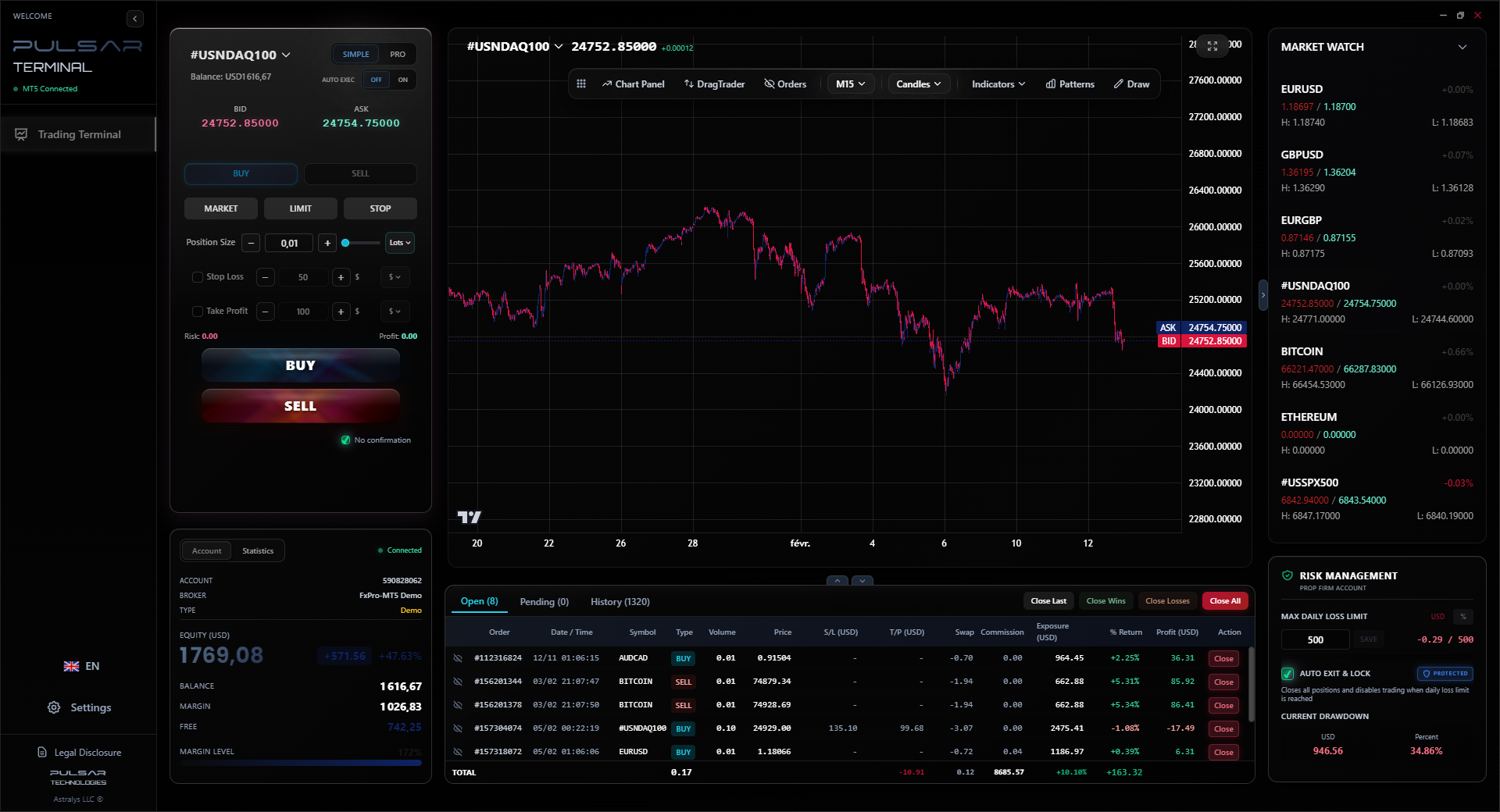
Managing strict risk rules, like those in a prop firm challenge or your own 2% rule, is easier when your trading tools help you automate stop-loss and take-profit orders directly on the chart.
“Your first investment shouldn't be in the market. It should be in yourself.”
Putting money in is step one. Protecting it is the real skill. This is non-negotiable.
The 2% Rule (Actually, Make it 1% When Starting): Never, ever risk more than 2% of your total account balance on a single trade. I'm so serious about this I'll say it again. When you're new, make it 1%. This means if you have a $500 account, your maximum loss on any trade is $5.
How does that work? It's all in your stop-loss and position size. If you buy EUR/USD at 1.0850 and place your stop-loss at 1.0830 (20 pips risk), you need to calculate a position size where a 20-pip loss equals $5. A position size calculator does this instantly. This rule alone will save you from account death.
I violated this early on. I was confident on a USD/JPY setup and risked 8% of my account. The trade went my way initially, then reversed violently on some news. I lost a month's progress in an hour. The sick feeling taught me more than any winning trade ever did.
Compounding: The Slow Magic
Forget get-rich-quick. Focus on get-rich-sure. If you start with $1,000 and average a modest 3% return per month (a realistic, disciplined target), and you reinvest all profits, here's what happens:
- Year 1 End: ~$1,425
- Year 2 End: ~$2,030
- Year 3 End: ~$2,895
You've nearly tripled your account in three years without ever adding more of your own money. That's the power of not blowing up. The key is surviving to compound. The traders who last are the ones who focus on risk first, profits second. A tool that helps you set stop-losses and take-profits precisely, like having a good trading terminal, removes emotion from this critical step.
💡 विंस्टन की सलाह
The market doesn't care if you traded with your rent money or bonus. Trade only with capital whose total loss would be an inconvenience, not a catastrophe.
“The traders who last are the ones who focus on risk first, profits second.”
So, how much can you invest in forex trading in Nigeria?
The technical minimum is almost zero. The practical minimum for meaningful learning is about $200 (₦250,000). The recommended start for a serious journey is $500-$1,000 (₦625,000-₦1,250,000).
Your first investment shouldn't be in the market. It should be in yourself.
- Educate Yourself for Free: Before you deposit a single kobo, spend months on demo accounts. Learn what a pip really is. Understand indicators like the RSI and MACD. Read our guide on trading a major pair like EUR/USD.
- Pick a Reputable Broker: Choose one that accepts Nigerians easily, has clear Naira deposits, and is regulated by a solid authority. Read our deep reviews on brokers like Exness, IC Markets, or XM to see their specific terms.
- Start Small & Scale Up: Fund your 'Serious Learner' account tier. Trade mini lots only. Your sole KPI for the first six months should be: "Did I follow my trading plan and my 1% risk rule?" Not "How much did I make?"
- Keep a Trading Journal: Write down every trade. The entry, the exit, the reason, the emotion. This is your most valuable tool for improvement.
Forex isn't a shortcut. It's a skilled profession. The amount you start with is less important than the discipline you build. Start with an amount that lets you sleep at night, risk so little that a loss is a lesson not a disaster, and focus on the long game. That's how you build something that lasts.
FAQ
Q1Is forex trading legal in Nigeria?
Yes, it is legal for individuals to trade forex with their own funds using international brokers. However, the local regulatory framework for online retail trading is still developing. The Central Bank of Nigeria (CBN) and SEC are the main bodies, but many Nigerian traders use brokers regulated overseas (like the UK's FCA or Cyprus's CySEC). Remember, you must report any trading profits for tax purposes.
Q2What is the best broker for Nigerians with a small budget?
Look for brokers that offer low minimum deposits in Naira and have reliable local payment methods. XM and HFM have $5 minimums and support Naira deposits. Exness also has low minimums and Naira accounts. The 'best' depends on your needs - check their spreads on pairs you want to trade and read detailed reviews like our XM review to compare.
Q3How much can I realistically make with a 100,000 Naira account?
Be very realistic. With a 100,000 Naira account (~$80), you're in the 'Serious Learner' tier. A good, consistent monthly return might be 5-10%. That's 5,000-10,000 Naira per month. The goal with this size isn't to live off the profits, but to learn and grow the account steadily without taking dangerous risks. Chasing 50% returns will almost certainly lead to a blown account.
Q4Do I pay tax on my forex trading profits in Nigeria?
Yes. Forex trading profits are generally subject to Capital Gains Tax in Nigeria. The standard rate is 10% of your gross profits. It's your responsibility to keep accurate records of your trades and declare this income. Consult with a local tax advisor for the most current and specific guidance.
Q5Can I use my Nigerian debit card to fund a forex account?
Directly, it's very difficult due to restrictions placed by Nigerian banks on international forex transactions. The most reliable methods now are: 1) Local Naira bank transfer to a broker's Nigerian account (if they offer one), 2) Using integrated fintech platforms (Flutterwave, Paystack), or 3) Depositing with cryptocurrency like USDT.
Q6What's more important: a big starting capital or good risk management?
Good risk management, 100 times out of 100. A trader with $1,000 and poor risk management will lose it faster than a trader with $100 who risks only 1% per trade. The smaller account with discipline will survive, learn, and grow. The large account without rules is just a bigger donation to the market. Always focus on protecting what you have first.
प्रो. विंस्टन का पाठ
:
- ✓Start with at least $200 (₦250k) to trade seriously.
- ✓Never risk more than 1-2% of your account per trade.
- ✓Use Naira accounts & fintech for easier funding.
- ✓use is a tool, not a shortcut. Start low (1:10).
- ✓Aim for consistent 3-5% monthly returns, not 100%.
यह लेख कितना उपयोगी था?
रेट करने के लिए स्टार पर क्लिक करें
साप्ताहिक ट्रेडिंग विश्लेषण
मुफ़्त साप्ताहिक विश्लेषण और रणनीतियाँ। कोई स्पैम नहीं।
लेखक के बारे में
Olumide Adeyemi
पश्चिम अफ्रीकी ट्रेडिंग अग्रणी
नाइजीरिया के सबसे सक्रिय फॉरेक्स ट्रेडिंग एजुकेटर्स में से एक। लागोस से 8 साल का ट्रेडिंग अनुभव। अफ्रीकी ट्रेडर्स के लिए लो-कैपिटल स्ट्रैटेजीज और प्रॉप फर्म चैलेंजेज में विशेषज्ञ।
टिप्पणियाँ
आपको यह भी पसंद आ सकता है

Cara Trading Forex Sukses: 7 Prinsip dari Trader Profesional
Cara trading forex sukses dengan 7 prinsip trader pro: manajemen modal, disiplin, journal trading, backtest. Data nyata, bukan janji profit palsu.
Jam Trading Forex Terbaik untuk Trader Indonesia: Panduan Lengkap dengan Tabel Waktu
Panduan jam trading forex untuk trader Indonesia. Tabel 4 sesi dunia, jam emas 20:00-00:00, sesi mana yang harus dihindari. Data akurat + tips dari trader berpengalaman.
Top 5 Sàn Forex Uy Tín Nhất 2026: Review Jujur dari Trader Indonesia
Top 5 sàn forex uy tín 2026 untuk trader Indonesia. Review jujur: spread, deposit, withdraw, dukungan lokal. Exness, XM, IC Markets & lebih.
All these calculators are built into Pulsar Terminal with real-time data from your MT5 account. One-click position sizing, automatic risk management, and instant calculations.
