


Most guys think starting a forex account is just about picking a broker and clicking 'deposit'.

David van der Merwe
उभरते बाजार के ट्रेडर ·  South Africa
☕ 11 मिनट पढ़ने
आप क्या सीखेंगे:
Most guys think starting a forex account is just about picking a broker and clicking 'deposit'. That's a quick way to lose your shirt. The real game is in the setup, the fine print, and the local rules you probably don't know about. I've seen too many South African traders get tripped up before they even place their first trade. Let's set the record straight and build your account the right way, from the ground up.
Before you even look at a broker, you need to know who's watching the game. In South Africa, the Financial Sector Conduct Authority (FSCA) is the main regulator. Trading with an FSCA-licensed broker isn't just a suggestion, it's your first line of defence. It means your funds should be held in segregated accounts (separate from the broker's own money), and you have a formal channel for complaints if things go sideways.
Here’s the kicker: many international brokers are popular here, but not all are FSCA-regulated. Some are licensed by top-tier authorities like ASIC in Australia or the FCA in the UK, which is also excellent. The red flag is if a broker is only regulated in some offshore haven with lax rules. Your safety net disappears.
I learned this the hard way early on. I funded an account with a flashy broker offering crazy use. When I tried to withdraw my first profitable trade of R4,200, it was a nightmare of delays and excuses. Their regulator was practically non-existent. I got my money eventually, but it took six weeks of stress. Never again.

Warning: If a broker's main selling point is "1:2000 use!" or "No verification needed!", run. That's a trap, not a service. Real protection comes from real regulation.
Your first step in learning how to start a forex trading account is this: check the 'Regulation' or 'Legal' page of any broker you consider. Look for FSCA license number, ASIC, FCA, or similar. If you can't find it easily, move on.

💡 विंस्टन की सलाह
Your first deposit isn't trading capital. It's tuition. Expect to pay it. The goal is to learn, not to withdraw a Lamborghini.
“High use is a debt trap, not a superpower.”
This is where most people spend 20 minutes and get it wrong. You need to compare more than just the welcome bonus. Let's break down what actually matters for us trading from SA.
The Big Four for South Africans
Based on my 12 years and chats with hundreds of local traders, a few names consistently come up for good reason. I've had personal accounts with most of them.
- Exness: Hugely popular here for its local deposit options. They accept Instant EFT, Ozow, and direct bank transfers in ZAR. Spreads are tight on majors, and they offer a unique feature for beginners: a cent account. This lets you trade with cents as dollars, so a R100 deposit feels like $100. Perfect for practicing real-money psychology without big risk. Check our full Exness review for the deep dive.
- IC Markets: My personal go-to for raw spreads and execution speed. If you're into scalping or algorithmic trading, their Raw Spread account is fantastic. The minimum deposit is $200 (about R3,600), which is reasonable. They're ASIC-regulated, which is solid.
- XM: A great all-rounder with excellent customer support that actually understands South African issues. They offer tons of educational resources, which is valuable when you're starting. I found their platform very stable during volatile news events.
- Pepperstone: Another top-tier ASIC broker known for its technology and range of platforms (MT4, MT5, cTrader). Their Pepperstone review shows why they're a favourite for serious retail traders.
What to Actually Compare
Don't just look at the headline spread for EUR/USD. Dig deeper.
| Feature | What to Look For | Why It Matters for SA Traders |
|---|---|---|
| Deposit/Withdrawal | Local ZAR transfers, Instant EFT, fees, processing time. | Saves you on bank forex fees and time. Exness is king here. |
| Spreads | Average spread on EUR/USD, not just the minimum. Check during SA evening (London session). | A 0.1 pip difference costs you R100s over 100 trades. |
| Platform | MT4, MT5, or proprietary? Most SA traders use MT4/5. | You want a platform you can get help with locally. |
| Customer Support | Local phone number, WhatsApp, ZA business hours. | When you have a margin call at 9 PM, you need help. |

Pro Tip: Open a demo account with your top 2 or 3 choices. Test the platform, execute dummy trades, and try making a dummy withdrawal. See how intuitive the process is. It's a free rehearsal.
“Your first deposit should be money you are 100% prepared to lose. It's tuition fee money, not rent money.”
It feels bureaucratic, but every step has a reason. Here’s exactly what to expect.
- Registration: Fill in your real details. Name, ID number, physical address. They will cross-check this.
- Verification (FICA): This is mandatory. You'll need a clear photo/scan of your SA ID book or card, and a recent proof of residence (utility bill or bank statement less than 3 months old). This can take from a few hours to 2 business days.
- Account Type Selection: This is crucial. You'll choose between a Standard account (commissions built into the spread) or a Raw/ECN account (tiny spread + separate commission per trade). As a beginner, start with Standard. It's simpler. You'll also pick your base currency (USD, EUR, or sometimes ZAR). I recommend USD, as most assets are quoted in it.
- use Selection: The broker will likely ask. For your first real account, I beg you: choose 1:30 or 1:50. The FSCA limits retail clients to 1:30 on majors, but some international brokers offer more. High use is a debt trap, not a superpower. Using a position size calculator is non-negotiable.
- Platform Download: Download MT4 or MT5 directly from your broker's website. This ensures you're connected to their correct servers.
A common mistake? Rushing the verification. A blurry ID photo will get rejected and delay you by a day. Get it right the first time.
“Your first deposit should be money you are 100% prepared to lose. It's tuition fee money, not rent money.”
This is where local knowledge saves you money. Funding in ZAR versus USD makes a big difference.
Option 1: Deposit in ZAR (via Local Transfer) Brokers like Exness have local South African bank accounts. You do an Instant EFT or EFT directly from your Absa/FNB/etc. account in Rands. The broker then converts it to USD at their interbank rate (which is usually very good). Big advantage: You avoid your bank's terrible forex conversion fees and the 1-3 day international wire delay.
Option 2: International Wire in USD You convert your Rands to USD at your bank, then send an international wire. Disadvantages: Your bank's rate is poor, they charge a forex fee (often 1-2%), plus a wire fee of R150-R300. It can take 3-5 business days.

Example: You want to deposit $500 (≈ R9,000).
- Local ZAR Deposit: You send R9,000 via Instant EFT. Broker converts at a 0.5% fee. Total cost: ~R45.
- Bank USD Wire: Your bank sells USD at 1.5% above interbank. Cost: R135. Plus wire fee: R200. Total cost: R335. You just saved R290 by using the local option.
How much to start? The biggest myth is that you need thousands. You don't. Most brokers have a $100 (R1,800) minimum. But here’s my iron rule: Your first deposit should be money you are 100% prepared to lose. It's tuition fee money, not rent money. Start with R2,000 - R5,000. The goal of your first account isn't to get rich, it's to learn to survive. Managing a small account well is harder and teaches you more about position size and risk than a large one ever will.
I started with $300. I blew it in 2 months. My second deposit was $500. I lasted 4 months. That $800 was the best trading education I ever bought, because the pain was real but survivable.
💡 विंस्टन की सलाह
The broker's 'use' dropdown menu is not a skill-level selector. Choosing 1:500 doesn't make you a better trader. It makes your mistakes more expensive.
“The broker is only 10% of the equation. Your psychology and strategy are the other 90%.”
Your account is funded. Now, don't just jump in. Set up your battlefield first.
Critical First Steps on MT4/5:
- Set Your Password: Change the temporary password to a secure one.
- Navigate to Market Watch: Right-click and 'Show All Symbols'. You'll see hundreds. For now, just focus on a few majors. Drag EUR/USD, GBP/USD, USD/ZAR, and XAU/USD (gold) onto your chart.
- Chart Setup: Choose a candlestick chart and a clean time frame like the 1-hour (H1) to start. Avoid the 1-minute chart, it's noise.
- Practice on Demo: Even with a live account, open a demo. Test your order placement. Understand the difference between a Market Order and a Pending Order.
Placing Your First Live Trade: Let's say you've done your analysis and want to buy EUR/USD.
- Click 'New Order'.
- Select the correct Symbol: EURUSD.
- Volume: Start with 0.01 lots (a micro lot). This is $0.10 per pip. With a $500 account, that's responsible.
- Set your Stop Loss (SL) immediately. Decide how much you're willing to risk on this trade (e.g., 1% = $5). If your stop is 50 pips away, then a 0.01 lot risks $5. That's perfect. Use the position size calculator to get this right.
- Set a Take Profit (TP). A good starter rule is a 1.5:1 or 2:1 reward-to-risk ratio. If your SL is 50 pips, your TP could be 75 or 100 pips away.
- Click 'Buy' or 'Sell'.
Warning: The adrenaline will hit. You'll stare at the screen. Don't. Set the trade, set an alert, and walk away. Overtrading your first position is a classic error.
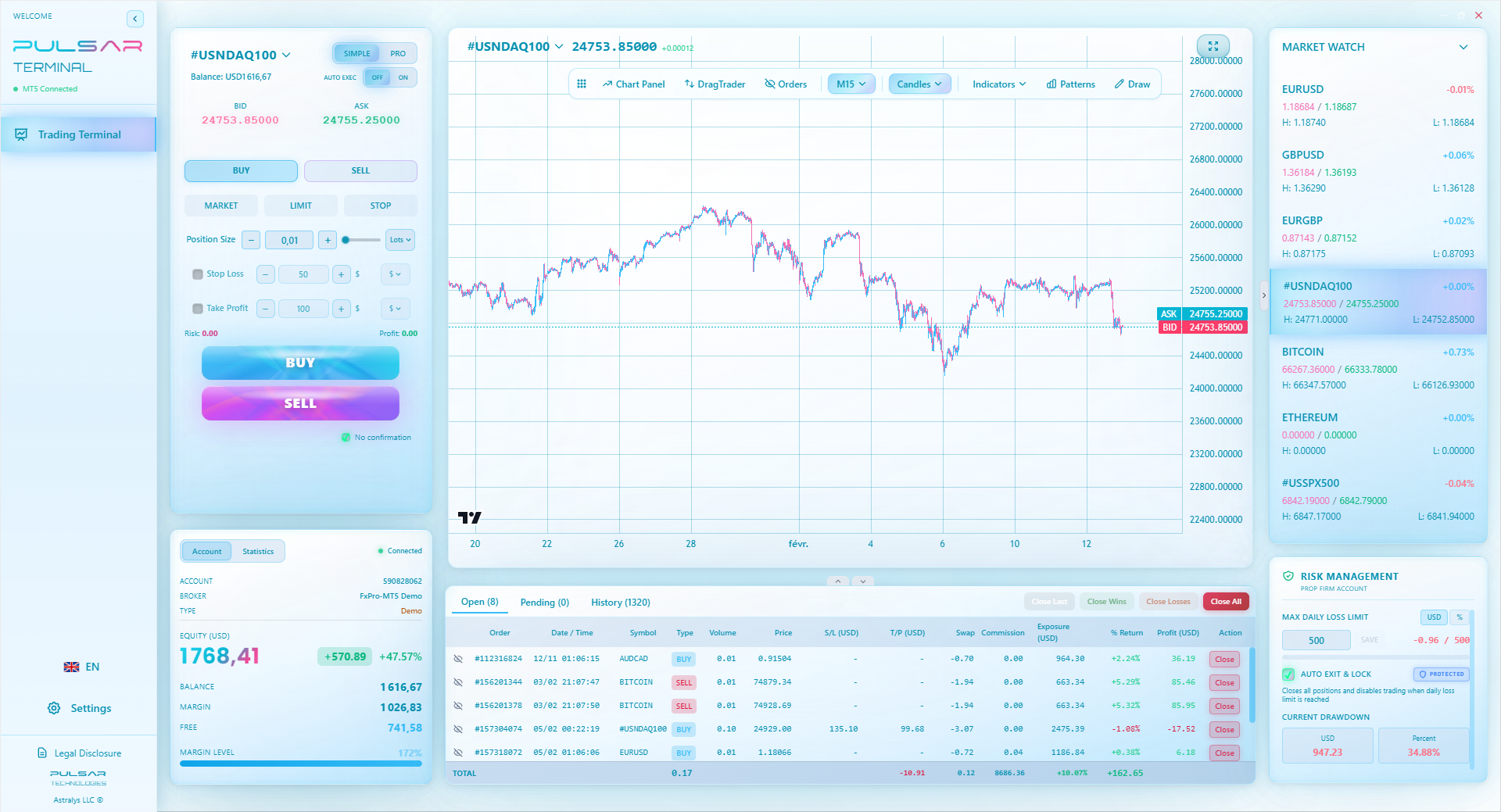
This is where tools can make a massive difference. Manually calculating position size for every trade is tedious. A tool that automates this, along with setting multiple take-profit levels or a trailing stop, removes emotion and error. For instance, trailing stops are crucial for locking in profits, and tools like Pulsar Terminal automate this directly on MT5, turning a complex manual process into a one-click rule.
Managing multiple take-profit levels and trailing stops manually is complex and error-prone; a tool like Pulsar Terminal automates these risk management rules directly on your MT5 platform.
“The broker is only 10% of the equation. Your psychology and strategy are the other 90%.”
I've made these mistakes so you don't have to.
- Chasing the 'Perfect' Broker: You can spend months researching. Pick a reputable one from the list above and start. The broker is only 10% of the equation. Your psychology and strategy are the other 90%.
- Starting Too Big: That R20,000 bonus from work is not trading capital. The pressure to "make it back" will destroy your discipline. Start small.
- Ignoring the USD/ZAR Effect: Your account is in USD. If the Rand strengthens (USD/ZAR goes down), your account balance in Rands decreases, even if your trades are flat. It's a hidden risk. Don't panic over it, just be aware.
- Trading Too Many Pairs: Stick to EUR/USD and maybe XAU/USD at first. They have the tightest spreads and most predictable liquidity. Adding exotic pairs is a recipe for confusion.
- Not Having a Daily Loss Limit: Before you start, decide: "If I lose X% today, I stop." For beginners, make it 2-3%. This single rule will save you from the death spiral of revenge trading. Some advanced platforms even have features to automatically enforce this, which is a lifesaver for prop firm challenges or just keeping yourself honest.
- Confusing a Demo with Live: Demo trading feels like a video game. Live trading with real money triggers fear and greed. That's why you start with a small, real account ASAP. The psychological education is the real value.
My most expensive early lesson? I didn't understand margin call mechanics. I had multiple trades open, used too much use, and a sudden move in GBP/USD wiped out 80% of my account in an hour because my broker's automatic stop-outs kicked in. I was using a "hold and hope" strategy. It was a brutal, but necessary, teacher.
💡 विंस्टन की सलाह
If you feel excitement or fear when clicking 'Buy', your position is too large. Scale down until the click feels boring. That's the sweet spot.
“Demo trading feels like a video game. Live trading with real money triggers fear and greed.”
Your account is live. Now the real work begins. Don't just trade randomly.
Phase 1: The Observation Month For your first month, your goal is not to be profitable. Your goal is to execute 20-30 trades with perfect discipline. Use your small 0.01 lot size. Practice your entry, always set your SL and TP, and journal every trade. Why did you enter? What did the RSI indicator or MACD indicator show? How did you feel?
Phase 2: Strategy Refinement After 30 trades, look at your journal. Are you better at buying pullbacks or breakouts? Do you lose more on scalping or swing trading setups? Double down on what shows a slight edge, and abandon what doesn't. This is how you build a personal strategy, not just copy someone else's.
Phase 3: Gradual Scaling Only after 3-6 months of consistent, disciplined trading (even if results are break-even) should you consider adding more capital or increasing your lot size from 0.01 to 0.02. Scaling too fast is the #1 cause of blowing up a growing account.
Remember, starting the forex account is the easy part. Building it into a sustainable vehicle for generating returns is the decade-long journey. You've now got the foundation. Build slowly, build smartly, and always protect your capital first.

FAQ
Q1What is the minimum amount I need to start a forex trading account in South Africa?
You can start with as little as $100 (roughly R1,800). Many brokers, like Exness or XM, have minimum deposits around this mark. However, I strongly recommend starting with an amount you are fully prepared to lose, such as R2,000 to R5,000. This gives you enough room to trade micro lots (0.01) and learn proper risk management without the pressure of losing significant savings.
Q2Which is the best forex trading platform for beginners in SA?
MetaTrader 4 (MT4) is overwhelmingly the best platform for beginners in South Africa. It's the industry standard, so you'll find endless free tutorials, indicators, and local support for it. Its interface is simpler than MT5 for basic trading. Almost all major brokers serving the SA market offer MT4. Stick with it until you're completely comfortable.
Q3How do I avoid scams when choosing a broker?
Stick to brokers regulated by reputable authorities. For South Africans, the safest bets are brokers regulated by the local FSCA, or top-tier international regulators like ASIC (Australia) or the FCA (UK). Always verify the license number on the regulator's official website. Avoid any broker that promises guaranteed profits, pressures you to deposit more, or is only regulated in offshore jurisdictions like St. Vincent and the Grenadines or Vanuatu.
Q4Can I trade forex in South Africa without paying tax?
No. In South Africa, profits from forex trading are considered taxable income by SARS. You need to declare your net trading profits (profits minus losses and allowable expenses) in your annual tax return. It's your responsibility to keep detailed records of all your trades, deposits, and withdrawals. Consult with a tax professional who understands trading for specific advice.
Q5Is it better to deposit in ZAR or USD?
For South Africans, it's almost always better and cheaper to deposit in ZAR directly into a broker's local South African bank account (via Instant EFT or normal EFT). This saves you your bank's high foreign exchange fees and international wire transfer charges. The broker will convert your Rands to USD at a much better interbank rate. Brokers like Exness excel at this.
Q6What use should I use as a beginner?
Use the lowest use you can. The FSCA caps use for retail clients at 1:30 for major currency pairs. As a beginner, I'd recommend starting at 1:10 or 1:20. High use (like 1:500) magnifies losses just as fast as profits. It's a risk accelerator, not a skill multiplier. Your focus should be on learning to pick good trades, not on how much debt you can take on for a trade.
Q7How long does it take to verify my account?
With a reputable broker, verification (FICA) typically takes between 1 and 48 hours if you submit clear, correct documents. The most common delay is a blurry ID photo or an expired proof of address. Use a recent utility bill or bank statement (under 3 months old) and make sure all four corners of your ID are visible in the photo.
प्रो. विंस्टन का पाठ
:
- ✓Always verify FSCA, ASIC, or FCA regulation first.
- ✓Deposit in ZAR via local EFT to save on bank fees.
- ✓Start with a maximum of 1:30 use, preferably less.
- ✓Your first trade should be a 0.01 lot micro trade.
- ✓Set a stop-loss on every single trade, no exceptions.
यह लेख कितना उपयोगी था?
रेट करने के लिए स्टार पर क्लिक करें
साप्ताहिक ट्रेडिंग विश्लेषण
मुफ़्त साप्ताहिक विश्लेषण और रणनीतियाँ। कोई स्पैम नहीं।
लेखक के बारे में
David van der Merwe
उभरते बाजार के ट्रेडर
जोहानसबर्ग स्थित ट्रेडर, इमर्जिंग मार्केट करेंसीज में 11 साल का अनुभव। ZAR पेयर्स, FSCA-विनियमित ट्रेडिंग और दक्षिण अफ्रीकी मार्केट एनालिसिस में विशेषज्ञ।
टिप्पणियाँ
आपको यह भी पसंद आ सकता है

Cara Trading Forex Sukses: 7 Prinsip dari Trader Profesional
Cara trading forex sukses dengan 7 prinsip trader pro: manajemen modal, disiplin, journal trading, backtest. Data nyata, bukan janji profit palsu.
Jam Trading Forex Terbaik untuk Trader Indonesia: Panduan Lengkap dengan Tabel Waktu
Panduan jam trading forex untuk trader Indonesia. Tabel 4 sesi dunia, jam emas 20:00-00:00, sesi mana yang harus dihindari. Data akurat + tips dari trader berpengalaman.
Top 5 Sàn Forex Uy Tín Nhất 2026: Review Jujur dari Trader Indonesia
Top 5 sàn forex uy tín 2026 untuk trader Indonesia. Review jujur: spread, deposit, withdraw, dukungan lokal. Exness, XM, IC Markets & lebih.
All these calculators are built into Pulsar Terminal with real-time data from your MT5 account. One-click position sizing, automatic risk management, and instant calculations.
