


It was July 2023, and EUR/USD had been stuck between 1.1000 and 1.1050 for what felt like an eternity.

Olumide Adeyemi
पश्चिम अफ्रीकी ट्रेडिंग अग्रणी ·  Nigeria
☕ 9 मिनट पढ़ने
आप क्या सीखेंगे:
It was July 2023, and EUR/USD had been stuck between 1.1000 and 1.1050 for what felt like an eternity. I watched a fellow trader in a Lagos WhatsApp group blow his entire account trying to force a breakout that never came. He kept buying at the top, convinced 'this is the one,' only to get stopped out at the bottom. That's the thing about consolidation - it looks easy until it bankrupts you. Learning how to trade consolidation in forex isn't about predicting the next big move; it's about surviving and profiting while the market makes up its mind. For us trading from Nigeria, with our unique broker options and market hours, this skill is non-negotiable.
Most traders think consolidation is just a boring pause. They're wrong. It's a battlefield where bulls and bears are evenly matched, exhausting each other before the next big push. Price gets trapped between clear support and resistance levels, creating a range. The candlesticks get smaller, the volume often dries up, and the RSI indicator might hover around the 50 line, refusing to commit.
Here's the key distinction everyone misses: there's healthy consolidation and distribution. Healthy consolidation, like after a strong trend, is a resting period. Distribution is when smart money is quietly getting out before a reversal. Telling the difference? That's the art. I got burned in early 2022 thinking a long GBP/USD consolidation was a continuation pattern. It wasn't. It was distribution, and the pair tanked 500 pips. I lost $1,200 on that one trade because I didn't respect the context.
For Nigerian traders, watching London and New York session overlaps is crucial. That's when these ranges often get tested. If a range holds through both sessions, it's strong. If it breaks on low volume during the Asian session? Probably fake. You need a broker with tight spreads during these times to avoid getting whipsawed; a 3-pip spread on EUR/USD can turn a profitable range trade into a loser. Check our Exness review and IC Markets review for brokers known for consistent execution during volatile sessions.
“Learning how to trade consolidation in forex isn't about predicting the next big move; it's about surviving and profiting while the market makes up its mind.”
You can't trade it if you can't see it. Forget fancy indicators at first. Draw two damn horizontal lines.
The Price Action Tell
Look for at least two clear touches on the top (resistance) and bottom (support). The more touches, the more valid the range. The candles between these touches should be messy - lots of dojis, small bodies, wicks probing the boundaries. If you see a giant engulfing candle that closes right in the middle of the range, that's a sign of equilibrium. No one is winning.
Volume Confirmation
This is where most free MT4/MT5 platforms let you down. You need to see volume declining as the range develops. High volume at the range extremes that fails to cause a breakout is a huge clue. It means there's massive selling at the top or buying at the bottom, reinforcing the range. I use a simple volume indicator, and if I see a spike on a touch of resistance followed by a quick rejection, I'm looking to sell, not buy the breakout.

Warning: The most common mistake is seeing a triangle or rectangle form over just 5-10 candles and calling it a consolidation. That's just noise. A tradable range needs time to develop - at least 20-30 candles on the H1 chart or more. On the 5-minute chart, you're just watching market maker games, especially with the Naira pairs.
Indicators can help, but don't let them do the thinking. A Bollinger Band squeeze is a classic consolidation signal. The bands tighten like a spring. The MACD indicator will hover around the zero line with minimal histogram movement. Use these as confirmations, not signals. The signal is the price rejecting a level you've already drawn.

💡 विंस्टन की सलाह
The market spends more time consolidating than trending. If you only know how to trade trends, you'll be sitting on your hands 60-70% of the time. Master the range, and you master market participation.
“Most breakouts fail. I'd say 60-70% are fakeouts designed to suck in late traders and run their stops.”
This is where you make money while everyone else is getting frustrated. You have two core approaches: fading the edges or playing the middle.
1. The Fade (My Preferred Method) This means selling at resistance and buying at support. It requires brass balls and strict discipline.
- Entry: Don't enter at the line. Wait for price to touch it and show rejection - a pin bar, a bearish engulfing candle, a false breakout with a quick return inside the range. That's your cue. I'll often enter on the close of that rejection candle.
- Stop Loss: This is critical. Your stop goes just beyond the extreme of the range. If selling at 1.1050 resistance with support at 1.1000, my stop goes at 1.1055 or 1.1060. A break of that level means the consolidation is likely failing, and you're wrong. Get out.
- Take Profit: Aim for the opposite side of the range. Don't get greedy. If the range is 50 pips tall, a 30-40 pip profit is excellent. You can scale out partially as price moves in your favor.
2. The Range Scalp This is for faster traders. You buy in the lower third of the range and sell in the upper third, aiming for smaller, quicker profits. This is a pure scalping strategy and requires a broker with ultra-low latency and tight spreads. You cannot do this effectively if your broker's execution is slow or spreads widen to 5 pips. I've tried this on NGN/USD proxies with local brokers and got slaughtered by slippage.

Pro Tip: Always use a position size calculator. In a range, you might be taking more trades than in a trend. Risking 1% per trade on 10 range trades is the same as risking 10% on one trend trade. Keep your position size small and consistent. A 20-pip stop on a 50-pip range means your risk/reward is inherently good if you're right.
“The steady grind of range trading is where consistent accounts are built.”
This is the million-naira question. When do you abandon the range trade and chase the breakout? Most breakouts fail. I'd say 60-70% are fakeouts designed to suck in late traders and run their stops.
Here's my checklist to spot a probable genuine breakout:
- Closing Power: The breakout candle should close clearly outside the range, not just wick out. A full-bodied candle is more convincing.
- Volume Surge: There must be a significant increase in volume on the breakout. No volume = no conviction. It's a trap.
- Fundamental Catalyst: Is there news or data that justifies the move? A breakout during the dead Asian session with no news is highly suspect.
- Retest and Hold: The most reliable breakouts often come back to retest the old resistance (now support) or old support (now resistance) and bounce off it. This is your high-probability entry.
I remember a classic fakeout on USD/NGN (using a CFD proxy) in late 2024. Price broke above a two-week range on what seemed like strong volume. I jumped in long. Two hours later, it crashed back down, taking out all the breakout longs and then continuing south. I lost 2% of my account learning that lesson. Now, I wait for the retest. If it doesn't come, I let the breakout go. There's always another trade.
This is where a tool that helps you manage multiple orders shines. You can set a buy stop above the range and a sell stop below it, with the understanding that only one will be triggered. But you must cancel the other order immediately. Managing this manually is stressful.
💡 विंस्टन की सलाह
A narrow range is a coiled spring. But you never know which way it will jump. Never bet the farm on a breakout direction. Trade the confirmed range until the market proves it has broken free.
“The steady grind of range trading is where consistent accounts are built.”
Trading from Nigeria isn't the same as trading from London or New York. Our context changes the game.
Broker Choice & Spreads: You're likely using an international broker like Exness, XM, or Pepperstone. During major news events or liquidity crunches (like around month-end when Nigerian corporates are buying dollars), spreads on exotic pairs and even majors can widen dramatically. A normally 1-pip spread on EUR/USD can blow out to 10 pips. If you're trading a 50-pip range, a 10-pip spread eats 20% of your potential profit instantly. Stick to major pairs during peak liquidity hours (London and New York sessions) for the cleanest range trading.
Funding and Withdrawals: The CBN's policies affect your cash flow. If you're using a range scalping strategy that requires frequent withdrawals of small profits, be aware of your broker's withdrawal processing times and fees. A strategy that generates 5% a month is useless if it takes two weeks and a $50 fee to get your money. Factor this into your cost analysis.
Tax Implications: Yes, the 10% Capital Gains Tax is a thing. Keep a simple spreadsheet. If you make 100 profitable range trades in a year netting $5,000, that's a $500 tax liability. It's not the broker's job to remind you. Plan for it. Consolidation trading, with its higher trade frequency, creates more accounting work. Be prepared.
Mental Aspect: The constant back-and-forth of range trading is mentally taxing. It requires patience to wait for the setup and the discipline to take small profits. It's the opposite of the 'get rich quick' fantasy sold on Instagram. It's a grind. Most Nigerian traders fail because they seek the explosive trend trade; the steady grind of range trading is where consistent accounts are built.
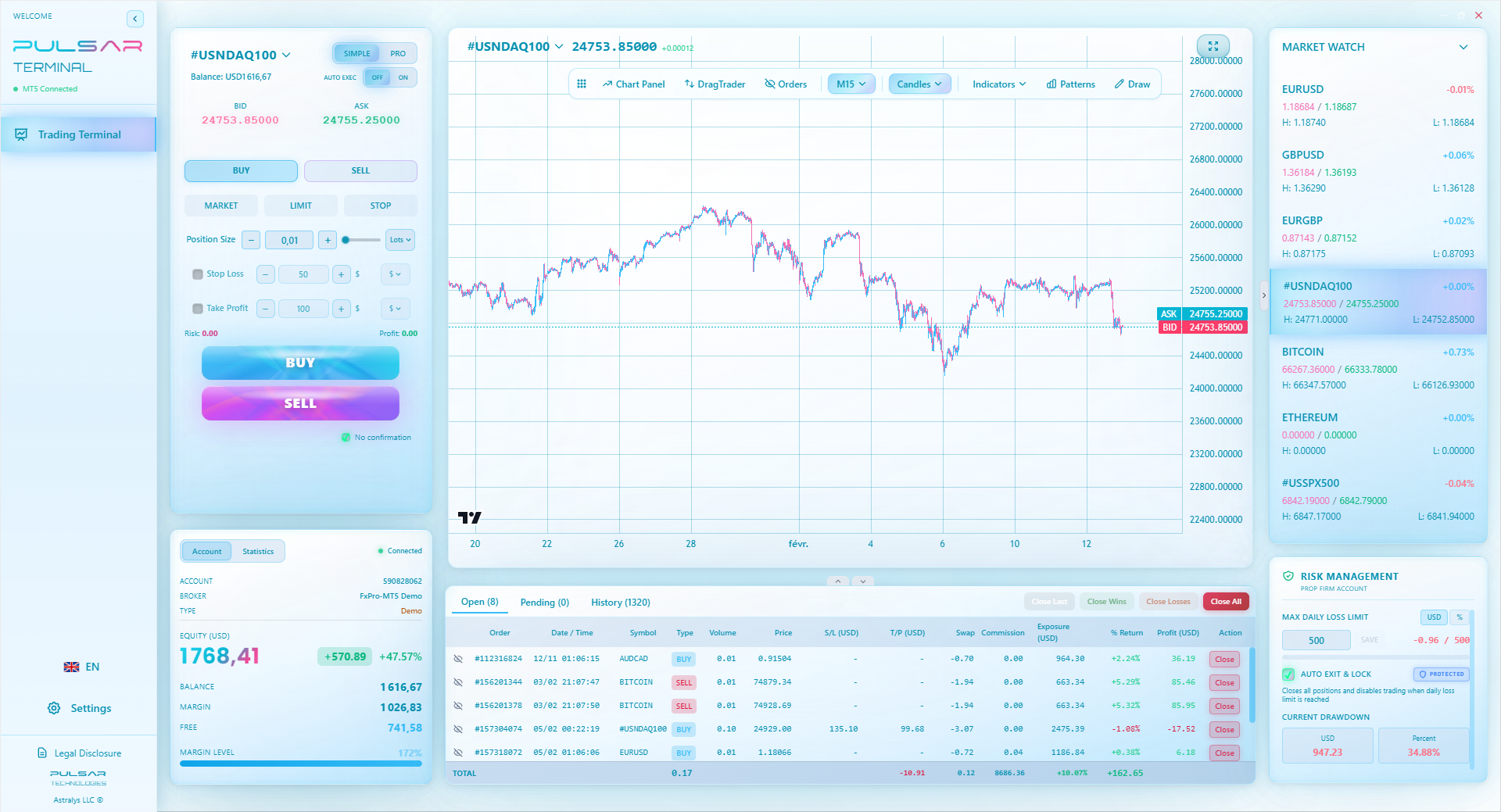
Managing multiple pending orders for range breakouts and fades is complex, but Pulsar Terminal's drag-and-drop order system lets you set buy limits, sell limits, and stop orders across your range in seconds directly on your MT5 chart.
“If you only know how to trade trends, you'll be sitting on your hands 60-70% of the time.”
Range trading will test your psychology more than any trend-following system. Here’s why: you will be wrong at the extremes sometimes. Price will break out just after you fade it. It happens.
Your Risk Rules Are Your Lifeline:
- Never add to a losing range trade. If you sold resistance and price moves against you, you are wrong. Adding more is a surefire path to a margin call.
- One trade at a time inside the range. Don't sell the top AND buy the bottom simultaneously hoping one wins. You'll just pay double the spread and likely lose on both when a real breakout occurs.
- Reduce position size in thin markets. If you're trading late Friday night or during a Nigerian public holiday, liquidity is lower. Your 20-pip stop might get slipped into a 30-pip loss. Size down by 50%.
The Boredom Trade: The biggest psychological danger is boredom. The market is quiet, nothing is happening, so you force a trade in a sloppy, ill-defined range. I've done this more times than I care to admit. The solution? Have a checklist for a 'qualified' range (minimum width, clear touches, low volatility) and if the market doesn't present it, walk away. Watch a movie. The charts will be there tomorrow.
, learning how to trade consolidation in forex is about embracing patience. It's not glamorous. But when you're consistently banking 20-30 pips per trade, week after week, while the breakout chasers blow up their accounts, you'll understand its power. It's the foundation upon which longer-term swing trading success is built, because you learn to read market structure and respect key levels.
💡 विंस्टन की सलाह
Your profit from a range trade is a gift from the market's indecision. Don't get greedy and turn it into a trend-trade hope. Take the money and reset for the next bounce.
FAQ
Q1What is the best time frame to trade consolidation in forex?
There's no single 'best,' but H1 and H4 charts offer the best balance between noise and clarity for most traders. On M15 or M5, you'll see many false ranges. On the Daily, you might only get 2-3 setups a month. I start my analysis on the H4 to identify the major range, then drop to H1 or M30 for precise entry timing. For Nigerian traders active in the evenings, the H1 chart aligning with the London/US overlap is particularly useful.
Q2How many pips should a consolidation range be to trade it?
It depends on the pair and your strategy. For a major like EUR/USD, I want a range of at least 30 pips to make it worth trading after accounting for the spread and a reasonable stop loss. For a cross pair with a larger spread, you might need 50+ pips. The key is the risk/reward. If the range is only 15 pips wide and the spread is 2 pips, your potential profit is too small relative to the risk of a false breakout.
Q3Can I use use when trading consolidations?
You can, but you must be extremely careful. Range trading involves more frequent trades and smaller profit targets. High use magnifies both profits AND the impact of spreads, slippage, and small mistakes. I use significantly lower use for range trading (e.g., 1:10 or 1:20) compared to when I'm swing trading a clear trend. The goal is steady accumulation, not a home run.
Q4What are the most common mistakes when trading ranges?
- Trading ill-defined ranges: Jumping into a choppy area with no clear support/resistance. 2. Placing stops too tight: Putting a stop loss just inside the range, guaranteeing you get stopped out on a normal probe. Stops belong beyond the range. 3. Chasing breakouts without confirmation: FOMO-ing into every move that ticks beyond a level. 4. Revenge trading after a stop-out: If you get stopped out on a false breakout, don't immediately reverse your trade. The market is telling you it's confused. Step back.
Q5How does the Nigerian forex market affect consolidation patterns?
The official Naira market (CBN/BDC rates) and the parallel market ('black market') often move in ranges dictated by CBN policy announcements and dollar supply. These ranges can be very persistent until a new policy shatters them. When trading major pairs like EUR/USD or GBP/USD from Nigeria, our local market doesn't directly affect the price, but periods of high local FX volatility can correlate with global risk-off sentiment, which can tighten ranges on majors as big players become cautious.
Q6Should I use pending orders or market orders for range trading?
I use a mix. I'll place limit orders just inside the range extremes (e.g., buy limit 5 pips above support) to try and get a better price if price snaps back quickly. However, I always have a mental or actual stop order beyond the range in case of a breakout. The danger with pending orders is you might forget about them, and they get triggered when the market context has changed. Always monitor your active orders.
प्रो. विंस्टन का पाठ
:
- ✓Draw clear horizontal lines for support/resistance.
- ✓Fade range extremes with stops beyond them.
- ✓Wait for volume confirmation on breakouts.
- ✓Use lower use for range trading.
- ✓Factor in local spreads and withdrawal costs.
यह लेख कितना उपयोगी था?
रेट करने के लिए स्टार पर क्लिक करें
साप्ताहिक ट्रेडिंग विश्लेषण
मुफ़्त साप्ताहिक विश्लेषण और रणनीतियाँ। कोई स्पैम नहीं।
लेखक के बारे में
Olumide Adeyemi
पश्चिम अफ्रीकी ट्रेडिंग अग्रणी
नाइजीरिया के सबसे सक्रिय फॉरेक्स ट्रेडिंग एजुकेटर्स में से एक। लागोस से 8 साल का ट्रेडिंग अनुभव। अफ्रीकी ट्रेडर्स के लिए लो-कैपिटल स्ट्रैटेजीज और प्रॉप फर्म चैलेंजेज में विशेषज्ञ।
टिप्पणियाँ
आपको यह भी पसंद आ सकता है

Cara Trading Forex Sukses: 7 Prinsip dari Trader Profesional
Cara trading forex sukses dengan 7 prinsip trader pro: manajemen modal, disiplin, journal trading, backtest. Data nyata, bukan janji profit palsu.
Jam Trading Forex Terbaik untuk Trader Indonesia: Panduan Lengkap dengan Tabel Waktu
Panduan jam trading forex untuk trader Indonesia. Tabel 4 sesi dunia, jam emas 20:00-00:00, sesi mana yang harus dihindari. Data akurat + tips dari trader berpengalaman.
Top 5 Sàn Forex Uy Tín Nhất 2026: Review Jujur dari Trader Indonesia
Top 5 sàn forex uy tín 2026 untuk trader Indonesia. Review jujur: spread, deposit, withdraw, dukungan lokal. Exness, XM, IC Markets & lebih.
All these calculators are built into Pulsar Terminal with real-time data from your MT5 account. One-click position sizing, automatic risk management, and instant calculations.
