


You've watched a dozen 'how to trade forex for beginners' videos on YouTube, haven't you? The ones promising millions from your phone, showing flashy cars and perfect trades.

Olumide Adeyemi
पश्चिम अफ्रीकी ट्रेडिंग अग्रणी ·  Nigeria
☕ 9 मिनट पढ़ने
आप क्या सीखेंगे:
You've watched a dozen 'how to trade forex for beginners' videos on YouTube, haven't you? The ones promising millions from your phone, showing flashy cars and perfect trades. And now you're here, probably broke or confused, wondering why it's not working for you. Good. That's the right place to start. I'm going to cut through the noise and show you the real structure, the actual costs, and the painful mistakes you must avoid to survive trading in Nigeria. Forget the hype, we're talking real numbers and hard lessons.
Let's get the uncomfortable stuff out of the way first. Forex trading is legal here, but the CBN isn't babysitting your Exness or XM account. They regulate the big banks, not the retail space where you and I play. This creates a gap. You're relying on international brokers regulated abroad, which is fine if you pick the right ones, but it means you have zero local regulatory protection if things go south.
The daily volume from Nigerian retail traders is massive, somewhere between ₦300 and ₦450 million. That's a lot of people hoping to make it, and a lot of money changing hands, mostly from the losers to the winners. Your first job isn't to pick a currency pair, it's to understand this environment. You are responsible for your own safety.

Warning: Any 'how to trade forex for beginners video' that doesn't start with risk and regulation is selling you a dream. Profits are taxed at 10% as capital gains. The FIRS will find you if you're successful, so keep records from day one.
I learned this the hard way early on. I got excited about a USD/NGN move, used too much use on a local platform that wasn't transparent about its quotes, and watched my position get stopped out at a worse price than my stop-loss. The spread was wild, the execution was slow, and I lost two weeks' profit in minutes. That's the Nigerian reality: costs and execution matter more than anywhere else.

💡 विंस्टन की सलाह
If a 'how to trade forex for beginners video' has better production quality than trading content, close it. The fancy edits are hiding a lack of substance.
You can't trade air. You need a broker, and your choice will make or break you before you even place a trade. In Nigeria, you're not choosing a Nigerian broker (there aren't any reputable ones), you're choosing an international broker that accepts Nigerians. The key is their regulation, their costs, and how you get money in and out.
Picking Your Broker
Look for brokers regulated by bodies like the FSCA, CySEC, or ASIC. They have rules. Here’s a quick comparison of popular options:
| Broker | Key Regulation | Min. Deposit (Approx.) | Avg. EUR/USD Spread | Good For Beginners? |
|---|---|---|---|---|
| XM | CySEC, ASIC | $5 (~₦7,500) | From 0.8 pips | Yes, low barrier. |
| Exness | FSA (Seychelles) | $10 (~₦15,000) | Variable, can be low | Yes, popular here. |
| HFM | FSCA | ₦4,000 (Cent Acc) | From 1.4 pips | Yes, Naira accounts. |
| IC Markets | ASIC | $200 (~₦300k) | From 0.0 pips + commission | Serious traders. |
| AvaTrade | ASIC, FSCA | $100 (~₦150k) | ~0.93 pips | Great education. |
I started with a broker offering "unlimited use" and a $1 minimum. It was a disaster. The spreads were so wide I was losing money the second I entered a trade. I switched to a broker with tighter spreads (like those in our IC Markets review) and my performance improved overnight. The cost per standard lot should be between $4 and $8 on majors. If it's more, you're being ripped off.
Funding in Naira
This is your lifeline. Use brokers that offer local bank transfer or partner with payment processors. HFM and FXTM offer Naira-denominated accounts, which simplifies things. Others accept cards or e-wallets like Skrill. Always check the deposit/withdrawal processing time and fees. A "free" deposit that takes 5 business days isn't free when you miss a trade setup.
“Your first job isn't to pick a currency pair, it's to understand the environment. You are responsible for your own safety.”
Every 'how to trade forex for beginners video' shows the MT4 screen. Let's talk about what you're actually looking at.
A trade is a bet on a price going up (Buy) or down (Sell). The price quote is two numbers: Bid (sell price) and Ask (buy price). The difference is the spread, your instant cost. If EUR/USD is quoted 1.0850/1.0852, the spread is 2 pips. You buy at 1.0852 and need it to rise above that just to break even.
use is a double-edged sword. It lets you control a ₦1,500,000 position with only ₦150,000 margin (at 1:10 use). Brokers here offer up to 1:1000. That's insanity for a beginner. At 1:1000, a 0.1% move against you wipes your account. I once used 1:500 on a GBP/USD scalping strategy. The trade went my way by 3 pips, then reversed 5 pips in seconds. I got a margin call and lost the entire margin. Stick to 1:10 or 1:20 while you learn.
Position sizing is survival. Never risk more than 1-2% of your account on a single trade. If you have a ₦100,000 account, that's ₦1,000-₦2,000 max risk. Use a position size calculator every single time. This one habit will keep you in the game longer than any fancy indicator.

Example: Account: ₦200,000. Risk per trade: 1% = ₦2,000. Stop-loss distance: 50 pips on EUR/USD. Pip value for a micro lot (0.01): ~₦40. Position size = ₦2,000 / (50 pips * ₦40) = 1 micro lot. That's it. Not 10 lots because you 'feel' it.
You need one clear, rules-based method. Ignore the 10-indicator mess on YouTube. Here’s a simple price action strategy I used for my first two years of consistent profits.
The "Pullback to Level" Setup (Best on EUR/USD or XAU/USD)
- Find the Trend: Look at the 4-hour chart. Are the price swings generally making higher highs and higher lows (uptrend), or lower highs and lower lows (downtrend)? If you can't tell, don't trade. Wait.
- Mark Key Levels: Draw a horizontal line at the most recent obvious high or low where the price previously reacted. This is your support (in uptrend) or resistance (in downtrend).
- Wait for the Pullback: In an uptrend, wait for the price to fall back to that support level. In a downtrend, wait for it to rise back to resistance. Don't chase the price.
- Look for a Rejection Candle: At the level, you want to see a candle that shows the price rejecting the level - a pin bar (long wick) or a bullish/bearish engulfing candle.
- Enter and Manage: Place your buy order just above the rejection candle in an uptrend (sell order just below in downtrend). Your stop-loss goes just below/above the level. Your take-profit target should be at least 1.5 times your risk distance.
I made over $1,200 in 2021 just repeating this on EUR/USD. Entry at 1.1750 support, stop at 1.1720 (30-pip risk), target at 1.1800 (50-pip reward). It's not glamorous, but it's repeatable. For more detail on tools that help, see our guide on the RSI indicator for confirming momentum.
💡 विंस्टन की सलाह
Your first profitable month will feel like luck. Your first profitable year will feel like a grind. The grind is the real success.
“A stop-loss is your ticket out of a bad movie. Don't sit through the whole thing hoping for a different ending.”
MetaTrader 4 (MT4) is the king in Nigeria. MT5 is gaining ground. Your broker will give you one or both. Download it to your PC and phone. The mobile app is for monitoring, not serious analysis.
Order Types You Must Know:
- Market Order: Buy/sell right now at the current price.
- Pending Order: Set an order to buy/sell if the price reaches a level you specify. This is crucial for the strategy above.
- Stop-Loss (SL): An order that closes your trade at a loss to save you. SET IT ALWAYS.
- Take-Profit (TP): An order that closes your trade at a profit. SET IT ALWAYS.
Execution speed matters. During major news (like US NFP), spreads can widen from 2 pips to 20 pips. Your market order will fill at a terrible price. This is why pending orders away from the chaos are smarter.
Charting tools are your best friends. Learn to draw trendlines and horizontal support/resistance. Before you touch an oscillator, master these. I wasted months trying to make the MACD indicator give me secret signals when the answer was a clear trendline break on the daily chart.
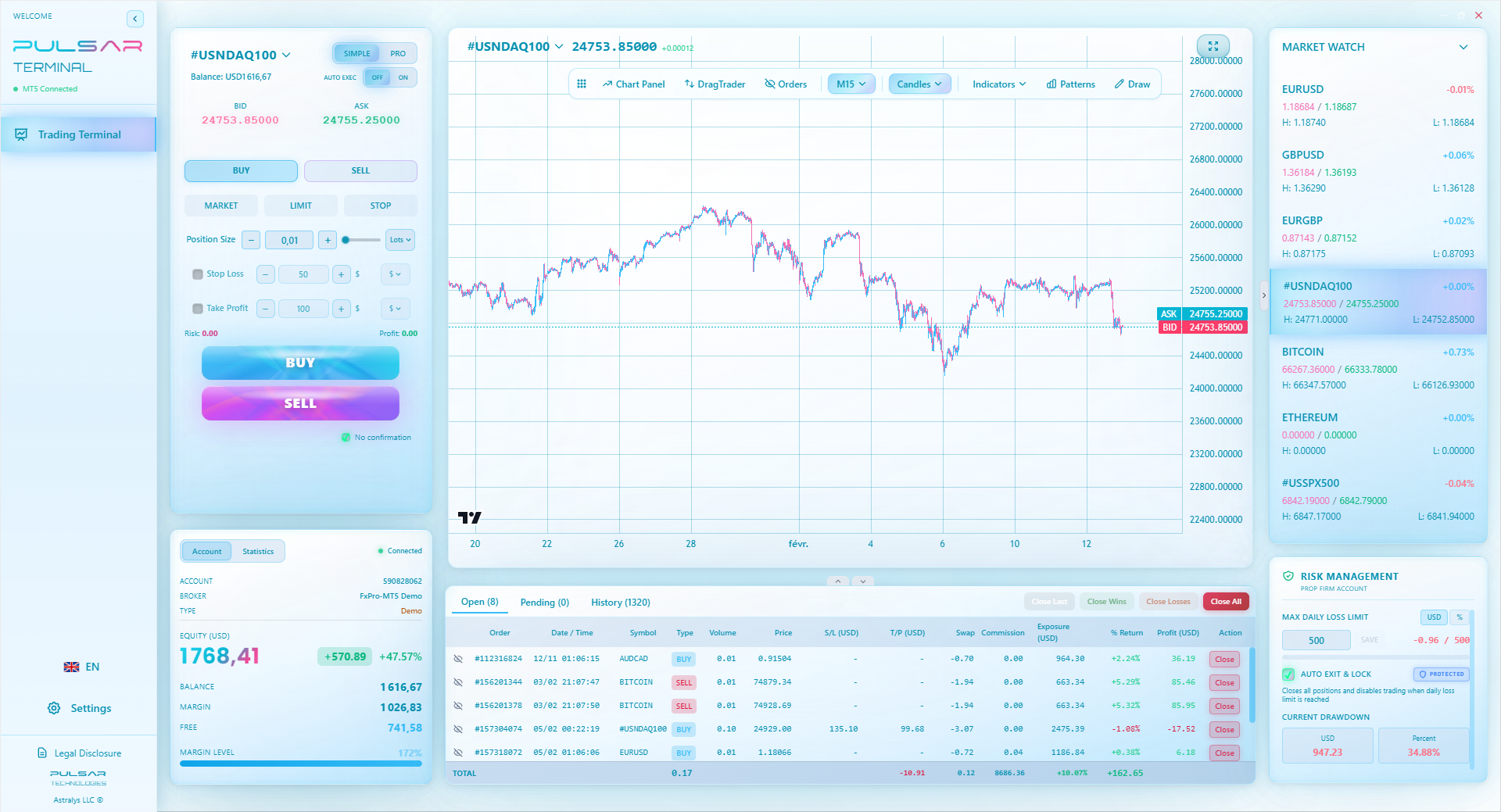
Manually moving stop-losses to breakeven is a chore that often gets forgotten; Pulsar Terminal automates this and other essential trade management tasks directly on your MT5 charts.
The charts are easy. Your head is the hard part. Here’s what will destroy your account:
- Trading to Get Rich Quick: You see a post about someone buying a car from trading. You increase your lot size to catch up. This is a guaranteed path to zero. Trade to follow your plan, not to hit a monetary target.
- Not Using a Stop-Loss: "The market will come back." Sometimes it doesn't. I held a losing USD/JPY trade for 3 weeks, hoping, watching my account equity bleed. It never came back. I took a loss 8 times bigger than my initial risk. A stop-loss is your ticket out of a bad movie.
- Overtrading: No clear setup? Stay out. Boredom is not a trading signal. Some of my most profitable months had fewer than 10 trades.
- Chasing "Sure" Tips: WhatsApp groups, signal sellers, 'mentors' charging ₦50k for a course. If their signals were so sure, they'd be trading, not selling. I paid for one once. The signals were late and contradictory. Total loss.

Pro Tip: Keep a trading journal. Write down every trade: reason for entry, emotion, outcome. After 50 trades, you'll see your own stupid patterns. I found I was 70% accurate on Tuesday mornings and 30% accurate on Friday afternoons. I stopped trading Fridays.
💡 विंस्टन की सलाह
The most important line on your chart isn't a moving average. It's the horizontal line where price has reversed before. History repeats itself more often than not.
“Trade to follow your plan, not to hit a monetary target. The money is a byproduct of discipline, not its goal.”
Stop watching random videos. Follow this sequence:
Week 1-2: Paper Trade. Open a demo account with a broker like XM or Pepperstone. Practice the "Pullback to Level" strategy on the EUR/USD 4H chart. Place 20 demo trades. Get used to setting pending orders, SL, and TP. Learn what a pip feels like in monetary terms.
Week 3: Fund a Live Account. Deposit the minimum amount you can afford to lose completely. For many, that's the ₦4,000 required for an HFM Cent account. This is real money, so the psychology changes.
Week 4: Execute Your Plan. Aim for 2-3 live trades maximum. Use your 1% risk rule. Your goal for the month is NOT profit. Your goal is to execute your plan perfectly on 3 trades, win or lose. If you can do that, you've outperformed 90% of beginners.
From there, you can explore other styles like swing trading or other instruments like XAU/USD. But first, build the foundation. The market isn't going anywhere. But your capital might if you rush.
FAQ
Q1Is forex trading legal and taxable in Nigeria?
Yes, it's legal for individuals. However, retail forex brokers aren't directly regulated by the CBN or SEC Nigeria. You must report your trading profits to the Federal Inland Revenue Service (FIRS), and they are subject to a 10% Capital Gains Tax.
Q2What is the minimum amount I need to start trading forex in Nigeria?
You can start with very little. Some brokers, like HFM, offer Cent accounts you can fund with as little as ₦4,000. Others like XM have a $5 (~₦7,500) minimum. Start with the absolute minimum you can afford to lose while you learn.
Q3Which trading platform is best for beginners in Nigeria?
MetaTrader 4 (MT4) is the most common, user-friendly, and widely supported platform. Almost every broker offers it. Stick with MT4 for your first year; it has all the tools you need without unnecessary complexity.
Q4How do I avoid forex scams in Nigeria?
Avoid any 'broker' or 'investment manager' not regulated by a known international authority (like FSCA, CySEC). Never send money to a personal account. Ignore WhatsApp/Facebook promises of guaranteed returns. Only use well-known, established brokers with transparent fee structures.
Q5Can I trade the Naira (NGN) in forex?
You can trade pairs like USD/NGN, but it's often through contracts for difference (CFDs) offered by international brokers, not on the actual interbank market. Be very careful, as liquidity can be low and spreads can be extremely wide, making it very risky for beginners.
Q6What's the biggest mistake Nigerian forex beginners make?
Using excessive use. Brokers offer up to 1:1000, but using more than 1:20 as a beginner is a recipe for a margin call. They also fail to use a stop-loss on every single trade, turning a small loss into an account-blowing disaster.
प्रो. विंस्टन का पाठ
:
- ✓Start with a regulated international broker, not a local scheme.
- ✓Never risk more than 1-2% of your account on a single trade.
- ✓Use use of 1:10 or 1:20 maximum as a beginner.
- ✓Master one simple strategy on one pair before adding complexity.
- ✓Your psychology will lose more money than your analysis ever will.
यह लेख कितना उपयोगी था?
रेट करने के लिए स्टार पर क्लिक करें
साप्ताहिक ट्रेडिंग विश्लेषण
मुफ़्त साप्ताहिक विश्लेषण और रणनीतियाँ। कोई स्पैम नहीं।
लेखक के बारे में
Olumide Adeyemi
पश्चिम अफ्रीकी ट्रेडिंग अग्रणी
नाइजीरिया के सबसे सक्रिय फॉरेक्स ट्रेडिंग एजुकेटर्स में से एक। लागोस से 8 साल का ट्रेडिंग अनुभव। अफ्रीकी ट्रेडर्स के लिए लो-कैपिटल स्ट्रैटेजीज और प्रॉप फर्म चैलेंजेज में विशेषज्ञ।
टिप्पणियाँ
आपको यह भी पसंद आ सकता है

Cara Trading Forex Sukses: 7 Prinsip dari Trader Profesional
Cara trading forex sukses dengan 7 prinsip trader pro: manajemen modal, disiplin, journal trading, backtest. Data nyata, bukan janji profit palsu.
Jam Trading Forex Terbaik untuk Trader Indonesia: Panduan Lengkap dengan Tabel Waktu
Panduan jam trading forex untuk trader Indonesia. Tabel 4 sesi dunia, jam emas 20:00-00:00, sesi mana yang harus dihindari. Data akurat + tips dari trader berpengalaman.
Top 5 Sàn Forex Uy Tín Nhất 2026: Review Jujur dari Trader Indonesia
Top 5 sàn forex uy tín 2026 untuk trader Indonesia. Review jujur: spread, deposit, withdraw, dukungan lokal. Exness, XM, IC Markets & lebih.
All these calculators are built into Pulsar Terminal with real-time data from your MT5 account. One-click position sizing, automatic risk management, and instant calculations.
