


I remember staring at my screen in 2018, watching the EUR/USD climb relentlessly.

Olumide Adeyemi
पश्चिम अफ्रीकी ट्रेडिंग अग्रणी ·  Nigeria
☕ 10 मिनट पढ़ने
आप क्या सीखेंगे:
I remember staring at my screen in 2018, watching the EUR/USD climb relentlessly. My RSI had been above 80 for what felt like hours, screaming 'overbought.' I was convinced a crash was coming, so I shorted at 1.2350 with a tight stop. The market didn't just ignore the signal, it laughed at it. Price kept climbing another 50 pips, stopping me out for a $250 loss, before finally turning. That trade taught me a hard lesson about how to use RSI in forex the right way. It's not a magic sell button, and using it wrong in Lagos can cost you real money.
The Relative Strength Index, or RSI, is one of those tools that looks simple but has real depth. Created by J. Welles Wilder back in 1978, it's a momentum oscillator that moves between 0 and 100. In plain English, it measures how fast and how far price has moved recently. Is it exhausted from a big run-up? Or is it oversold after a panic sell-off? That's what RSI tries to tell you.
For us trading from Nigeria, it's especially useful. Our market access can be tricky, and we're often trading major pairs like the EUR/USD guide against the dollar. RSI gives you a way to gauge market sentiment without needing expensive news feeds or insider information. It works on any chart, from the fast-paced 5-minute charts popular with scalping strategy traders in Lagos to the daily charts used for swing trading.

Warning: Don't fall for the 'set and forget' trap. An RSI reading above 70 doesn't automatically mean 'sell.' In a strong bull trend, it can stay overbought for weeks. I learned that the expensive way.

💡 विंस्टन की सलाह
An RSI reading above 70 isn't a sell signal. It's a warning that momentum is stretched. Wait for price to confirm with a rejection pattern before you act.
The Default Isn't Sacred
Most platforms, like MT4 or MT5, default the RSI to a 14-period setting. That's fine for a start, but it's not a holy number. For Nigerian traders, you need to think about what you're trading and your style. If you're day trading USD/JPY during London session, a shorter period like 7 or 9 will make the RSI more sensitive and reactive. You'll get more signals, but also more false alarms.
If you're a swing trader looking at the bigger picture on GBP/USD, a longer period like 21 or 34 smooths things out. It filters out the market noise and gives you fewer, but potentially higher-quality, signals. I personally use a 21-period RSI on my 4-hour charts for swing trades. It just fits my patience level better.
The Overbought/Oversold Lines
You'll see the classic 70 and 30 lines. Some aggressive traders shift these to 80 and 20, especially in trending markets. Here's a local tip: when trading pairs that involve commodities, like AUD/USD (linked to iron ore), the 70/30 levels get hit more often. The volatility is just different. Always backtest your levels on the specific pair you're trading. Don't just copy a setting from a YouTube video filmed abroad.
Platform-Specific Tips
If you're using a broker like Exness review or IC Markets review, their version of MT5 will have RSI built in. Just search for it in the 'Indicators' list under 'Oscillators.' The key setting is the 'period.' Leave the 'price' setting as 'Close' (which uses closing prices) unless you have a specific reason to change it. Keep it simple at first.
“In a strong trend, the RSI's 50 level is more important than the 70 or 30 levels.”
1. The Classic Overbought & Oversold Play
This is where everyone starts. RSI above 70 = potentially overbought, look for a pullback. RSI below 30 = potentially oversold, look for a bounce. The mistake is entering the second the line is crossed. The market can stay irrational longer than you can stay solvent, as they say.
The smarter way? Wait for a rejection. Look for the RSI to push above 70, then dip back below it. That's often a better sell signal than the first touch. Same for buys: wait for it to drop below 30, then climb back above. This 're-entry' into normal territory confirms the momentum shift. I used this on a USD/CAD trade last year. RSI hit 72, I waited. It dipped to 69.5, price formed a small bearish pin bar on the 1-hour chart, and I shorted. Took 45 pips in a day.
2. Using RSI for Trend Confirmation
This is where RSI gets powerful. In a strong uptrend, the RSI won't spend much time below 50. It'll make its lows around 40 or 50 and then bounce. Think of the 40-50 zone as support in an uptrend. Conversely, in a downtrend, the RSI struggles to get above 60. The 50-60 zone acts as resistance.
So, if you're thinking of buying a pullback in an uptrend, check the RSI. Is it holding above 40? That's a good sign the underlying trend is still healthy. If it crashes through 40 and heads for 30, maybe that 'pullback' is turning into a reversal. This concept saved me from buying a 'dip' in Gold (XAU/USD guide) last month. The trend was up, but the RSI broke 45 and kept going. I stayed out, and price fell another $30.
3. Spotting Divergence – The Holy Grail (When It Works)
Divergence is when price and RSI tell different stories. It's a potential reversal signal.
- Bearish Divergence: Price makes a new HIGH, but RSI makes a LOWER high. The momentum is weakening even as price edges up. That's a warning.
- Bullish Divergence: Price makes a new LOW, but RSI makes a HIGHER low. Selling momentum is fading.

Pro Tip: Don't trade every divergence. The strongest ones occur after clear, sustained trends and at clear overbought/oversold extremes. A hidden divergence in the middle of a range is usually just noise.
I caught a beautiful bullish divergence on EUR/USD in January. Price made a low at 1.0720, then a slightly lower low at 1.0695. But the RSI's low was significantly higher on the second dip. That was the clue. I went long at 1.0710 with a stop at 1.0670. The trade ran up to 1.0850 over the next week. That's the power of a clean divergence signal.
Remember, never rely on RSI alone. Use it with support/resistance levels or a moving average to filter your trades. And always, always use a position size calculator. A good signal with bad risk management is still a losing trade.
💡 विंस्टन की सलाह
In Nigeria, your biggest edge is patience. Wait for RSI to show divergence at a clear support level on the 4-hour chart. One clean setup a week beats ten rushed trades.
We have some unique pitfalls here. First is the 'Naira Panic.' When the local news is blaring about USD/NGN hitting 1700, traders get jumpy. They see RSI at 75 on GBP/USD and slam the sell button, thinking 'everything must fall against the dollar.' But GBP/USD has its own drivers, separate from Naira woes. Don't let local currency stress override your chart analysis.
Second is ignoring the timeframe. You might see a daily RSI looking oversold and think it's a buy. But on the 4-hour chart, the RSI is just breaking down from the 50 level, showing fresh bearish momentum. Which one wins? Usually, the shorter-term momentum leads first. Always check at least one timeframe higher and one lower than your trading chart.
Third is misreading overbought/oversold in a strong trend. This was my initial mistake. In a powerful trend like the USD bull run of 2022, the RSI on USD pairs could sit at 80 for days. Selling just because it was 'overbought' was a sure way to get run over. In trends, use the RSI to spot pullbacks (dips toward 50 in an uptrend) rather than reversals.
Finally, there's the broker spread issue. If you're scalping strategy with RSI on a 5-minute chart, a wide spread definition can kill your edge. That 'perfect' RSI bounce signal might need 3 pips to become profitable, but your broker's spread on EUR/USD is 2 pips. You're already in a hole. This is why I prefer brokers like Pepperstone review or IC Markets for short-term RSI plays, as their raw spreads are often below 0.5 pips on majors.
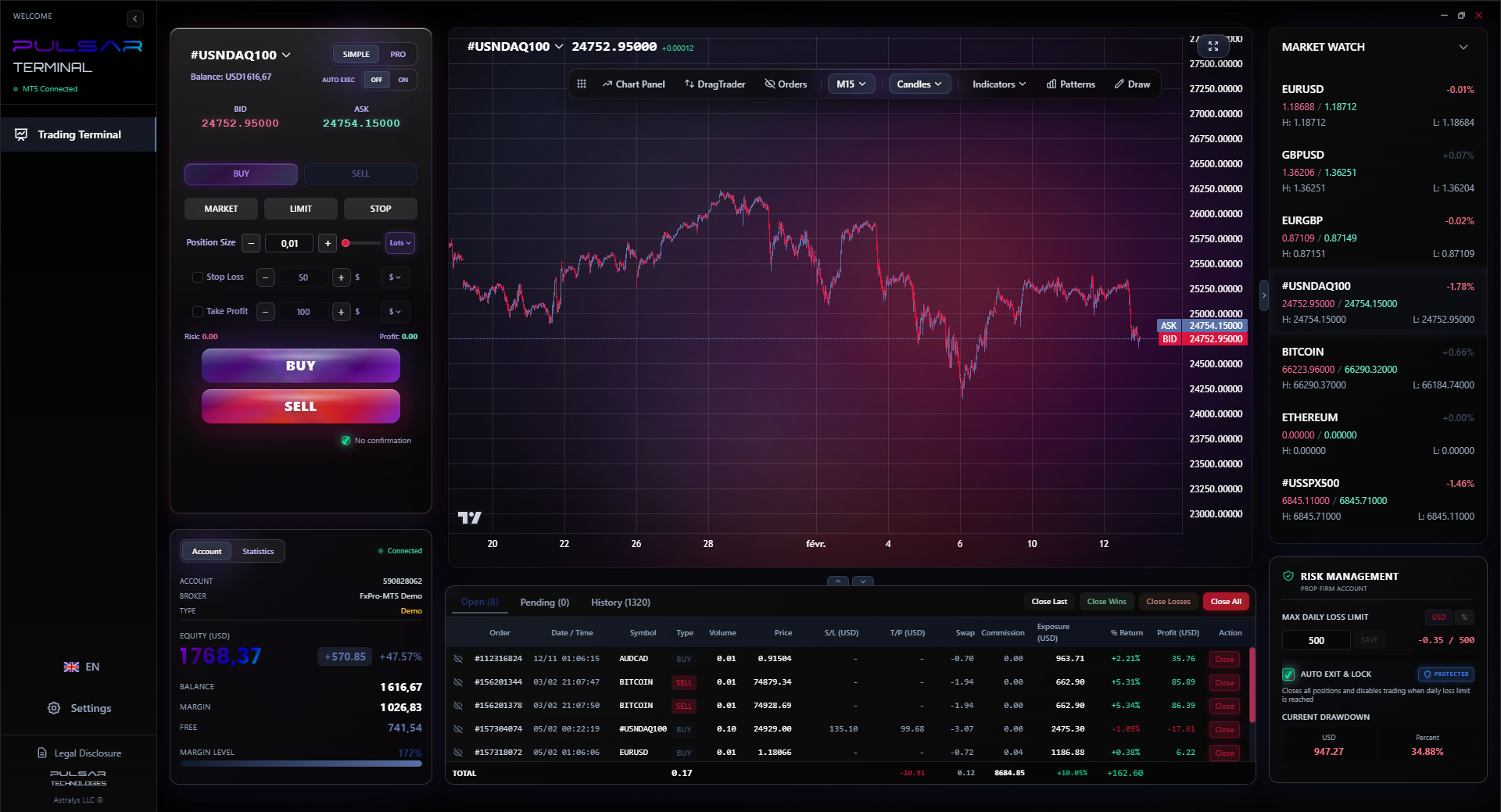
Managing multiple trades based on RSI signals is complex, but tools like Pulsar Terminal let you set multi-level take-profits and trailing stops directly on your MT5 charts, automating your exit strategy.
“A divergence without a clear trend behind it is just chart noise, not a trading signal.”
Multi-Timeframe Analysis for Clarity
This is a game-simplifier. Here’s my routine: I start with the Daily chart to see if the RSI is above or below 50. That tells me the broader momentum. Let's say it's above 50 (bullish). Then I drop to the 4-hour chart. I'll only look for buy signals here - like RSI bouncing from 40 or 50, or a bullish divergence. I ignore sell signals on the lower timeframe because they're fighting the bigger trend. This keeps you on the right side of the market.
RSI and Price Action Fusion
Combine RSI with simple price action. A bullish RSI divergence is nice, but if it happens right at a major support level and forms a hammer candlestick? That's a high-probability setup. Similarly, an RSI reading above 70 is more concerning if price is also hitting a strong resistance level it's failed at before.
Adapting for Nigerian Trading Hours
Our market activity peaks when London opens (1 pm Nigerian time) and overlaps with the US later. Volatility increases, which can cause RSI to swing more wildly. Don't be fooled by a sudden RSI spike to 75 on a 15-minute chart at 1:05 PM. It might just be the initial liquidity rush. Wait for the market to settle. Some of my worst early trades were jumping on these false opening-range signals.
A Word on USD/NGN
You won't find USD/NGN on most international forex brokers with a proper RSI. The market is too illiquid and controlled. If you're analyzing Naira rates, you're likely looking at a central bank rate or a parallel market quote, not a tradeable spot price. Don't waste time trying to apply technical RSI analysis there. Focus on the majors and crosses where the tool actually works in a liquid market.

Example: Let's say you have a $1,000 account with a broker like XM review. You see a bullish RSI divergence on the 4-hour EUR/USD chart at a key support. Your risk per trade should be 1-2%, so $10-$20. If your stop loss is 30 pips away, your position size should be roughly $20 / (30 pips * $1 per pip on a micro lot) = 0.67 micro lots. Round down to 0.6 lots. This keeps you in the game.
💡 विंस्टन की सलाह
Never let a profitable RSI trade turn into a loss. If you're up 20 pips and RSI reverses sharply, move your stop to breakeven. Protecting capital is your first job.
Learning how to use RSI in forex isn't about finding one perfect signal. It's about building a checklist. Here's a simple framework you can adapt:
- Trend Check: Look at the Daily chart. Is RSI above or below 50? That sets your bias (neutral above/below 45-55).
- Signal Hunt: On your trading timeframe (e.g., 4-hour), look for RSI signals that align with your Daily bias. Looking for buys if Daily RSI > 50.
- Confluence: Does the RSI signal line up with something else? A support/resistance level? A MACD indicator crossover? A 50-period moving average? One confluence is good, two is better.
- Entry & Risk: Place your entry order. Immediately set your stop loss based on a recent price swing, not the RSI. Use your position size calculator.
- Exit: Here's where RSI can help again. Consider taking partial profits when RSI reaches the opposite extreme (e.g., take 50% off at RSI 70 if you bought at RSI 40). Or trail your stop using a moving average.
I keep a trading journal where I note the RSI reading at my entry. Over time, you'll see which conditions are most profitable for you. Maybe you're great at trading RSI divergences off support, but terrible at fading overbought readings in a trend. Focus on your strengths.
The biggest lesson? RSI is a measure of momentum, not a crystal ball. It tells you what is happening (momentum is slowing/accelerating), not what will happen with certainty. Respect that distinction, manage your risk, and it can become one of the most reliable tools in your box. Just don't expect it to make you rich overnight. Consistency is the real goal, especially when trading from here in Nigeria with all its unique challenges.
FAQ
Q1What is the best RSI setting for forex day trading in Nigeria?
There's no single 'best' setting, but for day trading on charts like 15-minute or 1-hour, many Nigerian traders find a period between 9 and 14 works well. A lower period (like 9) is more sensitive and gives earlier signals, but also more false ones. Start with 14, then adjust based on the pair you trade most. If you trade volatile pairs like GBP/JPY, a slightly higher period (like 21) might smooth out the noise.
Q2Can I use RSI alone to trade forex successfully?
No, and this is a critical point. Using RSI alone is a recipe for frustration and losses. It's a supporting actor, not the star. You must combine it with other forms of analysis. Use it to confirm signals from price action (support/resistance, trendlines) or other indicators. Always use a stop loss. RSI gives you a probability, not a promise.
Q3Why does RSI give false signals sometimes, especially with USD/NGN news?
RSI measures price momentum. During major news events (like CBN announcements affecting Naira), price can spike violently on pure emotion and thin liquidity. This creates extreme, sharp RSI readings that reverse just as quickly once the news is digested. These are false signals in the classic sense. Avoid trading based on RSI during high-impact news releases. The indicator needs a normal, liquid market to work properly.
Q4How do I know if an RSI divergence is strong?
Look for three things. First, the price trend before the divergence should be clear and sustained. Second, the divergence should occur near classic overbought (70+) or oversold (30-) zones. Third, the divergence should be clear to the eye - the price and RSI should be telling obviously different stories. A weak, sloppy divergence is often ignored by the market.
Q5Is RSI or MACD better for forex trading?
They're different tools for different jobs, and many pros use both. The RSI indicator is best for identifying overbought/oversold conditions and spotting momentum divergences. The MACD indicator is better for identifying trend direction, strength, and changes (crossovers). Think of RSI as a momentum gauge and MACD as a trend gauge. Using them together can give you a more complete picture.
Q6What's a good profit target when using RSI signals?
Don't use RSI alone to set a profit target. Use it to manage the trade. A common method is to take partial profits when RSI reaches an extreme opposite your entry (e.g., take 50% off at RSI 70 if you bought at RSI 35). For the rest, use a trailing stop or target a technical level like the next resistance zone. Your initial risk-to-reward should be at least 1:1.5, based on your stop loss distance.
Q7Can I use RSI for scalping on a 1-minute chart?
You can, but it's tricky and not ideal for beginners. On a 1-minute chart, RSI is extremely noisy and heavily influenced by the broker's spread definition. You need a broker with ultra-low, stable spreads. Even then, signals will be frequent and often false. If you want to try scalping strategy with RSI, practice on a demo account first and consider using a slightly higher timeframe like the 5-minute chart for cleaner signals.
प्रो. विंस्टन का पाठ
:
- ✓RSI above 70 means 'watch for a sell', not 'sell now'.
- ✓Use 40-50 as support in uptrends, 50-60 as resistance in downtrends.
- ✓Always confirm RSI signals with price action or structure.
- ✓Risk no more than 2% per trade, regardless of how perfect the RSI looks.
यह लेख कितना उपयोगी था?
रेट करने के लिए स्टार पर क्लिक करें
साप्ताहिक ट्रेडिंग विश्लेषण
मुफ़्त साप्ताहिक विश्लेषण और रणनीतियाँ। कोई स्पैम नहीं।
लेखक के बारे में
Olumide Adeyemi
पश्चिम अफ्रीकी ट्रेडिंग अग्रणी
नाइजीरिया के सबसे सक्रिय फॉरेक्स ट्रेडिंग एजुकेटर्स में से एक। लागोस से 8 साल का ट्रेडिंग अनुभव। अफ्रीकी ट्रेडर्स के लिए लो-कैपिटल स्ट्रैटेजीज और प्रॉप फर्म चैलेंजेज में विशेषज्ञ।
टिप्पणियाँ
आपको यह भी पसंद आ सकता है

Cara Trading Forex Sukses: 7 Prinsip dari Trader Profesional
Cara trading forex sukses dengan 7 prinsip trader pro: manajemen modal, disiplin, journal trading, backtest. Data nyata, bukan janji profit palsu.
Jam Trading Forex Terbaik untuk Trader Indonesia: Panduan Lengkap dengan Tabel Waktu
Panduan jam trading forex untuk trader Indonesia. Tabel 4 sesi dunia, jam emas 20:00-00:00, sesi mana yang harus dihindari. Data akurat + tips dari trader berpengalaman.
Top 5 Sàn Forex Uy Tín Nhất 2026: Review Jujur dari Trader Indonesia
Top 5 sàn forex uy tín 2026 untuk trader Indonesia. Review jujur: spread, deposit, withdraw, dukungan lokal. Exness, XM, IC Markets & lebih.
All these calculators are built into Pulsar Terminal with real-time data from your MT5 account. One-click position sizing, automatic risk management, and instant calculations.
