


I once held a EUR/USD short for three days, convinced the trend would break.
James Mitchell
वरिष्ठ ट्रेडिंग विश्लेषक ·  Canada
☕ 10 मिनट पढ़ने
आप क्या सीखेंगे:
I once held a EUR/USD short for three days, convinced the trend would break. It didn't. The trade was a scratch, but the $14.72 in swap fees I paid felt like a moral tax. That's when the question hit me: is forex currency trading halal, or was I just financing interest? For Muslim traders in Canada, this isn't just about profit and loss. It's about aligning your capital with your faith, navigating a market built on overnight interest (swap) while staying within Sharia principles. Let's break down what makes trading permissible, the specific Canadian rules you need to know, and how to actually set up a halal trading operation.
Forget complex financial jargon for a second. The Islamic view on trading boils down to three big ideas: Riba, Gharar, and Maysir. If your trading violates these, it's haram. It's that straightforward.
Riba (Interest/Usury) is the big one for forex. In conventional trading, if you hold a position past 5 PM New York time, you either pay or receive a swap fee. That's interest. No debate. It's prohibited. So, a standard account where you're racking up swap charges? Not halal. The solution is an Islamic or swap-free account, which we'll get into.
Gharar (Excessive Uncertainty) is about gambling-like speculation. Buying a currency pair because you have a 'feeling' or using extreme use on a whim? That's Gharar. Halal trading requires a clear purpose, proper analysis, and avoiding deals with massive, unknown risks. It means having a real scalping strategy or a swing trading plan, not just throwing darts at a chart.
Maysir (Gambling) is closely tied to Gharar. It's getting rich quick through pure chance. Using 500:1 use on a micro account hoping for a miracle is Maysir. Trading based on solid technical analysis, economic understanding, and managed risk is not. The line is in your intent and method.

Warning: Don't fool yourself. Using a standard account and 'accepting' swap fees as a cost of business doesn't make it halal. You're directly engaging with Riba. The intention to avoid it is the first step.
This is the practical fix for the Riba problem. Brokers offer Islamic accounts that remove swap charges. But they're not a free lunch, and how they work varies wildly.
Instead of interest, brokers typically charge a fixed administrative fee or widen the spreads on these accounts to cover their costs. You need to read the fine print. For example, FP Markets charges a $3 commission per lot on its ECN Islamic accounts instead of swaps. Others might add 0.5 pips to the spread.
The Time Limit Trap
Here's a critical detail most gloss over: some 'swap-free' accounts aren't unlimited. A broker might offer zero swap fees for positions held 3, 5, or 10 days. After that? They start charging an 'admin fee' that looks suspiciously like interest. You must find a broker that offers genuinely unlimited swap-free conditions if you plan to hold trades for weeks or months.
Transparency is Key
A proper Islamic account should have all fees stated upfront - no hidden rollovers. The transaction should be a spot exchange: you buy one currency, you sell another, immediately. No deferred settlement nonsense. If a broker can't clearly explain their Islamic account structure, walk away.

Example: Let's say you trade 1 standard lot (100,000 units) of EUR/USD on a conventional account and hold it short for one night. You might pay a swap of -$5.00. On a true Islamic account from a broker like those in our Exness review or XM review, that charge is $0.00. Instead, your cost is baked into a slightly higher commission or spread.

💡 विंस्टन की सलाह
A swap-free account fixes the interest problem. It doesn't fix a stupid strategy. Don't confuse the tool for the skill.
“The Canadian regulatory environment creates a safer framework for disciplined, halal trading than many unregulated offshore jurisdictions.”
Trading halal in Canada means following both Sharia law and Canadian law. Thankfully, Canada has one of the most secure regulatory frameworks globally, which actually supports ethical trading.
The main watchdog is the Canadian Investment Regulatory Organization (CIRO), formed in 2023. Any broker seriously serving Canadians must be registered with them. This isn't optional. CIRO membership means your funds are segregated (the broker can't use them for their own bills) and you're protected by the Canadian Investor Protection Fund (CIPF) for up to CAD $1,000,000 if the broker goes bust.
use Limits Protect You
CIRO imposes strict use caps. For major forex pairs like EUR/USD, the max is 30:1. For minors, it's often lower. Compare this to offshore brokers offering 500:1 or 1000:1. Those insane levels practically invite Maysir (gambling). Canada's 30:1 limit forces you to use proper position size calculator and manage risk. It aligns surprisingly well with the Islamic principle of avoiding excessive uncertainty.
How Profits Are Taxed
This is where many get confused. Forex trading profits in Canada are generally treated as capital gains, not business income. Only 50% of your net profit is taxable at your marginal income tax rate. So, if you make $10,000 in a year, $5,000 is added to your income for tax purposes. Keep careful records. This capital gains treatment is consistent whether you use a conventional or Islamic account, but always consult a tax professional familiar with trading.

Pro Tip: Always verify a broker's CIRO registration on the CIRO website itself. Don't just trust the broker's homepage. This is your first line of defense against scams.
Let's talk specifics. What does it actually cost to trade halal in Canada right now? Here’s a breakdown based on current broker offerings. Remember, 'Islamic account' terms differ.
| Broker (CIRO-Regulated) | Islamic Account Offered? | Key Fee on Islamic Account | Min. Deposit (CAD) | Avg. EUR/USD Spread |
|---|---|---|---|---|
| FOREX.com | Yes | $5/lot/ side commission on Raw | $100 | From 0.0 pips (Raw) |
| OANDA | Yes | Wider spread or fee structure | $0 | ~1.2 pips (Standard) |
| Interactive Brokers | Complex* | Built into commission | $0 | Variable, commission-based |
| CMC Markets | No | N/A | $0 | From 0.7 pips |
| AvaTrade (Global) | Yes | No swap for 5 days, then fee | $100 | From 0.9 pips |
*Interactive Brokers' structure is complex; their commissions are considered a service fee, not interest, but you must review their specific policy for your situation.
The Spread Reality: The spread is your primary cost on many Islamic accounts. On major pairs like EUR/USD, expect 0.5 to 1.5 pips on a standard Islamic account. On a 'Raw' Islamic account like FP Markets', you might get 0.0 pips but pay a $3-$7 commission per lot. You need to calculate which is cheaper for your trading style.
Other Fees to Watch:
- Inactivity Fees: OANDA charges up to CAD $10/month after a year. AvaTrade charges $50 after 3 months. If you're a periodic trader, this matters.
- Currency Conversion: Funding in CAD but trading USD pairs? OANDA, for instance, adds a 0.5% mark-up. It's often better to fund in the currency you trade most.
My own experience? I tested a Raw Islamic account with a broker similar to IC Markets. Trading 5 lots of GBP/USD per month, the $7/round turn commission cost me about $35. On a standard account with 0.8 pip spreads, the spread cost would have been roughly $40, plus swaps. The Islamic account was actually cheaper for my volume, and it was compliant.
💡 विंस्टन की सलाह
Canada's 30:1 use limit isn't a restriction; it's a blessing. It's the regulator forcing risk management on you. Use it.
“An Islamic account only solves the Riba issue. It doesn't make a gambling strategy halal.”
Getting the account is step one. Trading in a halal manner is the lifelong practice. It's about discipline.
1. Choose the Right Account Type. Open a verified Islamic swap-free account with a reputable, CIRO-regulated broker like those discussed. During sign-up, explicitly select the Islamic account option. You'll often need to declare your faith - this is normal.
2. Adopt a Risk-First Mindset. This is where Gharar and Maysir are defeated. Never risk more than 1-2% of your capital on a single trade. Use stop-losses on every single position. I learned this the hard way early on, letting a USD/CAD trade run against me without a stop, hoping it would come back. It didn't. A 2% loss turned into a 12% disaster. That's gambling, not trading.
3. Use Analysis, Not Emotion. Base your trades on something concrete. Learn the MACD indicator for trend momentum or the RSI indicator for overbought/oversold levels. Have a reason for entering and exiting. Trading on a 'hunch' after reading a news headline is speculation bordering on Maysir.
4. Avoid Overtrading. Just because there's no swap cost doesn't mean you should hold 50 positions open. Each trade carries risk. Overtrading often stems from boredom or greed, both of which cloud judgment and increase Gharar.
5. Keep Your Intentions Clean. Are you trading to ethically grow wealth, or to get rich quick? Check your intention (niyyah). The former is halal, the latter leads to the haram behaviors you're trying to avoid.
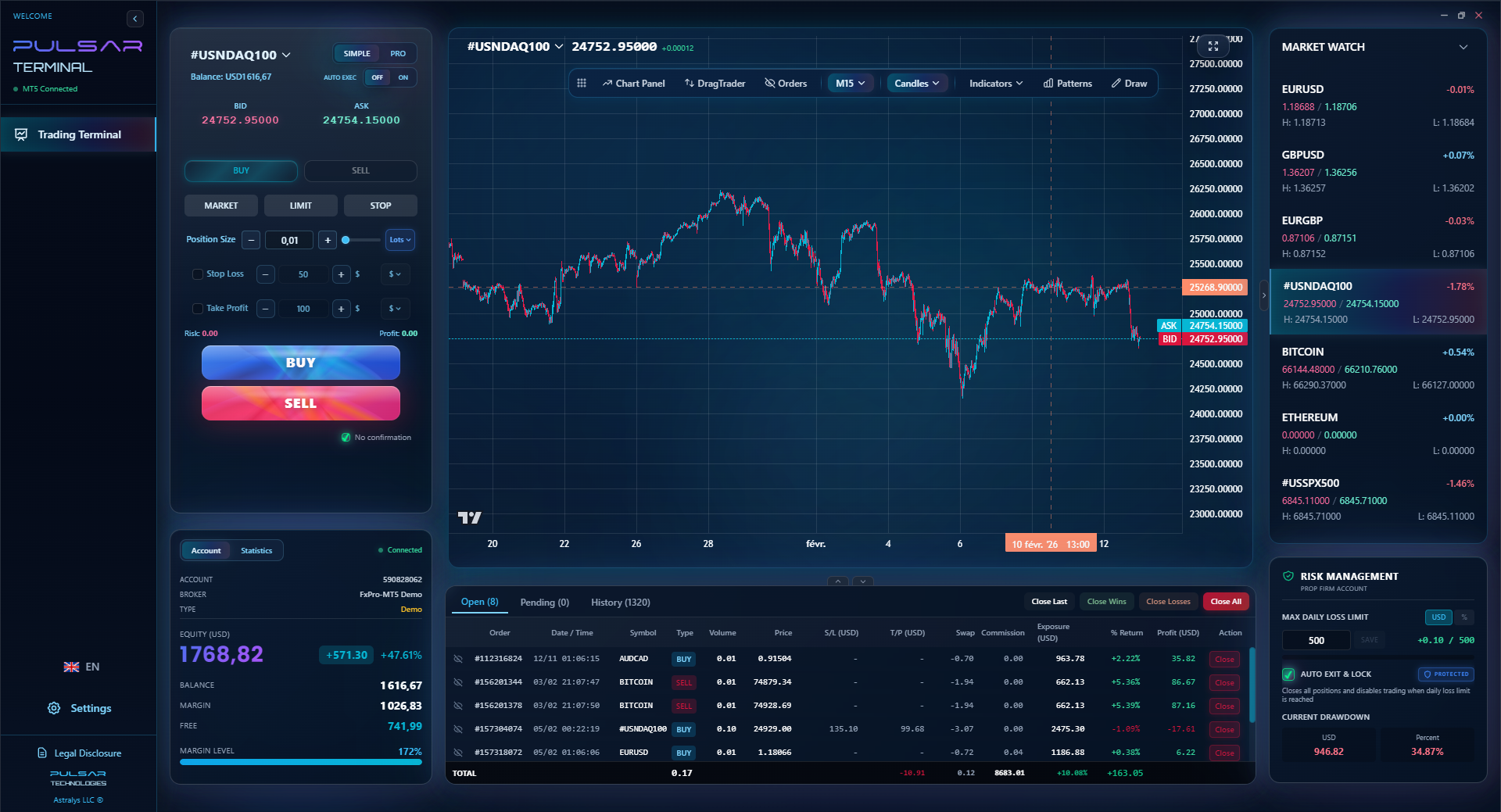
Maintaining a halal, disciplined strategy requires precise order management, which tools like Pulsar Terminal provide directly on your MT5 platform.
I've seen these mistakes tank accounts and faith alike.
Pitfall 1: The 'Halal Account, Haram Strategy' Paradox. You open an Islamic account but then trade with 30:1 use on 5-minute charts with no stop loss. The account is technically swap-free, but your behavior is pure Maysir. The tool is halal, but your use of it is not. Compliance is holistic.
Pitfall 2: Ignoring All Fees. You're so focused on avoiding swap you ignore huge spreads or commissions. A 3-pip spread on an Islamic account can be more expensive than a 1-pip spread plus a small swap on a short-term trade. You must calculate the all-in cost. Use a pip definition and a spread definition calculator to understand exactly what you're paying.
Pitfall 3: Trading During High Gharar Events. Non-farm payrolls, central bank meetings. The spreads widen to 10 pips or more, and price movement is chaotic. The uncertainty (Gharar) is extreme. Sitting these events out is not missing an opportunity; it's avoiding a prohibited level of risk. I used to trade these events, thinking I was smart. My win rate was barely 50%, a coin flip. The stress wasn't worth it.
Pitfall 4: Lack of Record-Keeping. For taxes and for auditing your own compliance, you need clear records. Which trades were based on analysis? What was your risk percentage? Without this, you can't honestly assess if you're trading or gambling.
💡 विंस्टन की सलाह
If you can't explain your trade's thesis in one sentence, it's not analysis. It's a guess. And guesses have no place in halal trading.
“The line between trading and gambling is drawn by your analysis, your risk management, and your intention.”
So, is forex currency trading halal? The answer is: It can be.
It is halal IF you:
- Use a genuine, unlimited swap-free (Islamic) account from a trustworthy broker.
- Trade with a clear, analytical strategy - not speculation.
- Employ strict risk management (use, position sizing, stop-losses).
- Maintain pure intentions for ethical wealth growth.
The Canadian regulatory environment, with its strong CIRO oversight and sensible 30:1 use limits, actually creates a safer framework for this kind of disciplined, halal trading than many unregulated offshore jurisdictions.
It's not easy. It requires more diligence than conventional trading. You have to vet brokers harder, understand fees deeper, and exercise more self-control. But that discipline will make you a better trader, period. The question isn't just 'is forex currency trading halal?' It's 'am I willing to do the work to make it so?' Your capital and your conscience are both on the line.
FAQ
Q1Do all brokers in Canada offer Islamic accounts?
No, not all. Major CIRO-regulated brokers like FOREX.com and OANDA do, but others like CMC Markets currently do not. You must check each broker's website specifically for 'Islamic account' or 'swap-free account' details. Many international brokers accepting Canadian clients, such as AvaTrade or FP Markets, also offer them.
Q2If I have an Islamic account, can I use any trading strategy?
Technically, yes, the broker won't stop you. But Islamically, no. An Islamic account only solves the Riba (interest) issue. If you use a high-frequency, high-use strategy with no analysis, you're likely engaging in Gharar (excessive uncertainty) and Maysir (gambling), which are also haram. The account type doesn't make a gambling strategy halal.
Q3How are profits from halal forex trading taxed in Canada?
Profits are typically treated as capital gains. Only 50% of your net annual profit is added to your taxable income. For example, a $10,000 profit means $5,000 is taxable at your marginal tax rate. This applies regardless of using an Islamic or conventional account. Always consult a tax professional.
Q4What's the difference between a swap-free account and an Islamic account?
In practice, they are the same thing - both eliminate overnight interest (swap) charges. 'Islamic account' is the marketing term used to indicate Sharia compliance. However, always read the terms. Some 'swap-free' accounts might have time limits or other conditions that may not be fully compliant.
Q5Can I trade gold (XAU/USD) or cryptocurrencies on an Islamic account?
You can, but you must check the specific asset. Forex brokers often extend swap-free conditions to major metals like XAU/USD. For cryptocurrencies, the permissibility is a separate and debated Islamic finance issue (involving ownership and speculation), and swap-free status may not apply. You must research the Islamic ruling on the specific asset class itself.
Q6What happens if I get a margin call on an Islamic account?
A margin call is a risk warning, not an interest charge. It occurs when your losses eat up your available margin. This is a result of market risk and poor risk management, not Riba. The rules for margin calls are the same on Islamic and conventional accounts. It highlights why using low use and stop-losses is crucial for halal trading.
प्रो. विंस्टन का पाठ
:
- ✓Forex is halal only with a true swap-free Islamic account.
- ✓Canada's 30:1 use cap aligns with Sharia risk principles.
- ✓Only 50% of trading profits are taxable as capital gains.
- ✓Halal trading requires a strategy, not speculation.
यह लेख कितना उपयोगी था?
रेट करने के लिए स्टार पर क्लिक करें
साप्ताहिक ट्रेडिंग विश्लेषण
मुफ़्त साप्ताहिक विश्लेषण और रणनीतियाँ। कोई स्पैम नहीं।
लेखक के बारे में
James Mitchell
वरिष्ठ ट्रेडिंग विश्लेषक
न्यूयॉर्क में स्थित, 9 साल से अधिक का ट्रेडिंग अनुभव। प्रमुख USD पेयर्स, प्रॉप फर्म चैलेंजेज और अमेरिकी नियामक परिदृश्य पर फोकस।
टिप्पणियाँ
आपको यह भी पसंद आ सकता है

Cara Trading Forex Sukses: 7 Prinsip dari Trader Profesional
Cara trading forex sukses dengan 7 prinsip trader pro: manajemen modal, disiplin, journal trading, backtest. Data nyata, bukan janji profit palsu.
Jam Trading Forex Terbaik untuk Trader Indonesia: Panduan Lengkap dengan Tabel Waktu
Panduan jam trading forex untuk trader Indonesia. Tabel 4 sesi dunia, jam emas 20:00-00:00, sesi mana yang harus dihindari. Data akurat + tips dari trader berpengalaman.
Top 5 Sàn Forex Uy Tín Nhất 2026: Review Jujur dari Trader Indonesia
Top 5 sàn forex uy tín 2026 untuk trader Indonesia. Review jujur: spread, deposit, withdraw, dukungan lokal. Exness, XM, IC Markets & lebih.
All these calculators are built into Pulsar Terminal with real-time data from your MT5 account. One-click position sizing, automatic risk management, and instant calculations.
