


Let's cut the nonsense.

Olumide Adeyemi
पश्चिम अफ्रीकी ट्रेडिंग अग्रणी ·  Nigeria
☕ 9 मिनट पढ़ने
आप क्या सीखेंगे:
- 1The Harsh Nigerian Reality: It's Legal, But They Don't Make It Easy
- 2The Naked Numbers: Why 80% of Accounts Blow Up
- 3The Real Difficulty Isn't the Charts, It's Your Mind
- 4Building a Strategy That Doesn't Self-Destruct
- 5Practical First Steps for a Nigerian Trader
- 6Tools That Actually Reduce the Difficulty
- 7The Final Verdict: Is Forex Trading Difficult?
Let's cut the nonsense. Everyone selling you a course or a signal says forex is easy. They're lying. Is forex trading difficult? In Nigeria, it's brutally hard for most people, but not because the charts are confusing. It's difficult because it's a psychological war where your own brain is the enemy, and the system is stacked against you from day one. I've blown accounts, I've made comebacks, and I'll show you exactly what makes this game so tough and what it really takes to have a shot.
First things first, let's clear up the legal fog. Yes, you can trade forex as an individual in Nigeria. No, you don't need a CBN license to open an account with an international broker like Exness or IC Markets. The SEC is more worried about companies scamming people than stopping you from trading GBP/USD in your pajamas.
But here's where the difficulty starts. The Central Bank of Nigeria (CBN) has made funding your account a proper headache. You can't use the official forex window (the cheap rate) for trading. Trying to fund an offshore broker with your Nigerian debit card? Good luck. Most banks block those transactions now. You'll likely need to use crypto or a payment processor like Korapay, which adds its own fees and delays. Before you've even placed a trade, you're already down.
And don't forget the taxman. You owe a 10% capital gains tax on your gross profits. That's right, gross. Not what's left after your losses. If you make N500,000 in a month but have N300,000 in losses, you still pay tax on the N500,000. That alone makes consistent profitability a much steeper hill to climb.

Warning: Always keep detailed records of all your trades, deposits, and withdrawals. When the tax authority comes knocking (and they might), you need to show your math. Trading with an international broker doesn't make you tax-exempt.

💡 विंस्टन की सलाह
The market's only job is to prove you wrong. Your only job is to have a plan for when it does. A stop loss isn't an admission of failure; it's the cost of doing business.
“The difficulty of forex is 90% about managing yourself.”
You've seen the stats: 65% to 90% of retail traders lose money. In Nigeria, I'd argue it's at the higher end of that range. Why? Let's break it down with real numbers.
The Deadly Combo: Small Account + High use
This is the classic Nigerian beginner trap. You see an ad for a broker with a $5 minimum deposit and 1:1000 use. You think, "With N4,000, I can control $5,000!" That's a fantasy, not a strategy.
Here's a real example from my early days. I deposited $100 with a broker offering 1:500 use. I bought 0.5 lots of EUR/USD (controlling $50,000). The trade moved 20 pips against me. A pip on that position was worth $5. I lost $100 in seconds. Account gone. I didn't understand that use is a double-edged sword that cuts your throat much faster than it fills your pocket.
The Spread & Slippage Tax
You're not just trading against the market; you're trading against the broker's spread. On a volatile pair like GBP/NGN or even EUR/USD during news, spreads can widen massively. You enter a trade already 3-5 pips in the red. For a scalping strategy, that's often your entire profit target gone before you start.
| Broker Type | Typical EUR/USD Spread | Cost per Standard Lot ($100k) |
|---|---|---|
| Standard Account | 1.2 pips | $12 |
| Raw Spread Account | 0.1 pip + $7 commission | ~$8 |
That cost is a constant drain. It's why brokers love high-frequency, undercapitalized traders. You're basically paying a toll on a road that leads to a margin call most of the time.

Example: If your strategy aims for a 10-pip profit, a 2-pip spread means the market has to move 12 pips in your favor just for you to break even. That's a 20% bigger move required on every single trade. Over 100 trades, that's a huge hurdle.
“Your first job is not to make money. Your first job is to not lose your capital.”
This is the core of it. The mechanics of trading are simple. Buy low, sell high. Support, resistance, RSI indicator. You can learn that in a month. The psychological discipline? That takes years, and most people never get it.
I remember a specific trade on XAU/USD (gold). I had a solid plan based on the XAU/USD guide I'd written. Entry at $1830, stop loss at $1822, target at $1845. Price hit $1844.90, then reversed. My plan said take profit at $1845. My brain said, "It's going to $1850, hold!" I held. It dropped to $1835. My brain then said, "It'll bounce back, just wait." It didn't. I finally panicked and sold at $1825, turning a potential $1500 profit into a $500 loss. I broke every rule I knew because of greed and then hope.
This happens every single day. The market is designed to trigger your emotional responses: FOMO (Fear Of Missing Out), revenge trading after a loss, and the inability to accept a small, planned loss. The difficulty of forex is 90% about managing yourself. Can you stick to a plan when you're down? Can you walk away when you're up? Most can't.
“Your first job is not to make money. Your first job is to not lose your capital.”
So how do you build something that can survive the Nigerian context and your own psychology? You start by accepting that you will be wrong. A lot.
Your first job is not to make money. Your first job is to not lose your capital. This means risk management isn't a suggestion; it's the entire game. I never risk more than 1% of my account on any single trade. Ever. I use a position size calculator before every entry. If my stop loss is 50 pips away, I adjust my lot size down so that 50 pips = 1% of my account, not 10%.
Find Your Timeframe
Are you a scalper, a day trader, or a swing trader? Your personality decides this. I'm impatient. I found out (the hard way) that swing trading made me anxious holding trades for days. I'm better suited to the 5-minute and 15-minute charts where I can be in and out. You need to test this in a demo account for at least 3 months.
Keep It Stupid Simple (KISS)
You don't need 10 indicators. Find one or two that work for you. I use price action (support/resistance) and the MACD indicator for confirmation. That's it. More indicators just give you more reasons to doubt your entry and break your plan.

Pro Tip: Backtest and forward-test your strategy for a minimum of 100 trades before risking real money. Write down every entry, exit, and reason in a journal. The data doesn't lie. If it's not profitable over 100 trades, it's not a strategy, it's a guess.
💡 विंस्टन की सलाह
If you can't explain your trade in one sentence ('I'm buying GBP/USD because it bounced off the daily support with RSI oversold'), you shouldn't be in it. Complexity is the enemy of execution.
“High use is a double-edged sword that cuts your throat much faster than it fills your pocket.”
Let's get concrete. If you're starting today in Lagos, Abuja, or Port Harcourt, here's your roadmap.
- Education First, Money Last: Spend 3-6 months learning. Not from Instagram gurus, but from reputable sources. Understand fundamental analysis (how CBN decisions move the Naira), technical analysis, and, most importantly, risk management.
- Choose a Regulated Broker: This is non-negotiable. Your money needs to be safe. Look for brokers with strong international regulation like ASIC or FSCA. Do your due diligence. We have reviews on brokers like XM and Pepperstone to help you start your research.
- Start with a Realistic Demo: Don't demo trade with $1,000,000. It's useless. Demo with the amount you can realistically start with: $500, $1000, $2000. Practice your risk management with real-world numbers.
- Fund with a Sustainable Amount: When you go live, start with money you can afford to lose completely. That $500 shouldn't be your rent or school fees. The psychological pressure will destroy your trading.
- Go Live with Micro Lots: Even if your broker allows standard lots (100k units), start with micro lots (1k units). Your goal for the first year is not to get rich. Your goal is to survive, learn, and achieve consistency. A 5% return while preserving capital is a massive success.
I started my first live account with $300. I traded only 0.01 lots (micro lots) for six months. My biggest daily profit was $18. My biggest loss was $25. It was boring. But it taught me discipline without the emotional rollercoaster of watching hundreds of dollars vanish in a blink.
“High use is a double-edged sword that cuts your throat much faster than it fills your pocket.”
You can't eliminate the psychological battle, but you can use tools to enforce discipline and save you from yourself.
A trading journal is the most important one. Not just a notepad, but a detailed log: date, instrument, entry/exit price, lot size, risk %, profit/loss, and a screenshot of the chart. Review it weekly. You'll see your stupid patterns (like always losing on Friday afternoons).
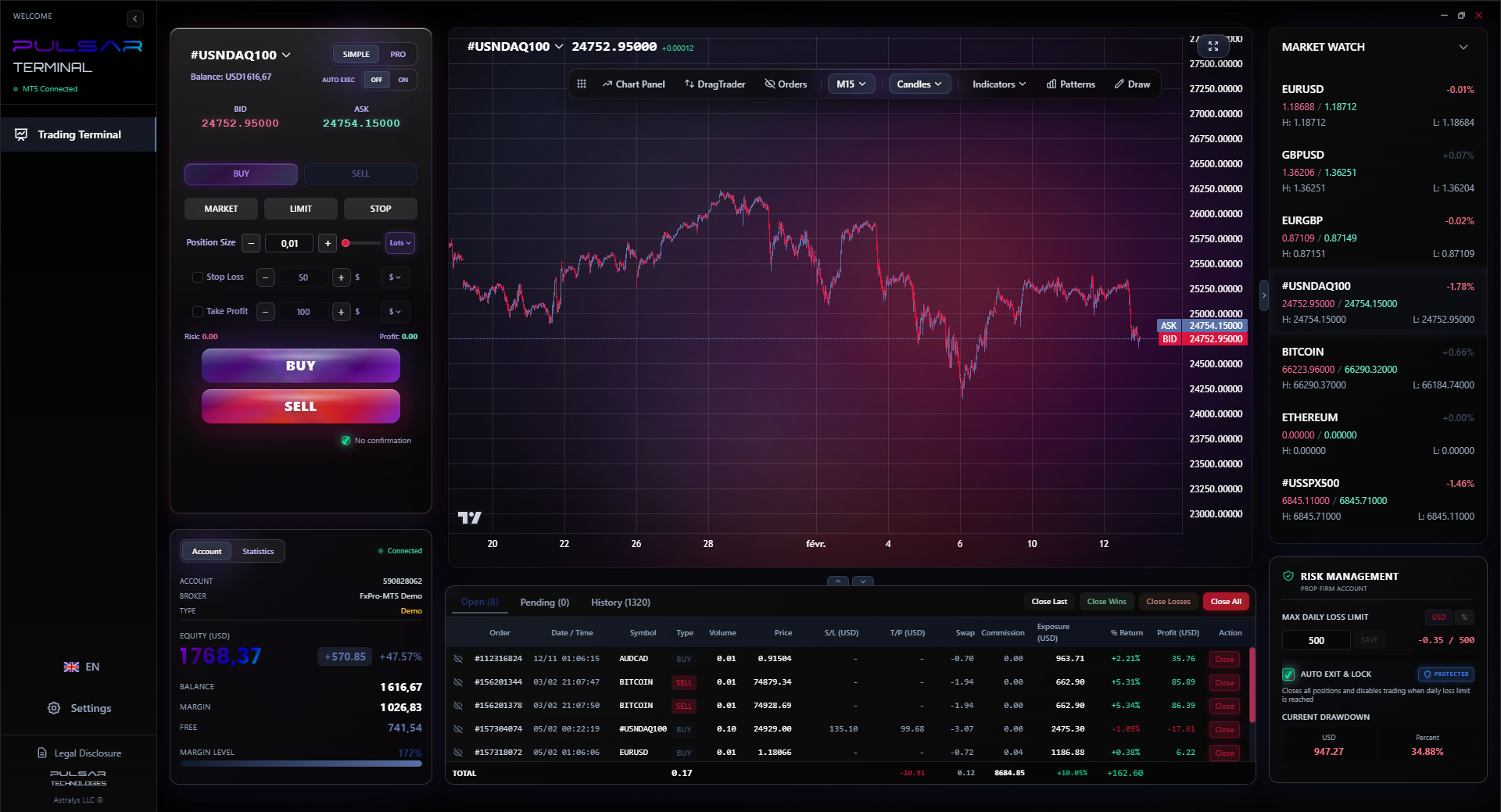
Another game-changer for me was using advanced trade management tools. Manually moving stop losses to breakeven or setting trailing stops is a chore, and you'll often forget or hesitate.
Pro Tip: Automate your trade management rules. If your rule is "move stop to breakeven at +15 pips," use a tool that does it for you instantly. This removes emotion and ensures your rules are followed, especially when you're in multiple trades or away from the screen. It turns your plan into an executable system.
💡 विंस्टन की सलाह
Treat every Naira in your trading account as a soldier. Never send all your soldiers into one battle. Risking 1% per trade means you get 100 battles before you're out of the war.
Automating your trade management rules, like moving stops to breakeven, is a key discipline tool that Pulsar Terminal handles directly on your MT5 platform.
“The difficulty is also the barrier to entry. If it were easy, everyone would do it.”
So, is forex trading difficult? Absolutely. It's one of the hardest ways to make an easy living.
The difficulty isn't in clicking buttons. It's in the relentless discipline required. It's in accepting 5 losing trades in a row without doubting your system. It's in taking a 2% profit when your gut screams it's going to 10%. It's in logging off after a loss instead of revenge trading.
In Nigeria, you have the added layers of funding hassles and a 10% gross profit tax. It's an uphill race.
But here's the flip side. The difficulty is also the barrier to entry. If it were easy, everyone would do it and there'd be no money to be made. The fact that 80% quit or fail means there is opportunity for the 20% who are willing to do the brutally hard work of mastering themselves.
It took me three years of losses, frustration, and blown accounts before I found my footing. My first profitable year, I made a 26% return. That's less than a good crypto pump. But it was consistent, measured, and repeatable. That's the real goal: sustainable growth, not lottery tickets.
Forex trading is difficult. But for the right person - someone who is patient, disciplined, and treats it like a serious business - the difficulty is what makes the eventual success so valuable. Don't start to get rich quick. Start to learn. The money might follow, but only if you respect how hard this game really is.
FAQ
Q1Is forex trading illegal in Nigeria?
No, it's not illegal for individuals. You can legally open an account with international brokers regulated abroad (like by ASIC or FSCA). The CBN and SEC regulate financial institutions operating within Nigeria, but they don't ban individuals from participating in the global forex market. Just be prepared for challenges funding your account.
Q2What is the minimum amount to start forex trading in Nigeria?
While some brokers advertise $5 minimums, that's a trap. To practice proper risk management and avoid being wiped out by a single trade, a realistic minimum is between $500 and $1000. This allows you to trade micro lots and survive the inevitable losing streaks without a margin call on your first bad day.
Q3Why do most forex traders fail in Nigeria?
The core reasons are universal: poor risk management, emotional trading, and being undercapitalized. In Nigeria, high use offers (like 1:1000) tempt beginners to over-trade small accounts, leading to instant wipeouts. The funding and tax hurdles also add pressure, encouraging traders to take excessive risks to make up for costs.
Q4How much tax do I pay on forex profits in Nigeria?
You are subject to a 10% Capital Gains Tax on your gross trading profits. This is a critical point. It's not on your net profit (profits minus losses). If you make N1,000,000 in profitable trades in a year, you owe N100,000 in tax, even if you had N800,000 in losses. This makes record-keeping essential.
Q5Can I use my Nigerian bank card to fund a forex account?
It's increasingly difficult. Many Nigerian banks now block international transactions to known forex brokers. The most common workarounds are using cryptocurrency (transferring USDT to your broker) or third-party payment processors like Korapay or Wise, which may have their own limits and fees.
Q6Which is the best broker for beginners in Nigeria?
There's no single "best" broker, but a good beginner broker should have strong regulation, low minimum deposits, and offer micro lots for sensible risk-taking. Brokers like XM and Exness are popular choices among Nigerians due to their accessibility. Always prioritize the broker's regulatory status over flashy bonuses.
Q7How long does it take to become a profitable forex trader?
Expect a minimum of 1-2 years of dedicated learning, demo trading, and small live trading before you can reasonably expect consistent profitability. It's a skill like any other. You wouldn't expect to be a professional surgeon or engineer after a few months. Trading requires the same level of serious commitment and practice.
प्रो. विंस्टन का पाठ
:
- ✓Risk a maximum of 1% of capital per trade.
- ✓10% gross profit tax applies to all Nigerian traders.
- ✓Realistic starting capital is $500-$1000, not $5.
- ✓Master your psychology before mastering the charts.
- ✓Demo trade for 3-6 months minimum before going live.
यह लेख कितना उपयोगी था?
रेट करने के लिए स्टार पर क्लिक करें
साप्ताहिक ट्रेडिंग विश्लेषण
मुफ़्त साप्ताहिक विश्लेषण और रणनीतियाँ। कोई स्पैम नहीं।
लेखक के बारे में
Olumide Adeyemi
पश्चिम अफ्रीकी ट्रेडिंग अग्रणी
नाइजीरिया के सबसे सक्रिय फॉरेक्स ट्रेडिंग एजुकेटर्स में से एक। लागोस से 8 साल का ट्रेडिंग अनुभव। अफ्रीकी ट्रेडर्स के लिए लो-कैपिटल स्ट्रैटेजीज और प्रॉप फर्म चैलेंजेज में विशेषज्ञ।
टिप्पणियाँ
आपको यह भी पसंद आ सकता है

Cara Trading Forex Sukses: 7 Prinsip dari Trader Profesional
Cara trading forex sukses dengan 7 prinsip trader pro: manajemen modal, disiplin, journal trading, backtest. Data nyata, bukan janji profit palsu.
Jam Trading Forex Terbaik untuk Trader Indonesia: Panduan Lengkap dengan Tabel Waktu
Panduan jam trading forex untuk trader Indonesia. Tabel 4 sesi dunia, jam emas 20:00-00:00, sesi mana yang harus dihindari. Data akurat + tips dari trader berpengalaman.
Top 5 Sàn Forex Uy Tín Nhất 2026: Review Jujur dari Trader Indonesia
Top 5 sàn forex uy tín 2026 untuk trader Indonesia. Review jujur: spread, deposit, withdraw, dukungan lokal. Exness, XM, IC Markets & lebih.
All these calculators are built into Pulsar Terminal with real-time data from your MT5 account. One-click position sizing, automatic risk management, and instant calculations.
