


Here's the myth I hear all the time from traders in India: 'Everyone trades EUR/USD, it's fine, the rules are just for show.' Let me be blunt - that's a fast track to getting your funds frozen.

Rajesh Sharma
वरिष्ठ फॉरेक्स विश्लेषक ·  India
India
☕ 8 मिनट पढ़ने
आप क्या सीखेंगे:

Here's the myth I hear all the time from traders in India: 'Everyone trades EUR/USD, it's fine, the rules are just for show.' Let me be blunt - that's a fast track to getting your funds frozen. I learned this the hard way years ago, trying to skirt the system. Today, I'm going to set the record straight on what 'legal forex brokers in India' actually means. It's not about finding a loophole; it's about understanding a completely different, exchange-traded market.
I need to start with the cold, hard legal facts because your capital depends on it. The Foreign Exchange Management Act (FEMA) of 1999 is the law of the land. It's not some vague guideline brokers can interpret. The Reserve Bank of India (RBI) and the Securities and Exchange Board of India (SEBI) enforce it, and they don't mess around.
For you, the retail trader, this means one thing: you can only legally trade currency derivatives (futures and options) on Indian exchanges like the NSE, BSE, or MSEI. You must do this through a SEBI-regulated broker. Full stop.
The biggest shock for new traders? The pairs you can trade. Forget everything you've seen on YouTube about EUR/USD or GBP/JPY. For Indian residents, legal trading is restricted to INR-based pairs only. We're talking USD/INR, EUR/INR, GBP/INR, and JPY/INR. That's your universe.

Warning: Trading major pairs like EUR/USD through an offshore broker (even a big name like IC Markets or XM) is a violation of FEMA. I've seen accounts get flagged and withdrawals held up indefinitely. The risk isn't worth the few extra pips of liquidity.
This creates a unique market. You're not trading the global spot forex market. You're trading exchange-traded derivatives on the value of the Rupee. The liquidity, the spreads, the trading hours - it's all different. Your first job is to reset your expectations.

💡 विंस्टन की सलाह
The most expensive tool in your kit is denial. If you're trading a prohibited pair, you've already added an unquantifiable risk premium to every position. Price that in.

So, who are the actual legal forex brokers in India? They're the domestic giants you might know from stock trading.
The Legal (SEBI-Regulated) Players:
- Zerodha: Probably the most popular. Their brokerage for currency intraday is a flat ₹20 or 0.03% per order, whichever is lower.
- ICICI Direct: A banking heavyweight with integrated services.
- HDFC Securities: Another major bank-backed broker.
- Angel One: Known for its active trader platforms.
These brokers give you access to the NSE's currency derivatives segment. You'll use their proprietary platform or something like NEST Trader, not MT4/MT5 for these INR pairs.
The Offshore Illusion: Now, visit any international broker's website. Yes, you can open an account. Yes, you can deposit funds. Brokers like XM, IC Markets, and Pepperstone accept Indian clients seamlessly. They'll onboard you under their global entity (Cyprus, Seychelles, etc.). This is the trap. Just because you can, doesn't mean it's legal under Indian law for trading forex. You're taking money out of India's regulated perimeter to gamble on a market the RBI has explicitly walled off.
I made this mistake in 2015. Funded a $500 account with an offshore broker, thrilled by the 1:500 use. I made 30% in two weeks trading gold (XAU/USD). When I tried to withdraw my profit? Radio silence for a month, followed by a request for endless 'source of funds' documentation. I got my initial deposit back, minus fees, and lost the profits. The broker wasn't a scam; the entire structure of the transaction was the problem.

Pro Tip: If you use an international broker for other assets (like international stocks), keep that account completely separate. Never commingle funds intended for legal INR currency trading. It keeps your records clean for tax season.

“You're not trading the global spot forex market. You're trading exchange-traded derivatives on the value of the Rupee.”
Trading USD/INR futures is nothing like trading EUR/USD. If you come in with a standard scalping strategy, you'll get chewed up. Here's what you're working with.
Liquidity and Session
Liquidity is fantastic during Indian market hours (9:00 AM to 5:00 PM IST) and dies a quick death after. Most of the volume is in the near-month futures contract. This isn't a 24-hour market. You need to plan your swing trading around this schedule, as overnight gaps can be significant based on global USD moves.
Costs You Can't Ignore
Forget just the spread. Your cost structure is layered:
- Brokerage: (e.g., ₹20 per order)
- Exchange Transaction Charge: A tiny percentage of turnover.
- SEBI Turnover Fee: 0.0001% of transaction value.
- GST: 18% on all of the above fees. This is the killer. That ₹20 trade actually costs you ₹23.6.
- Stamp Duty: A small state-level charge.
You need a wider profit target just to cover costs. A 5-pip scalp on USD/INR is often pointless after fees. I learned this after 10 trades where my 'winning' position size calculator setup netted me a loss once GST and charges were deducted.
Strategy Shift
Trend-following and breakouts often work better than choppy range strategies. The market is heavily influenced by RBI intervention, corporate hedging flows, and global USD strength. I spend more time analyzing RBI policy and oil prices (India's big import) than looking at the MACD indicator on a 15-minute chart. It's a macro-driven market.
💡 विंस्टन की सलाह
Treat the 18% GST on brokerage not as a fee, but as a mandatory part of your stop-loss. If your target isn't at least 20 pips away on USD/INR, you're just paying the government for the privilege of watching a chart.
This is where the Indian regulator's paternalism is clear. The use on exchange-traded currency derivatives is severely restricted compared to offshore offers. While you might see 1:500 or 1:1000 advertised by international brokers, in India, you're looking at something more like 1:10 to 1:20 for most clients on margin.
This feels frustrating at first. You see a perfect setup and think, 'If only I had more use...' But let me reframe that. The low use is your best risk management tool. It forces you to be patient and pick only high-conviction trades. It makes a margin call a rare event instead of a weekly anxiety attack.
In my early offshore days, I blew a $2,000 account in an afternoon using 1:200 use on a volatile XAU/USD news trade. The move was right, but a 50-pip spike against me before it reversed wiped me out. That same trade size in India's regulated environment would have required 10x the capital, making the position size sane and survivable.
The risk isn't just market risk. The legal risk of using an offshore broker is a constant, silent spread on your life. The anxiety of a potential tax notice or fund blockage isn't quantifiable in pips, but it's real.

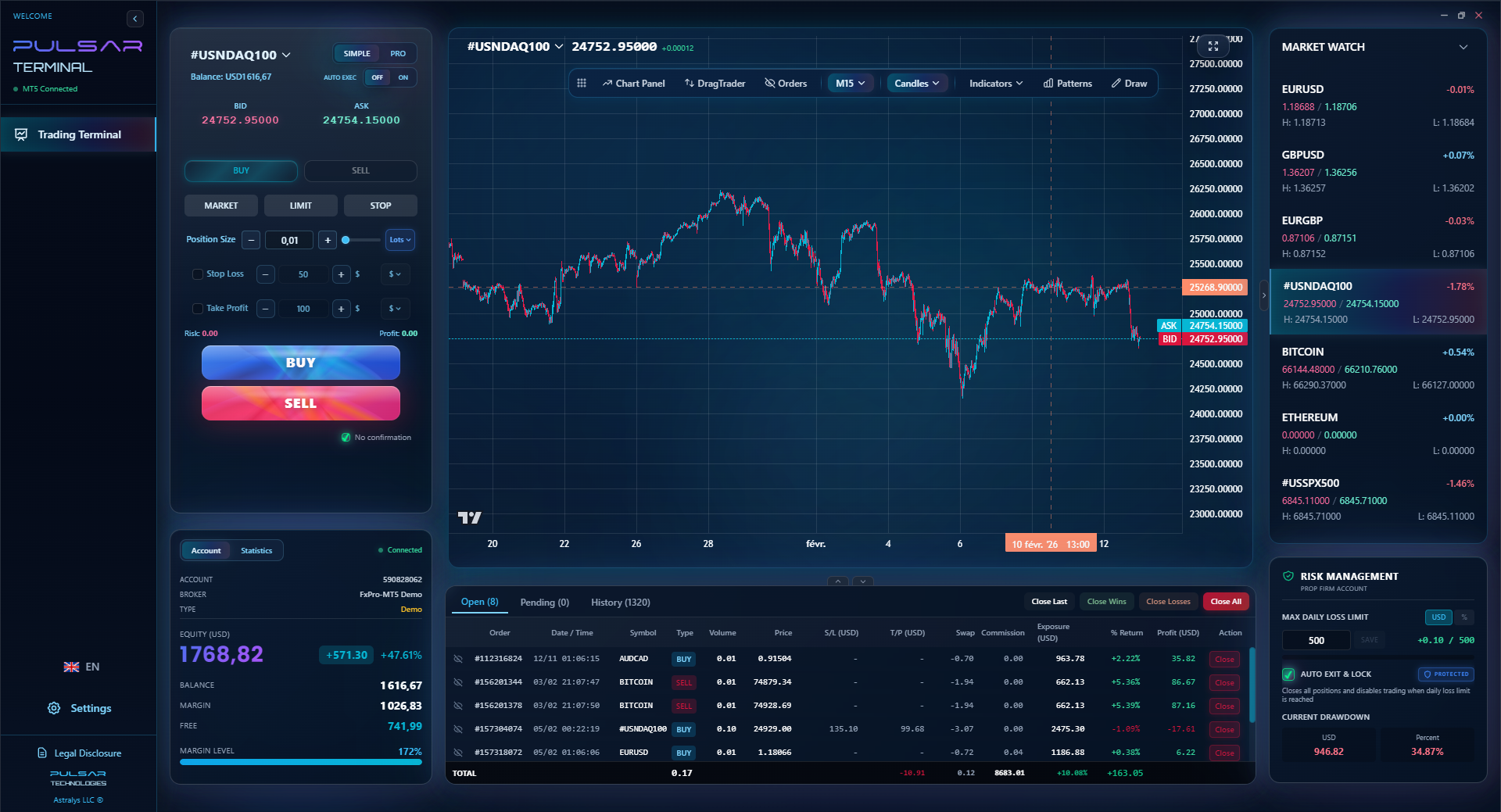
When trading in a lower-leverage environment, precise order management is key, and Pulsar Terminal's drag-and-drop orders and multi-TP/SL tools on MT5 help you execute complex risk plans without hesitation.
“The peace of mind of trading legally and declaring everything is, in my opinion, a huge part of your edge.”
With a SEBI broker, funding is trivial and instant. UPI is a game-changer. I can move funds from my bank to my Zerodha account in 10 seconds. Withdrawals hit my bank the same day or next. It's seamless.
With an offshore broker, you're dealing with international wire transfers, currency conversion fees (INR to USD), and possible scrutiny from your bank. Each transfer is a cross-border transaction that gets logged.
Now, taxes. This is non-negotiable. Profits from trading currency derivatives on Indian exchanges are treated as 'Business Income' or 'Speculative Business Income' if you're an active trader. You need to file ITR-3 and maintain proper books of account. You can deduct expenses like data feeds, brokerage, and even a home office portion.

Example: Let's say you make a profit of ₹5,00,000 from trading in a financial year. After deducting allowable expenses of ₹50,000, your taxable income is ₹4,50,000. This gets added to your other income and taxed at your applicable slab rate.
Trying to hide profits from an offshore broker account is a serious legal gamble. The tax authorities are getting smarter at tracking digital footprints. The peace of mind of trading legally and declaring everything is, in my opinion, a huge part of your edge. You sleep better, and you trade better.
💡 विंस्टन की सलाह
Specialization is freedom. Becoming an expert on just USD/INR and EUR/INR will yield more consistent returns than dabbling in 28 pairs you can't legally touch. Depth beats breadth in a regulated cage.

After 12 years, here's my honest take. The allure of offshore brokers is strong: more pairs, higher use, fancy platforms like MT5. But for an Indian resident, it's a compromised path. The regulatory risk hangs over every trade.
The legal path - trading INR pairs on Indian exchanges - is less glamorous but sustainable. It forces you to become a specialist in the Rupee. You learn about trade deficits, RBI repo rates, and how global risk-off flows impact USD/INR. You become a macro trader, which is a far more valuable and transferable skill in the long run.
Start with a demo account on a platform like Zerodha or Angel One. Get a feel for the liquidity and the order book. Paper trade USD/INR futures for a month. Track your results after including all statutory charges. It's a humbling experience.
If you absolutely must trade global pairs, consider other legal instruments. Some brokers offer access to currency ETFs or structured products that give you exposure without breaking FEMA. It's not the same as direct forex, but it's within the law.
Your journey with legal forex brokers in India is about working within clear boundaries. Within those boundaries, there's more than enough opportunity to build real skill and capital. The discipline this environment demands will make you a better trader anywhere in the world.

FAQ
Q1Can I legally trade EUR/USD if I use an international broker like XM or IC Markets?
No. As an Indian resident, trading any non-INR currency pair (like EUR/USD, GBP/USD) is a violation of the Foreign Exchange Management Act (FEMA), regardless of the broker you use. You are taking capital out of India's regulated framework to speculate on a prohibited market. The broker may accept you, but Indian law does not.
Q2What are the actual costs of trading USD/INR futures on NSE?
It's more than just the spread. You pay brokerage (e.g., ₹20 per order), exchange transaction charges, a SEBI turnover fee (0.0001%), GST (18% on all fees), and stamp duty. A typical round-turn trade can have a total cost of ₹40-₹50, meaning you need a move of several pips just to break even.
Q3Is use really that low with Indian brokers?
Yes. SEBI imposes strict use limits on currency derivatives to protect retail traders. You might get 1:10 to 1:20 margin, which is drastically lower than the 1:500 or 1:1000 offered offshore. This forces safer position sizing.
Q4How are profits from trading INR pairs taxed?
Profits are treated as 'Business Income' (or 'Speculative Business Income') if trading is your primary activity. You must file ITR-3, declare the income, and can claim deductions for related expenses (brokerage, software, internet). It's crucial to maintain clean records.
Q5What's the best payment method to fund a legal Indian trading account?
Unified Payments Interface (UPI) is the fastest and most seamless. Transfers from your bank to your broker's account are instantaneous and free. For offshore brokers, you'd need international wire transfers, which are slower, costlier, and more scrutinized.
Q6Can I use MetaTrader 5 (MT5) for legal forex trading in India?
Not for the legal INR pairs on Indian exchanges. SEBI-regulated brokers provide their own platforms (like Zerodha's Kite) or platforms like NEST Trader for accessing the NSE/BSE. You would only use MT5 if you were trading illegally with an offshore broker.
Q7What happens if I get caught trading forex illegally?
Potential consequences include penalties under FEMA, freezing of the funds in the offshore account, tax evasion charges, and legal action from authorities. Your bank may also flag your account for suspicious cross-border transactions.
प्रो. विंस्टन का पाठ
:
- ✓Legal trading is only on INR pairs: USD/INR, EUR/INR, GBP/INR, JPY/INR.
- ✓Add 18% GST to every fee calculation; it changes your profit targets.
- ✓Use UPI for instant, traceable funding with SEBI brokers.
- ✓Profits are taxable business income; file ITR-3.
- ✓Offshore use of 1:500 is a trap, not a feature.
यह लेख कितना उपयोगी था?
रेट करने के लिए स्टार पर क्लिक करें
साप्ताहिक ट्रेडिंग विश्लेषण
मुफ़्त साप्ताहिक विश्लेषण और रणनीतियाँ। कोई स्पैम नहीं।
लेखक के बारे में
Rajesh Sharma
वरिष्ठ फॉरेक्स विश्लेषक
भारतीय और दक्षिण एशियाई बाज़ारों में 10 साल से अधिक का ट्रेडिंग अनुभव। NSE करेंसी डेरिवेटिव्स से शुरुआत करके अंतरराष्ट्रीय फॉरेक्स में आए। USD/INR और इमर्जिंग मार्केट पेयर्स में विशेषज्ञता।
टिप्पणियाँ
आपको यह भी पसंद आ सकता है

Cara Trading Forex Sukses: 7 Prinsip dari Trader Profesional
Cara trading forex sukses dengan 7 prinsip trader pro: manajemen modal, disiplin, journal trading, backtest. Data nyata, bukan janji profit palsu.
Jam Trading Forex Terbaik untuk Trader Indonesia: Panduan Lengkap dengan Tabel Waktu
Panduan jam trading forex untuk trader Indonesia. Tabel 4 sesi dunia, jam emas 20:00-00:00, sesi mana yang harus dihindari. Data akurat + tips dari trader berpengalaman.
Top 5 Sàn Forex Uy Tín Nhất 2026: Review Jujur dari Trader Indonesia
Top 5 sàn forex uy tín 2026 untuk trader Indonesia. Review jujur: spread, deposit, withdraw, dukungan lokal. Exness, XM, IC Markets & lebih.
All these calculators are built into Pulsar Terminal with real-time data from your MT5 account. One-click position sizing, automatic risk management, and instant calculations.
