


It was October 2022, and the GBP/USD was in freefall.

Olumide Adeyemi
पश्चिम अफ्रीकी ट्रेडिंग अग्रणी ·  Nigeria
☕ 11 मिनट पढ़ने
आप क्या सीखेंगे:
It was October 2022, and the GBP/USD was in freefall. The pound had just crashed through 1.1000, a level not seen since 1985, after the UK's mini-budget. My phone was buzzing with messages from traders in Lagos asking if it was time to buy. I told them to look at the chart, not the headlines. That's the thing with the majors: they're liquid, they're volatile, and they'll humble you faster than you can say 'Liz Truss.' In Nigeria, where we're trading with one eye on the CBN and the other on our 10% tax bill, picking the right major pair isn't just about preference; it's about survival. Let's break down the seven that actually matter.
Forget the fancy definitions. A major forex pair is simply any currency pair that includes the US Dollar (USD) and one of the other big global economies. Think EUR/USD, GBP/USD, USD/JPY. They're the blue-chip stocks of the forex world.
Why do they dominate? Three words: liquidity, volatility, and information. The EUR/USD alone accounts for nearly a quarter of all daily forex volume. That means you can get in and out of trades with minimal slippage, even with larger positions. The spreads are tight, often below 1 pip on a good ECN account. For a Nigerian trader, this is crucial. Our internet can be shaky, and a wide spread on an exotic pair can eat your profit before the trade even moves.

Warning: High liquidity doesn't mean low risk. It just means the market can move very fast in one direction when big news hits. I've seen the USD/JPY rip 200 pips in an hour on a Bank of Japan whisper. Don't confuse activity with opportunity.
The majors are also the most reported on. You'll find analysis, forecasts, and economic calendars focused on them. This is a double-edged sword. It's easier to do your homework, but it also means everyone else is reading the same news. Your edge has to come from how you interpret it, not just what you know. For a solid foundation on the most traded pair, check out our deep dive on the EUR/USD guide.

💡 विंस्टन की सलाह
The market's job is to make you feel stupid right before it makes you rich. That shakeout below support on EUR/USD? That's it doing its job. Don't take it personally.
“In Nigeria, where we're trading with one eye on the CBN and the other on our 10% tax bill, picking the right major pair isn't just about preference; it's about survival.”
EUR/USD (The Euro / US Dollar)
The big kahuna. It's the most traded financial instrument on the planet. It's generally less volatile than the pound pairs but has deep, clean trends. It's heavily influenced by the ECB and Fed policy divergence. I find it responds beautifully to pure price action on the 4-hour and daily charts. A classic trade for me was shorting at 1.0950 in September 2023 after a clear rejection at the 1.1000 psychological level, riding it down to 1.0650 for a 300-pip gain. It's a pair that rewards patience.
GBP/USD (The Pound / US Dollar)
Also known as 'Cable.' This pair has personality. It's volatile, emotional, and prone to sharp reversals. It loves UK politics and Bank of England rhetoric. The spreads are slightly wider than EUR/USD, but the moves can be bigger. I got burned in 2019 trying to fade a Brexit headline gap. Lesson learned: never trade Cable around major UK political announcements without a massive stop loss.
USD/JPY (The US Dollar / Japanese Yen)
This is the carry trade king. When the Fed is hiking and the Bank of Japan is doing nothing, this pair trends up beautifully. It's a fantastic pair for swing trading trends that can last for months. The key level to watch is the 10-year US Treasury yield. When yields rise, USD/JPY usually follows. It can be prone to sudden, violent interventions by the Japanese Ministry of Finance, which is why I always use a trailing stop once a trend is established.
AUD/USD, USD/CAD, NZD/USD (The Commodity Dollars)
These are your economic barometers. AUD/USD is a proxy for Chinese demand and iron ore. USD/CAD (the 'Loonie') lives and dies with oil prices. NZD/USD follows dairy prices. If you have a view on commodities, trade these. They're more volatile than EUR/USD and can gap over weekends if commodity markets move. I once caught a nice 150-pip rally on AUD/USD off a key support level after a strong Chinese PMI print. Always check the commodity calendar alongside the economic one.
USD/CHF (The US Dollar / Swiss Franc)
The 'Swissie.' It's often seen as a safe-haven pair, but honestly, it's become more of a euro proxy (since the EUR/CHF is heavily managed). It's the least volatile of the majors and often moves in the opposite direction of the EUR/USD. I use it mostly for hedging or when I want exposure to the dollar without the noise of the other pairs.

Example: Let's say you trade a standard lot (100,000 units) on EUR/USD. A 1 pip move is worth $10. If you buy at 1.0800 and sell at 1.0830, that's a 30-pip gain, or $300, before spreads and commissions. Now, apply the 10% Nigerian capital gains tax. You owe FIRS $30 on that trade. Always factor that into your profit targets. Use a position size calculator to work this out before you enter.
“High liquidity doesn't mean low risk. It just means the market can move very fast in one direction when big news hits.”
Trading from Nigeria adds layers you won't read about in generic guides. First, the tax man. The Federal Inland Revenue Service (FIRS) wants 10% of your gross profits. Not net, gross. That means if you have a winning trade and a losing trade in a day, you still owe tax on the winner. It changes your entire risk calculus. You need a higher win rate or larger winning trades to be profitable after tax.
Second, funding. The CBN doesn't want you using official windows to fund forex trading accounts. You'll be using international payment processors, cards, or sometimes crypto. This adds cost and delay. Choose a broker with multiple, reliable deposit options for Nigeria. I've had good experiences with brokers like Exness and XM for smooth deposits and withdrawals in Naira.
Third, use. It's tempting to use the 1:1000 or even 1:2000 offered by some brokers. Don't. With the volatility of majors, especially around news, high use is a one-way ticket to a margin call. I never use more than 1:50 on majors, even on a small account. A 2% move against you at 1:1000 use wipes you out. It's that simple.
Finally, broker choice. You need a broker regulated by a reputable authority (like the FCA, ASIC, or CySEC) that accepts Nigerian clients. Check their average spreads on the majors you want to trade. A broker like IC Markets or Pepperstone might offer raw spreads of 0.1 pips on EUR/USD but charge a commission. Do the math to see if that's cheaper than a 'commission-free' broker with a 1.5 pip spread.
“High liquidity doesn't mean low risk. It just means the market can move very fast in one direction when big news hits.”
You can't trade all seven the same way. Each has a personality.
Economic Calendar is King: For EUR/USD and GBP/USD, Non-Farm Payrolls (NFP), CPI inflation data, and central bank meetings are non-negotiable events. I often close all positions 30 minutes before a high-impact news release. The volatility isn't worth the gamble.
Time Your Sessions: The London (8 AM - 5 PM GMT) and New York (1 PM - 10 PM GMT) overlaps are when the majors see the most volume and clearest moves. As a Nigerian trader (GMT+1), this is perfect. The overlap happens from 2 PM to 5 PM our time. That's your prime trading window.
Keep It Simple: I use a combination of:
- Price Action: Support/Resistance, trend lines, and candlestick patterns.
- Two Indicators: The RSI indicator for overbought/oversold conditions and the MACD indicator for trend confirmation and momentum shifts.
- Volume: Not the fake MT4 volume, but if your platform shows tick volume, a surge often precedes a big move.
My biggest mistake early on was overcomplicating charts with 10 indicators. A clean chart lets you see what the market is actually doing. For fast-moving conditions, a scalping strategy might work on EUR/USD during the overlap, but you need a broker with ultra-low latency and tight spreads.
💡 विंस्टन की सलाह
Your first loss is your best loss. A trade that goes 10 pips against you and hits your stop is a good trade. A trade that goes 50 pips against you and you're still hoping is a disaster in progress.
“Your edge has to come from how you interpret the news, not just what you know.”
Let's talk real numbers. Your profitability on majors is directly tied to your costs. Here’s a comparison of what you might actually pay as a Nigerian trader.
| Broker (Example) | Avg. EUR/USD Spread | Commission (per standard lot) | Effective Cost per Trade* | Good For... |
|---|---|---|---|---|
| 'Commission-Free' Broker | 1.2 pips | $0 | $12 | Beginners, small accounts where commission would be a large %. |
| 'Raw Spread' ECN Broker | 0.1 pips | $3.50 per side | $7 ($0.70 spread + $7 commission) | Active traders, scalpers, larger accounts. |
*Effective Cost = (Spread in pips x $10) + Commission. Assumes 1 standard lot.
As you can see, the 'commission-free' broker isn't always cheaper. If you're trading 5 lots a day, those extra costs add up fast.
Other Nigerian Costs:
- Swap Fees: Holding a GBP/USD long position overnight might cost you a few dollars. It can add up if you're a long-term swing trader.
- Deposit/Withdrawal Fees: Some brokers charge, some don't. Some payment processors charge a percentage. This is a hidden cost that can eat 2-5% of your capital if you're not careful.
- Inactivity Fees: If you don't trade for 3-6 months, some brokers will start charging you. Read the fine print.
My advice? Start with a broker offering a $0 or very low minimum deposit to test their platform and execution. XM and Exness are popular here for that reason. But as you grow, seriously consider moving to a tier-1 regulated broker with transparent pricing, even if the minimum is higher, like IC Markets at $200.
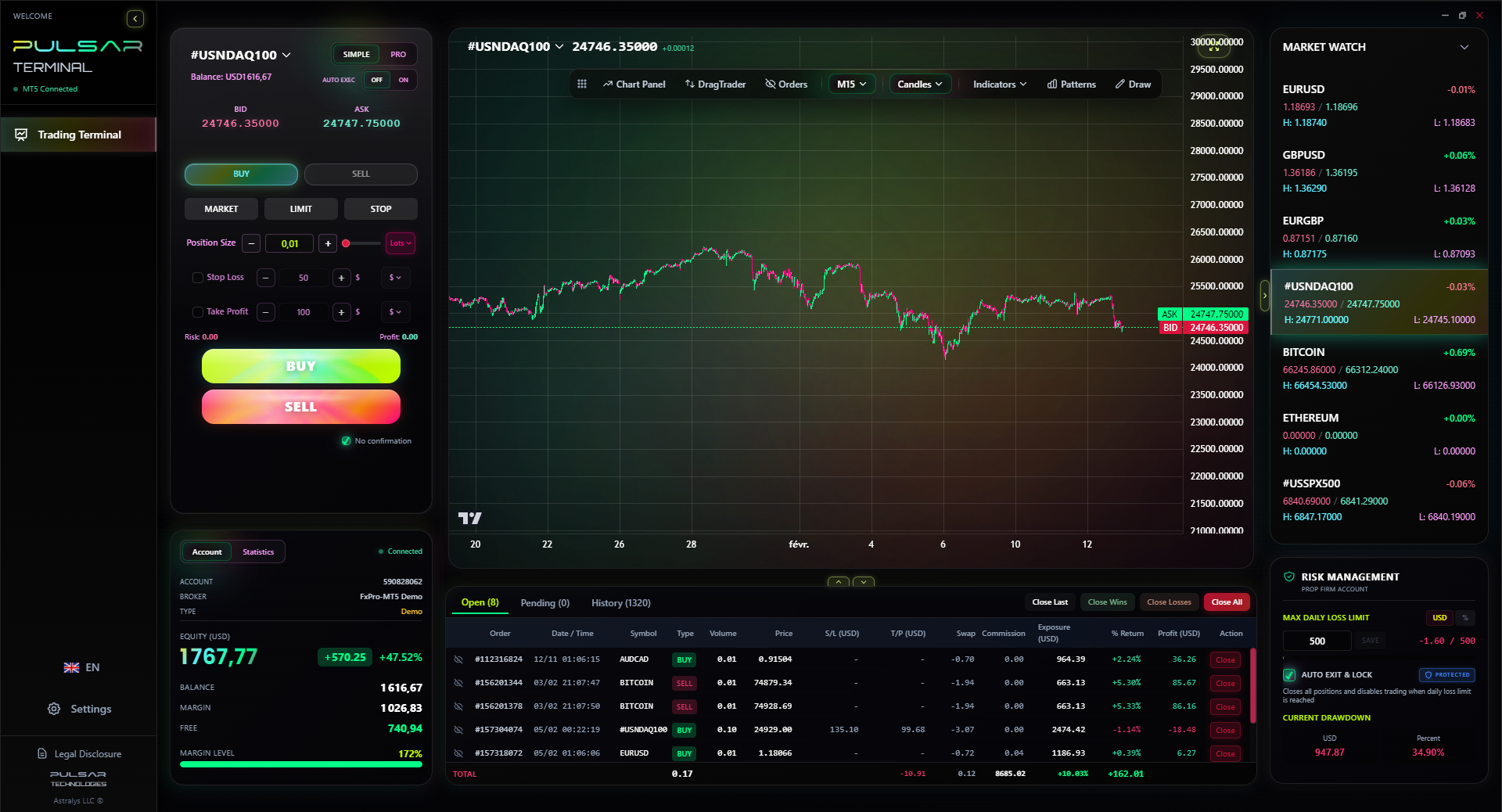
Managing multiple trades on volatile majors is a headache, but tools like Pulsar Terminal let you set multi-level take-profits and trailing stops on MT5 with one click, so you can lock in profits as the market moves.
“Your edge has to come from how you interpret the news, not just what you know.”
I've made these mistakes so you don't have to.
1. Chasing News: You see NFP come out bullish for the USD, and EUR/USD drops 30 pips in seconds. You jump in to short, only for it to reverse and rally 50 pips. News is often 'bought' or 'sold.' Wait for the initial volatility spike to settle and look for a price action confirmation (like a rejection candle at a key level) before entering.
2. Ignoring Correlations: EUR/USD and GBP/USD often move in the same direction. Going long on both is effectively doubling your risk on one bet (a stronger dollar). It's not diversification.
3. Misunderstanding the Pip: A pip on USD/JPY is not the same as a pip on EUR/USD when calculating profit? Actually, for most majors where USD is the quote currency (XXX/USD), a pip is always $10 on a standard lot. But for pairs where USD is the base currency (USD/XXX), the pip value fluctuates. Know your pip definition and value.
4. Trading Without a Stop Loss: This is suicide, especially on majors. A 'flash crash' or a surprise central bank intervention can move a pair 2% in minutes. If you're leveraged 1:100, that's a 200% loss. Always, always use a stop.
5. Letting Tax Dictate Trades: Never hold a losing trade just to avoid booking a profit and triggering a tax event. A small tax bill is better than a large, growing loss. Cut your losers fast.
“A small tax bill is better than a large, growing loss. Cut your losers fast.”
Mastering the major forex trading pairs is the foundation of a lasting trading career. You don't need to trade all seven. Pick two or three that match your personality and schedule. Are you patient? Try swing trading USD/JPY. Do you like action? Watch GBP/USD during London hours.
For Nigerian traders, the equation has an extra variable: the 10% gross profit tax. This makes consistent, disciplined strategy even more critical. Your edge must be wide enough to cover spreads, commissions, and the FIRS's cut.
Start with a demo account. Paper trade your chosen majors for at least three months through different market conditions (trending, ranging, high volatility). Then, fund a small live account with money you can afford to lose. Treat every trade as a lesson. Journal your entries, exits, and, most importantly, your emotional state.
The majors will always be there. They offer more than enough opportunity. The question is whether you have the discipline to wait for the right one. Focus on the process, manage your risk ruthlessly, and the profits will follow. Now go look at those charts.
FAQ
Q1Which major forex pair is best for beginners in Nigeria?
EUR/USD, no contest. It has the tightest spreads, the most liquidity (meaning less slippage), and the most available analysis. Its movements are generally smoother than something like GBP/USD. This lets you focus on learning price action and risk management without getting whipsawed constantly. Just remember, 'best for beginners' doesn't mean 'easiest to profit from.'
Q2How do I pay the 10% capital gains tax on forex profits in Nigeria?
You are responsible for declaring and paying it yourself to the Federal Inland Revenue Service (FIRS). The broker won't do it for you. Keep detailed records of all your trades (profits and losses). At the end of the tax year, you calculate your total gross profits from all winning trades. You owe 10% of that total. You file and pay through the FIRS portal or at a tax office. It's a good idea to consult a local accountant familiar with trader taxes.
Q3Can I trade major pairs with a small account like $50?
Technically, yes. Some brokers allow it. But practically, it's incredibly difficult and risky. With $50, even at 1:100 use, you're controlling $5,000. A 1% move against you (50 pips on EUR/USD) wipes out half your account. You'll be forced to use micro or nano lots, and trading costs (as a percentage of your capital) will be high. I'd strongly recommend saving until you have at least $200-$500 to start, which allows for sensible position sizing and breathing room.
Q4What time is best to trade major pairs from Nigeria?
The sweet spot is 2:00 PM to 5:00 PM Nigerian Time (GMT+1). This is when the London and New York trading sessions overlap (1 PM - 5 PM GMT). This 4-hour window has the highest trading volume and volatility, creating the best opportunities for clear, directional moves on pairs like EUR/USD, GBP/USD, and USD/JPY.
Q5Is high use (like 1:1000) good for trading majors?
No, it's a trap. High use magnifies both profits and losses. The major pairs can easily move 1-2% in a day. A 1% move against you at 1:1000 use wipes out your entire account. It encourages over-trading and poor risk management. For trading majors, I never recommend using more than 1:50 use, and often use much less. Your focus should be on percentage risk per trade (e.g., 1% of your account), not on how much you can borrow.
Q6Do I need to follow all the economic news for each major pair?
Not all of it, but you must know the key releases. For EUR/USD and GBP/USD, you must be aware of US Non-Farm Payrolls, CPI inflation data from both regions, and European Central Bank (ECB) / Federal Reserve / Bank of England (BoE) meetings. For USD/JPY, watch US data and any comments from the Bank of Japan. For commodity dollars (AUD, CAD, NZD), watch their respective CPI and employment data, plus key commodity prices (iron ore, oil, dairy). Use an economic calendar and set alerts.
प्रो. विंस्टन का पाठ
:
- ✓Master EUR/USD first; it's the most liquid and forgiving.
- ✓10% Nigerian tax on gross profits demands a higher win rate.
- ✓Never use more than 1:50 use on volatile majors.
- ✓Trade the 2 PM - 5 PM WAT overlap for the best moves.
- ✓A tight stop-loss is cheaper than the FIRS and your pride.
यह लेख कितना उपयोगी था?
रेट करने के लिए स्टार पर क्लिक करें
साप्ताहिक ट्रेडिंग विश्लेषण
मुफ़्त साप्ताहिक विश्लेषण और रणनीतियाँ। कोई स्पैम नहीं।
लेखक के बारे में
Olumide Adeyemi
पश्चिम अफ्रीकी ट्रेडिंग अग्रणी
नाइजीरिया के सबसे सक्रिय फॉरेक्स ट्रेडिंग एजुकेटर्स में से एक। लागोस से 8 साल का ट्रेडिंग अनुभव। अफ्रीकी ट्रेडर्स के लिए लो-कैपिटल स्ट्रैटेजीज और प्रॉप फर्म चैलेंजेज में विशेषज्ञ।
टिप्पणियाँ
आपको यह भी पसंद आ सकता है

Cara Trading Forex Sukses: 7 Prinsip dari Trader Profesional
Cara trading forex sukses dengan 7 prinsip trader pro: manajemen modal, disiplin, journal trading, backtest. Data nyata, bukan janji profit palsu.
Jam Trading Forex Terbaik untuk Trader Indonesia: Panduan Lengkap dengan Tabel Waktu
Panduan jam trading forex untuk trader Indonesia. Tabel 4 sesi dunia, jam emas 20:00-00:00, sesi mana yang harus dihindari. Data akurat + tips dari trader berpengalaman.
Top 5 Sàn Forex Uy Tín Nhất 2026: Review Jujur dari Trader Indonesia
Top 5 sàn forex uy tín 2026 untuk trader Indonesia. Review jujur: spread, deposit, withdraw, dukungan lokal. Exness, XM, IC Markets & lebih.
All these calculators are built into Pulsar Terminal with real-time data from your MT5 account. One-click position sizing, automatic risk management, and instant calculations.
