


Think you can just buy the dip and sell the rip on Nifty forever? That's the seductive promise of a mean reversion trading strategy.

Rajesh Sharma
वरिष्ठ फॉरेक्स विश्लेषक ·  India
India
☕ 12 मिनट पढ़ने
आप क्या सीखेंगे:
- 1What Mean Reversion Actually Means (And What It Doesn't)
- 2SEBI's 2026 Algo Rules: The Game Has Changed
- 3The Real Cost of Trading in India: Why Theory Fails
- 4Building a strong Mean Reversion Strategy for Nifty & Stocks
- 5Brokers, Platforms, and Tools for 2026
- 6The Pitfalls: Where I (And You) Will Go Wrong
- 7Final Verdict: Is Mean Reversion Worth It in 2026?
Think you can just buy the dip and sell the rip on Nifty forever? That's the seductive promise of a mean reversion trading strategy. The math looks beautiful on paper: prices swing away from their average and then snap back. It feels logical, almost inevitable. But here in India, with SEBI's new 2026 rules clamping down and transaction costs eating you alive, is it still a viable way to trade, or a fast track to joining the 93% of retail traders who lose money? Let's strip away the theory and look at the cold, hard numbers.
At its core, mean reversion is the financial version of "what goes up must come down." It's the idea that an asset's price will tend to move back towards its historical average over time. You identify when a stock or index is statistically stretched - overbought or oversold - and bet on it returning to normal.
In the Indian context, you might look at Nifty 50 or Bank Nifty hitting extreme levels on the RSI indicator or Bollinger Bands and plan a trade. The theory is solid. The practice is where it gets messy.
Here's what most tutorials won't tell you: mean reversion assumes a stable average. In a trending market, that 'average' is a moving target. I learned this the hard way in 2022 shorting Bank Nifty during its relentless rally. The RSI was screaming 'overbought' for weeks. I kept selling, convinced reversion was due. The index just kept going. I blew up 15% of my account fighting the trend before I finally stepped aside. A pure mean reversion strategy ignores momentum, and momentum can bankrupt you.

Warning: A market can stay irrational longer than you can stay solvent. This isn't just a fancy quote; it's the fundamental risk of mean reversion. You're betting against the current price action, which is a dangerous game.
“A pure mean reversion strategy ignores momentum, and momentum can bankrupt you.”
If you're planning to automate your mean reversion strategy (and you should, if you're serious), you need to understand the new landscape. SEBI's framework, fully mandatory since April 1, 2026, was built for this. The wild west days of unchecked algo trading are over.
The New Reality for Retail Algo Traders
First, forget about running some Python script from your laptop directly to the exchange. That's illegal now. Every algorithm must be hosted on your broker's infrastructure. Brokers like Zerodha, Upstox, and Angel One are now legally responsible for every algo running on their systems. This has made them incredibly cautious.
Second, every single order your strategy places must carry a unique Algo ID assigned by the exchange (NSE/BSE). If your system places more than 10 orders per second in a segment, it's officially an algo and needs formal registration. Even below that threshold, you need a 'Generic Algo ID.' There's no hiding.
What This Means for Your Strategy
Let's say you're building a mean reversion bot for Nifty futures. You plan to scale in as price moves further from the VWAP. Under the new rules:
- Your entire code logic needs approval from your broker and the exchange before you can trade a single rupee with it.
- Your API access must come from a static, whitelisted IP address. No trading from your phone on mobile data.
- You must use strong two-factor authentication (2FA).
The goal is safety and auditability. The cost is friction. Testing and deploying a strategy now involves more paperwork and broker compliance checks than ever before. This directly impacts strategies that rely on high order frequency, a common feature in sophisticated mean reversion systems that scale in and out.

💡 विंस्टन की सलाह
Your first ₹50,000 in trading should be spent on education and simulated trading, not live markets. Blowing it on tuition is smarter than donating it to the market.
“You need to make at least ₹550 in gross profits just to break even on costs. That changes your entire risk-reward math.”
This is where most mean reversion backtests die. You see a beautiful equity curve in your simulation, then you trade it live and lose money. Why? Because you didn't account for the Indian market's silent partners: the taxman and the broker.
Let's break down a single ₹1,00,000 trade in Nifty futures, assuming a profitable exit:
| Cost Component | Approximate Charge | Who Gets It |
|---|---|---|
| Brokerage | ₹20 per order (₹40 round turn) | Your Broker |
| Exchange Transaction Charge | ~₹5.30 per ₹1 lakh | NSE |
| SEBI Turnover Fee | ₹1.50 per ₹1 crore (negligible) | SEBI |
| GST (on brokerage + charges) | 18% on the above (~₹8) | Government |
| Stamp Duty | ₹200 per ₹1 crore (State specific) | State Government |
Your total cost for this one trade: Roughly ₹53-₹55.
Now, a typical mean reversion trade on a 15-minute chart might aim for a 0.3% move (30 points on Nifty). On ₹1 lakh, that's ₹300. Sounds good? Minus ₹55 in costs, your profit is ₹245. That's an 18% haircut on your gross profit before you even blink.

Example: If your strategy has a 60% win rate and makes 10 trades a day, your daily cost is ₹550. You need to make at least ₹550 in gross profits just to break even on costs. That changes your entire risk-reward math.
And we haven't even talked about slippage. In fast markets, your limit order might not get filled, or your market order fills much worse than expected. I once had a mean reversion stop-loss on Bank Nifty trigger with 15 points of slippage. That one event wiped out the profits from three previous successful trades. You must use a position size calculator that includes a realistic slippage assumption, or you're fooling yourself.
The biggest statistic you must internalize: In FY 2024, 93% of non-algorithmic retail traders lost money in the F&O segment. A large chunk of them were probably trying some version of 'buy low, sell high.' The costs and poor execution ate them alive.
“You need to make at least ₹550 in gross profits just to break even on costs. That changes your entire risk-reward math.”
Forget copying a simple RSI strategy from a blog. To have a shot, you need layers of confirmation. Here’s a framework I’ve used, combining mean reversion with trend filtering.
Step 1: Define Your "Mean"
Don't just use a simple moving average (SMA). For indices like Nifty, a Volume-Weighted Average Price (VWAP) or a moving average of the daily pivot point is often more relevant. For individual stocks, a 20-period exponential moving average (EMA) on the hourly chart can work. The key is to test which 'mean' the specific asset actually reverts to.
Step 2: Identify the Extreme
This is where indicators come in. But use them as a committee, not a dictator.
- Bollinger Bands: Price touching or breaking the outer band (2 standard deviations) is a classic signal.
- RSI: Readings above 70 (overbought) or below 30 (oversold). But in a strong trend, I only take signals in the direction of the trend. In an uptrend, I only look for oversold RSI readings to buy.
- Market Context: Is price at a major previous support or resistance level on the higher timeframe? A mean reversion signal at a key level is worth ten signals in the middle of nowhere.
Step 3: The Trend Filter (The Most Important Step)
This saved my account. Never take a mean reversion signal against the dominant higher timeframe trend. How do you define trend? I keep it simple:
- For swing trading: Price above the 200-day EMA = uptrend. Only look for buy (oversold) signals. Price below = downtrend. Only look for sell (overbought) signals.
- For intraday: Price above the VWAP on the 30-minute chart = bias is up. Look for dips to buy.
Step 4: Entry, Stop Loss, and Take Profit
Entry: Don't market order. Place a limit order at the level you've identified (e.g., at the lower Bollinger Band). Let the market come to you.
Stop Loss: This is critical. Your stop must be placed beyond the extreme. If you're buying at the lower Bollinger Band, your stop should be a set distance below it (e.g., 1.5x the band width). If the price breaks that, the mean reversion premise is broken.
Take Profit: Your first target is the mean (the middle Bollinger Band or your moving average). You can take partial profit there and trail the rest. This is where tools that manage multiple take-profit levels automatically become useful.

Pro Tip: Backtest this with costs included. Use a platform like Streak (Zerodha) or Tradetron that lets you bake in brokerage, taxes, and an assumed slippage of 1-2 points for Nifty. If it's not profitable after costs in the backtest, it will destroy your live account.
💡 विंस्टन की सलाह
If you can't clearly write down your strategy's rules on one page - including entry, exit, stop loss, and position size - you don't have a strategy. You have a hope.
“Your edge in 2026 won't be knowing about Bollinger Bands. Everyone knows that. Your edge will be in superior execution.”
Your choice of broker and platform is now a strategic decision, not just about who has the cheapest brokerage.
Brokers Supporting Algo Trading
- Zerodha (Kite Connect): The giant. strong API, but you pay ₹2000/month for Kite Connect. Their in-house no-code platform, Streak, is excellent for building and testing strategies without coding.
- Upstox (Pro API): Free API access. Gaining popularity quickly among algo developers.
- Angel One (SmartAPI): Also free API. Good documentation and community.
- Fyers, Dhan, Shoonya: Offer free or low-cost API options. Dhan might charge for data feeds.
Remember, under SEBI's 2026 rules, all these brokers must approve and host your strategy. Their risk teams will scrutinize it.
No-Code/Low-Code Platforms (A Lifesaver)
If you're not a coder, these are your best friends. They let you build, backtest, and deploy strategies visually, and they handle all the exchange compliance and Algo ID tagging.
- Streak by Zerodha: Integrated with Zerodha, very user-friendly.
- Tradetron: Supports multiple brokers. Powerful backtesting engine.
- uTrade Algos, Sensibull: Good for options-based mean reversion strategies.
The Tool You Didn't Know You Needed
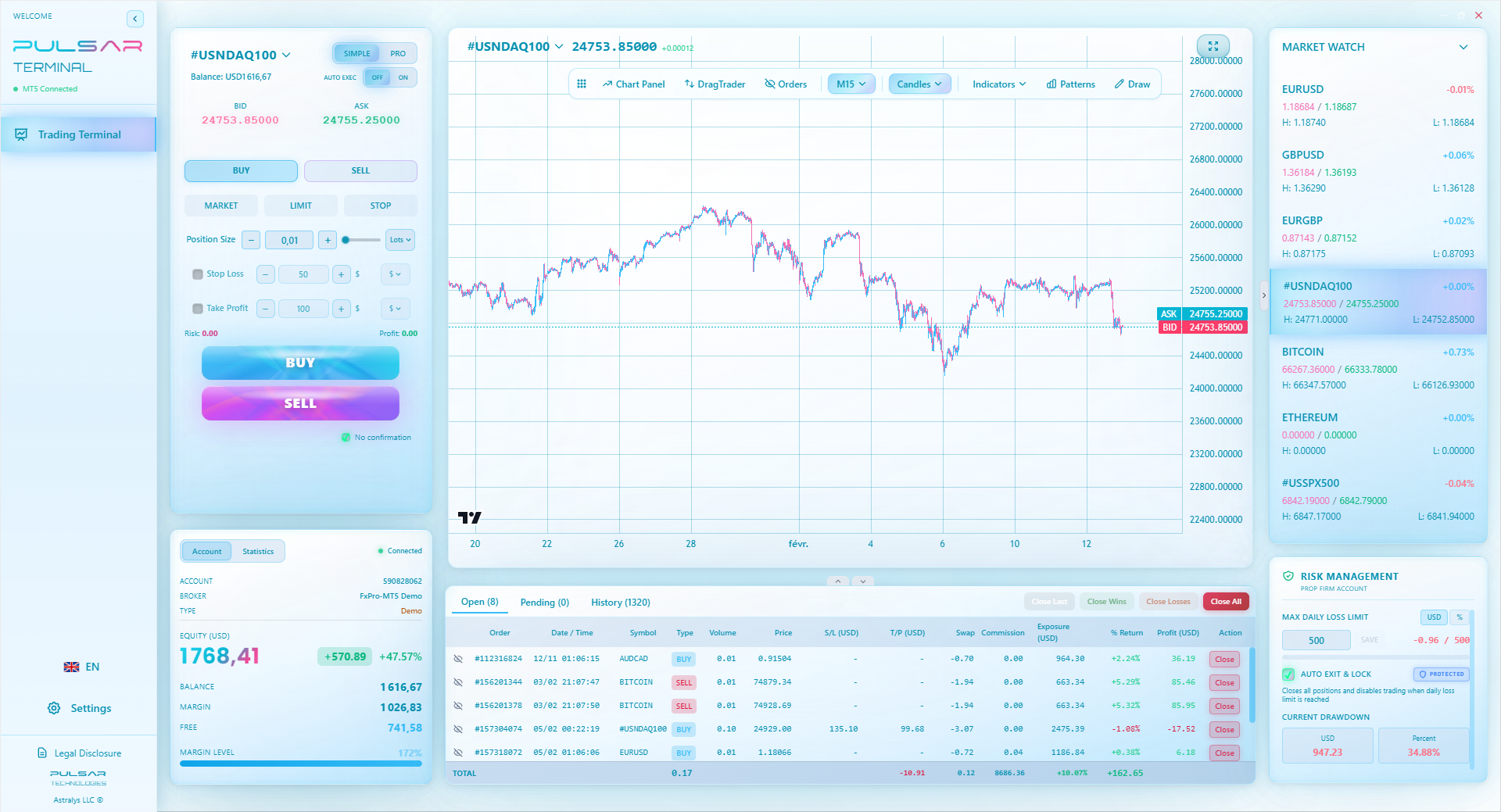
When running a live strategy, managing multiple trades with partial closures, trailing stops, and breakeven levels is a manual nightmare. This is where a dedicated trade management terminal shines. Imagine automating your trailing stop to kick in after price moves 1x your risk, or scaling out of a position at three predefined profit targets without staring at the screen.
Having this automation is the difference between executing your plan perfectly and making an emotional mistake when the market moves fast. For strategies that require precise order management beyond a simple buy and sell, this isn't a luxury; it's a necessity for consistent execution.
Managing multiple profit targets and trailing stops for a mean reversion strategy is complex, but tools like Pulsar Terminal automate this execution directly on your MT5 platform.
“Your edge in 2026 won't be knowing about Bollinger Bands. Everyone knows that. Your edge will be in superior execution.”
Let me save you some money by sharing where I've set it on fire.
Pitfall 1: Reversion to the Wrong Mean. In 2023, I built a strategy around the 50-day SMA for a midcap stock. It worked for months. Then the company had a stellar earnings report, and the stock entered a new, higher trading range. The old 50-day SMA was now support, not a mean to revert to. The strategy kept shorting the 'overbought' moves in the new uptrend and got slaughtered. The lesson? Periodically re-check if your chosen 'mean' is still valid.
Pitfall 2: Ignoring Liquidity. Trying mean reversion on a low-volume stock is suicide. The spread will kill you, and slippage will be enormous. Stick to high-liquidity instruments like Nifty, Bank Nifty, and large-cap stocks. Even better, focus on the most liquid options contracts if that's your arena.
Pitfall 3: Over-optimization. You can curve-fit a strategy to the past data perfectly. It will look like a money printer in backtest and fail immediately in live markets. My rule: if you're adding more than 3 conditions to your strategy, you're probably overcomplicating it. The market doesn't care about your clever RSI+MACD+Stochastic soup.
Pitfall 4: Poor Position Sizing. This is the ultimate killer. A 2% loss feels like nothing. A 2% loss on ten consecutive failed trades (which happens) is a 20% drawdown that will shatter your psychology. Never risk more than 1% of your capital on a single mean reversion setup. The market will give you streaks of losses; your job is to survive them.
Pitfall 5: Not Accounting for the New Rules. Trying to deploy a strategy that places 20 quick orders to scale in? Under the 10 OPS rule, that will require formal algo registration. Your broker will flag it. Build your strategy with the regulatory limits in mind from day one.
💡 विंस्टन की सलाह
The moment you find yourself saying 'this time is different' to justify a trade that breaks your rules, shut down the platform. You've switched from trading to gambling.
“Never take a mean reversion signal against the dominant higher timeframe trend. This saved my account.”
So, after all this, should you bother?
If you're a casual trader looking for a simple 'set and forget' system, no. The regulatory overhead, the cost structure, and the market's tendency to trend make it a brutal path. You're likely to become part of the losing 93%.
If you're a disciplined, process-oriented trader or a budding quant who enjoys the grind, yes, but with major caveats.
- You must treat it as a systematic business. That means coding or using a strong platform, rigorous backtesting with real costs, and strict risk management.
- You must integrate a trend filter. Pure mean reversion is a martyr's game.
- You must embrace the new SEBI compliance framework. It's not going away; it's the cost of admission.
- You need sufficient capital. Starting with ₹50,000 to test an intraday strategy is possible, but you have no room for error. For a serious swing trading system, consider at least ₹2-5 lakhs to allow for proper position sizing and drawdowns.
The algorithmic trading market in India is projected to hit ₹19,000 crore by 2030. The money is flowing there. But it's flowing to the professionals, the funds, and the disciplined systematic traders. The old, manual way of 'buying the dip' is being squeezed out by costs and complexity.
Your edge in 2026 won't be knowing about Bollinger Bands. Everyone knows that. Your edge will be in superior execution, stricter discipline, and a system that respects the real-world friction of the Indian markets. Build that, and you have a fighting chance.
FAQ
Q1What is the simplest mean reversion strategy I can start with in India?
For Nifty 50 intraday, try this: On a 15-minute chart, plot Bollinger Bands (20,2). Only take trades in the direction of the 200-period EMA on the hourly chart (your trend filter). If the trend is up, wait for price to touch the lower Bollinger Band. Place a buy limit order there. Set a stop loss just below the band. Set your first take-profit target at the middle band. Backtest this for 6 months with all costs included before trading a single rupee.
Q2How much capital do I realistically need to start mean reversion trading?
For intraday on Nifty futures, you need enough to cover the margin (roughly ₹1.2-1.5 lakh per lot) plus a buffer for losses. Realistically, don't start with less than ₹3 lakhs if you want to trade one lot and survive a drawdown. For stocks, you can start smaller (₹50k-₹1 lakh), but remember, lower capital forces smaller position sizes, making it harder to overcome fixed transaction costs.
Q3What are the biggest SEBI rules affecting my mean reversion algo in 2026?
Two are critical: 1) Your algo must be hosted and approved by your broker (you can't run it from your own server). 2) Every order carries a unique Algo ID. If your strategy places more than 10 orders per second, it requires formal exchange registration. This directly impacts strategies that use rapid scaling-in of orders.
Q4Why does my profitable backtest fail in live trading?
Three main reasons: 1) You didn't include all transaction costs (brokerage, STT, GST, charges) and slippage in your backtest. 2) You over-optimized the strategy to past data (curve-fitting). 3) Market dynamics changed; the 'mean' your strategy reverts to may have shifted. Live trade with tiny size for at least a month to see real-world performance.
Q5Can I use mean reversion for Bank Nifty options?
Yes, but it's advanced and risky. Options have decaying time value (theta) and are sensitive to volatility (vega). A mean reversion in price might not save you if volatility explodes or time decay eats your premium. It's better suited for futures or the spot index. If you do trade options, use far-out-of-the-money options to define your risk, and be acutely aware of expiry.
Q6Is mean reversion better than trend following in India?
Neither is inherently 'better.' They perform in different market conditions. Mean reversion works well in ranging, sideways markets. Trend following works in sustained directional moves. The Indian market has periods of both. The smart approach is to have a way to identify the market regime (ranging vs. trending) and then apply the appropriate strategy, or to use a trend filter on your mean reversion trades as outlined in the article.
प्रो. विंस्टन का पाठ
:
- ✓Always filter mean reversion with the higher timeframe trend.
- ✓Include all transaction costs + 2-point slippage in backtests.
- ✓Under SEBI's 2026 rules, broker approval is mandatory for algos.
- ✓Risk a maximum of 1% of capital per trade to survive drawdowns.
यह लेख कितना उपयोगी था?
रेट करने के लिए स्टार पर क्लिक करें
साप्ताहिक ट्रेडिंग विश्लेषण
मुफ़्त साप्ताहिक विश्लेषण और रणनीतियाँ। कोई स्पैम नहीं।
लेखक के बारे में
Rajesh Sharma
वरिष्ठ फॉरेक्स विश्लेषक
भारतीय और दक्षिण एशियाई बाज़ारों में 10 साल से अधिक का ट्रेडिंग अनुभव। NSE करेंसी डेरिवेटिव्स से शुरुआत करके अंतरराष्ट्रीय फॉरेक्स में आए। USD/INR और इमर्जिंग मार्केट पेयर्स में विशेषज्ञता।
टिप्पणियाँ
आपको यह भी पसंद आ सकता है

Cara Trading Forex Sukses: 7 Prinsip dari Trader Profesional
Cara trading forex sukses dengan 7 prinsip trader pro: manajemen modal, disiplin, journal trading, backtest. Data nyata, bukan janji profit palsu.
Jam Trading Forex Terbaik untuk Trader Indonesia: Panduan Lengkap dengan Tabel Waktu
Panduan jam trading forex untuk trader Indonesia. Tabel 4 sesi dunia, jam emas 20:00-00:00, sesi mana yang harus dihindari. Data akurat + tips dari trader berpengalaman.
Top 5 Sàn Forex Uy Tín Nhất 2026: Review Jujur dari Trader Indonesia
Top 5 sàn forex uy tín 2026 untuk trader Indonesia. Review jujur: spread, deposit, withdraw, dukungan lokal. Exness, XM, IC Markets & lebih.
All these calculators are built into Pulsar Terminal with real-time data from your MT5 account. One-click position sizing, automatic risk management, and instant calculations.
