


You've probably downloaded a 'pivot point trading strategy pdf' hoping for a magic formula.

Rajesh Sharma
वरिष्ठ फॉरेक्स विश्लेषक ·  India
India
☕ 12 मिनट पढ़ने
आप क्या सीखेंगे:
- 1What Are Pivot Points, Really? (It's Not Rocket Science)
- 2The 3 Fatal Mistakes Indian Traders Make With Pivots
- 3A Profitable, Simple Pivot Point Setup for Nifty & Bank Nifty
- 4SEBI's New Algo Rules: Can You Even Automate a Pivot Strategy?
- 5How Taxes & Fees Slaughter a Thin Pivot Edge
- 6Best Indian Platforms for Pivot Point Trading (2026)
- 7Beyond the Basics: Confluence & the Weekly Pivot Secret
- 8Your Action Plan: From PDF to Profitable Practice

You've probably downloaded a 'pivot point trading strategy pdf' hoping for a magic formula. Here's the brutal truth: most traders who use pivot points lose money. Not because the tool is bad, but because they treat these levels like concrete walls instead of zones of probability. In India's volatile markets, where the Nifty can swing 300 points on a rumor, a rigid pivot strategy will get you slaughtered. I've blown up an account trying to trade them like gospel. Let's break down what actually works, how the new SEBI rules change everything, and why your downloaded PDF is missing the most critical page.
Forget the complex jargon. A pivot point is simply the average of yesterday's high, low, and closing price. That's it. It's a single number. The 'strategy' part comes from the support and resistance levels we calculate from it. The classic formula is:
Pivot Point (PP) = (High + Low + Close) / 3
From there, we get the first levels of support (S1) and resistance (R1):
- R1 = (2 x PP) - Low
- S1 = (2 x PP) - High
You can calculate further levels (R2, R3, S2, S3), but in my 12 years, R1, PP, and S1 see 80% of the action. The idea is simple: price tends to react around these levels because a huge number of institutional desks and algorithms are watching the same numbers. It's a self-fulfilling prophecy.

Example: Let's say Bank Nifty yesterday had a High of 48500, a Low of 47850, and a Close of 48200. PP = (48500 + 47850 + 48200) / 3 = 48183 R1 = (2 * 48183) - 47850 = 48516 S1 = (2 * 48183) - 48500 = 47866 So, for today's session, 48183 becomes the central pivot, with resistance expected near 48516 and support near 47866.
The biggest mistake? Treating these as exact prices. If R1 is 48516, the reaction zone is more like 48500-48530. Waiting for a perfect touch at 48516 means you'll miss most trades.
I learned this the hard way. I once shorted Nifty Futures precisely at a calculated R1 level, only to watch it blow past by 15 points, trigger my stop-loss, and then reverse perfectly. I was right on the level, but wrong on the execution. Price doesn't respect lines; it respects areas.
1. Ignoring the Market Context
Pivot points are not a standalone system. Using them during a massive news event like a Budget announcement or an RBI policy is suicide. I did this in 2020. Pivots suggested strong support on Bank Nifty. Then the RBI announced a surprise measure, and price sliced through S1, S2, and S3 like they weren't even there. I was buying each 'support' all the way down. A classic margin call story. Pivots work best in ranging or moderately trending markets, not during event-driven chaos.
2. Using the Wrong Formula for the Wrong Market
Most free 'pivot point trading strategy pdf' guides teach the Standard method. But for Nifty or Bank Nifty Futures, the Floor Trader's method (which uses the Open) can be more relevant for intraday. For scalping currency pairs like USD/INR, you might want Camarilla pivots. Using one formula for everything is lazy. I back-tested this: on Nifty, the Standard method had a 52% hit rate for R1/S1 reactions. The Floor method bumped it to 58%. That 6% edge compounds massively over a year.
3. Not Adjusting for Gaps
Indian markets often gap up or down based on global cues. If Nifty closes at 22000 but opens at 22250, yesterday's pivots are largely irrelevant. You must recalculate using the current session's developing high/low, or use a gap theory approach. Holding onto stale levels from a gapped close is a surefire way to get run over.

Warning: A pivot level is not a trade signal. It's a potential area of interest. You still need a price action confirmation - a pin bar, a rejection candle, a volume spike - to tell you the level is actually holding. Entering blindly because price 'touched R1' is gambling.

💡 विंस्टन की सलाह
The pivot point is not a traffic light. It's a 'caution: possible pothole' sign. Slow down and look for other clues before you commit.

“A pivot level is not a trade signal. It's a potential area of interest.”
Here's the exact 3-step process I use now, which saved me from my earlier disasters. This works for intraday and swing trading on the higher timeframes.
Step 1: Identify the Primary Trend (5-minutes before the trade) Are we above or below the Daily Pivot Point (PP)? If price is consistently above PP, my bias is bullish, and I only look for buy setups at support pivots (S1, PP). I ignore sell setups at R1. This filters out 50% of noisy, counter-trend signals. The opposite is true for a bearish trend below PP.
Step 2: Wait for Price to Reach the Pivot Zone Let price come to R1, S1, or PP. Don't chase it. Use a 15-minute or 1-hour chart to see the level clearly.
Step 3: Get Confirmation, Then Enter This is the missing step in every PDF. I wait for one of two confirmations:
- A Rejection Candle: A pin bar or bearish engulfing at R1, with the wick testing the level and the body closing back into the range.
- A Momentum Indicator Divergence: If price hits R1 but my RSI indicator or MACD indicator is showing bearish divergence (making a lower high), that's my signal.
Real Trade Example (Bank Nifty Futures, March 2024):
- Daily PP: 46220. Price opening above it → Bullish bias.
- Price dips during mid-session to test S1 at 46080.
- On the 5-minute chart, a bullish hammer forms exactly at 46080, with a long lower wick.
- Entry: 46110 (after the candle closes). Stop-loss: 45990 (just below the day's low). Target: PP at 46220.
- Result: +110 points. Not a home run, but clean, low-risk. This is how you use pivots: as a framework, not a crystal ball.
Always, always use a position size calculator. Risking 1% on this trade meant my position size was about 75 shares. No emotion, just math.

This is critical. If your 'pivot point trading strategy pdf' includes code or suggests automation, you need to understand the regulatory minefield. SEBI's 2024-2026 clampdown on algorithmic trading is a game-changer (and I use that term deliberately here).
Gone are the days of casually connecting a Python script to a broker's API. The new framework, fully effective from April 1, 2026, means:
- Every single algorithm must be approved by the exchange and SEBI. Your simple "Buy at S1, Sell at R1" bot is now a regulated financial product. The approval process is non-trivial.
- Brokers are 100% liable. Because of this, most brokers have severely restricted or shut down easy API access for retail traders. They won't risk their license for your pivot bot.
- You can't host it on your laptop. The algo must run on the broker's own infrastructure. So if your broker's platform (like Kite or Upstox) doesn't have a built-in, customizable pivot point strategy builder, you're out of luck.
What does this mean for you? If you're a retail trader, forget about building and running your own automated pivot system from home. It's practically illegal now. Your only legal avenues are:
- Manual Trading: Plot the pivots on your chart and execute manually. This is what 99.9% of us will do.
- Broker-Provided Tools: Use the strategy builders within platforms like Zerodha's Streak or Angel One's SmartAPI, if they offer a pivot-based rule set.
- Registered PMS/Algo Providers: If you have serious capital, you can work with a SEBI-registered entity, but that's for institutions, not the average Joe.
The dream of downloading a PDF, copying some code, and running a passive income bot is dead in India. This regulation actually protects you from yourself, but it also kills a lot of legitimate retail innovation.
💡 विंस्टन की सलाह
If you find yourself calculating pivots to the third decimal place, you've already lost. The market doesn't care about ₹22,517.83. It cares about 22,500.

“The dream of downloading a PDF, copying some code, and running a passive income bot is dead in India.”
Your pivot strategy might have a 55% win rate in theory. In practice, Indian transaction costs can turn that into a loser before you even start. You must account for every rupee. Let's break down a typical ₹100,000 intraday trade on Nifty, aiming for a 50-point profit (a common pivot swing).
| Charge | Calculation | Amount (₹) |
|---|---|---|
| Brokerage (Zerodha) | ₹20 per order (Buy & Sell) | 40.00 |
| STT (Securities Transaction Tax) | 0.025% of Sell Value (₹100,000) | 25.00 |
| Exchange Transaction Charge | ~0.00325% (NSE) on both sides | ~6.50 |
| SEBI Turnover Fee | ₹10 per ₹1 crore (₹100k = ₹0.1) | 0.10 |
| GST | 18% on (Brokerage + Ex. Charge) | 8.37 |
| Total Cost | ~79.97 |
Now, your 50-point profit on 1 lot of Nifty (75 shares) is 50 * 75 = ₹3,750.
Your net profit is ₹3,750 - ₹80 = ₹3,670.
That's a 2.1% drag on your gross profit. If your stop-loss is also 50 points, your risk-to-reward is 1:1. To just break even on a round trip (win and a loss), your strategy needs a win rate higher than 50% - it needs to overcome this ₹80 friction per trade. If you're scalping for 20-point moves, the costs become prohibitive. This is why pivot strategies work better with wider targets (R1 to S1 moves) rather than tiny scalps around the central PP. The math must work first.

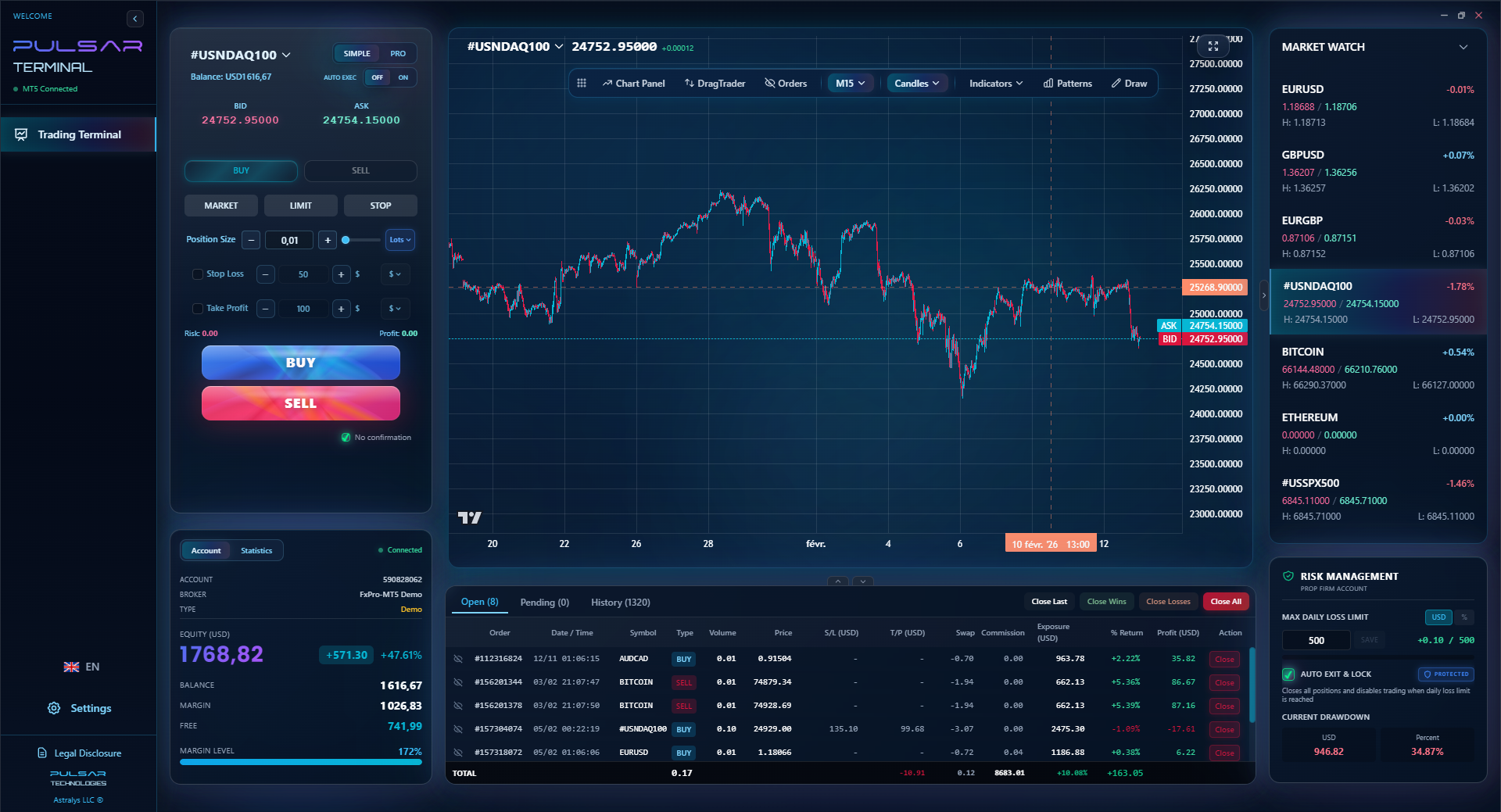
Manually plotting pivot levels and managing orders is time-consuming; a tool like Pulsar Terminal can automate drawing tools and execute multi-TP/SL strategies directly on your MT5 platform, letting you focus on the trade, not the mechanics.
You need a platform with reliable, automatic pivot point drawing tools. Manually calculating every day is a waste of time. Here’s the real scoop on popular Indian brokers:
Zerodha Kite: The king for a reason. Its charting (powered by TradingView) has built-in Pivot Point Standard indicators. You can plot daily, weekly, monthly pivots with one click. Execution is fast, and the brokerage structure is clear. This is my primary platform. The only con is that for multi-timeframe analysis, you need to open multiple charts.
Upstox Pro Web: Also offers good built-in pivot indicators on its charts. The UI is clean. However, I've found their intraday data feed can occasionally lag during extreme volatility compared to Kite, which is a killer when trading precise levels.
Dhan: This is the dark horse for serious traders. The charts are excellent, and they cater heavily to the API/algo crowd (within the new SEBI rules). Their pivot tools are strong, and the platform feels built for speed. If you're technically inclined, Dhan is worth a deep look.
Angel One: Offers SmartAPI, which could be a way to systematically back-test pivot ideas in a SEBI-compliant sandbox. Their charting is decent.
Avoid platforms with poor charting. If you can't easily see and draw pivot levels, you're fighting blindfolded. Most discount brokers now offer these tools for free. Don't overcomplicate it; start with Kite or Upstox.

Pro Tip: Don't rely solely on the platform's default pivot indicator. Cross-reference it with your own calculation for the first week to ensure it's using the correct formula (High, Low, Close of the previous day). I've seen discrepancies.
“Your edge comes from your patience to wait for price to reach those zones, not from the calculation itself.”
Once you're comfortable with daily pivots, these two concepts will improve your trading.
1. Confluence is King A pivot level alone is weak. A pivot level plus something else is strong. Look for:
- Pivot + Previous Day High/Low: If today's R1 is also yesterday's high, that's a stronger resistance zone.
- Pivot + Round Number: R1 at 22500 is stronger than R1 at 22517.
- Pivot + Fibonacci Level: If S1 coincides with a 61.8% Fibonacci retracement, the support is much more significant. I enter trades only when I see at least two forms of confluence. It increases the probability enough to justify the risk.
2. The Weekly Pivot Power Daily pivots guide intraday action. Weekly Pivots guide the entire week's trend. The Weekly Pivot Point (calculated from last week's High, Low, Close) is a massive level. If the market is above the Weekly PP, the broader weekly bias is bullish. I use this to filter my daily trades. If we're above Weekly PP, I only take daily buy setups at support. This simple filter aligned me with the higher-timeframe trend and dramatically improved my results. You can find these on most platforms by switching your pivot indicator to the 'Weekly' timeframe.
💡 विंस्टन की सलाह
The most important pivot is the one in your mind between discipline and impulse. Master that first.
- Ditch the Search: Stop looking for a magical 'pivot point trading strategy pdf'. The core math is free and simple. The secret is in the application, not the calculation.
- Set Up Your Charts: On your broker's platform (Kite, Upstox, etc.), add the Pivot Points indicator to your Nifty and Bank Nifty charts. Set it to 'Daily'.
- Paper Trade for a Month: Don't use real money. For 4 weeks, log every time price approaches R1, S1, or PP. Note what happens. Does it reverse? Does it pause and break through? What did the candle look like? This builds intuition.
- Add One Filter: Start applying the 'Primary Trend' filter. Only take trades in the direction of the Daily PP.
- Incorporate Confluence: In your second month of paper trading, only note setups where the pivot aligns with another level (yesterday's high, a round number).
- Calculate Real Costs: Before going live, use a position size calculator and model the exact brokerage, STT, and GST for your intended trade size. Ensure your target is at least 2-3 times the total transaction cost.
- Start Small: When you go live, trade 1/10th of your normal size for the first 20 trades. You need to manage the psychology of seeing real money at these levels.
The pivot point is a tool for finding high-probability zones. It is not a signal generator. Your edge comes from your patience to wait for price to reach those zones, your discipline to seek confirmation, and your risk management to survive when the 40% of times the level fails. That's the page missing from every PDF.

FAQ
Q1What is the best pivot point formula for Indian stock markets?
For Nifty and Bank Nifty intraday, the Standard (Floor) formula using the previous day's High, Low, and Close works well. Many traders find it more responsive than other variations. The key is consistency - pick one formula and stick with it so you learn how price typically reacts to it.
Q2Are pivot points legal for trading in India?
Absolutely. Using pivot points as a manual technical analysis tool is 100% legal. The regulatory concern from SEBI only arises if you try to fully automate the strategy as an algorithm, which now requires formal exchange approval and must run on broker infrastructure under the strict 2024-2026 algo trading framework.
Q3Can I use pivot points for scalping in India?
You can, but it's tough. The transaction costs (STT, brokerage, GST) for high-frequency trades will eat into thin scalping profits very quickly. Pivots are better suited for capturing larger intraday swings between levels like S1 and R1, where the profit potential is 2-3 times the cost of the trade.
Q4How do I adjust pivot points for a gap-up opening?
If the market gaps significantly above or below the prior day's close, the traditional pivots become less reliable. Many traders then use the 'current day's developing high and low' to calculate a dynamic pivot, or they treat the opening price as a key level itself, watching for a fill of the gap back towards the previous close/PP.
Q5Do professional traders in India use pivot points?
Yes, extensively. But not in isolation. Desk traders and institutional algorithms use pivot levels as key reference points for liquidity and order placement. They combine them with order flow data, volume profiles, and larger macroeconomic context, which retail traders often lack.
Q6Is there a free pivot point calculator for Indian markets?
You don't need a separate calculator. Every major trading platform in India (Zerodha Kite, Upstox, Dhan) has a built-in Pivot Point indicator you can apply directly to your charts. This is better than an external calculator as it updates automatically and plots the levels visually.
Q7What time frame is best for pivot point trading?
Use multiple timeframes. Use the Daily chart to plot your main pivot levels (R1, PP, S1). Then use a 15-minute or 5-minute chart to fine-tune your entry and look for price action confirmation as price approaches those daily levels on the smaller timeframe.
प्रो. विंस्टन का पाठ
:
- ✓Pivot points are zones, not exact prices. Give them a 20-30 point buffer.
- ✓Always filter trades with the Daily PP trend. Trade with it, not against it.
- ✓Indian transaction costs require a minimum 1:1.5 risk-reward for pivots to work.
- ✓Under new SEBI rules, retail algorithmic pivot strategies are nearly impossible.
यह लेख कितना उपयोगी था?
रेट करने के लिए स्टार पर क्लिक करें
साप्ताहिक ट्रेडिंग विश्लेषण
मुफ़्त साप्ताहिक विश्लेषण और रणनीतियाँ। कोई स्पैम नहीं।
लेखक के बारे में
Rajesh Sharma
वरिष्ठ फॉरेक्स विश्लेषक
भारतीय और दक्षिण एशियाई बाज़ारों में 10 साल से अधिक का ट्रेडिंग अनुभव। NSE करेंसी डेरिवेटिव्स से शुरुआत करके अंतरराष्ट्रीय फॉरेक्स में आए। USD/INR और इमर्जिंग मार्केट पेयर्स में विशेषज्ञता।
टिप्पणियाँ
आपको यह भी पसंद आ सकता है

Cara Trading Forex Sukses: 7 Prinsip dari Trader Profesional
Cara trading forex sukses dengan 7 prinsip trader pro: manajemen modal, disiplin, journal trading, backtest. Data nyata, bukan janji profit palsu.
Jam Trading Forex Terbaik untuk Trader Indonesia: Panduan Lengkap dengan Tabel Waktu
Panduan jam trading forex untuk trader Indonesia. Tabel 4 sesi dunia, jam emas 20:00-00:00, sesi mana yang harus dihindari. Data akurat + tips dari trader berpengalaman.
Top 5 Sàn Forex Uy Tín Nhất 2026: Review Jujur dari Trader Indonesia
Top 5 sàn forex uy tín 2026 untuk trader Indonesia. Review jujur: spread, deposit, withdraw, dukungan lokal. Exness, XM, IC Markets & lebih.
All these calculators are built into Pulsar Terminal with real-time data from your MT5 account. One-click position sizing, automatic risk management, and instant calculations.
