


Here's a brutal truth: about 80% of traders who try to trade pullbacks end up losing their accounts.

David van der Merwe
उभरते बाजार के ट्रेडर ·  South Africa
☕ 11 मिनट पढ़ने
आप क्या सीखेंगे:
- 1What Actually Is a Pullback? (It's Not What You Think)
- 2Why Pullback Trading in South Africa is Different
- 3How to Spot a Real Pullback (And Ignore the Fakes)
- 4A Complete Pullback Entry and Exit Strategy
- 5The Top 3 Mistakes That Blow Up South African Accounts
- 6The Best (and Worst) Tools for Pullback Trading
- 7The Mental Game: How to Sit Through a Pullback
Here's a brutal truth: about 80% of traders who try to trade pullbacks end up losing their accounts. It's not because the strategy is bad. It's because they're doing it wrong. In South Africa, with our unique rules and the Rand's volatility, the mistakes are even more expensive. I've seen it happen to mates in Joburg and Cape Town. This guide isn't about getting rich quick. It's about understanding what a real pullback is, how to trade it without gambling your Rands, and how to survive long enough to make it work.
Most guys get this wrong from the start. They see a price dip and jump in, calling it a pullback. That's a great way to catch a falling knife.
A genuine pullback is a temporary counter-trend move within a larger, established trend. Think of it as the market taking a breath before continuing its main journey. The key word is temporary. If the 'pullback' breaks the main trend structure, it's not a pullback anymore. It's a potential reversal.
The Three Non-Negotiables of a Pullback:
- A Clear, Prior Trend: You need a confirmed uptrend or downtrend first. No trend, no pullback. It's that simple.
- Shallow Retracement: In a healthy trend, pullbacks don't go too far. They often stall at key Fibonacci levels (like the 38.2% or 50% retracement) or at previous support/resistance zones that have now flipped roles.
- Volume Tells the Story: During the pullback, volume should typically dry up. The big money isn't pushing the reversal; it's just profit-taking or weak hands getting out. When volume spikes again in the direction of the main trend, that's your signal the pullback is likely over.

Warning: The most common mistake in pullback forex is entering too early. You think you're buying a discount, but you're just buying into a slide that hasn't finished yet. Patience isn't a virtue here; it's a survival skill.
I learned this the hard way trading USD/ZAR in 2021. The Dollar was in a strong uptrend against the Rand. It pulled back about 300 pips. I thought, 'Bargain!' and bought at what I thought was the 50% Fib level. It wasn't. The pullback deepened, turned into a full reversal, and I took a R12,000 loss because I didn't wait for confirmation the downtrend move had exhausted itself.

💡 विंस्टन की सलाह
A pullback isn't a bargain hunt. It's a tactical entry into confirmed momentum. If you can't clearly draw the prior trend on a chart, put your wallet away.
Trading from SA isn't like trading from London or New York. We have our own set of rules that directly impact how you manage a pullback strategy, especially when it goes wrong.
The 30:1 use Cap
Since 2021, the FSCA capped use at 30:1 for retail clients. This is a good thing, but most traders hate it. They think it limits their profits. What it really does is limit the speed at which you can blow up on a bad pullback trade. With lower use, a pullback that goes slightly deeper than expected won't immediately trigger a margin call. It gives you a tiny bit of breathing room to assess if you're wrong.
The Rand and Exchange Controls
This is critical. You are a South African resident trading with Rands.
- You can't legally speculate directly against the ZAR with an offshore broker. This means pairs like EUR/ZAR or GBP/ZAR are often off the table for pure speculation. Your main playground becomes major pairs like EUR/USD or USD/JPY, or commodities like Gold (XAU/USD).
- Your money movement is limited. You have a Single Discretionary Allowance of R1 million per year to move offshore (no tax clearance), and a Foreign Investment Allowance of R10 million (with SARS clearance). A string of bad pullback trades that wipe out your capital isn't just a loss. It's a loss that eats into your annual allowance to reload your trading account. This makes capital preservation not just smart, it's essential.
Broker Choice Matters
You can use an international broker like IC Markets or Pepperstone, but if they aren't also FSCA-regulated, you lose local recourse if something goes wrong. An FSCA-regulated broker must segregate your funds. For pullback trading, where you might hold a trade through a drawdown, knowing your broker is solid is one less thing to worry about.

Pro Tip: Always check the FSCA's public register for your broker's license status. If you're using your Foreign Investment Allowance, keep careful records of every transfer for SARS.
“You're not buying the bottom of a pullback, you're buying the proven resumption of momentum.”
This is where you move from gambler to trader. You need a filter. I use a simple, three-step process.
Step 1: Define the Trend Don't guess. Use a tool. A simple 50-period and 200-period Exponential Moving Average (EMA) on the 4-hour or daily chart works. If price is above both, and the 50 EMA is above the 200 EMA (a Golden Cross), the trend is up. The opposite for a downtrend. Only look for pullbacks in the direction of this higher-timeframe trend.
Step 2: Identify the Pullback Zone Where is the pullback likely to find buyers (in an uptrend) or sellers (in a downtrend)?
- Dynamic Support/Resistance: The 50-period EMA often acts as a magnet in a strong trend.
- Fibonacci Levels: Draw the Fib tool from the start of the trend swing to its recent peak (for an uptrend). Focus on the 38.2%, 50%, and 61.8% levels. Confluence is key – if the 50% Fib level aligns with a previous resistance-turned-support level, that zone is much stronger.
- Price Action Structure: Look for a break in the counter-trend momentum. In a downtrend pullback (a rise), you might see a series of lower highs start to fail, or a bearish candlestick pattern like a pin bar or engulfing pattern at a key Fib level.
Step 3: Wait for the Confirmation This is the step 90% of people skip, and it's why they lose. Do NOT buy the low of the pullback. Wait for price to show it's done pulling back and is resuming the main trend.
My signal is a strong, closing candle in the direction of the trend that breaks past a recent minor high (in an uptrend) or low (in a downtrend) formed during the pullback. This is your trigger. You're not buying the bottom, you're buying the proven resumption of momentum.
For example, on the EUR/USD guide, I might wait for a pullback to the 50% Fib level on the 4H chart, see a bullish engulfing candle form there, and only enter when price moves above the high of that candle's range.
💡 विंस्टन की सलाह
The FSCA's 30:1 use cap isn't a limit on your genius. It's a governor on your stupidity. Use it as the foundation for your position sizing, not a constraint to work around.
Let's build a real trade plan. We'll use an uptrend example.
Entry:
- Trend Confirmed: Daily chart shows higher highs, higher lows, price above 50 & 200 EMA.
- Pullback Identified: Price dips on the 4-hour chart into a confluence zone (e.g., 50% Fib + previous support level).
- Confirmation Signal: A 4-hour bullish candlestick pattern forms (e.g., hammer, bullish engulfing) and then the next candle closes above the high of that signal candle.
- Enter: Place a buy limit order just above that confirmation candle's high.
Stop Loss: This is non-negotiable. Your stop loss goes below the most recent significant swing low of the pullback. If you're buying at the 50% retracement, your stop should be below the 61.8% or even the recent low. You must give the trade room to breathe. A tight stop on a pullback trade will get hit by market noise almost every time. If the price hits your stop, your pullback thesis was wrong. Accept it and move on.
Take Profit: This is where you get paid. I use a multi-target approach:
- TP1: At the previous swing high (the start of the pullback). This secures some profit.
- TP2: At a 1:2 or 1:3 risk-to-reward ratio from your entry. Use a position size calculator to figure out your lot size based on this distance.
- Runner: Consider moving your stop loss to breakeven after TP1 is hit, and letting a small portion of the trade run to capture a potential extended trend move.

Example: You buy EUR/USD at 1.0850. Your stop loss is at 1.0800 (50 pips risk). TP1 is at 1.0900 (50 pips profit). TP2 is at 1.0950 (100 pips profit, a 1:2 R:R). You close half at TP1, move stop to breakeven, and let the other half aim for TP2.
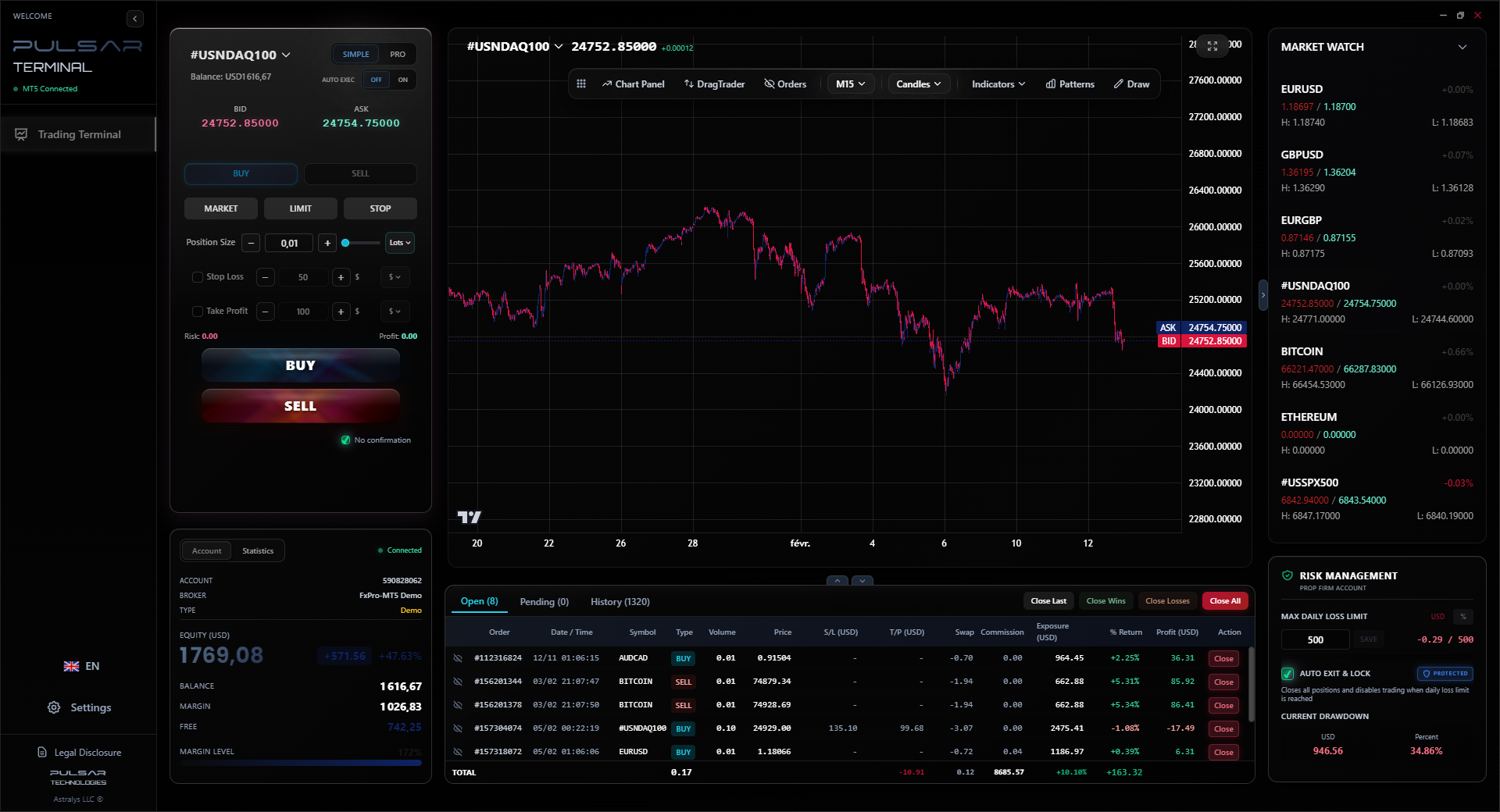
Managing multiple targets manually is a pain. This is where tools that automate partial closures become useful, letting you lock in profit without staring at the screen all day.
“One bad averaged-down trade can wipe out 10 good ones.”
I've made these. My friends have made these. Let's kill these habits.
1. Adding to a Losing Pullback Trade (Averaging Down) This is the account killer. Your buy pullback trade goes south. Instead of admitting the trend might be broken, you think, 'It's even cheaper now!' and buy more. You're not trading a pullback anymore. You're fighting the trend and doubling your bet while wrong. One bad averaged-down trade can wipe out 10 good ones. The FSCA's 30:1 use might save you from instant vaporization, but it won't save you from this slow bleed.
2. Ignoring Higher Timeframes You see a nice little pullback on the 5-minute chart and take it. But on the 1-hour chart, that 'pullback' is just noise within a massive ranging market. There's no dominant trend to pull back from. Always, always check at least one timeframe higher than the one you're trading on. A pullback on the 4-hour chart within a daily uptrend is a hundred times more reliable than a pullback on the 5-minute chart.
3. Risking Too Much Per Trade Because pullbacks can feel 'safe' and 'logical', traders get overconfident and risk 3%, 5%, even 10% of their account on one idea. This is insane. No trade is a sure thing. With our SARB allowances limiting how easily you can fund an account, you must protect your capital. I never, ever risk more than 1% of my account equity on a single pullback trade. Usually, it's 0.5%. This means I can be wrong 20 times in a row and still be in the game. It forces me to be picky and only take the highest-quality setups.
A tool that can enforce daily loss limits is a lifesaver here, especially if you're prone to revenge trading after a failed pullback.
When trading pullbacks, managing multiple profit targets and moving stops to breakeven is critical, and Pulsar Terminal automates these actions directly on your MT5 platform.
Keep it simple. More indicators just mean more confusion.
What Works:
- Moving Averages (50 & 200 EMA): For trend definition and dynamic support/resistance.
- Fibonacci Retracement Tool: The single most useful tool for identifying potential pullback depth zones.
- Horizontal Support/Resistance Lines: Price respects old levels.
- Volume: To see if the pullback is happening on low volume (good) or high volume (bad, might be a reversal).
- Basic Candlestick Patterns: Pin bars, engulfing bars, inside bars at key levels for confirmation.
What Mostly Distracts:
- Oscillators like RSI or MACD on low timeframes: In a strong trend, the RSI can stay overbought or oversold for weeks. A pullback might only cause the RSI to dip from 80 to 60, not to 30. Using these to time entries will have you missing the best moves.
- A screen cluttered with 10 different indicators: It creates analysis paralysis. You'll see conflicting signals and do nothing, or worse, invent a reason to take a bad trade.
My chart for swing trading pullbacks is clean: Price, two EMAs, a Volume indicator at the bottom, and that's it. I draw my Fibs and horizontal lines manually for each setup. The simpler your screen, the clearer your thinking.
💡 विंस्टन की सलाह
Your most important tool isn't an indicator. It's the delete key. Remove everything from your chart that doesn't directly help you see the trend, the pullback zone, and the confirmation.
“The market will test your conviction. It always does.”
This is the hardest part. You've entered a perfect pullback. Then price stalls. It chops. It goes against you by a few pips. Your brain screams, 'Get out! It's failing!'
You have to trust your plan. If your stop loss is placed logically (beyond the pullback's reasonable depth), and your entry was confirmed, then you must allow the trade the space you defined. The market will test your conviction. It always does.
The Breakeven Temptation: As soon as your trade goes into a small profit, the urge is to move your stop to breakeven to 'remove the risk.' Don't do it too early. You've placed your stop for a reason. Moving it to breakeven the moment you're up 5 pips guarantees you'll get stopped out by meaningless noise and miss the 50-pip move you planned for. I only move to breakeven after price has clearly moved in my favor and reached a logical milestone, like a previous minor swing point.
Journal Everything. After every pullback trade, win or lose, write it down. What did the setup look like? Why did you enter? Did you follow your rules? How did you feel? Over time, you'll see patterns in your mistakes. Maybe you consistently enter before confirmation. Maybe you cut winners short. The journal tells you what to fix.
Psychology is why a scalping strategy feels different to a pullback swing trade. Scalping is fast action. Pullback trading is about patience, discipline, and enduring discomfort for a larger reward. They train different mental muscles.
FAQ
Q1Is pullback trading suitable for beginners in South Africa?
It can be, but only if they start with a severe focus on risk management. The concepts are simple to understand, which is tempting, but the discipline required is high. A beginner should paper trade pullback strategies extensively first, focusing entirely on correct identification and strict stop-loss placement, before risking any Rands. Understanding the SARB exchange controls is also a crucial first step.
Q2What's the best timeframe for pullback forex trading?
There's no single 'best,' but for most retail traders, the 4-hour chart within the context of a daily chart trend offers a good balance. It's slow enough to filter out market noise and avoid overtrading, but fast enough to provide several opportunities per month. Avoid pullback trading on timeframes below 1-hour when starting out; the noise-to-signal ratio is terrible.
Q3How do I know if a pullback is turning into a reversal?
Your stop loss will tell you. If price breaks through your logically placed stop (beyond the key Fibonacci or structure level), it's no longer a pullback. Other signs include a strong, high-volume break of the main trendline on a higher timeframe, or price making a lower low in an uptrend (or higher high in a downtrend) on the timeframe you're trading. The market will announce a reversal; you don't need to predict it.
Q4Can I use this strategy on Gold (XAU/USD)?
Absolutely. Gold trends beautifully and often has clean pullbacks to moving averages or Fibonacci levels. The principles are identical. Just remember that gold's pip value is different (usually $0.10 per pip per micro lot), and its volatility can be higher, so your stop losses need to be wider accordingly. Check our XAU/USD guide for more specifics.
Q5Why does my broker's spread matter for pullback trading?
It matters a lot. If you're aiming for a 50-pip profit on a trade, a 2-pip spread is a 4% drag on your potential profit before you even start. On a shallow pullback entry, a wide spread can mean you're in negative territory immediately. This is why South African traders often look for brokers with tight, consistent spreads on major pairs, like some of the conditions noted in our Exness review or XM review.
Q6How many pullback trades should I take per week?
As many as your system provides, and not one more. This isn't a numbers game. A high-quality pullback setup in a strong trend might only appear 2-3 times per month on a given pair. Forcing trades in sub-optimal conditions is the fastest path to losses. It's better to have 2 high-probability trades per month than 10 mediocre ones.
प्रो. विंस्टन का पाठ
:
- ✓Define the trend first. No trend, no trade.
- ✓Wait for price confirmation. Never buy the low.
- ✓Place your stop loss beyond the pullback's logic.
- ✓Risk a maximum of 1% of your capital per trade.
- ✓The SARB's R1m allowance makes capital preservation a legal necessity.
यह लेख कितना उपयोगी था?
रेट करने के लिए स्टार पर क्लिक करें
साप्ताहिक ट्रेडिंग विश्लेषण
मुफ़्त साप्ताहिक विश्लेषण और रणनीतियाँ। कोई स्पैम नहीं।
लेखक के बारे में
David van der Merwe
उभरते बाजार के ट्रेडर
जोहानसबर्ग स्थित ट्रेडर, इमर्जिंग मार्केट करेंसीज में 11 साल का अनुभव। ZAR पेयर्स, FSCA-विनियमित ट्रेडिंग और दक्षिण अफ्रीकी मार्केट एनालिसिस में विशेषज्ञ।
टिप्पणियाँ
आपको यह भी पसंद आ सकता है

Cara Trading Forex Sukses: 7 Prinsip dari Trader Profesional
Cara trading forex sukses dengan 7 prinsip trader pro: manajemen modal, disiplin, journal trading, backtest. Data nyata, bukan janji profit palsu.
Jam Trading Forex Terbaik untuk Trader Indonesia: Panduan Lengkap dengan Tabel Waktu
Panduan jam trading forex untuk trader Indonesia. Tabel 4 sesi dunia, jam emas 20:00-00:00, sesi mana yang harus dihindari. Data akurat + tips dari trader berpengalaman.
Top 5 Sàn Forex Uy Tín Nhất 2026: Review Jujur dari Trader Indonesia
Top 5 sàn forex uy tín 2026 untuk trader Indonesia. Review jujur: spread, deposit, withdraw, dukungan lokal. Exness, XM, IC Markets & lebih.
All these calculators are built into Pulsar Terminal with real-time data from your MT5 account. One-click position sizing, automatic risk management, and instant calculations.
