


I remember watching the USD/ZAR chart in October 2022, my finger hovering over the sell button as the pair broke above R18.50.

David van der Merwe
उभरते बाजार के ट्रेडर ·  South Africa
☕ 9 मिनट पढ़ने
आप क्या सीखेंगे:
I remember watching the USD/ZAR chart in October 2022, my finger hovering over the sell button as the pair broke above R18.50. The move was violent, and my margin was getting thin. In that moment, the only thing that stopped me from panicking was knowing my broker was properly regulated by the FSCA. My funds were segregated, and there was a real authority I could call if things went sideways. That peace of mind? It's not optional. Let's talk about how to find it.
Look, I get it. When you're starting out, that 1:500 use from an offshore broker looks tempting. I made that mistake in 2015 with a firm registered in some island I couldn't find on a map. When I tried to withdraw R15,000 in profits, it took three months of emails that went nowhere. I learned the hard way: if you can't walk into their office in Sandton or Cape Town, you're playing a dangerous game.
The Financial Sector Conduct Authority (FSCA) isn't just a logo on a website. It's your first line of defense. An FSCA-regulated broker must follow strict rules. Your money goes into a separate, segregated bank account. It can't be used for the broker's office rent or to cover their other clients' losses. If the broker goes under (it happens more than you think), your capital is protected from their creditors.
They also have to be transparent about their fees and risks. No hidden charges buried in page 87 of a terms document. The FSCA maintains a public register where you can check any broker's FSP number. If they're not on it, walk away. Immediately. This due diligence takes five minutes and can save you thousands.

Warning: Many international brokers 'accept' South African clients through their global entities. This often means you're not protected by South African law. You want a broker that holds a direct FSCA license, not just one that lets you sign up from SA.

💡 विंस्टन की सलाह
A broker's customer service response time at 10 PM on a Sunday tells you more about their reliability than any slick marketing brochure ever will.
Let's cut through the marketing. 'Zero spread' accounts sound amazing, but they usually come with a commission. You need to calculate the total cost per trade. A 0.0 pip spread with a $7 commission on a standard lot is often more expensive than a 0.8 pip spread with no commission on a small trade.
Here’s a real example from my trading journal. On a standard account with a 1.2 pip spread on EUR/USD, my cost to open and close a 0.1 lot trade was about $1.20. On a 'raw' account with a 0.1 pip spread and a $3.50 per lot commission, the same 0.1 lot trade cost me $3.51. The 'cheaper' account was actually three times more expensive for my style of trading.
The use Trap
Since 2021, the FSCA's official limit for retail traders is 30:1. You'll still see brokers advertising 1:500 or even 1:1000. How? They often classify you as a 'professional client' if you meet certain criteria (like having a large portfolio or experience). This sounds cool, but it strips away many of the retail protection rules. I don't recommend it. High use is a shortcut to a margin call. Trust me, 30:1 is more than enough to make serious money - and lose it.
Other Fees to Watch
Swap fees (overnight financing) can eat into profits on longer-term trades. Deposit and withdrawal fees vary wildly. Some local brokers offer free EFTs in ZAR, while others charge for card deposits. Always, always check the fee schedule before you fund your account. Use a position size calculator that includes commission to understand your true break-even point.
“High use is a shortcut to a margin call. Trust me, 30:1 is more than enough to make serious money - and lose it.”
Based on my experience and the community chatter, here are a few brokers with solid FSCA presence. This isn't a 'best' list, but a starting point for your own research.
| Broker | Key Feature for SA Traders | My Note on Spread/Cost | Min Deposit (ZAR approx) |
|---|---|---|---|
| Khwezi Trade | Local JSE-listed broker, pure FSCA/ODP regulation. | True ECN pricing, spreads from 0.4 pips. | R500 |
| Exness | Popular for its low minimum deposit. | Raw spreads can be tight, but watch commission structure. | ~R70 |
| IC Markets | Great for algo traders & raw spreads. | Consistently good liquidity, true to its 'raw' account claims. | ~R3,700 ($200) |
| XM Group | Strong educational resources for beginners. | Spreads are decent, not the tightest, but reliable execution. | ~R70 |
| Tickmill | Clear fee structure, good for cost-conscious traders. | Excellent raw spreads, low commission. | R100 |

Pro Tip: Don't just pick the broker with the lowest minimum deposit. A R500 minimum often means the broker is serious about attracting committed traders. I started with a R2000 deposit at Khwezi, which forced me to be more disciplined than when I had a $10 account elsewhere.
Platform choice matters too. Most offer MT4 or MT5, which are industry standards. If you're into advanced order types or scalping strategies, test their platform's execution speed with a demo account first. A broker can have great prices but slow execution that slips your orders.
The sign-up process is straightforward, but where most people slip up is in the details. You'll need a clear copy of your SA ID, a recent proof of residence (like a utility bill less than 3 months old), and sometimes a bank statement.
When it asks for your trading experience and financial knowledge, be honest. Don't exaggerate to get higher use. If you mark yourself as an 'expert,' you might lose certain protections. I always put 'intermediate' - it keeps me humble and protected.
Funding in ZAR is King
Always choose a ZAR-denominated account if it's offered. This way, your profit and loss are in Rands, and you avoid the hidden cost of dynamic currency conversion. If you deposit R10,000, you're trading with R10,000, not with $547.23 that fluctuates daily.
Funding methods:
- EFT/Bank Transfer: Usually free, but can take 1-2 business days. Use the broker's local South African bank details if they have them.
- Credit/Debit Card: Instant, but some banks might block it as a 'foreign transaction' or charge a fee. Call your bank first.
- E-wallets (Neteller, Skrill): Fast, but often involves currency conversion fees from ZAR to USD.

Example: I funded my Exness account with R5000 via EFT. It arrived in two days, no fees. When I used my credit card on another platform, the bank charged a 2.5% cross-border fee. That's R125 gone before I even placed a trade.
💡 विंस्टन की सलाह
If you can't calculate your exact cost per trade, including spread and commission, in under ten seconds, you're trading blind. Know your numbers cold.
“The right SA regulated forex broker isn't a magic profit machine. It's a reliable tool.”
Most FSCA-regulated brokers will offer the majors (like EUR/USD), indices, commodities, and cryptocurrencies. But as a South African trader, you have a unique advantage: direct access to ZAR pairs.
USD/ZAR, EUR/ZAR, and GBP/ZAR are incredibly liquid. You're trading your home currency, so you're naturally more tuned into the local news that moves these pairs - load-shedding announcements, SARB interest rate decisions, political developments. I've caught some of my biggest wins on USD/ZAR by simply paying attention to local headlines that international traders missed.
However, ZAR pairs can be volatile. The spread is usually wider than on EUR/USD. A 50-pip move on USD/ZAR is a normal Tuesday, whereas that would be a huge deal on a major pair. This volatility requires careful position size management. A standard lot on USD/ZAR is 100,000 USD, but the pip value in ZAR is massive. I never risk more than 0.5% of my account on a single ZAR trade.
Gold (XAU/USD) is also hugely popular here, often seen as a hedge against Rand volatility. Many brokers offer it with competitive spreads.
I've blown up an account. Most honest traders have. The goal is to learn from it, not repeat it. Here are the big mistakes I see with SA traders.
Pitfall 1: Chasing Bonuses. Some brokers offer 50% deposit bonuses. Sounds free money, right? It's a trap. These bonuses always come with insane trading volume requirements (like trade 10,000 lots before you can withdraw). You'll overtrade just to hit the target and blow your account. I learned this with a R2000 'bonus' that locked my capital for months.
Pitfall 2: Ignoring Tax Implications. SARS is not your broker. Your broker won't prepare your tax return. Profits from forex trading are considered income and are taxable. Keep a detailed log of all your trades - entry, exit, profit/loss in ZAR. I use a simple spreadsheet. When tax season comes, you'll be grateful.
Pitfall 3: Not Using a Demo Account First. You wouldn't buy a car without a test drive. Don't deposit real money without spending at least two weeks on a demo account. Test the platform, the execution speed, the customer service response time. See how their spreads behave during the London open (7 AM our time). This is your free rehearsal.
Pitfall 4: Going It Alone. The trading community in SA is vibrant. Join a few reputable forums or social media groups. Not for signal chasing, but to learn about other traders' experiences with different brokers and strategies. It's how I first heard about the importance of FSCA regulation.
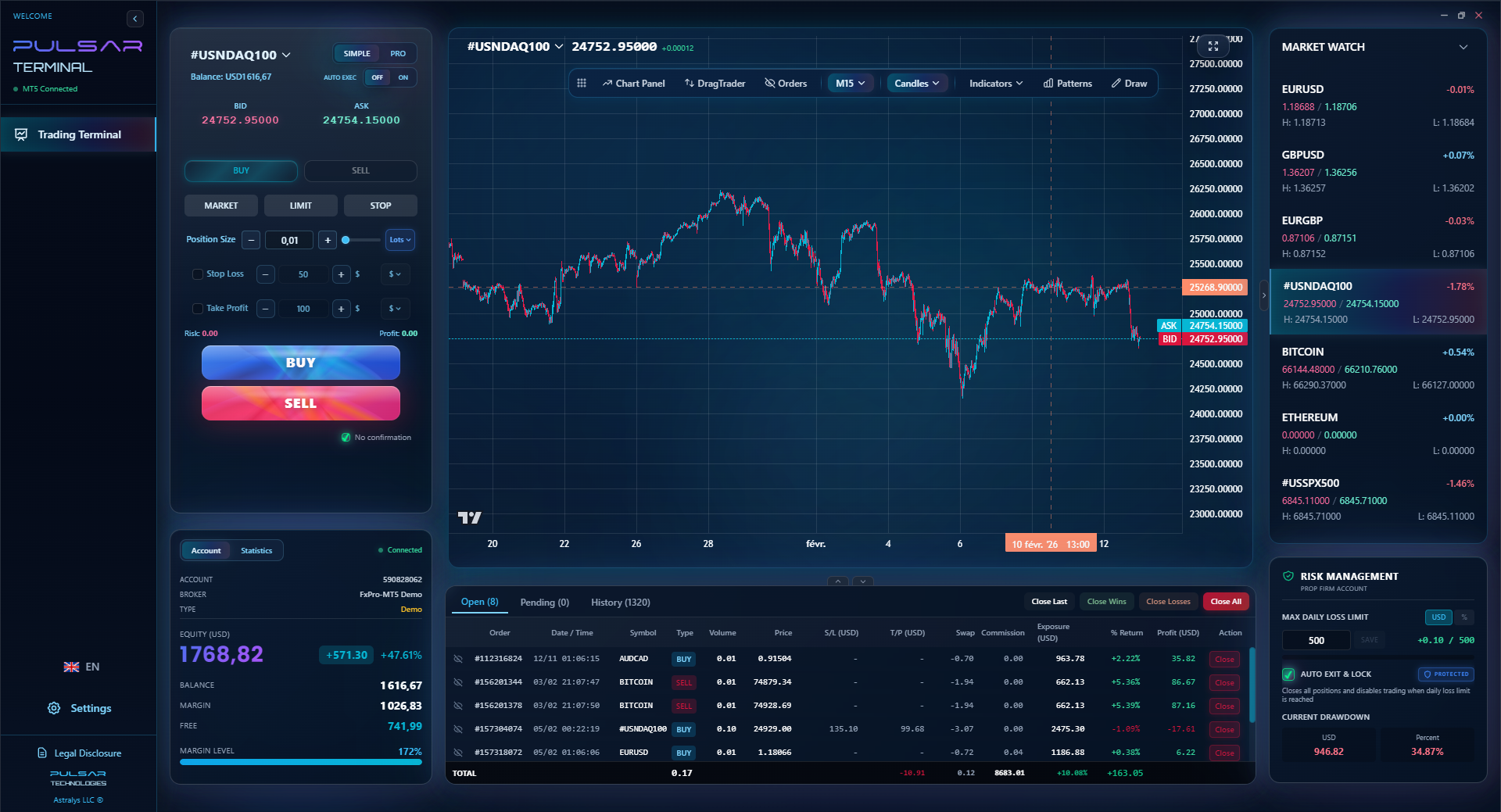
Managing the volatility of ZAR pairs requires precise order management, and Pulsar Terminal's drag-and-drop stop-loss and take-profit tools on MT5 make it much faster to adjust your risk in a fast market.
“I learned the hard way: if you can't walk into their office in Sandton or Cape Town, you're playing a dangerous game.”
Alright, let's get you started on solid ground. Follow these steps in order.
- Verify the Regulator: Shortlist 3-4 brokers. Go to the FSCA website (fsb.co.za) and search their FSP number. Confirm their license is active and includes 'Forex/CFD trading.'
- Compare Real Costs: Open a demo account with each. Don't just look at the advertised EUR/USD spread. Check the spread on USD/ZAR at 9 AM and 5 PM. See what the commission does to your typical trade size.
- Test the Platform: Try placing different order types. Set a stop-loss and take-profit. See how easy it is to modify them. If you use indicators like the RSI or MACD, make sure they work smoothly.
- Contact Support: Send them a WhatsApp or email with a random question. See how long they take to respond and how helpful they are. You'll need them when you have a real problem.
- Start Small: Once you choose, open a live account with the minimum deposit. Not your life savings. Trade with this small amount for a full month. Prove to yourself that you can follow your plan, manage risk, and make consistent withdrawals.
- Withdraw Early: Make your first withdrawal after your first profitable week. Don't wait for months. This tests the broker's withdrawal process and gives you the psychological win of getting money back into your bank account.
The right SA regulated forex broker isn't a magic profit machine. It's a reliable tool. It won't make you a good trader, but a bad one can definitely break you. Do the work upfront, and you can focus on what actually matters: reading the markets and managing your risk. Good luck, and trade safe.
FAQ
Q1Is forex trading legal in South Africa?
Yes, absolutely. Forex trading is completely legal for individuals in South Africa. It's regulated by the Financial Sector Conduct Authority (FSCA). The key is to use a broker that is licensed by the FSCA to ensure you're operating within the legal framework and have protection.
Q2Can I use international brokers like Pepperstone or IC Markets as a South African?
Many international brokers like IC Markets and Pepperstone do accept South African clients. However, you are often signing up with their global entity (e.g., based in Australia or Cyprus). This means you are protected under that country's regulations, not South Africa's. For direct FSCA protection, you need a broker that holds a local FSCA license.
Q3What is the maximum use I can get with an FSCA broker?
For retail clients, the FSCA's official limit is 30:1. Some brokers may offer higher use (like 100:1 or 500:1) if you qualify as a 'professional client,' but this requires meeting specific financial and experience criteria and means you lose certain retail investor protections. I generally advise sticking to 30:1 or lower.
Q4How do I verify a broker's FSCA license?
Go to the official FSCA website (fsb.co.za). Use their 'Search for an FSP' function. Enter the broker's company name or the FSP number they provide. The search result will show if the license is active and what financial products (like Forex) they are authorized to offer.
Q5Are my funds safe if an FSCA-regulated broker goes bankrupt?
FSCA rules require client funds to be held in segregated accounts at reputable banks. This means your money is separate from the broker's company money. In a bankruptcy, your funds should be safe from the broker's creditors and, in theory, returned to you. This is a core reason why regulation is so important.
Q6What's better for a beginner: a ZAR account or a USD account?
Start with a ZAR account. It simplifies everything. Your deposit, your profit/loss, and your withdrawals are all in Rands. With a USD account, your bank will convert your ZAR deposit to USD, and then convert your USD profits back to ZAR on withdrawal, often with poor exchange rates and fees. Keep it simple.
Q7Do I pay tax on my forex trading profits in South Africa?
Yes. Profits from trading are considered income by SARS and are subject to income tax. It's your responsibility to keep accurate records of all your trades and declare the profits on your annual tax return. Losses can sometimes be deducted, but you should consult with a tax professional familiar with trading.
प्रो. विंस्टन का पाठ
:
- ✓Always verify the FSP number on the FSCA website.
- ✓Choose a ZAR account to avoid hidden conversion fees.
- ✓Start with the minimum deposit, not your savings.
- ✓Test withdrawals early to confirm the broker's process.
- ✓30:1 use is a protective rule, not a limitation.
यह लेख कितना उपयोगी था?
रेट करने के लिए स्टार पर क्लिक करें
साप्ताहिक ट्रेडिंग विश्लेषण
मुफ़्त साप्ताहिक विश्लेषण और रणनीतियाँ। कोई स्पैम नहीं।
लेखक के बारे में
David van der Merwe
उभरते बाजार के ट्रेडर
जोहानसबर्ग स्थित ट्रेडर, इमर्जिंग मार्केट करेंसीज में 11 साल का अनुभव। ZAR पेयर्स, FSCA-विनियमित ट्रेडिंग और दक्षिण अफ्रीकी मार्केट एनालिसिस में विशेषज्ञ।
टिप्पणियाँ
आपको यह भी पसंद आ सकता है

Cara Trading Forex Sukses: 7 Prinsip dari Trader Profesional
Cara trading forex sukses dengan 7 prinsip trader pro: manajemen modal, disiplin, journal trading, backtest. Data nyata, bukan janji profit palsu.
Jam Trading Forex Terbaik untuk Trader Indonesia: Panduan Lengkap dengan Tabel Waktu
Panduan jam trading forex untuk trader Indonesia. Tabel 4 sesi dunia, jam emas 20:00-00:00, sesi mana yang harus dihindari. Data akurat + tips dari trader berpengalaman.
Top 5 Sàn Forex Uy Tín Nhất 2026: Review Jujur dari Trader Indonesia
Top 5 sàn forex uy tín 2026 untuk trader Indonesia. Review jujur: spread, deposit, withdraw, dukungan lokal. Exness, XM, IC Markets & lebih.
All these calculators are built into Pulsar Terminal with real-time data from your MT5 account. One-click position sizing, automatic risk management, and instant calculations.
