


I was staring at my screen in 2023, watching USD/NGN blow through every technical level I had marked.

Olumide Adeyemi
पश्चिम अफ्रीकी ट्रेडिंग अग्रणी ·  Nigeria
☕ 9 मिनट पढ़ने
आप क्या सीखेंगे:
- 1Why There's No Single 'Best' Book (Especially Here)
- 2The Non-Negotiable Foundation (Start Here)
- 3Leveling Up: The Psychology & Strategy Gap
- 4Advanced Reads for the Nigerian Context
- 5What the Books Won't Teach You: The Nigerian Reality
- 6Building Your Personal Trading Library
- 7The Final Verdict: If You Held a Gun to My Head...
I was staring at my screen in 2023, watching USD/NGN blow through every technical level I had marked. My copy of 'Technical Analysis of the Financial Markets' was open beside me, useless. The CBN had just announced another policy shift, and all the classic chart patterns in the world couldn't save my position. That's when I learned the hard truth: the best forex trading book for a Nigerian isn't one book. It's a specific stack of them, read in a specific order, with our unique market chaos in mind. Forget the generic lists. Here's what actually works when you're trading from Lagos, Abuja, or Port Harcourt.
Let's get this out of the way first. Anyone telling you one book has all the answers is selling you something. The forex market is global, but your trading reality is local. In Nigeria, you're not just trading charts; you're trading CBN pronouncements, fuel subsidy rumors, and the occasional liquidity crunch that makes spreads on USD/NGN look like the Grand Canyon.
A book written for a London prop desk doesn't cover how to handle your broker freezing withdrawals during a naira crisis. A classic like 'Market Wizards' is inspiring, but it won't teach you how to calculate your position size when your capital is in naira but your broker account is in USD, and the official rate is ₦1,400 while the parallel market is whispering ₦1,650.
The best forex trading book for you depends entirely on your phase. Are you a complete beginner who doesn't know a pip from a pepper soup? Or are you an intermediate trader getting wrecked by your own emotions? I've made costly mistakes trying to apply advanced strategies before mastering the basics. I once blew a $500 account trying to replicate a complex 'harmonic pattern' strategy from a book, when I hadn't even nailed down a simple support and resistance strategy. Lesson learned.

Warning: Be wary of any 'guru' selling a single secret book. Real trading education is a curriculum, not a magic bullet. The psychology book that saved my career would have bored me to tears in my first month.
“The best forex trading book for a Nigerian isn't one book. It's a specific stack, read in a specific order, with our unique market chaos in mind.”
You can't build a house on sand, and you can't build a trading career on YouTube videos alone. These books are your concrete. Ignore them at your own financial peril.
For Absolute Beginners
'Currency Trading for Dummies' is the best starting point, period. It sounds basic, but that's the point. It explains the market structure, what a bid/ask spread is, and how an order gets filled. This is crucial because many Nigerian traders jump straight into platforms like Exness or XM without knowing what they're actually clicking on. This book demystifies the jargon.
'Forex Trading: The Basics Explained in Simple Terms' by Jim Brown is another solid, no-nonsense option. It's shorter and gets straight to the point about selecting a broker and placing your first trade.
The Charting Bible
Once you know what forex is, you need to learn how to read it. 'Japanese Candlestick Charting Techniques' by Steve Nison is not optional. This is the language of price. Every single bar on your MT5 chart is a candlestick telling a story of bullish or bearish pressure. I can't tell you how many times simply recognizing a bullish engulfing pattern or a doji at a key level has kept me out of a bad trade. This skill is foundational for any strategy, whether you're into scalping or swing trading.

Pro Tip: Don't just read Nison's book. Open a demo account and label every single candlestick pattern you see for two weeks. It needs to become second nature.

💡 विंस्टन की सलाह
A library of a thousand books is useless if you haven't mastered the first one. Read 'The Disciplined Trader' twice. Then read it a third time.
“Your biggest enemy isn't the market; it's the person in the mirror.”
This is where most traders fail. They learn the basics, get a few lucky wins, and then blow up their account. Why? They skipped the mental game. Your biggest enemy isn't the market; it's the person in the mirror.
'The Disciplined Trader: Developing Winning Attitudes' by Mark Douglas is the most important book you will ever read after the basics. I read it after a devastating 30% drawdown in 2019. Douglas forces you to confront the probabilistic nature of trading. No trade is a sure thing. This book taught me to accept losses as a cost of doing business, not a personal failure. It's the reason I now use a strict position size calculator for every single entry.
'Day Trading and Swing Trading the Currency Market' by Kathy Lien is your bridge from theory to practice. She brilliantly combines fundamental drivers (like interest rates, which the CBN loves to tweak) with technical setups. This is critical for us. Understanding why the naira might move based on a CBN governor's speech, and then where to enter based on the chart, is a powerful combo. Her work on correlation (e.g., how AUD/USD often moves with gold) directly improved my hedging strategies.
'The New Trading for a Living' by Alexander Elder is the complete manual. It ties together psychology, risk management, and technical analysis into one system. His 'Three M's' (Mind, Method, Money) framework is golden. My personal takeaway was his emphasis on the MACD indicator histogram for spotting momentum shifts, which I now use alongside price action on pairs like EUR/USD.
“Your biggest enemy isn't the market; it's the person in the mirror.”
Okay, you've got the basics down and your psychology is in check. Now you want to trade like a pro, not just a hopeful retail punter. These books offer a glimpse into the big leagues.
'The Art of Currency Trading' by Brent Donnelly is like getting a job on a bank trading floor. He focuses heavily on fundamental analysis and market flow - how large institutional orders move prices. This perspective helps you understand the 'why' behind major moves, which is often a combination of global risk sentiment and local factors that hit our shores. When you see a sudden spike in USD/NGN, Donnelly's framework helps you guess whether it's a local bank covering a short or genuine offshore selling.
'Technical Analysis of the Financial Markets' by John Murphy is the encyclopedia. You don't read it cover-to-cover initially. You use it as a reference. Want an in-depth explanation of point & figure charts, intermarket analysis, or the RSI indicator? It's in here. When I started analyzing XAU/USD (gold) as a hedge against naira volatility, Murphy's sections on commodity analysis were useful.

Example: In late 2025, I used a combination of Donnelly's fundamental analysis (anticipating a CBN rate hold) and Murphy's technical work on support zones to take a long position on a local bank stock CFD. Entry at ₦25.50, exit at ₦28.90. The trade wasn't based on a gut feeling; it was based on a synthesized method from these advanced texts.
💡 विंस्टन की सलाह
The market doesn't care how many books you've read. It only cares if your risk is managed. Use a position size calculator. Every. Single. Time.
“A book written for a London prop desk doesn't cover how to handle your broker freezing withdrawals during a naira crisis.”
Here's the raw truth no international book covers. Your success depends on how you adapt the principles to our messy, beautiful market.
1. Regulation & Broker Choice: The books say 'choose a regulated broker.' Here, you need to choose an international broker that accepts Nigerians and has reliable deposit/withdrawal methods. I've had great execution with IC Markets and Pepperstone for their raw spreads. But you must test withdrawal times yourself with a small amount first. The SEC's 2024 rules are more about digital assets, so for now, we rely on international oversight.
2. The Naira Problem: Your capital is in naira. Trading USD-denominated accounts means you have FX risk on your capital before you even place a trade. If the naira weakens, your dollar-equivalent capital shrinks. Some traders use stablecoin on-ramps, but that's its own risk. I keep a portion of my savings in hard currency for this reason.
3. Liquidity & Slippage: Around major CBN announcements or during local market hours with low liquidity, expect wider spreads and potential slippage, especially on exotic pairs. A strategy that works flawlessly on EUR/USD at London open might get shredded on USD/NGN.
4. Emotional Triggers: The stress of unreliable electricity, internet issues, and economic pressure is unique. A margin call feels ten times worse when you're also worrying about fuel for your generator. This is why Mark Douglas's psychology work is not theoretical here; it's a survival manual.
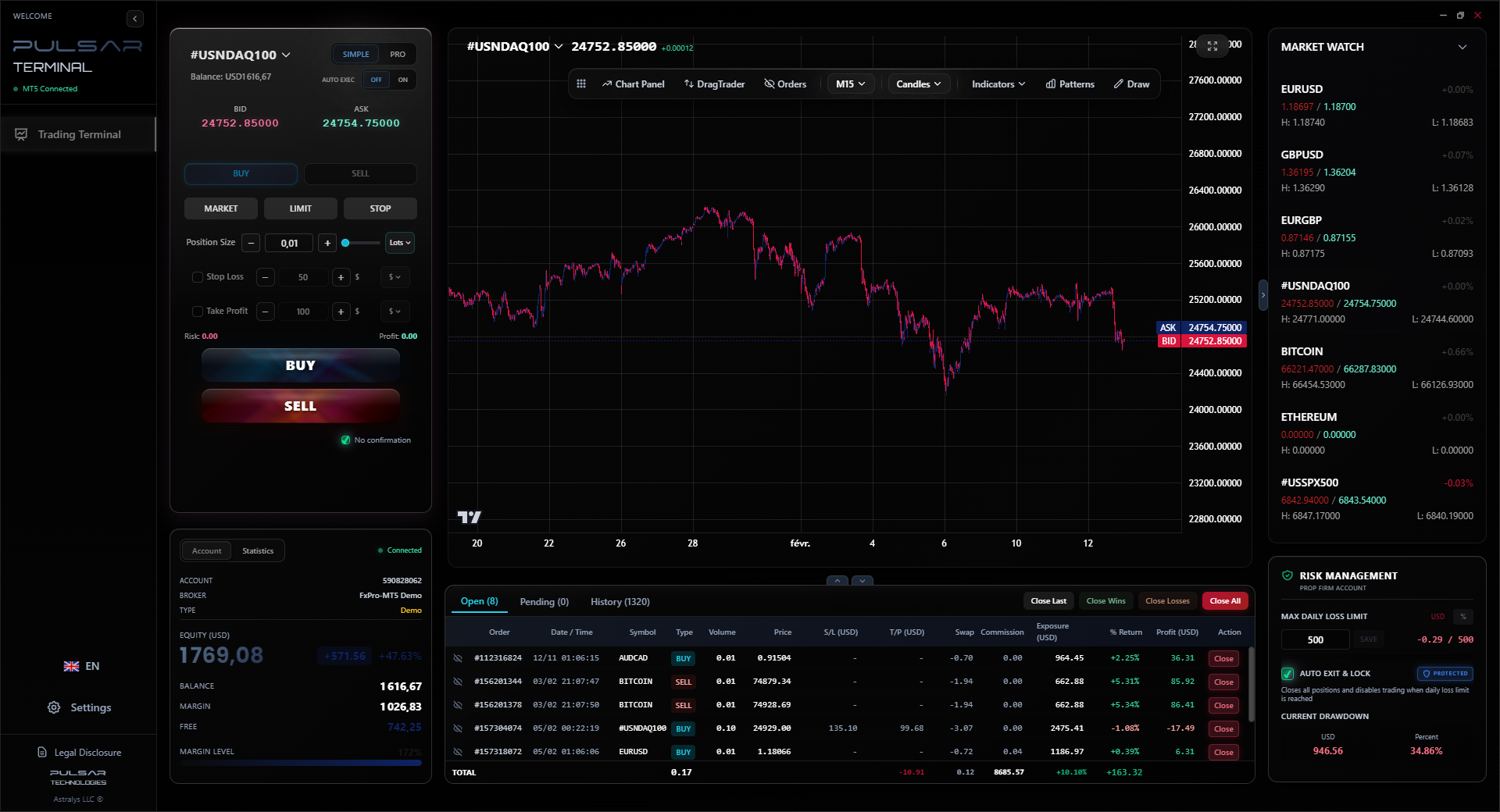
Managing the psychological stress and strict rules of trading, especially during volatile Nigerian market hours, is easier when your tools handle the mechanics. Pulsar Terminal automates complex order types and prop firm risk rules directly on your MT5, so you can focus on the strategy from your books.
“A book written for a London prop desk doesn't cover how to handle your broker freezing withdrawals during a naira crisis.”
Don't buy all these at once. Follow this progression:
Phase 1 (Months 1-3):
- Currency Trading for Dummies (Get the big picture)
- Japanese Candlestick Charting Techniques (Learn the alphabet of charts)
Phase 2 (Months 4-6): 3. The Disciplined Trader (Fix your head. This is mandatory.) 4. Day Trading and Swing Trading the Currency Market (Apply fundamentals & tech together)
Phase 3 (Ongoing): 5. The New Trading for a Living (Your all-in-one reference) 6. Technical Analysis of the Financial Markets (The deep-dive encyclopedia) 7. The Art of Currency Trading (For when you think like an institutional trader)
I keep Douglas and Elder on my desk. The others are on my shelf for reference. And I still re-read sections of Nison every year. It’s a living library.
Pro Tip: Buy physical copies. The act of writing notes in the margins, highlighting, and flipping pages creates a deeper connection to the material than scrolling on a PDF. Trust me on this.
💡 विंस्टन की सलाह
Your best edge as a Nigerian trader is understanding local macro. Pair Kathy Lien's fundamental framework with the BusinessDay newspaper.
“Without the right mindset, all the strategy knowledge in the world is worthless.”
If you forced me to pick one book for a Nigerian trader who already knows the absolute basics (what forex is, what a broker does), I wouldn't choose a strategy book. I'd choose 'The Disciplined Trader' by Mark Douglas.
Why? Because without the right mindset, all the strategy knowledge in the world is worthless. You'll second-guess, overtrade, revenge trade, and ignore your stop losses. I've seen it destroy more talented chart readers than anything else. Douglas's book is the foundation upon which you can profitably build any strategy, whether it's from Kathy Lien, Alexander Elder, or your own.
The second-place answer is 'The New Trading for a Living' because it's the most complete single volume covering all three pillars: psychology, analysis, and money management.
But remember, the best forex trading book is the one you actually read, understand, and apply consistently. Start small. Master one concept from one book before moving to the next. In this game, slow, disciplined learning beats frantic, scattered genius every single time.
FAQ
Q1I'm a complete beginner in Nigeria. What's the very first book I should buy?
Get 'Currency Trading for Dummies.' Don't be put off by the title. It will honestly and clearly explain how the forex market works, the terminology, and the basics of opening an account. It's the perfect, frustration-free starting point before you touch a demo account.
Q2Are these books available in Nigeria? Where can I buy them?
Yes. Check Roving Heights, Laterna Books, or The Bookworm in Lagos. For the fastest option, order the paperback versions from Amazon - they ship to Nigeria reliably. Avoid shady PDF sites; you want the real copy to make notes in.
Q3Which book is best for learning technical analysis?
Start with 'Japanese Candlestick Charting Techniques' by Steve Nison to learn the core language of price action. Then, use 'Technical Analysis of the Financial Markets' by John Murphy as your definitive reference guide for everything else, from indicators to chart patterns.
Q4I keep blowing my account. What book should I read?
Stop trading. Right now. Your problem isn't strategy, it's psychology. Read 'The Disciplined Trader' by Mark Douglas. It will challenge everything you think you know about trading and force you to confront your relationship with risk and loss. This is non-negotiable rehab for your trading mind.
Q5How do I apply these international books to trading the Nigerian Naira (NGN)?
The principles are universal: supply/demand, support/resistance, risk management. The application isn't. Use the books to build your core skills. Then, layer on your local knowledge: track CBN policy dates, understand local liquidity hours (which can cause wider spreads), and always account for the FX risk between your naira capital and your USD trading account.
Q6Is a book on trading psychology really that important?
It's the single most important thing after the basics. I'd rather trade with a novice who has rock-solid discipline than a charting expert who panics. Your emotions will cost you more money than a bad technical analysis ever will. Douglas's book is an investment in your future profitability.
Q7Can these books help me pass a prop firm challenge?
Absolutely. The psychology books (Douglas, Elder) are crucial for managing the daily loss limits and pressure. The strategy books provide the systematic approach you need. A tool like Pulsar Terminal can then automate the strict risk rules (like daily stop-outs) required to pass, letting you focus on the trades.
प्रो. विंस्टन का पाठ
:
- ✓Start with 'For Dummies', master candlesticks with Nison.
- ✓Your next book MUST be on trading psychology (Mark Douglas).
- ✓Bridge theory & practice with Kathy Lien's fundamental/technical mix.
- ✓Use John Murphy's book as an encyclopedia, not a novel.
- ✓Adapt every lesson to Nigeria's liquidity & regulatory reality.
यह लेख कितना उपयोगी था?
रेट करने के लिए स्टार पर क्लिक करें
साप्ताहिक ट्रेडिंग विश्लेषण
मुफ़्त साप्ताहिक विश्लेषण और रणनीतियाँ। कोई स्पैम नहीं।
लेखक के बारे में
Olumide Adeyemi
पश्चिम अफ्रीकी ट्रेडिंग अग्रणी
नाइजीरिया के सबसे सक्रिय फॉरेक्स ट्रेडिंग एजुकेटर्स में से एक। लागोस से 8 साल का ट्रेडिंग अनुभव। अफ्रीकी ट्रेडर्स के लिए लो-कैपिटल स्ट्रैटेजीज और प्रॉप फर्म चैलेंजेज में विशेषज्ञ।
टिप्पणियाँ
आपको यह भी पसंद आ सकता है

Cara Trading Forex Sukses: 7 Prinsip dari Trader Profesional
Cara trading forex sukses dengan 7 prinsip trader pro: manajemen modal, disiplin, journal trading, backtest. Data nyata, bukan janji profit palsu.
Jam Trading Forex Terbaik untuk Trader Indonesia: Panduan Lengkap dengan Tabel Waktu
Panduan jam trading forex untuk trader Indonesia. Tabel 4 sesi dunia, jam emas 20:00-00:00, sesi mana yang harus dihindari. Data akurat + tips dari trader berpengalaman.
Top 5 Sàn Forex Uy Tín Nhất 2026: Review Jujur dari Trader Indonesia
Top 5 sàn forex uy tín 2026 untuk trader Indonesia. Review jujur: spread, deposit, withdraw, dukungan lokal. Exness, XM, IC Markets & lebih.
All these calculators are built into Pulsar Terminal with real-time data from your MT5 account. One-click position sizing, automatic risk management, and instant calculations.
