


If you've spent any time in Nigerian trading groups, you've seen it.

Olumide Adeyemi
पश्चिम अफ्रीकी ट्रेडिंग अग्रणी ·  Nigeria
☕ 10 मिनट पढ़ने
आप क्या सीखेंगे:
If you've spent any time in Nigerian trading groups, you've seen it. The promise of a 'secret' system that prints money, usually sold by a 'guru' in a flashy car. Let me save you some cash and heartache right now. The real secret of forex trading isn't hidden in a paid course. It's the boring, unsexy stuff nobody wants to talk about: discipline, local context, and managing your psychology. I learned this the hard way, blowing up my first $500 account trying to chase the 'one weird trick' everyone was selling. Today, I'll walk you through what actually works here in Naija.
Here's the uncomfortable truth. The secret of forex trading is that there is no secret. Not in the way it's advertised. The market is a chaotic, emotional beast, and anyone telling you they've tamed it with a simple formula is likely selling something.
What successful trading actually requires is a framework. Think of it like building a business. You need a business plan (your trading strategy), capital management rules (your risk management), and the mental fortitude to stick to the plan when things get tough (your psychology). I spent my first two years searching for the holy grail indicator. I bought systems, followed signals, and consistently lost money. My turnaround started when I threw all that out and focused on these three pillars instead.
The Nigerian angle is crucial here. Our market participation is exploding. A 2021 report estimated about 300,000 retail traders, with youths aged 18-35 making up a staggering 93.7%. That's a lot of emotion and herd behavior moving the markets during our most active sessions. Understanding this local context is part of the real 'secret'.

Warning: The biggest red flag is any 'mentor' who guarantees profits or asks for a huge percentage of your wins. Real education teaches you how to fish; it doesn't just sell you a single fish every day.

💡 विंस्टन की सलाह
The market doesn't know you deposited ₦500,000. It doesn't care. Trade the chart, not your bank balance.
Trading legally and safely in Nigeria means understanding the lay of the land. You can't just jump in with an international broker and forget about local rules.
The Regulatory Shift
For years, trading with international brokers was the wild west. That's changing fast. In April 2025, the Investment and Securities Act (ISA) 2025 was signed into law. This is a big deal. It makes it illegal for any entity to run an online forex trading platform without registering with the SEC. The Central Bank of Nigeria (CBN) also dropped the Nigeria Foreign Exchange Code in January 2025, tightening rules for the wholesale market.
What does this mean for you? While many still use brokers like Exness or IC Markets regulated abroad (which is still common), the local environment is getting more structured. Always verify a broker's international regulation (like FCA, ASIC, FSCA) as your first line of defense.
The Tax Man Cometh
This is the part most new traders ignore until it's too late. Your forex profits are subject to Capital Gains Tax in Nigeria. The rate is 10%. You're responsible for declaring this to the Federal Inland Revenue Service (FIRS). Keep detailed records of all your trades - wins and losses. I learned this lesson after a surprisingly good quarter; getting your accounting in order from day one saves major headaches later.

Pro Tip: Open a separate bank account just for trading funds. It makes tracking deposits, withdrawals, and calculating your taxable profit infinitely easier.
“The real secret of forex trading is that there is no secret.”
Let's talk real numbers. How much do you actually need to start in Nigeria? You'll see ads for accounts as low as $10 (about ₦15,000). Technically, you can start. But should you?
I made this mistake. I funded a $50 account, thinking I'd 'test the waters.' With micro lots, the commissions and spreads ate me alive, and proper risk management was impossible. A single 20-pip move felt meaningless. You need enough capital to breathe.
From my experience and watching others, a realistic starting point is between $200 and $500 (₦300,000 to ₦750,000). This allows you to trade mini lots (0.1), where a 10-pip move on EUR/USD is a $1 change. It's enough to feel the market's rhythm and apply risk management without blowing up from two bad trades. For a standard account, think $500-$1000 (₦750,000-₦1,500,000).
Your first calculation before every trade shouldn't be 'how much will I make?' It should be 'how much can I afford to lose?' This is where a position size calculator is non-negotiable. If your account is $500, risking even 5% ($25) per trade is aggressive. I use a max of 2% ($10). It sounds small, but it keeps you in the game after a losing streak. I once took six consecutive losses. At 2% risk each time, my account was down 12%, which stung but was recoverable. At 5% risk, I'd have been down 30% and probably quit.
📊 Example: You have a ₦500,000 account ($333 approx.). You decide to risk 2% (₦10,000 or ~$6.66) on a EUR/USD trade. Your stop-loss is 20 pips away. Your position size should be: ($6.66 / 20 pips) = 0.33 micro lots. You'd round down to 0.3 lots. This math is your survival kit.
Choosing where to trade is your most important early decision. You need a broker that accepts Nigerians, supports Naira deposits, and is legitimately regulated. Here’s a breakdown of what to look for, based on real data.
| Broker | Key Regulation (Int'l) | Min. Deposit (Approx.) | Avg. EUR/USD Spread | Naira (NGN) Support? |
|---|---|---|---|---|
| Exness | FSCA, CySEC | $10 (₦15k) | From 1.0 pip | Yes |
| XM | IFSC, FSA | $5 (₦7.5k) | From 0.8 pips | Yes |
| IC Markets | ASIC | $200 (₦300k) | From 0.0 pips* | Yes |
| Pepperstone | FCA, ASIC, CMA | $200 (₦300k) | Raw spreads available | Yes |
| HF Markets | FSCA, FCA | $5 (₦7.5k) | From 1.4 pips | Yes |
*Note: 'From 0.0 pips' usually involves a commission per trade.
Look for brokers that offer local deposit methods like bank transfers, debit cards, and maybe even USSD or mobile money. Withdrawal speed and fees are critical. Test their customer service with a question before you deposit. I once had a withdrawal take 5 days with one broker; I switched to one with 24-hour processing.
use is a double-edged sword. Brokers here often offer up to 1:1000 or even 1:2000. That's insane for a new trader. I never use more than 1:50 on my main account. High use is the fastest path to a margin call. Start low. You can read detailed reviews on our site for brokers like XM and Pepperstone to get the full picture.
💡 विंस्टन की सलाह
If you can't explain your trade setup in one simple sentence, you don't have a setup. You have a hope.
“Your first calculation before every trade shouldn't be 'how much will I make?' It should be 'how much can I afford to lose?'”
Your strategy must fit your life and the liquidity of the Nigerian trading day. Most of us aren't professional day traders glued to the screen.
Session Awareness is Key
The London session (8 AM - 5 PM WAT) overlaps with our morning and afternoon. This is when volume and volatility are highest for pairs like EUR/USD. The New York session (1 PM - 10 PM WAT) also has good movement. If you have a 9-5, maybe you focus on end-of-day analysis and swing trading setups that play out over days. If you're free in the afternoons, the London/New York overlap is prime time.
Keep It Simple, Seriously
I used to have charts with 15 indicators. It was a mess of conflicting signals. Now, I use price action (support/resistance) and maybe one or two indicators for confirmation. The MACD indicator can help gauge momentum, and the RSI indicator can spot overbought/oversold conditions. That's it.
For example, I look for price to approach a clear support level on the 1-hour chart during the London session. If the RSI indicator is showing oversold conditions (below 30) and starts turning up, that's a potential long entry. I place my stop-loss just below the support. No magic, just logic.
Pro Tip: Backtest and forward-test any strategy in a demo account for at least 2-3 months. Track every trade in a journal. The goal isn't to be right every time, but to have a statistical edge over dozens of trades.
This is the true secret of forex trading. You can have the best strategy in the world, but if your mind isn't right, you'll lose. I've been there.
The two biggest psychological killers are fear and greed. Fear makes you move your stop-loss further away, turning a small loss into a catastrophic one. Greed makes you take profits too early on a runner or double down on a losing trade. In 2023, I had a perfect scalping strategy setup on Gold (XAU/USD). My plan was to take 5 pips. Price hit my target instantly, then ran another 15 pips. I was so angry at 'missing out' that I revenge-traded the next three signals, losing all my gains and more.
You have to detach your self-worth from your trading results. A losing trade doesn't make you a loser. It's just feedback. The only way to build this muscle is through repetition and strict adherence to your rules. Use tools that remove emotion. Setting a stop-loss and take-profit the moment you enter a trade is non-negotiable. Don't even give yourself the option to fiddle with it.
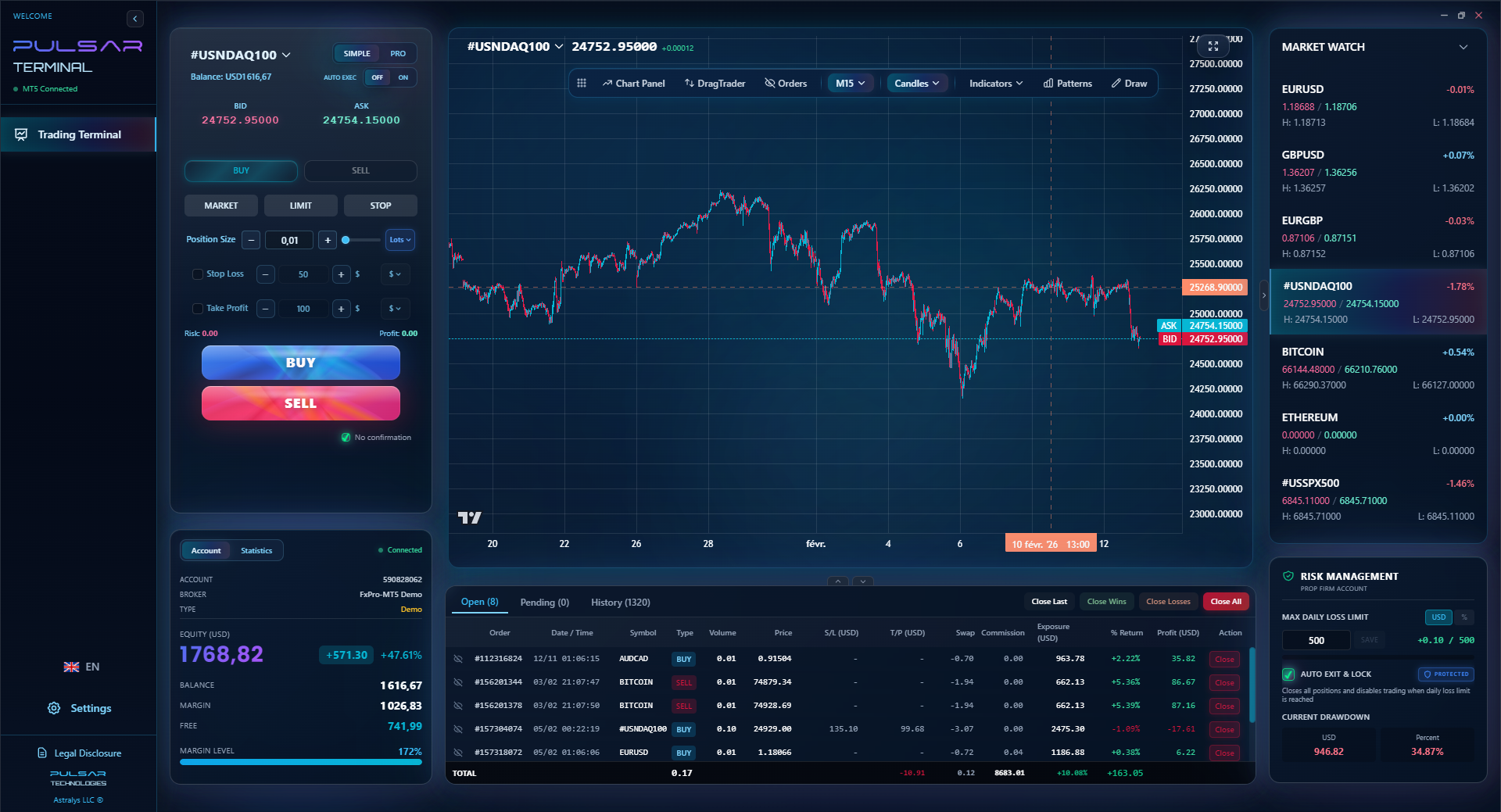
This is where technology can be a lifesaver. Having a platform that lets you set multiple take-profit levels or automate a trailing stop can lock in profits while you're away from the screen, fighting the urge to interfere.
Sticking to your trading plan requires tools that automate discipline, like Pulsar Terminal's one-click order templates and automatic trailing stops on MT5.
“A losing trade doesn't make you a loser. It's just feedback.”
Forget the guru nonsense. Here's your real, actionable plan to start trading forex in Nigeria the right way.
- Education First, Money Second: Spend 3 months learning. Understand what a pip definition is, how the spread definition affects you, and basic chart patterns. Use free resources.
- Open a Demo Account: Pick a reputable broker from the list above. Trade the demo like it's real money. Practice your risk management there. Try to 'blow up' the demo account. It's a valuable lesson.
- Develop a Simple Plan: Choose one market (start with EUR/USD). Choose one time frame (1-hour is good). Define your entry rules, exit rules, and risk-per-trade (start at 1%). Write it down.
- Fund a Live Account: Start with that $200-$500. This is your 'tuition fee.' Expect to learn, not to get rich.
- Trade Small & Journal: Execute your plan for 100 trades. Log every single one: entry, exit, reason, emotion. After 100 trades, you'll have data, not opinions.
- Review and Refine: Analyze your journal. Is your strategy working? Are you sticking to your rules? Tweak only one thing at a time.
The market's not going anywhere. The goal is to be a consistent, disciplined trader in six months or a year, not a lottery winner next week. That patience and process - that's the only secret worth knowing.
💡 विंस्टन की सलाह
Your first 100 live trades are data collection, not profit generation. Pay your 'tuition' in small lots.
FAQ
Q1Is forex trading illegal in Nigeria?
No, forex trading is legal for individuals in Nigeria. However, the regulatory environment is evolving. The new ISA 2025 law requires platforms operating locally to register with the SEC. Most Nigerian traders use internationally regulated brokers, which is a common and accepted practice.
Q2How much money do I need to start forex trading in Nigeria?
You can technically start with as little as $10 (₦15,000), but it's not practical for learning proper risk management. A more realistic amount that gives you room to breathe and learn is between $200 and $500 (₦300,000 to ₦750,000). This allows you to trade mini lots and absorb a few losses without blowing your account.
Q3How do I pay taxes on my forex trading profits?
Forex trading profits are considered capital gains in Nigeria and are subject to a 10% tax. You are responsible for declaring this income to the Federal Inland Revenue Service (FIRS). It's crucial to keep detailed, accurate records of all your trades for tax purposes.
Q4Which broker is best for Nigerian traders?
There's no single 'best' broker. Look for one with strong international regulation (like FCA, ASIC, FSCA), low and transparent costs (spreads/commissions), support for Naira deposits and withdrawals, and reliable customer service. Popular choices among experienced traders include IC Markets, Pepperstone, and Exness, but you should always do your own research based on your needs.
Q5What's the biggest mistake new Nigerian traders make?
Two tied for first: using excessive use and having no risk management plan. use of 1:1000 can wipe out a small account in minutes if a trade moves slightly against you. Not using a stop-loss is simply gambling. Always define your risk before you enter a trade.
Q6Can I make a living from forex trading in Nigeria?
It's possible, but it's incredibly difficult and should not be your initial goal. Treat it as a skilled profession that requires years of education and practice. Most successful traders start by supplementing their income and gradually scale up as they prove their consistency over hundreds of trades. Don't quit your job to trade.
प्रो. विंस्टन का पाठ
:
- ✓Start with at least $200, not $10.
- ✓Never risk more than 2% of your account per trade.
- ✓Use use below 1:50 as a beginner.
- ✓Pay your 10% capital gains tax.
- ✓Trade the London/New York overlap for best liquidity.
यह लेख कितना उपयोगी था?
रेट करने के लिए स्टार पर क्लिक करें
साप्ताहिक ट्रेडिंग विश्लेषण
मुफ़्त साप्ताहिक विश्लेषण और रणनीतियाँ। कोई स्पैम नहीं।
लेखक के बारे में
Olumide Adeyemi
पश्चिम अफ्रीकी ट्रेडिंग अग्रणी
नाइजीरिया के सबसे सक्रिय फॉरेक्स ट्रेडिंग एजुकेटर्स में से एक। लागोस से 8 साल का ट्रेडिंग अनुभव। अफ्रीकी ट्रेडर्स के लिए लो-कैपिटल स्ट्रैटेजीज और प्रॉप फर्म चैलेंजेज में विशेषज्ञ।
टिप्पणियाँ
आपको यह भी पसंद आ सकता है

Cara Trading Forex Sukses: 7 Prinsip dari Trader Profesional
Cara trading forex sukses dengan 7 prinsip trader pro: manajemen modal, disiplin, journal trading, backtest. Data nyata, bukan janji profit palsu.
Jam Trading Forex Terbaik untuk Trader Indonesia: Panduan Lengkap dengan Tabel Waktu
Panduan jam trading forex untuk trader Indonesia. Tabel 4 sesi dunia, jam emas 20:00-00:00, sesi mana yang harus dihindari. Data akurat + tips dari trader berpengalaman.
Top 5 Sàn Forex Uy Tín Nhất 2026: Review Jujur dari Trader Indonesia
Top 5 sàn forex uy tín 2026 untuk trader Indonesia. Review jujur: spread, deposit, withdraw, dukungan lokal. Exness, XM, IC Markets & lebih.
All these calculators are built into Pulsar Terminal with real-time data from your MT5 account. One-click position sizing, automatic risk management, and instant calculations.
