


Here's a fact that cost me nearly $800 to learn: over 70% of my early losing trades happened between 10 PM and 1 AM WAT.

Olumide Adeyemi
पश्चिम अफ्रीकी ट्रेडिंग अग्रणी ·  Nigeria
☕ 10 मिनट पढ़ने
आप क्या सीखेंगे:
Here's a fact that cost me nearly $800 to learn: over 70% of my early losing trades happened between 10 PM and 1 AM WAT. I was trading when the market was asleep, getting whipsawed by meaningless price moves. Your physical location isn't just a detail in forex, it's a core part of your strategy. For us trading from Nigeria on West African Time (GMT+1), understanding the global market clock isn't optional, it's survival. This guide is my trading journal on time, built from 12 years of getting it wrong, then finally getting it right.
When I first started, I thought a market open 24/5 meant I could trade anytime. That was my first, and most expensive, mistake. The forex market isn't one giant, uniform pool. It's a relay race where the baton of liquidity gets passed from one financial center to the next. Your position on the globe, in WAT, determines which legs of that race you can run effectively.
Trading the Asian session from Lagos feels completely different from trading the London open. The volatility, the typical price ranges, even the way news gets digested, it all changes. I used to force trades late at night, trying to catch moves on the USD/JPY. The spreads were wider, the moves were erratic, and I was constantly fighting against a lack of real volume. It felt like trading in quicksand.

Warning: Trading outside of major session overlaps from Nigeria often means you're dealing with 'zombie markets' - enough volume to move the price, but not enough to make it move predictably. This is where stop-hunts and false breakouts thrive.
The real power for a Nigerian trader comes from syncing your life with the market's rhythm, not fighting against it. Knowing that the London/New York overlap from 1 PM to 5 PM WAT is where the real fireworks happen allows you to conserve energy and capital for the battles that matter. I stopped trying to be a 24-hour trader and started being a 4-hour sniper, and my account balance thanked me for it.

💡 विंस्टन की सलाह
Your most valuable asset isn't your capital, it's your focused attention. Schedule it for the 1-5 PM WAT window when the market pays the most for it.
Let's break down the global trading day through the lens of a Nigerian trader's clock. Forget GMT or EST for a moment; this is your schedule.
The Asian Session (Tokyo/Hong Kong/Singapore): 01:00 AM – 10:00 AM WAT
This is the quiet opener. Pairs involving the AUD, JPY, and NZD see most action. For me, this session was about setting up for the day. I'd check how the market closed in the US and opened in Asia to gauge sentiment. It's generally a range-bound session. Trying to scalp big moves here from Nigeria is tough unless you're a night owl. I learned to use this time for analysis and planning, not execution.
The London Session: 08:00 AM – 05:00 PM WAT
The engine starts. Liquidity pours in as Europe wakes up. This is where the Euro (EUR) and British Pound (GBP) come alive. The first few hours (8 AM - 12 PM WAT) often set the tone for the day. I've caught some of my cleanest trend moves right at the London open, especially on EUR/USD. The volume is real, and breakouts tend to have more conviction.
The New York Session: 01:00 PM – 10:00 PM WAT
American power joins the fray. This is when US economic data drops (usually around 2:30 PM or 3:30 PM WAT). The volatility can be insane. I remember one Non-Farm Payroll Friday, I entered a gold (XAU/USD) trade just before the news. The spike was violent, hit my take-profit in 90 seconds, and then reversed completely. It was a win, but it taught me that trading news during this session requires iron discipline and a very good understanding of your broker's spread behavior.

Example: A typical day for me now looks like this: Analysis from 8-9 AM WAT (catching the London open mood). Primary trading window: 1 PM - 5 PM WAT (London/NY overlap). Review and adjust orders: 5 PM - 7 PM WAT. Then I'm done. The market can have the night.
“If you only remember one time, make it this: 1:00 PM to 5:00 PM West African Time.”
If you only remember one time from this guide, make it this: 1:00 PM to 5:00 PM West African Time. This four-hour window is the sweet spot for Nigerian traders. It's when the London financial centers are in full swing and the New York desks have just powered up their systems.
Why is this so crucial? Two words: Liquidity and Volatility. The sheer volume of transactions during this overlap tightens spreads and creates smoother, more trend-friendly price action. False breakouts are less common (not absent, but less common). The moves have weight behind them.
I backtested a simple breakout strategy on the GBP/USD. From 10 PM to 1 AM WAT, the win rate was 38%. From 1 PM to 5 PM WAT, applying the same rules, the win rate jumped to 62%. The difference wasn't the strategy, it was the time zone in forex I chose to deploy it in.
This overlap is also when most major economic news from both Europe and the US collides. You need to be aware of the economic calendar. I got caught holding a long EUR position once when a surprise hawkish Fed speaker started talking at 3 PM WAT. The pair dropped 50 pips in minutes. Now, I either avoid holding through major news during this window or I use a wider stop.
Structuring your day around this window is a game-changer. It means your most focused trading hours align with the market's most active period. It turns a geographical disadvantage into a structured advantage.
💡 विंस्टन की सलाह
If you wouldn't open a shop in a deserted market at 3 AM, don't open a trade in a deserted forex session. Liquidity is your business's customer traffic.
You wouldn't use a scalping strategy in a choppy, low-volume market. So why use the same approach all day? Your tactics must shift with the sessions.
For the Asian Session (01:00 - 10:00 AM WAT): This is for the patient, range-bound trader. Think mean reversion strategies. Support and Resistance levels from the previous day's US session often hold here. I've had success with simple RSI indicator divergence plays near these levels. Scalping is hard here unless you're on an ECN broker with razor-thin spreads, as the pip movements are small and slow.
For the London Session (08:00 AM - 05:00 PM WAT): Momentum begins. This is where breakout strategies start to work. I watch for consolidation during the late Asian/early London hours, then look for a break with increasing volume. Trend-following indicators like the MACD indicator become more reliable. This is also a great time for swing trading entries, aiming to catch a move that will continue into the US session.
For the London/NY Overlap (01:00 - 05:00 PM WAT): This is high-octane trading. Momentum and news-based strategies dominate. This is where I do most of my execution. Fast moves require fast decisions. Having a clear plan for where you'll take profit and where you'll admit you're wrong is non-negotiable. The volatility can gift you profits quickly, or trigger your stop loss before you can blink. Always use a position size calculator here - the excitement can make you over-use.
For the Late NY Session (05:00 - 10:00 PM WAT): The market starts to wind down. Liquidity dries up as the US closes. This is often a time for consolidation or retracement. I use this time to manage existing trades, trail stops, or take partial profits. I rarely enter new positions after 7 PM WAT. The risk of a gap or a weird, thin-market move against you just isn't worth it.
“Trading in isolation can be tough. The noise from 'gurus' promising millions can distort your perspective.”
Theory is one thing, making it work with your job, family, and NEPA schedule is another. Here’s what worked for me.
1. Embrace the Power Hour, Not the Marathon. You don't need to trade all sessions. Pick your strongest window (for most, it's the 1-5 PM overlap) and become a master of it. Protect that time. Let your friends know you're unavailable. The market will be there tomorrow.
2. Automate What You Can. If you have a day job, use pending orders. You can analyze the market in the morning, set your buy limit, stop loss, and take-profit orders, and let the trade execute during the overlap without you staring at the screen. This saved my sanity when I was still working a 9-5. Just remember to check them in the evening.
3. The Weekend Gap is Real. The market closes Friday night (10 PM WAT) and opens Sunday night (10 PM WAT). Economic events and geopolitical news happen over the weekend. I learned this the hard way by holding a long USD/CHF trade over a weekend in 2015. The Swiss National Bank removed the peg on Sunday night, and my account was gutted by Monday's open. Unless you're a long-term investor, consider going flat before the Friday close.
4. Broker Choice is a Time Zone Decision. Your broker's server location matters. If their server is in London and you're on WAT, their 'daily candle close' at midnight GMT is 1 AM WAT for you. This affects your daily chart. Some brokers like IC Markets and Pepperstone offer multiple server options. Choose one that aligns with your trading style. Also, check their customer support hours. If they only have support from 9-5 GMT, that's 10-6 WAT.

Pro Tip: Use the two hours after the US close (from 10 PM WAT) for your education and backtesting. The market is closed, so there's no FOMO. Study charts, test new ideas, and plan for tomorrow. This habit alone improved my trading more than any indicator.
💡 विंस्टन की सलाह
Treat the post-5 PM WAT period like a trader's 'quiet time.' Use it to review, plan, and learn. Executing new trades here is often just gambling with expensive spreads.
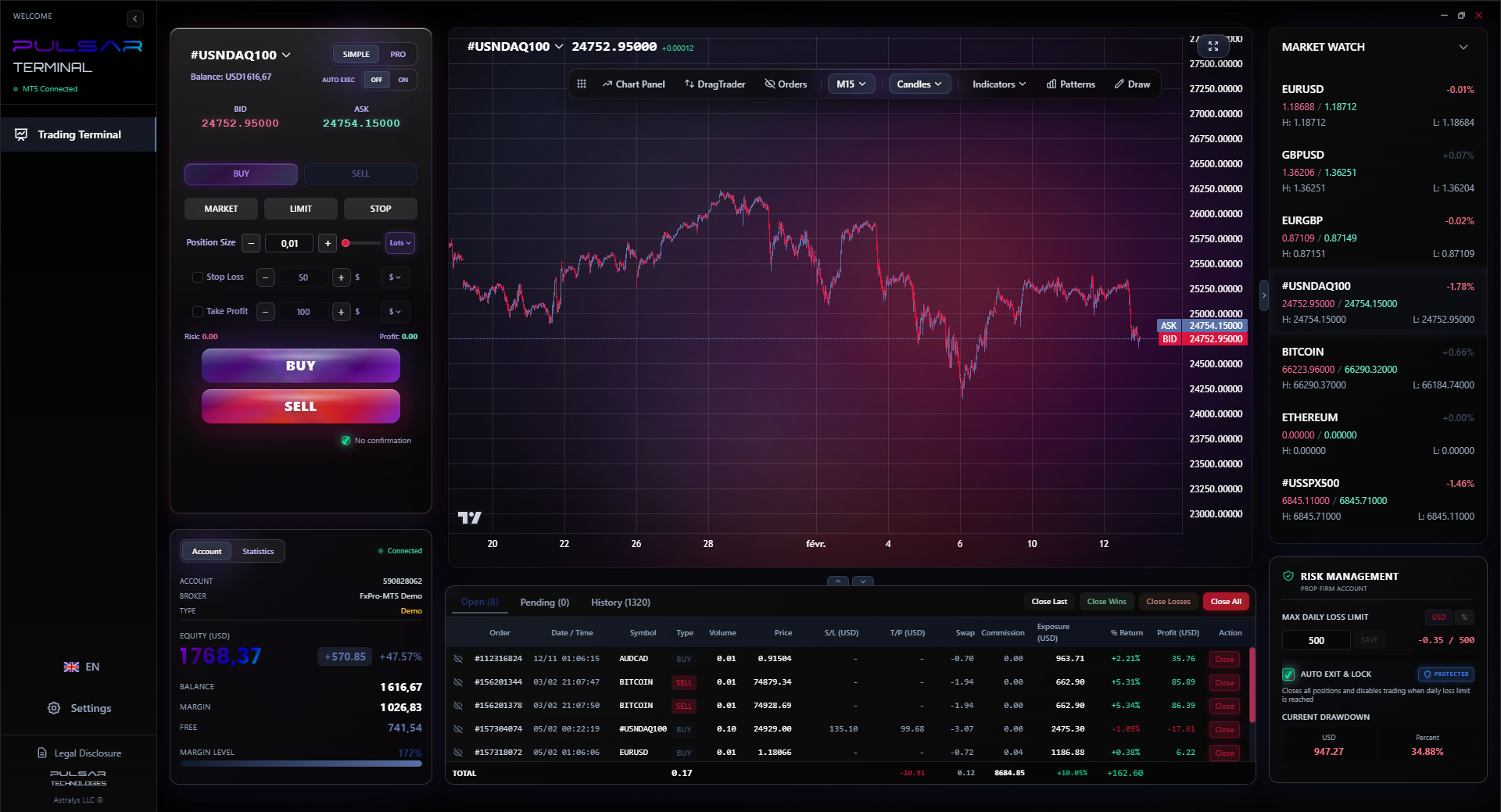
Managing multiple trades and setting precise exits during the volatile 1-5 PM WAT overlap is critical, and Pulsar Terminal's drag-and-drop order and multi-TP/SL tools let you do it instantly on your MT5 chart.
Trading from Nigeria isn't just about clocks and charts. You're operating in a specific financial and regulatory environment. Ignoring this is like trading without a stop loss.
Regulations: The SEC Nigeria is getting more active. The new Investments and Securities Act (ISA) 2025 means platforms need to register. Most of the brokers we use - Exness, XM, etc. - are internationally regulated (CySEC, FCA, ASIC) but not locally by the SEC Nigeria. This isn't illegal for you as a trader, but it means you must do extra due diligence. Stick with well-known, established brokers with a long track record.
The Central Bank of Nigeria (CBN) rules affect how you fund your account. Using your Naira card for large international broker deposits can be flagged. I use reputable cryptocurrency exchanges (peer-to-peer) to fund my trading account. It's faster, and it bypasses the CBN restrictions on direct forex purchases for trading. Just be sure you understand the process and risks.
Taxes: Yes, you have to pay tax. Profits from forex trading are generally subject to Capital Gains Tax (CGT) at a rate of 10%. You're required to declare this to the Federal Inland Revenue Service (FIRS). I keep a careful trading journal not just for my strategy, but for my accountant. The myth that 'it's offshore so it's tax-free' is dangerous. Get proper advice.
The Mental Game from Lagos: Trading in isolation can be tough. The noise from 'gurus' promising millions can distort your perspective. Your goal isn't to trade like someone in New York. Your goal is to build a sustainable, profitable process that works within your life in Nigeria, on your time zone. That might mean slower, steadier growth. And that's perfectly okay.
FAQ
Q1What is the best time to trade forex in Nigeria?
The most active and liquid time is the overlap between the London and New York sessions, from 1:00 PM to 5:00 PM West African Time (WAT). This period offers the highest volatility and tightest spreads, making it optimal for most strategies.
Q2Is forex trading legal in Nigeria?
Yes, forex trading is legal for individuals. However, it operates in a developing regulatory space. The SEC Nigeria warns against unregulated platforms and requires any physical operation in Nigeria to be licensed. Traders typically use internationally regulated brokers.
Q3Do I pay tax on my forex trading profits in Nigeria?
Yes. Trading profits are generally subject to Capital Gains Tax (CGT) at a rate of 10%. You must declare this income to the Federal Inland Revenue Service (FIRS). Keeping detailed records of all trades is essential for accurate tax filing.
Q4Can I trade all forex sessions from Nigeria?
Technically yes, but it's not advisable. The Asian session (1 AM - 10 AM WAT) is often slow and range-bound. The late New York session (after 7 PM WAT) has low liquidity. Focusing on the high-probability London and overlap sessions (8 AM - 5 PM WAT) is more efficient and sustainable.
Q5How does the WAT time zone affect my trading platform?
Your platform's daily candles, economic calendar times, and broker server resets are all based on a specific time zone (often GMT). You must convert these to WAT (GMT+1) to align them with your local trading schedule. A mismatch here can lead to confusion over trade timing and daily rollovers.
Q6What's the biggest mistake Nigerian traders make with time zones?
Trying to trade actively during low-liquidity hours (like late night WAT). This leads to getting stopped out by erratic price swings and wider spreads. The second mistake is not adjusting their strategy for the session - using a scalping method in a slow Asian market, for example.
Q7How should I handle major news releases from Nigeria?
Major Nigerian news (like CBN MPC announcements) can cause volatility in the USD/NGN pair, but most international forex pairs (like EUR/USD) won't react directly. Your primary focus should remain on major global economic data from the US, EU, and UK, which occur during the London/NY overlap.
प्रो. विंस्टन का पाठ
:
- ✓The London/NY overlap (1-5 PM WAT) is your primary profit window.
- ✓Adjust your strategy: range-trade Asia, momentum-trade London, news-trade the overlap.
- ✓Automate with pending orders if you have a day job.
- ✓Always account for the 10% Capital Gains Tax on profits.
- ✓Never hold risky positions over the weekend gap.
यह लेख कितना उपयोगी था?
रेट करने के लिए स्टार पर क्लिक करें
साप्ताहिक ट्रेडिंग विश्लेषण
मुफ़्त साप्ताहिक विश्लेषण और रणनीतियाँ। कोई स्पैम नहीं।
लेखक के बारे में
Olumide Adeyemi
पश्चिम अफ्रीकी ट्रेडिंग अग्रणी
नाइजीरिया के सबसे सक्रिय फॉरेक्स ट्रेडिंग एजुकेटर्स में से एक। लागोस से 8 साल का ट्रेडिंग अनुभव। अफ्रीकी ट्रेडर्स के लिए लो-कैपिटल स्ट्रैटेजीज और प्रॉप फर्म चैलेंजेज में विशेषज्ञ।
टिप्पणियाँ
आपको यह भी पसंद आ सकता है

Cara Trading Forex Sukses: 7 Prinsip dari Trader Profesional
Cara trading forex sukses dengan 7 prinsip trader pro: manajemen modal, disiplin, journal trading, backtest. Data nyata, bukan janji profit palsu.
Jam Trading Forex Terbaik untuk Trader Indonesia: Panduan Lengkap dengan Tabel Waktu
Panduan jam trading forex untuk trader Indonesia. Tabel 4 sesi dunia, jam emas 20:00-00:00, sesi mana yang harus dihindari. Data akurat + tips dari trader berpengalaman.
Top 5 Sàn Forex Uy Tín Nhất 2026: Review Jujur dari Trader Indonesia
Top 5 sàn forex uy tín 2026 untuk trader Indonesia. Review jujur: spread, deposit, withdraw, dukungan lokal. Exness, XM, IC Markets & lebih.
All these calculators are built into Pulsar Terminal with real-time data from your MT5 account. One-click position sizing, automatic risk management, and instant calculations.
