


I lost R1,200 in under a minute because I didn't understand pips.

David van der Merwe
उभरते बाजार के ट्रेडर ·  South Africa
☕ 11 मिनट पढ़ने
आप क्या सीखेंगे:
I lost R1,200 in under a minute because I didn't understand pips. It was early 2015, and I'd just opened a position on USD/ZAR. The price moved 50 points, and I thought, 'Great, that's R50.' I closed the trade, smug. My account balance told a different story. I'd miscalculated the pip value by a factor of ten. That R50 was actually a R500 loss, and with use, it doubled. That painful lesson burned the meaning of 'what does pip stand for in forex' into my trading brain forever. It's not just jargon, it's the fundamental unit of your profit and loss.
So, what does pip stand for in forex? Most textbooks will tell you it's 'Percentage in Point' or 'Price Interest Point.' Honestly, after 12 years, I just think of it as 'the point.' It's the smallest standardised move a currency pair can make. Forget the fancy name, focus on what it does: it measures your wins and losses.
For most pairs, like our beloved EUR/USD, one pip is a move at the fourth decimal place. If EUR/USD goes from 1.0850 to 1.0851, that's one pip. Simple. The big exception is any pair with the Japanese Yen (JPY), where a pip is the second decimal place. So USD/JPY moving from 151.50 to 151.51 is also one pip.

Warning: New traders often confuse 'pips' with 'points' on their platform. Many brokers now show a fifth decimal place (e.g., 1.08501). That last digit is a 'pipette' or fractional pip - one-tenth of a pip. Don't let it trip you up. Your core calculations should always be based on the standard pip (the 4th or 2nd decimal).
Getting this wrong is how you blow up an account. I've seen it. A guy once thought a 100-pip stop-loss on GBP/JPY was the same distance as on EUR/USD. It's not. The volatility is completely different. Understanding the pip is step zero before you even think about a scalping strategy.
This is where the rubber meets the road. A pip is just a number until you attach a monetary value to it. That value depends on three things: the currency pair, your trade size (lot size), and your account currency.
The Standard Formula
For a USD-based account, the old rule of thumb is easy:
- 1 Standard Lot (100,000 units): 1 pip = $10
- 1 Mini Lot (10,000 units): 1 pip = $1
- 1 Micro Lot (1,000 units): 1 pip = $0.10
But you're in South Africa. Your brain thinks in Rands. If your account is in ZAR, you need to convert. Let's say you're trading EUR/USD, your account is in ZAR, and the USD/ZAR rate is 18.50.
- You trade 1 mini lot (10,000 units). 1 pip on EUR/USD = $1.
- To get the ZAR value: $1 * 18.50 (USD/ZAR rate) = R18.50 per pip.
Local Pair Example: USD/ZAR
This is different because the quote currency (the second one) is ZAR. The formula changes. For a standard lot (100,000 units) on USD/ZAR:
- Pip Value = (0.0001 / Current USD/ZAR Price) * Lot Size
- If USD/ZAR is at 18.5000: (0.0001 / 18.5000) * 100,000 = 0.54 USD.
- Then convert that USD to ZAR: 0.54 * 18.50 = R10.00 per pip (approximately).
See? It's not a fixed $10. This is why using a position size calculator is non-negotiable. I don't do this math in my head anymore. I let a calculator do it, every single time. It saves you from my R1,200 mistake.


💡 विंस्टन की सलाह
A pip is a unit of measurement, not a unit of value. Never confuse the distance on the chart with the money in your account. Always, always calculate the pip value first.
“That painful lesson burned the meaning of 'what does pip stand for in forex' into my trading brain forever. It's not just jargon, it's the fundamental unit of your profit and loss.”
Pips aren't just for measuring profit. They measure your costs, too. The spread - the difference between the buy and sell price - is quoted in pips. It's the broker's cut. In South Africa, with the FSCA keeping an eye on things, you get decent transparency, but costs vary wildly.
Look at the raw numbers from some FSCA-regulated brokers:
| Broker | FSCA Reg. No. | Typical EUR/USD Spread | Min Deposit (ZAR approx.) |
|---|---|---|---|
| IC Markets | Juristic Rep | 0.0 pips + commission | ~R750 ($50) |
| FP Markets | Juristic Rep | From 0.0 pips + commission | ~R750 ($50) |
| XM | 51936 | From 0.6 pips (commission-free) | R85 ($5) |
| AvaTrade | 45984 | From 0.9 pips (commission-free) | ~R1,850 ($100) |
| HFM | 46632 | From 0.0 pips + commission | R0 |
That '0.0 pips' looks beautiful, but remember, you're paying a commission per lot instead. A 0.0 pip spread with a $3.50 commission on a round-turn trade is often cheaper than a 1.5 pip spread with no commission on larger positions. You have to do the maths for your style.
For a local trading USD/ZAR, spreads are wider. Don't expect 0.5 pips. It's more like 15-50 pips during active hours, because it's an exotic pair. That means the price has to move 15-50 pips just for you to break even. This massively affects strategies like scalping, which is why I rarely scalp ZAR pairs.

Pro Tip: Always check if the spread is fixed or variable. During major news events (like SARB interest rate announcements), variable spreads on USD/ZAR can widen to 100+ pips in a blink. If you're in a trade, your stop-loss can get slipped. A fixed spread account from a broker like Trade Nation can be a safer playground for news traders, but you pay for that stability in slightly higher everyday spreads.
This is the most important section. use amplifies everything, especially the value of each pip. The FSCA allows use up to 1:500 for retail clients, and some offshore-regulated brokers offer up to 1:2000. This is a double-edged sword so sharp it can cut your account in half before you finish your coffee.
Let's use my early disaster as an example with clearer numbers. Say you have R10,000.
- Without use: To buy 1 standard lot of USD/ZAR (worth roughly $100,000 or R1,850,000), you'd need... well, you can't. You don't have R1.85 million.
- With 1:100 use: Your required margin is now 1%. You only need to put up roughly R18,500 as collateral. Your broker 'lends' you the rest.
Now, that 1 standard lot has a pip value of about R10 (as we calculated).
- A 50-pip move against you = R500 loss.
- On your R10,000 account, that's a 5% loss from one trade. Manageable.
- A 200-pip move against you = R2,000 loss. That's 20% gone.
Now, imagine you got greedy and used 1:500 use on that R10,000. Your margin requirement is tiny. You could open 5 standard lots. Now your pip value is R50 per pip.
- A mere 40-pip move against you = R2,000 loss. 20% of your account, gone in seconds.
- A 100-pip move triggers a margin call. You're out.
use doesn't change the pip value itself, but it allows you to control a position size where the pip value is dangerously large relative to your capital. I learned this the hard way. Now, I rarely use more than 1:30 use, even if my broker offers 1:500. It's about survival. Your first goal isn't to get rich, it's to stay in the game. Managing your risk per pip is how you do that.
💡 विंस्टन की सलाह
If you can't instantly state your pip value and total risk in Rands before clicking 'buy,' you have no business being in that trade. Period.
“use amplifies everything, especially the value of each pip. This is a double-edged sword so sharp it can cut your account in half before you finish your coffee.”
Okay, you know what a pip is and what it's worth. How do you use it? It becomes the building block for every plan you make.
Setting Stop-Losses & Take-Profit: You don't say 'I'll risk R100.' You say, 'My stop-loss is 25 pips away, and my pip value is R4, so I'm risking R100.' You place the stop-loss 25 pips from your entry. This objective distance, measured in market pips, is cleaner than a vague monetary value. For a swing trading setup on Gold (XAU/USD), your stop might be 150 pips away. On a fast EUR/USD scalp, it might be 10.
Measuring Reward-to-Risk: This is crucial. If your stop-loss is 20 pips away (risk), and your profit target is 60 pips away (reward), you have a 1:3 risk-to-reward ratio. You can be wrong twice for every time you're right and still break even. I look for setups with at least 1:2. Pips make this calculation instant.
Analyzing Performance: Don't just look at your P&L in Rands. Look at it in pips. Did you make 500 pips this month? That's a solid metric that removes the distortion of position size. If you lost 200 pips, you need to review your analysis, not blame your lot size.
A Real Trade: In January 2024, I went long on Gold (XAU/USD) at $2021.50. My analysis said if it broke $2030, it could run. I placed my stop at $2015.00 (65 pips risk). My first target was $2045 (235 pips reward). That's a great 1:3.6 ratio. I used a position size where 65 pips = 1.5% of my account. The trade hit my first target, I moved my stop to breakeven, and it ran further. I closed the final portion at $2060. That first chunk netted 235 pips. The pip value, based on my calculated position size, made that a very good week. The pip was my ruler for the entire plan.
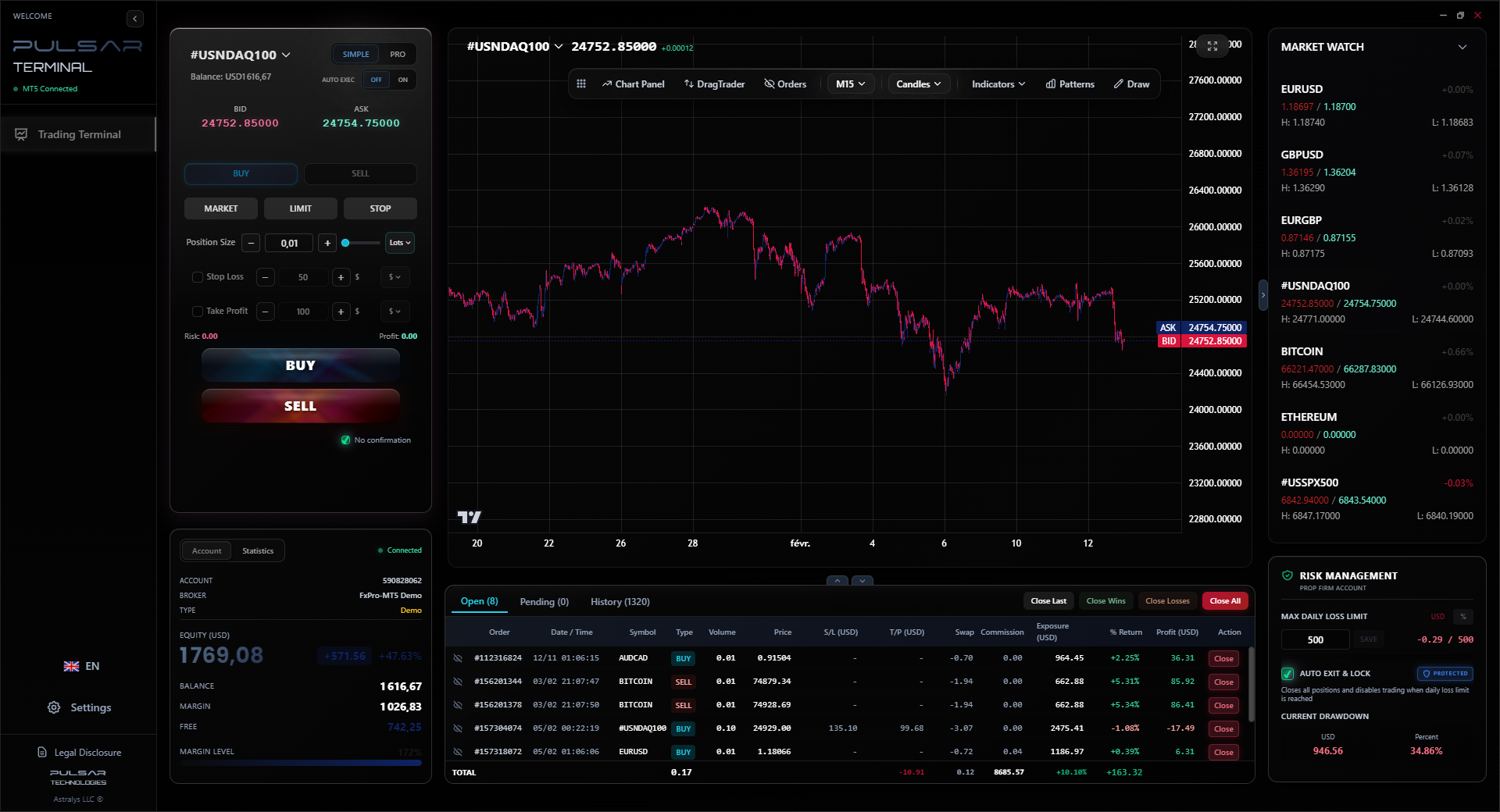
Manually calculating pip distances for stop-losses and multiple take-profit levels is tedious and error-prone, which is why tools like Pulsar Terminal automate this directly on your MT5 charts.
Trading from SA adds unique layers to the pip story.
ZAR Account Advantage: Many brokers like HFM, XM, and Trade Nation offer ZAR-denominated accounts. This is a game-saver. You deposit Rands, your profit and loss are displayed in Rands, and the pip value for most major pairs is automatically converted for you. It eliminates the hidden cost of converting your profits from USD back to ZAR, which can eat 1-2% per round trip with your bank's lousy rates and fees.
Funding Realities: That R85 minimum deposit from XM? It's real. You can start. But here's my strong opinion: starting with less than R5,000 is a practice exercise, not real trading. Why? Let's say you deposit R1,000. With sensible 1:30 use, you can maybe control a position with a pip value of R1. To make R500 profit, you need to catch 500 pips. That's a monumental task. You'll be tempted to over-use to make it 'worthwhile,' and that's the fast track to a zero balance. Be realistic.
Local Bank Fees: Remember, pips measure trading costs, but your bank adds its own 'pips' in fees. Sending money to your broker via a SWIFT transfer from Standard Bank or FNB can cost R250-R500 per transaction. That's the equivalent of wiping out 25-50 profitable pips on a small account before you even start. Use local EFTs to broker ZAR accounts or e-wallets like Skrill where possible to keep those non-trading costs down.
💡 विंस्टन की सलाह
The most expensive pips you'll ever pay are the ones that hit your stop-loss because you placed it at a random number instead of a logical market level.
“Understanding what a pip stands for in forex is the foundation. Respecting it is what separates the gamblers from the traders.”
Let's wrap this up with a blunt list of errors I've made or seen countless times.
- Ignoring Pip Value for Different Pairs: Assuming a 30-pip stop on GBP/JPY carries the same risk as 30 pips on EUR/USD. It doesn't. GBP/JPY is more volatile; the pip value in your account currency is also different. Calculate it. Every. Single. Time.
- Confusing Pips with Percentages: A 100-pip move on USD/ZAR (from 18.50 to 18.60) is about a 0.54% change. A 100-pip move on EUR/USD (1.0850 to 1.0950) is about a 0.92% change. The pip count is the same; the market impact is not. Use tools like the RSI indicator or MACD indicator to gauge momentum, but always contextualize pip moves with percentage change on the chart.
- Forgetting About Spread on Entry/Exit: You buy EUR/USD at 1.0850 (ask price). The spread is 1 pip. The bid price is 1.0849. The second you open the trade, you're already 1 pip down. Your analysis needs to account for the price moving past the spread before you're in profit.
- Not Aligning Pip Stops with Market Structure: Placing a random 20-pip stop because it fits your risk, while ignoring that it sits right below a major support level that the market will obviously test. Your stop should be based on where the market structure invalidates your idea, not an arbitrary pip number. The pip number is just the result of that calculation.
Understanding what a pip stands for in forex is the foundation. Respecting it is what separates the gamblers from the traders. It turns the chaotic blips on a screen into a measurable, manageable business. Now go plug some numbers into a calculator before you place another trade.
FAQ
Q1What does 'pip' actually stand for?
It stands for 'Percentage in Point' or 'Price Interest Point.' In practice, traders just use it to mean the smallest standard price move. For most pairs (like EUR/USD), that's 0.0001. For JPY pairs (like USD/JPY), it's 0.01.
Q2How much is 1 pip in South African Rands?
It's not a fixed amount. It depends on the pair you trade, your position size, and the current USD/ZAR exchange rate. For a standard lot (100,000 units) of EUR/USD with USD/ZAR at 18.50, 1 pip is roughly R18.50. You must use a position size calculator for accuracy.
Q3Why is the pip different for USD/ZAR?
Because the South African Rand is the quote currency. The formula for pip value changes when your account currency matches the quote currency. For USD/ZAR, a pip is typically a move at the fourth decimal place (e.g., 18.5000 to 18.5001), but its monetary value is calculated differently than for a pair like EUR/USD.
Q4What's the difference between a pip and a pipette?
A pipette is one-tenth of a pip. Many brokers quote prices to a fifth decimal place (e.g., 1.08501). That last '1' is a pipette. It allows for more precise pricing, but your core profit/loss and risk management should always be based on full pips.
Q5Is a 50-pip stop-loss good?
There's no universal 'good' or 'bad.' It depends entirely on the currency pair's volatility, your timeframe, and the trade setup. A 50-pip stop on a calm EUR/USD swing trade might be fine. On a volatile GBP/JPY scalp, it's enormous. The stop should be placed where your trade idea is proven wrong, not at an arbitrary pip distance.
Q6Can I start trading forex in South Africa with just R100?
Technically, yes. Brokers like XM accept deposits as low as R85. But realistically, it's a major handicap. With such a small amount, sensible position sizes yield tiny pip values (cents), making meaningful profit nearly impossible without resorting to dangerous over-use. I recommend at least R5,000 as serious starting capital.
Q7Do all brokers in South Africa use the same pip?
Yes, the definition of a pip is standard across the global market. However, how they quote the price can differ. Some show 4 decimals (full pips), others show 5 (including pipettes). Always check your platform's quote format so you know what you're looking at.
प्रो. विंस्टन का पाठ
:
- ✓A pip is a 0.0001 move for most pairs, 0.01 for JPY pairs.
- ✓Pip value in ZAR depends on the pair, lot size, and USD/ZAR rate.
- ✓Never set a stop-loss based on arbitrary pips; use market structure.
- ✓use amplifies pip value, making risk management non-negotiable.
- ✓A R5,000 minimum is realistic for serious ZAR-based trading.
यह लेख कितना उपयोगी था?
रेट करने के लिए स्टार पर क्लिक करें
साप्ताहिक ट्रेडिंग विश्लेषण
मुफ़्त साप्ताहिक विश्लेषण और रणनीतियाँ। कोई स्पैम नहीं।
लेखक के बारे में
David van der Merwe
उभरते बाजार के ट्रेडर
जोहानसबर्ग स्थित ट्रेडर, इमर्जिंग मार्केट करेंसीज में 11 साल का अनुभव। ZAR पेयर्स, FSCA-विनियमित ट्रेडिंग और दक्षिण अफ्रीकी मार्केट एनालिसिस में विशेषज्ञ।
टिप्पणियाँ
आपको यह भी पसंद आ सकता है

Cara Trading Forex Sukses: 7 Prinsip dari Trader Profesional
Cara trading forex sukses dengan 7 prinsip trader pro: manajemen modal, disiplin, journal trading, backtest. Data nyata, bukan janji profit palsu.
Jam Trading Forex Terbaik untuk Trader Indonesia: Panduan Lengkap dengan Tabel Waktu
Panduan jam trading forex untuk trader Indonesia. Tabel 4 sesi dunia, jam emas 20:00-00:00, sesi mana yang harus dihindari. Data akurat + tips dari trader berpengalaman.
Top 5 Sàn Forex Uy Tín Nhất 2026: Review Jujur dari Trader Indonesia
Top 5 sàn forex uy tín 2026 untuk trader Indonesia. Review jujur: spread, deposit, withdraw, dukungan lokal. Exness, XM, IC Markets & lebih.
All these calculators are built into Pulsar Terminal with real-time data from your MT5 account. One-click position sizing, automatic risk management, and instant calculations.
