


Most Nigerian traders get this completely wrong.

Olumide Adeyemi
पश्चिम अफ्रीकी ट्रेडिंग अग्रणी ·  Nigeria
☕ 11 मिनट पढ़ने
आप क्या सीखेंगे:
- 1The Basics: What a Trend Actually Is (And Isn't)
- 2How to Spot a Trend: Tools Nigerian Traders Actually Use
- 3How to Trade With the Trend: Practical Strategies for Nigeria
- 4The Nigerian Context: Trading Trends with Naira Pairs
- 5Mistakes Nigerian Traders Make (I've Made Them All)
- 6Your Simple Trend Trading Plan
Most Nigerian traders get this completely wrong. They think a trend is just a line on a chart or a feeling in their gut. That's why they get chopped up in the market. The truth is, a trend is a mathematical reality of supply and demand, and understanding it is the single biggest difference between someone who funds a broker and someone who funds their lifestyle. I'll show you exactly how to see it, trade it, and avoid the traps that catch 90% of traders here in Lagos, Port Harcourt, and Abuja.
Let's cut through the noise. In forex, a trend is simply the sustained directional movement of a currency pair's price over a specific period. It's not a guess. It's not a hope. It's an observable pattern of price action that tells you where the big money is flowing.
Think of it like the current in the Lagos lagoon. You can try to swim against it, but you'll exhaust yourself and get nowhere. Smart traders learn to swim with the current. There are only three types of trends:
- Uptrend (Bullish): The price is making a series of higher highs (HH) and higher lows (HL). Each peak and each trough is higher than the last. This is the market's way of saying demand is outpacing supply.
- Downtrend (Bearish): The price is making a series of lower highs (LH) and lower lows (LL). Each rally fails to reach the previous high, and each drop goes lower. Supply is overwhelming demand.
- Sideways Trend (Range-bound): The price is bouncing between a clear support level (floor) and resistance level (ceiling). There's no clear winner between buyers and sellers, so the price chops around.

Warning: A common mistake is calling every little price move a 'new trend.' A real trend needs structure - those clear HH/HL or LH/LL patterns. Two green candles do not make an uptrend.
For us trading with Naira, this is crucial. When you're looking at USD/NGN, you're not just looking at lines. You're watching the collective sentiment about the Nigerian economy versus the US. A sustained uptrend in USD/NGN (meaning the Naira is weakening) isn't just a chart pattern; it's a story about inflation, oil prices, and central bank policy. You can learn more about the foundational unit of these movements in our guide on what a pip is.

💡 विंस्टन की सलाह
A trend isn't what you want it to be. It's what the price is actually doing. Your job is to follow, not lead.
“A trend is a mathematical reality of supply and demand, not a feeling in your gut.”
You don't need fancy, expensive software. You need to know how to use a few basic tools properly. Here’s what works on the ground, from my screen to yours.
The Naked Chart: Drawing Trendlines
This is the oldest trick in the book, and it still works. For an uptrend, you draw a line connecting at least two higher lows. That's your support line. For a downtrend, connect at least two lower highs for your resistance line. The price should respect this line multiple times for it to be valid.
I remember trading GBP/JPY in 2021. I drew a trendline off three clear higher lows on the 4-hour chart. The price touched that line a fourth time, bounced exactly, and ran for 180 pips. Simple, but effective. The key is waiting for the touch and the confirmation candle.
Moving Averages: The Market's Pulse
Moving averages smooth out price noise and show you the underlying direction. Most traders here use two:
- A fast one (like the 20-period) to show short-term momentum.
- A slow one (like the 50 or 200-period) to show the primary trend.
The rule is simple: When the fast MA is above the slow MA, the trend is up. When it's below, the trend is down. The 200-period MA is especially watched globally; price above it is generally considered bullish territory.
Momentum Indicators: The RSI Reality Check
The Relative Strength Index (RSI) is my go-to for checking if a trend is healthy or exhausted. In a strong uptrend, the RSI will often stay above 50 and may even live in the 60-80 zone during powerful moves. In a downtrend, it hangs below 50.
The big mistake? Selling just because RSI hits 80 or buying because it hits 20. In a raging trend, RSI can stay 'overbought' or 'oversold' for weeks. I learned this the hard way shorting EUR/USD in 2017. The RSI was at 85 on the daily chart. I thought it was a sure thing. It stayed above 70 for another month and the pair rallied another 300 pips. I got margin called. Use RSI to confirm the trend's strength, not blindly predict reversals. You can explore the RSI indicator in more depth to avoid this pitfall.

Pro Tip: Align your timeframes. A trend on the daily chart is more powerful than one on the 15-minute chart. I use the daily to define the major trend, the 4-hour to find the direction within that trend, and the 1-hour to fine-tune my entry. Fighting the daily trend is a quick way to blow your account.
“Fighting the daily trend is a quick way to blow your account.”
Knowing the trend is one thing. Making money from it is another. Here are two core strategies I've used successfully.
The Pullback Strategy (My Personal Favorite)
This is all about patience. Instead of chasing a price that's already run far, you wait for it to take a breather and pull back against the main trend, then jump in when it resumes.
How it works in an Uptrend:
- Identify a clear uptrend (HH & HL).
- Wait for the price to dip down towards a key support level. This could be your rising trendline, the 50-period MA, or a previous resistance-turned-support area.
- Look for a bullish reversal candlestick pattern (like a hammer or bullish engulfing) at that support.
- Enter long, placing your stop loss just below the support level.
I used this on XAU/USD (Gold) last year. The daily trend was up. It pulled back to the 50-day moving average. A bullish pin bar formed right on it. I entered at $1812, placed my stop at $1799, and rode it to $1880. That's a 68-pip risk for a 680-pip reward. That's the power of a trend pullback. For more on trading gold, check out our XAU/USD guide.
The Breakout Strategy
This is for when a market has been stuck in a range (sideways trend) and finally commits to a direction.
How it works:
- Identify a strong consolidation range with clear support and resistance.
- Wait for the price to close decisively outside of the range (a breakout).
- Enter in the direction of the breakout, placing your stop loss on the other side of the range.
The key word is 'decisively.' A false breakout, where the price pokes out then snaps back, is a classic trap. I wait for a full candle close outside the range, preferably with increased volume.

Example: Let's say USD/NGN has been trading between 1450 and 1480 for two weeks. It then rallies and the daily candle closes at 1490. That's a breakout signal. A long entry could be placed near 1485 with a stop loss at 1479 (just below the old resistance, now support).
Your biggest weapon in both strategies is your position size calculator. Never risk more than 1-2% of your account on a single trade, no matter how 'sure' the trend looks. A margin call doesn't care about your analysis.
💡 विंस्टन की सलाह
The most expensive lesson is learning that a pullback isn't a reversal. Wait for the structure to break before you bet against the tide.
“Adding to a losing trade turns a small, manageable loss into a catastrophic one.”
Trading trends here isn't abstract. It's directly tied to our economic reality, and that changes how you approach certain pairs.
Trading USD/NGN: This is the most politically sensitive pair. The official rate, the NAFEX rate, and the black-market rate can tell different stories. A sustained uptrend (weakening Naira) on your broker's chart is often a reflection of dollar scarcity, inflation, and monetary policy. These trends can be long-lasting and powerful, but they can also be interrupted suddenly by Central Bank of Nigeria (CBN) interventions. The volatility is high, so your stop losses must be wider, and your position size must be smaller.
Trading Major Pairs (EUR/USD, GBP/USD): For most Nigerian traders, these are where the cleanest technical trends play out. They're less susceptible to local shocks and have immense liquidity. The spreads are usually tighter, making them ideal for strategies like scalping or swing trading. When I'm analyzing the trend on EUR/USD, I'm looking at global risk sentiment and central bank divergence, not local fuel queues. It's a cleaner chart.
The Cost of Trading: Remember, every pip of movement costs or makes you money. Nigerian traders often face higher transaction costs indirectly. While brokers like IC Markets or Exness might offer tight spreads, you need to factor in the cost of funding your account. Using cards or transfers often involves bank charges and less-than-ideal exchange rates. That 10% capital gains tax on your gross profits is also a major trend in your P&L statement you can't ignore. A winning trade isn't truly won until you've accounted for all costs.
My advice? Start by mastering trends on the major pairs where the charts behave more technically. Use USD/NGN as a macroeconomic indicator rather than your primary trading instrument when you're still building your skills.
“Adding to a losing trade turns a small, manageable loss into a catastrophic one.”
Let's be honest. We've all fallen into these traps. Recognizing them is half the battle.
1. Confusing a Bounce for a Reversal: This is the killer. The market is in a strong downtrend. It has a sharp 80-pip rally. You think, "Ah! The trend has changed!" and go long. More often than not, that's just a pullback (a short-covering bounce) before the downtrend resumes and takes out your stop loss. A true reversal needs a change in the structure (e.g., breaking a key trendline and then making a higher high), not just a big green candle.
2. Over-Leveraging in a Trend: "The trend is my friend," so you think you can max out your 1:1000 use. Wrong. Even the strongest friend can betray you with a sudden spike of volatility. A 100-pip move against you with over-sized use will wipe you out, trend or no trend. use amplifies losses faster than it amplifies gains.
3. Ignoring Higher Timeframes: You see a beautiful uptrend on the 15-minute chart and go all in long. Meanwhile, on the daily chart, the price is rejecting a massive resistance level and is in a clear long-term downtrend. The lower timeframe trend gets swallowed by the higher timeframe trend every single time. Always zoom out.
4. Adding to a Losing Trade (Averaging Down): You buy EUR/USD because it's in an uptrend. It turns against you. Instead of admitting the trend may have paused or your entry was wrong, you buy more to "lower your average price." This is not a trend strategy. This is a hope strategy. It turns a small, manageable loss into a catastrophic one. I turned a $200 loss into a $1,500 loss on GBP/JPY doing this. Never add to a loser.
Using tools like the MACD indicator can help confirm trend momentum and avoid some of these early entry or reversal traps, but discipline is your ultimate tool.
💡 विंस्टन की सलाह
Your use should be inversely proportional to the strength of your conviction. The more 'sure' you are, the less you need to borrow.
“The goal isn't to catch the very top or bottom. The goal is to catch the meaty middle section.”
Here’s a straightforward, 5-step checklist you can use before every trade. I have this taped next to my monitor.
| Step | Question to Ask | Action |
|---|---|---|
| 1. Identify | What is the primary trend on the DAILY chart? | Draw trendlines, check if price is above/below key MAs. No trade unless this is clear. |
| 2. Refine | On the 4-HOUR chart, is there a tradable move in the direction of the daily trend? | Look for a pullback to support (in uptrend) or resistance (in downtrend). |
| 3. Signal | Is there a price action confirmation at my level? | Look for a pin bar, engulfing candle, or a break of a small consolidation. |
| 4. Risk | Where is my exact stop loss? Does it risk more than 1.5% of my account? | Use the position size calculator. Place stop beyond the recent swing point. |
| 5. Execute | What is my take-profit target? | Aim for a risk-reward ratio of at least 1:2. Consider taking partial profits at 1:1 R:R. |
Start with a demo account and follow this plan for 50 trades. Log every single one. You'll quickly see if you're good at identifying trends or just good at telling yourself stories about the charts. The market doesn't lie. Your job is to listen to what it's saying, not argue with it.
Finally, remember that no trend lasts forever. The goal isn't to catch the very top or bottom. The goal is to catch the meaty middle section where the trend is clear and the momentum is strong. That's where consistent profits are made. For managing those profits actively, especially in strong trends, tools that automate exits are useful. A trailing stop that locks in profits as the market moves can be the difference between a good trade and a great one.
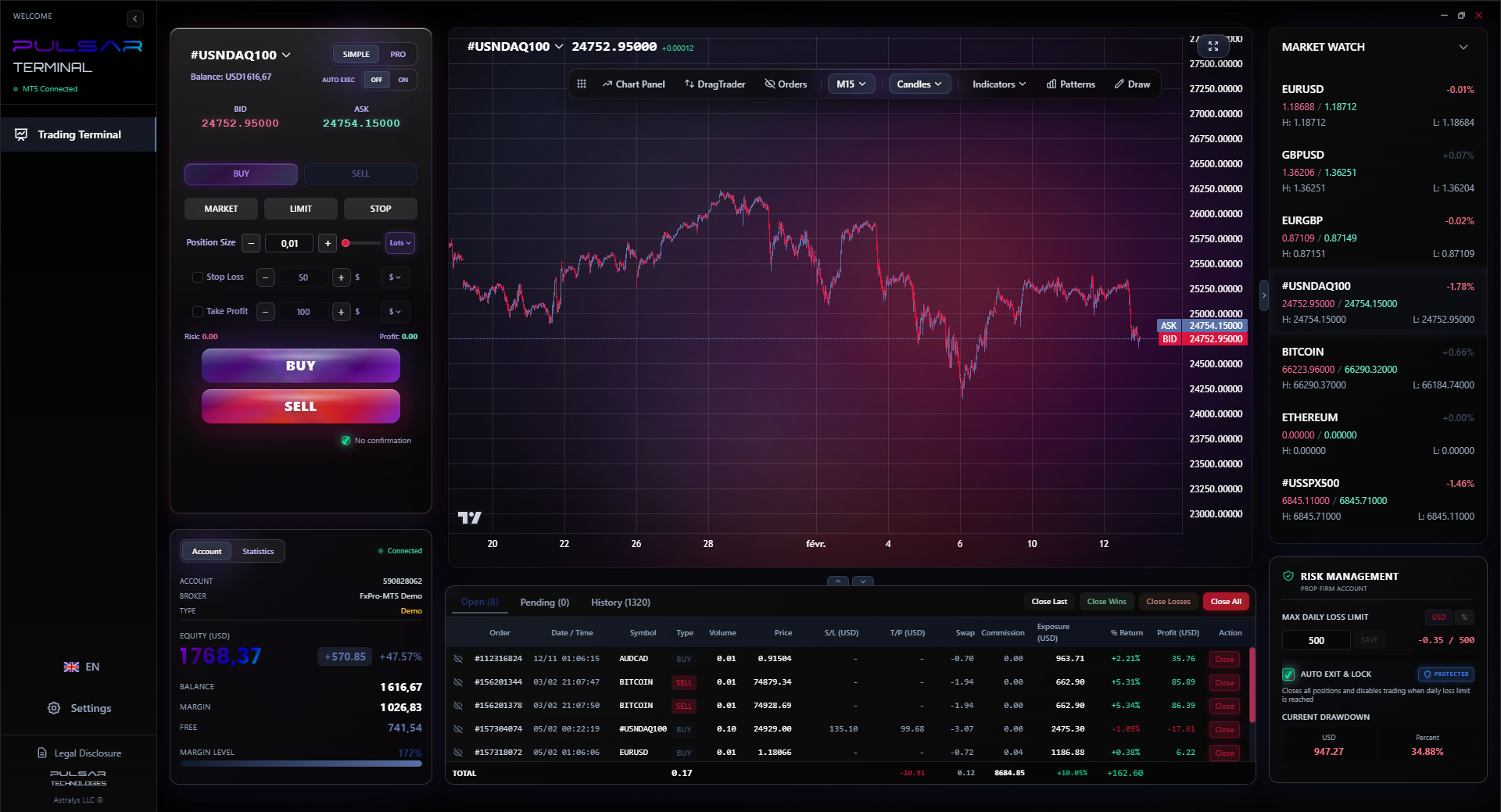
Managing a strong trend trade requires active profit protection, and Pulsar Terminal's automated trailing stop feature lets you lock in gains without staring at the screen all day.
FAQ
Q1What is the simplest way to identify a trend in forex?
Look at the daily chart. Are the price peaks and troughs generally moving up (higher highs, higher lows) or down (lower highs, lower lows)? If you can draw an ascending line under the price lows (uptrend) or a descending line above the price highs (downtrend) that connects multiple points, you've identified the trend. Start with your eyes, not the indicators.
Q2Is it better to trade with the trend or against it?
For 95% of traders, especially beginners, trading with the trend is statistically far better. It's like swimming with the current. Trading against the trend (catching reversals) is a specialist skill with a much lower success rate. Your primary goal should be to find high-probability entries in the direction of the established trend.
Q3How do I know when a trend is ending?
No one knows for sure, but watch for warning signs: the price starts making lower highs in an uptrend (momentum fading), it breaks a key trendline and fails to reclaim it, or momentum indicators like the RSI show strong divergence (price makes a new high but RSI makes a lower high). This doesn't mean reverse immediately, but it's a signal to tighten stop losses or take partial profits.
Q4What timeframe is best for trend trading in Nigeria?
It depends on your style. For swing trading (holding trades days to weeks), the 4-hour and daily charts are best for identifying the core trend. For intraday trading, use the 1-hour chart for direction and the 15-minute for entries. Always check the higher timeframe first to see the bigger picture.
Q5Can I use trend trading for USD/NGN?
You can, but be extremely cautious. USD/NGN trends are driven heavily by local dollar liquidity and CBN policy, not just pure technicals. Volatility is high and spreads can be wide. Use much wider stop losses and smaller position sizes. Many find it easier to trade the trend on major pairs like EUR/USD where technical analysis is more reliable.
Q6Do I need to pay tax on profits from trend trading in Nigeria?
Yes. The Federal Inland Revenue Service (FIRS) expects a 10% capital gains tax on your gross forex trading profits. It's your responsibility to declare and pay this, regardless of whether your broker is local or international. Keep detailed records of all your trades.
प्रो. विंस्टन का पाठ
:
- ✓Define trend by structure: HH/HL for uptrend, LH/LL for downtrend.
- ✓Always align trades with the higher timeframe (Daily/4H) direction.
- ✓Never risk more than 1-2% of capital on a single trend trade.
- ✓Use pullbacks in the direction of the trend for high-probability entries.
- ✓A breakout needs a decisive candle close, not just a price spike.
यह लेख कितना उपयोगी था?
रेट करने के लिए स्टार पर क्लिक करें
साप्ताहिक ट्रेडिंग विश्लेषण
मुफ़्त साप्ताहिक विश्लेषण और रणनीतियाँ। कोई स्पैम नहीं।
लेखक के बारे में
Olumide Adeyemi
पश्चिम अफ्रीकी ट्रेडिंग अग्रणी
नाइजीरिया के सबसे सक्रिय फॉरेक्स ट्रेडिंग एजुकेटर्स में से एक। लागोस से 8 साल का ट्रेडिंग अनुभव। अफ्रीकी ट्रेडर्स के लिए लो-कैपिटल स्ट्रैटेजीज और प्रॉप फर्म चैलेंजेज में विशेषज्ञ।
टिप्पणियाँ
आपको यह भी पसंद आ सकता है

Cara Trading Forex Sukses: 7 Prinsip dari Trader Profesional
Cara trading forex sukses dengan 7 prinsip trader pro: manajemen modal, disiplin, journal trading, backtest. Data nyata, bukan janji profit palsu.
Jam Trading Forex Terbaik untuk Trader Indonesia: Panduan Lengkap dengan Tabel Waktu
Panduan jam trading forex untuk trader Indonesia. Tabel 4 sesi dunia, jam emas 20:00-00:00, sesi mana yang harus dihindari. Data akurat + tips dari trader berpengalaman.
Top 5 Sàn Forex Uy Tín Nhất 2026: Review Jujur dari Trader Indonesia
Top 5 sàn forex uy tín 2026 untuk trader Indonesia. Review jujur: spread, deposit, withdraw, dukungan lokal. Exness, XM, IC Markets & lebih.
All these calculators are built into Pulsar Terminal with real-time data from your MT5 account. One-click position sizing, automatic risk management, and instant calculations.
