


It was a Sunday night in October, and I was watching the EUR/USD chart like a hawk.

Olumide Adeyemi
पश्चिम अफ्रीकी ट्रेडिंग अग्रणी ·  Nigeria
☕ 10 मिनट पढ़ने
आप क्या सीखेंगे:
- 1The Official Sunday Open Time in Nigeria
- 2Why the Sunday Open is a Big Deal for Nigerian Traders
- 3What Should You Actually Trade on Sunday Night?
- 4The 3 Biggest Mistakes Nigerian Traders Make
- 5How Nigerian Brokers Handle the Sunday Open
- 6My Sunday Night Trading Routine (Step-by-Step)
- 7Going Deeper: Advanced Strategies for the Open

It was a Sunday night in October, and I was watching the EUR/USD chart like a hawk. My screen showed 9:59 PM Lagos time. The spread on my broker's platform was widening, a sure sign the market was about to wake up. At exactly 10:00 PM, the first candle printed. It was a massive 15-pip bearish bar. I had a sell limit order waiting, and it filled instantly. That trade netted me 28 pips in under 20 minutes. That's the power of knowing exactly what time the forex market opens on Sunday in Nigeria. It's not just a time, it's the first real opportunity of the week.
Alright, let's get straight to the point. The global forex market officially reopens for the week on Sunday at 10:00 PM Nigerian Time (WAT, West Africa Time). This is when the electronic trading systems in Sydney, Australia, come online, marking the start of the Asia-Pacific session.
Now, here's where it gets a bit tricky, and I've seen many traders get confused. Some brokers, especially international ones like IC Markets or Pepperstone, might show trading as 'available' from 10 PM, but the real liquidity often doesn't kick in for another 5 to 15 minutes. The first few minutes can be pure chaos with wild spreads. I made the mistake of jumping in at 10:01 PM once on a GBP/USD trade, and the 5-pip spread ate a huge chunk of my potential profit before the price even moved.

Warning: Don't place a market order right at 10:00 PM. The spreads are often at their widest point of the entire week. Use limit orders if you must trade the open.
So, while the clock says 10 PM, think of 10:05 PM to 10:15 PM as when the market truly 'opens' with normal conditions. This is the time you should be watching your charts most intently.

You might think, 'It's just another session open.' Trust me, it's not. For us trading from Nigeria, the Sunday open is uniquely important for three reasons.
First, it's the market's first reaction to all the news and events that built up over the weekend. Did a central bank governor make a surprise statement on Saturday? Did geopolitical tensions flare up? All that pent-up energy gets released in the first hour of trading. This often creates the week's first major swing trading opportunity.
Second, our time zone is perfect for it. 10 PM on a Sunday is a reasonable time to be at your desk. You're not sacrificing sleep like a trader in the Americas would. It's a quiet time at home, perfect for focused analysis before the week gets hectic.
Third, and this is crucial, the initial moves can set the tone. A strong, directional breakout in the first hour often leads to follow-through in the Asian session. I've built entire weekly bias views based on the price action I see between 10 PM and midnight. It doesn't always work, but when it does, it gives you a massive head start.
The 'Gap' Phenomenon
Most major currencies are technically closed over the weekend, but the world doesn't stop. When the market reopens, the price often 'gaps' - it opens at a different level than it closed on Friday. Trading these gaps is a classic strategy, but it requires serious skill. I've had more failures than successes trying to 'fade' (trade against) Sunday gaps. The smarter play is often to wait for the initial volatility to settle and then trade in the direction of the new weekly momentum.

💡 विंस्टन की सलाह
The first candle of the week often tells a lie. It's the second and third that show the market's true intention. Watch the close, not the wick.
“The Sunday open isn't just a time, it's the market's first reaction to 48 hours of pent-up global energy.”
Not all instruments are created equal when the market opens. You need to trade the pairs with the most action and the least hassle.
Focus on the Majors: Stick to the big pairs that involve the Japanese Yen (JPY) or Australian/New Zealand Dollars (AUD, NZD), as the Asia session is driving the action. Your best bets are:
| Pair | Why It's Good for Sunday | Nigerian Trader Tip |
|---|---|---|
| AUD/USD | Directly tied to the Australian economy. Often has the cleanest initial move. | Watch for Chinese economic data released over the weekend. |
| NZD/USD | Similar to AUD/USD, but can be more volatile. | Be extra cautious with spreads on this one at open. |
| USD/JPY | The king of the Asia session. Huge liquidity. | The first 30-minute range often gets tested later. |
| EUR/USD | The world's most liquid pair. Always moves. | The initial move can be deceptive; wait for confirmation. |
Avoid Exotics and Crosses: Pairs like USD/NGN (Naira) or EUR/GBP might look tempting, but their liquidity is terrible on a Sunday night. The spreads will be outrageous, and you could get stuck in a bad trade. I learned this the hard way trying to trade GBP/AUD early on a Sunday. The chart looked like it was moving, but trying to get out was a nightmare.
Gold (XAU/USD) is a special case. It often reacts strongly to weekend geopolitical news. If there's been tension, gold can gap dramatically. My guide on trading XAU/USD covers how to handle these volatile opens. The key is to use a wide stop loss because the whipsaws can be brutal.
I've made all of these. Let me save you the money and frustration.
1. Overtrading the Volatility: The first hour is exciting. Candles are big, prices are jumping. It's easy to feel like you're missing out and start chasing the market. This is how you blow up an account before Monday morning. Have one, maybe two planned setups. Execute them and then step back. The market will be there tomorrow.
2. Ignoring the Spread: I can't stress this enough. That spread is your first cost of doing business. If the normal spread on EUR/USD is 0.8 pips, at 10:02 PM it could be 5 pips or more. That means your trade is down 5 pips the second you enter. You need the market to move 5 pips just to break even. Always, always check the live spread window before clicking 'buy' or 'sell'.
3. Forgetting About News: The economic calendar doesn't take the weekend off. Sometimes major data (like Chinese PMI) is released on a Sunday morning. If you haven't checked the calendar before sitting down at 9:55 PM, you're trading blind. A surprise news item can completely invalidate your technical setup in seconds.

Pro Tip: Use your Sunday evening for analysis, not just execution. Review the weekly charts, set alerts for key levels, and plan your trades for Monday. The calm before the storm is the best time to think clearly.
💡 विंस्टन की सलाह
If you wouldn't place the trade at 2 PM on a Tuesday, don't place it at 10:02 PM on a Sunday. Volatility is not a strategy.
“Wide spreads at the open aren't a suggestion, they're a toll booth. Don't pay it with a market order.”
Not all brokers show the same thing at 10 PM. This is critical to understand.
International Brokers (Recommended): Brokers like Exness, IC Markets, and XM are plugged directly into the global interbank market. At 10 PM WAT, their servers in Sydney connect, and you see the real, live price movement instantly. This is what you want for trading the open.
Some Local/Offshore Brokers: Be wary. Some platforms might not show accurate price movement until much later, or they might have 'maintenance' periods that last past 10 PM. I once used a broker whose platform didn't update until 10:30 PM. By the time I could trade, the big move was already over. Always test your broker on a Sunday night with a demo account first. Place a few watchlist orders and see if they execute at the prices you expect.
Trading Hours Display: Most good platforms will display the session times in GMT or your local time. Make sure your trading terminal's clock is set to Nigerian time (WAT) so there's no confusion. A one-hour mistake here is a disaster.
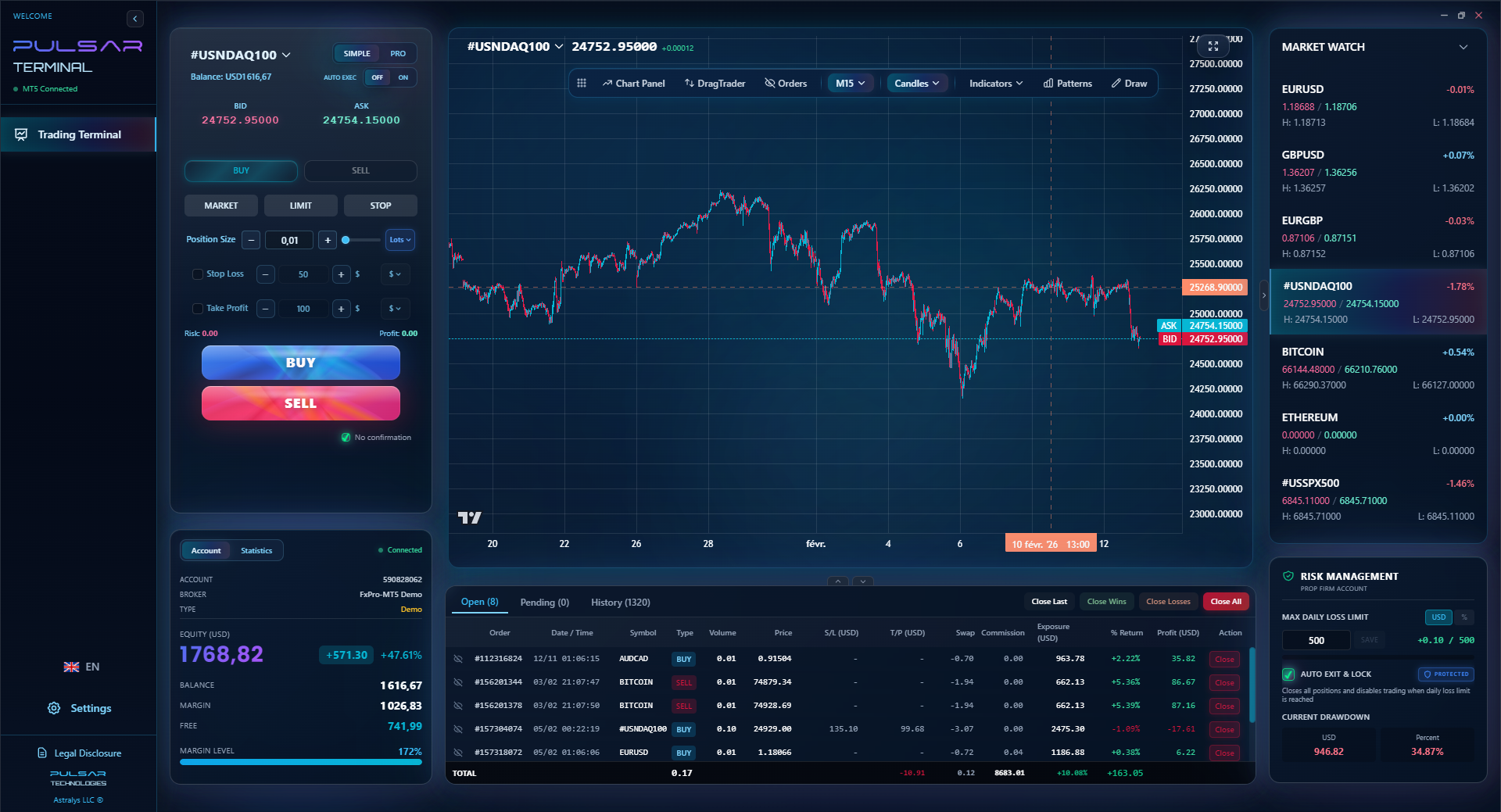
This is also where a good trading tool shines. Having a platform that lets you set precise entry orders, multiple take-profit levels, and automated stops before the market opens is a huge advantage. You can set your trades during the calm of Sunday afternoon and let them execute in the volatility of the open, without emotional interference.
Managing the volatility of the Sunday open is easier when you can pre-set complex orders with multiple take-profit levels and trailing stops, features that Pulsar Terminal brings directly to your MT5 platform.
Here's exactly what I do every Sunday, from about 9 PM onwards. Steal this routine.
9:00 PM - 9:30 PM: The Prep Work I'm not even looking at charts yet. I'm doing my homework.
- Scan the News: Reuters, Bloomberg, ForexLive. What happened over the weekend? Any central bank speeches, political events, or surprise data?
- Check the Calendar: I open the economic calendar for the upcoming week. I mark down the big events (CPI, NFP, central bank decisions).
- Review Friday's Close: I look at the daily and weekly charts of my 3-4 favorite pairs to see where they closed. Were there any major rejections or breakouts?
9:30 PM - 9:55 PM: Chart Analysis & Planning Now I open my charts (15-minute and 1-hour timeframes).
- I identify clear support and resistance levels from Friday's action.
- I decide on my bias: Am I looking to buy or sell on a retest of a level? Or am I waiting for a breakout?
- I use my position size calculator to determine my exact lot size based on my account balance and stop-loss distance. No guessing.
- I set my entry orders (usually limit orders) and my stop loss and take profit levels. My entry is NEVER at market price at the open.
9:55 PM - 10:15 PM: Execution & Watch I watch the clock. At 10 PM, I observe. I don't touch anything.
- I watch the first 5-minute candle. Where does it close?
- I monitor the spreads. When do they normalize to their usual width?
- If my pre-set limit order gets filled, great. I manage the trade. If not, I watch the price action to see if my bias was correct. This gives me confidence for Monday.
This disciplined routine turns a chaotic event into a structured opportunity.
💡 विंस्टन की सलाह
Use the Sunday open to test your discipline, not your luck. A well-placed limit order that doesn't get filled is a successful trade.
“Your best tool for the Sunday open is a pre-written plan and the patience to wait for your price.”
Once you're comfortable with the basics, you can explore more nuanced approaches to the Sunday open.
The 'First Range' Breakout: This is my personal favorite. After the initial 15-30 minutes of chaos, the market often establishes a clear high and low for the first hour (say, 10:15 PM to 11:15 PM WAT). I draw a rectangle around this range. A clean breakout and close above the high or below the low can signal strong directional intent for the next several hours. I'll enter on a retest of the breakout level. This strategy requires patience but has a high reward-to-risk ratio.
Using Indicators Wisely: Forget about lagging indicators like moving averages at the open. They're useless on a fresh chart. Instead, I keep it simple:
- Horizontal Lines: For support/resistance.
- Volume: If your platform shows it (many forex platforms don't show real volume, just tick volume), a surge on a breakout is a good sign.
- The RSI indicator or MACD on a 5-minute chart can be useful after the first 30 minutes to spot early divergences if the price is making a new high but momentum is fading.
Managing the Trade: This is where most profits are saved or lost. If you get in a good Sunday night trade, consider using a trailing stop to lock in profits as the Asian session progresses. The move can be swift, and you don't want to give back 20 pips because you were asleep. Automating this process removes emotion and is a key feature of professional trading tools.
Remember, the goal of trading the Sunday open isn't to get rich in one hour. It's to start the week on the right foot, with a well-executed plan and controlled risk. A successful 20-pip trade on Sunday night builds psychological momentum that can carry you through the entire week.

FAQ
Q1Is the forex market open 24 hours from Sunday 10 PM in Nigeria?
Yes, . Once it opens at 10 PM Sunday (WAT), it trades continuously 24 hours a day, through the Asian, European, and North American sessions, until it closes on Friday around 10 PM WAT. It's a 24/5 market.
Q2Can I trade the Naira (NGN) on Sunday at 10 PM?
Almost certainly not. The USD/NGN pair is not a major forex pair and is heavily influenced by local Nigerian market hours and central bank activity. Liquidity will be extremely thin or non-existent on a Sunday night. Stick to major pairs like EUR/USD or USD/JPY.
Q3Why are spreads so wide at the Sunday open?
Liquidity is low. The big banks and institutional traders are just starting their engines. With fewer buyers and sellers in the market, the difference between the buy and sell price (the spread) widens. It's the market maker's way of protecting themselves from the initial volatility.
Q4What if my broker's platform is under 'maintenance' at 10 PM?
This is a red flag for a broker you shouldn't be using for active trading. A reputable international broker will have seamless weekend maintenance that finishes well before the market open. If this happens, contact support and consider switching to a more reliable broker like the ones we review.
Q5Is it better to trade right at 10 PM or wait?
For 99% of traders, waiting is better. The first 5-15 minutes are for watching, not trading. Let the market find its feet, let the spreads tighten, and then look for a confirmed setup. Patience prevents costly mistakes.
Q6Do all currency pairs open at the same time?
Technically, yes, the market opens. But pairs involving the Australian Dollar (AUD), New Zealand Dollar (NZD), and Japanese Yen (JPY) will see the most immediate action and liquidity because the Asia-Pacific session is starting. Pairs like EUR/GBP may be very quiet initially.
प्रो. विंस्टन का पाठ
:
- ✓The market opens Sunday at 10 PM WAT, but real liquidity starts 5-15 mins later.
- ✓Spreads are widest at the open; use limit orders, not market orders.
- ✓Focus on AUD, NZD, JPY pairs for the cleanest initial moves.
- ✓Use the open to observe and plan, not to chase and overtrade.
यह लेख कितना उपयोगी था?
रेट करने के लिए स्टार पर क्लिक करें
साप्ताहिक ट्रेडिंग विश्लेषण
मुफ़्त साप्ताहिक विश्लेषण और रणनीतियाँ। कोई स्पैम नहीं।
लेखक के बारे में
Olumide Adeyemi
पश्चिम अफ्रीकी ट्रेडिंग अग्रणी
नाइजीरिया के सबसे सक्रिय फॉरेक्स ट्रेडिंग एजुकेटर्स में से एक। लागोस से 8 साल का ट्रेडिंग अनुभव। अफ्रीकी ट्रेडर्स के लिए लो-कैपिटल स्ट्रैटेजीज और प्रॉप फर्म चैलेंजेज में विशेषज्ञ।
टिप्पणियाँ
आपको यह भी पसंद आ सकता है

Cara Trading Forex Sukses: 7 Prinsip dari Trader Profesional
Cara trading forex sukses dengan 7 prinsip trader pro: manajemen modal, disiplin, journal trading, backtest. Data nyata, bukan janji profit palsu.
Jam Trading Forex Terbaik untuk Trader Indonesia: Panduan Lengkap dengan Tabel Waktu
Panduan jam trading forex untuk trader Indonesia. Tabel 4 sesi dunia, jam emas 20:00-00:00, sesi mana yang harus dihindari. Data akurat + tips dari trader berpengalaman.
Top 5 Sàn Forex Uy Tín Nhất 2026: Review Jujur dari Trader Indonesia
Top 5 sàn forex uy tín 2026 untuk trader Indonesia. Review jujur: spread, deposit, withdraw, dukungan lokal. Exness, XM, IC Markets & lebih.
All these calculators are built into Pulsar Terminal with real-time data from your MT5 account. One-click position sizing, automatic risk management, and instant calculations.
