


Let's get one thing straight: the Indian government doesn't hate you.

Rajesh Sharma
वरिष्ठ फॉरेक्स विश्लेषक ·  India
India
☕ 10 मिनट पढ़ने
आप क्या सीखेंगे:
Let's get one thing straight: the Indian government doesn't hate you. They just don't trust you with your own money when it comes to global currencies. The common belief that forex trading is 'banned' in India is a massive oversimplification. The truth is far more nuanced, and frankly, more frustrating for anyone who's seen the opportunities on platforms like MT5. I've watched traders try to sneak around these rules for over a decade, and I can tell you the system is designed to make you fail if you go offshore. This isn't about protection; it's about control. I'll show you exactly how the rules work, why they exist, and what happens when you think you're smarter than the Reserve Bank of India.
The first rule of Forex Club India: you don't talk about trading EUR/USD for real. The legal framework, governed by the Foreign Exchange Management Act (FEMA), creates a very specific sandbox. You're allowed to play, but only with toys stamped 'Made in India.'
The Permitted List (The Sandbox) You can legally trade currency derivatives - futures and options - on Indian exchanges like the NSE or BSE. The key condition? The Indian Rupee (INR) must be one side of the pair. Think USD/INR, EUR/INR, GBP/INR. They've also allowed some cross-currency pairs like EUR/USD on exchange, but here's the catch: your profit and loss is calculated in the foreign currency but settled in INR using the RBI's reference rate. You're not actually touching the global EUR/USD market; you're trading a domestically settled derivative of it. It's like watching a live football match versus playing a video game of it. The outcome is similar, but the feel, liquidity, and connection to the real world are completely different.

Warning: Trading the actual spot EUR/USD market through an international broker like IC Markets or Exness is illegal for an Indian resident. Full stop. This is the line that gets people into serious trouble.
The Forbidden Fruit (What Everyone Actually Wants) What's banned is direct participation in the global, decentralized, over-the-counter (OTC) forex market. Trading GBP/JPY on MetaTrader? Illegal. Using the 500:1 use offered offshore? A direct FEMA violation. Sending money under the Liberalised Remittance Scheme (LRS) to fund an account with a foreign broker for speculation? That's the quickest way to get a notice from the authorities. The system is designed to keep all currency speculation within the country's regulatory gaze and, more importantly, within its economic control. For strategies that thrive in fast-moving markets, like scalping, the domestic derivative market often feels sluggish and expensive by comparison.

💡 विंस्टन की सलाह
A market that doesn't exist for you is a 100% losing trade. Stop staring at the EUR/USD chart and master the USD/INR. Your P&L is measured in rupees, not daydreams.
We need to move past the idea that these rules exist to protect retail traders from themselves. That's a convenient side effect. The core motive is macroeconomic stability. The RBI's primary job is to protect the value of the Indian Rupee and manage the country's foreign exchange reserves.
Think of India's forex reserves as a national war chest. Every time you want to buy US Dollars to trade on an offshore platform, you're drawing down those reserves. If millions of traders did this simultaneously during a period of rupee weakness, it could accelerate a crisis. The RBI remembers the 1991 balance of payments crisis all too well. FEMA, enacted in 1999, was a direct response to that era of vulnerability.
Also,, unregulated outflow of capital for speculation makes it harder for the RBI to manage the exchange rate. Your dream of swing trading AUD/USD is, in their eyes, a potential leak in the dam. By forcing all currency speculation through domestic exchanges, they contain the pressure. They can monitor volumes, see where sentiment lies, and intervene if necessary. Your personal margin call is irrelevant to them; a systemic run on the rupee is existential.
Recent Crackdowns Prove the Point
Look at the April 2026 RBI restriction banning banks from offering rupee-linked Non-Deliverable Forward (NDF) contracts. NDFs are offshore derivatives used to speculate on the rupee's value. By shutting this down, the RBI is forcefully funneling all rupee speculation back onshore where they can see and control it. This isn't retail-focused; it's a move against large institutional speculative flows. Retail traders just get caught in the crossfire of this broader capital control regime.
“The penalty can be up to three times the amount involved. That's not a fine; it's financial annihilation.”
This is where theory meets reality. The penalties under FEMA aren't parking tickets. They are designed to be punitive and memorable. Let's talk numbers, because this is where I've seen traders' bravado evaporate.
- Financial Wipeout: The penalty can be up to three times the amount involved in the illegal transaction. Let that sink in. If you got caught sending ₹10 lakh to an offshore broker, you could be fined ₹30 lakh. That's life-altering debt.
- Daily Accumulating Fines: On top of that, there can be a penalty of ₹10,000 for each day the violation continued. A trade you held for a month? That's an additional ₹3 lakh.
- The Blanket Fine: If the exact value is hard to determine, authorities can impose a flat penalty of up to ₹2 lakh plus the daily ₹10,000.
- Jail Time: Under Section 13(1C), you can face imprisonment for up to five years. This isn't a hollow threat for large, repeated violations.
- The Silent Killers: Your bank accounts can be frozen. You can be blacklisted, making future financial transactions a nightmare. And the Income Tax department will come knocking, treating any unreported profits from these trades as pure, taxable income with added scrutiny.
I knew a trader in Mumbai who thought he was clever. He used a relative's international business to fund a small $5,000 account with a broker like XM. He made a few good scalping trades on gold (XAU/USD) and grew it to $12,000. When he tried to bring the profits back through an unusual channel, it triggered an audit trail. He didn't go to jail, but the tax and penalty demands wiped out the profits, his original capital, and a chunk of his savings. The stress alone was a different kind of penalty. He was using a basic position size calculator for his trades, but had no calculator for the regulatory risk.
So, you follow the rules. You open an account with a SEBI-regulated broker like Zerodha or Angel One. You trade USD/INR futures. And you immediately feel the difference, and not in a good way.
The Liquidity Gap The global EUR/USD market trades trillions daily. The Indian currency derivatives market is a fraction of that. This often translates to wider spreads and less optimal order fills, especially during volatile news events. Your perfect entry based on your MACD indicator signal might slip by several pips because the domestic market depth isn't there.
The use Lock Forget 100:1 or 500:1. SEBI has drastically curtailed use in the derivatives segment. You're often working with 10:1 or 20:1 at most. This forces safer position sizing, which is good risk management, but it completely eliminates certain high-octane trading styles. A 10-pip move on a highly leveraged offshore account can be meaningful; on a domestic account, it's a rounding error.
The Instrument Limitation You want to trade the Australian dollar because the RBA just hiked rates? Tough luck if you don't have a direct AUD/INR contract. Your playbook is limited to the majors vs. INR and a handful of cross-currency derivatives. The vibrant world of exotic pairs or direct commodity currencies is off-limits. This is why discussions about relaxing these curbs, as were reported in late 2025, are so closely watched. The market is begging for more flexibility, but the RBI's default setting is caution.

Pro Tip: If you trade legally on Indian exchanges, treat it as a different asset class altogether. Don't try to apply the same scalping strategies you see on YouTube from international traders. The market microstructure won't support it. Focus on longer timeframes and broader technical levels.
💡 विंस्टन की सलाह
The first rule of risk management in India is regulatory risk. If your strategy's biggest threat is a letter from the RBI, you have no strategy. Build your plan inside the walls they've given you.
“The most successful Indian traders I know stopped fighting the market that wasn't allowed and mastered the one that was.”
This is the biggest trap. Brokers like IC Markets, Pepperstone, and XM openly accept Indian residents. Their websites work flawlessly. You can deposit money using an international credit card (though your bank might flag it). The platform runs smoothly. It feels legal. It's not.
These brokers are regulated in Cyprus, Australia, the Seychelles - not by SEBI. Their compliance with Indian law is not their problem; it's yours. They provide the highway, but you're driving without a license. The RBI and SEBI have no jurisdiction over them. When you have a withdrawal issue, you can't complain to SEBI. When the taxman asks how you funded the account, you have no legal leg to stand on.
I made this mistake early in my career. Funded an account with a now-defunct offshore broker. The trades were fine, but the existential anxiety wasn't. Every withdrawal felt like a potential trigger. I was constantly calculating not just my stop-loss, but my 'regulatory-risk-loss.' It's no way to trade. I closed it and took a 15% hit on wire transfer fees just to get my capital back into the clear. The peace of mind was worth more than the potential profits.
The recent hike in the LRS Tax Collected at Source (TCS) threshold to ₹10 lakh (April 2025) is interesting. It liberalizes sending money abroad for travel, education, etc. Some traders mistakenly see this as a loophole. It is not. The LRS explicitly prohibits remittances for speculative trading. Using it for that purpose is fraud, plain and simple.
When trading domestic USD/INR derivatives, precise order management is key, and tools like Pulsar Terminal that offer advanced drag-and-drop orders and multi-TP/SL directly on your platform can make a significant difference in execution.
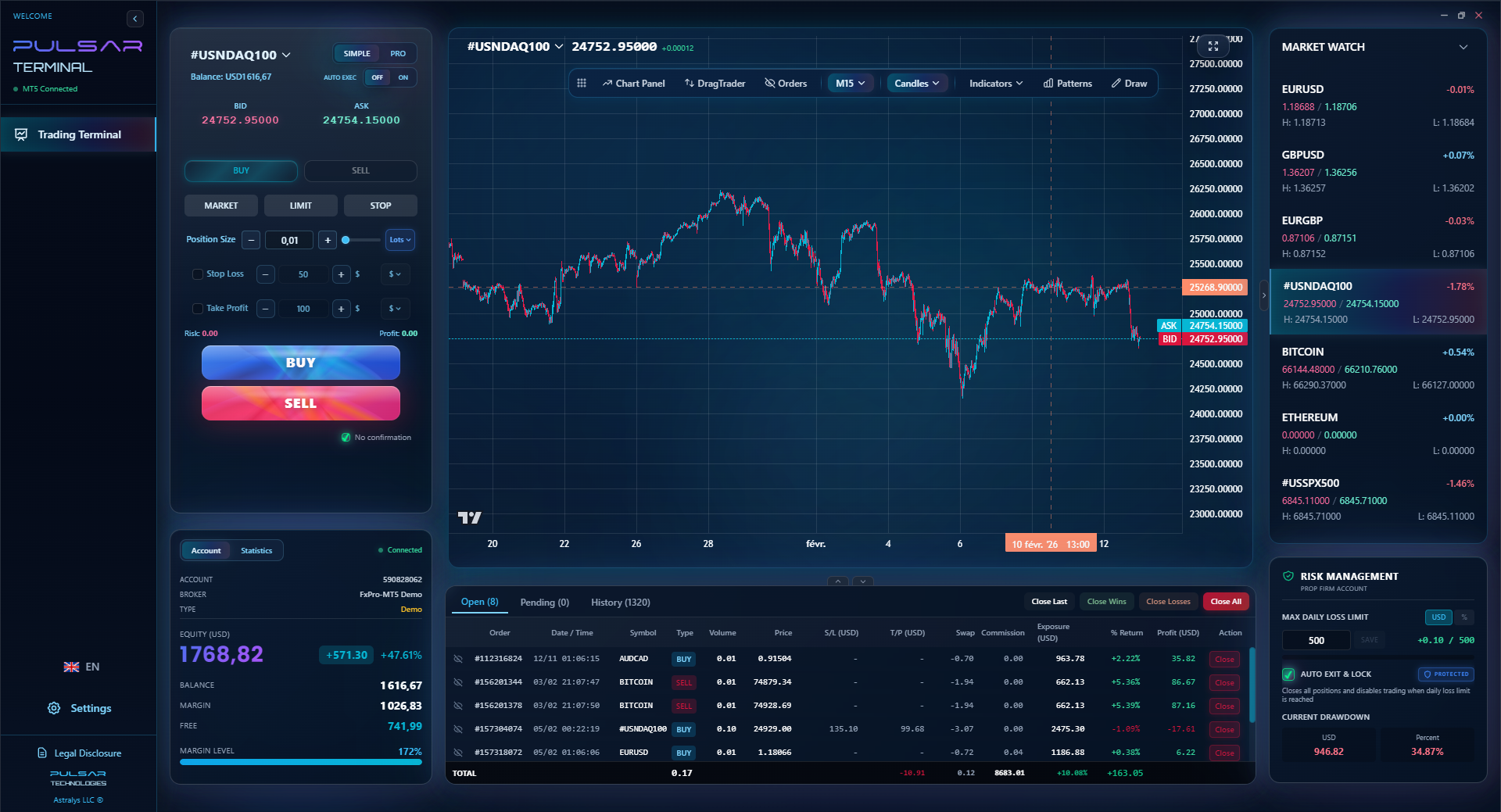
Given this landscape, what's a serious Indian market participant to do?
- Accept the Sandbox: Your first mental shift is to accept that you are a currency derivatives trader on the NSE, not a forex trader in London. Your market is USD/INR, not EUR/USD. Study its unique rhythms, its correlation with domestic flows, and RBI intervention patterns.
- Master Legal Technical Analysis: The principles still work. Support/resistance, RSI divergences, and chart patterns are valid. A double top on the USD/INR chart is just as significant. Focus your energy here. Tools that help manage trades within this environment, like platforms that offer sophisticated order types, become useful. For instance, managing a multi-leg options strategy on USD/INR requires precision that basic platforms lack.
- Consider the Indirect Route: If you have a burning desire to trade global macros, look at legal, indirect instruments. This could mean trading INR-sensitive export/import stocks, or using international equity ETFs (where permitted) to get currency exposure. It's not the same, but it's a legal channel.
- Risk Management is Your Armor: With limited use, you're forced to be sensible. Use this to your advantage. Build a strategy that doesn't rely on insane use to work. A solid 2% risk-per-trade rule with 10:1 use will keep you in the game far longer than a 10% risk with 100:1 use ever will.
- Stay Updated: The rules are not static. The January 2024 RBI circular on hedging, the ongoing talks about relaxing derivative rules - these are moving parts. Your edge might come from being the first to correctly adapt to a regulatory change, not from fighting the last war.
The brutal truth is that the question of why forex trading is banned in India is answered by looking at the RBI's balance sheet, not your trading account. Your freedom is collateral in their fight for monetary stability. You can lament it, or you can learn to trade the market that actually exists. The most successful Indian traders I know did the latter.
FAQ
Q1Can I legally use MetaTrader 5 (MT5) in India?
You can use the MT5 software, but not with an offshore broker for forex trading. A few SEBI-registered brokers might offer MT5 as a platform for trading domestic currency derivatives, but this is rare. Most legal trading happens on the brokers' proprietary platforms like Zerodha Kite. Using MT5 to connect to an international broker like IC Markets is illegal.
Q2What happens if I trade with a foreign broker and make a profit?
First, withdrawing the profit back to India creates a paper trail that can trigger scrutiny under FEMA and income tax laws. The profits could be confiscated, and you'll face the penalties described (up to 3x the amount). You'll also owe tax on the profits, and the IT department will want to know how you funded the illegal account in the first place. The risk far outweighs the reward.
Q3Is trading EUR/USD futures on NSE the same as the real forex market?
No. It's a derivative contract that settles in INR based on the RBI's reference rate for EUR/USD. You're trading a domestically settled contract whose value is derived from the global rate, but you are not participating in the actual, liquid global interbank market. The spreads, liquidity, and sometimes the price itself can differ.
Q4Can I get in trouble for just learning on a demo account with a foreign broker?
Using a demo account for education is generally in a gray area and low risk, as no real money crosses borders. However, the moment you fund a live account, you cross into illegal territory. Authorities are concerned with capital flows, not theoretical practice.
Q5What is the single biggest risk with using an offshore broker?
Beyond legal penalties, it's the total lack of recourse. If the broker refuses a withdrawal, goes bankrupt, or manipulates prices, you cannot complain to SEBI, RBI, or any Indian authority. You are at the mercy of a foreign regulator's efficiency and the broker's honesty.
Q6Are there any signs the rules will be relaxed soon?
There have been periodic discussions (like in late 2025) about relaxing rules for exchange-traded currency derivatives to boost volume. However, the RBI's recent actions (like the April 2026 NDF ban) show a tightening grip on offshore rupee speculation. Any relaxation will likely be slow, incremental, and focused on the onshore market, not opening the floodgates to offshore platforms.
प्रो. विंस्टन का पाठ
:
- ✓Forex isn't banned; global, unregulated participation is.
- ✓Legal trading is INR-centric & exchange-traded only.
- ✓Penalties under FEMA can exceed 3x your trade value.
- ✓Offshore brokers offer a highway with no legal license.
- ✓The RBI's motive is currency stability, not your protection.
यह लेख कितना उपयोगी था?
रेट करने के लिए स्टार पर क्लिक करें
साप्ताहिक ट्रेडिंग विश्लेषण
मुफ़्त साप्ताहिक विश्लेषण और रणनीतियाँ। कोई स्पैम नहीं।
लेखक के बारे में
Rajesh Sharma
वरिष्ठ फॉरेक्स विश्लेषक
भारतीय और दक्षिण एशियाई बाज़ारों में 10 साल से अधिक का ट्रेडिंग अनुभव। NSE करेंसी डेरिवेटिव्स से शुरुआत करके अंतरराष्ट्रीय फॉरेक्स में आए। USD/INR और इमर्जिंग मार्केट पेयर्स में विशेषज्ञता।
टिप्पणियाँ
आपको यह भी पसंद आ सकता है

Cara Trading Forex Sukses: 7 Prinsip dari Trader Profesional
Cara trading forex sukses dengan 7 prinsip trader pro: manajemen modal, disiplin, journal trading, backtest. Data nyata, bukan janji profit palsu.
Jam Trading Forex Terbaik untuk Trader Indonesia: Panduan Lengkap dengan Tabel Waktu
Panduan jam trading forex untuk trader Indonesia. Tabel 4 sesi dunia, jam emas 20:00-00:00, sesi mana yang harus dihindari. Data akurat + tips dari trader berpengalaman.
Top 5 Sàn Forex Uy Tín Nhất 2026: Review Jujur dari Trader Indonesia
Top 5 sàn forex uy tín 2026 untuk trader Indonesia. Review jujur: spread, deposit, withdraw, dukungan lokal. Exness, XM, IC Markets & lebih.
All these calculators are built into Pulsar Terminal with real-time data from your MT5 account. One-click position sizing, automatic risk management, and instant calculations.
