


I remember staring at the screen, my heart pounding.

James Mitchell
Analis Trading Senior
☕ 10 mnt baca
Yang akan Anda pelajari:

I remember staring at the screen, my heart pounding. It was October 2022, and I was in the final hours of a 5ers High Stakes challenge. My account was up 7.8%, just 0.2% shy of the 8% profit target. A single, well-placed trade on the EUR/USD could do it. But the market had gone quiet, and the clock was ticking. That moment, stuck between patience and panic, taught me more about prop firm psychology than any rulebook ever could. Let's talk about what The 5ers really offers, the numbers that matter, and how you can realistically approach their funding programs without losing your shirt.
The 5ers (often stylized as The5ers) is a proprietary trading firm founded in 2016. Their core pitch is simple: you prove you can trade profitably under specific rules in a simulated environment (a 'challenge'), and they give you a live, funded account with their capital. If you make money, you keep a big chunk of the profits.
It's not a broker. You're not depositing your own money to trade with (aside from the challenge fee). You're auditioning to manage a slice of their bankroll. The appeal is obvious - access to larger capital than most retail traders have. A $100,000 account can be had for a challenge fee starting at $545. That's use on your skills, not just your trades.
But here's the thing they don't put in the big, bold letters: it's a business model designed for them to win. The challenge fees from the 90-95% of traders who don't pass fund the payouts to the few who do. Understanding that dynamic is key. You're not just trading the market; you're trading against a very specific set of constraints.

Warning: Don't confuse a prop firm with a broker. Your relationship is completely different. You have no regulatory protections like you might with a broker like IC Markets or Pepperstone. Your rights are defined by their terms of service, period.

💡 Tips Winston
The profit target is a distraction. Your only focus for the first 10 days should be the daily loss limit. Build a buffer of small wins before you even think about the target.
“You're not just trading the market; you're trading against a very specific set of constraints.”
The 5ers offers three main programs: Hyper Growth (1-step), High Stakes (2-step), and Bootcamp (3-step). The names sound exciting, but the numbers tell the real story.
The Price of Admission
You pay a one-time fee to enter a challenge. This isn't a deposit; it's a non-refundable test fee.
| Program | Example Account Size | Challenge Fee | Profit Target | Max Daily Loss | Max Total Loss |
|---|---|---|---|---|---|
| High Stakes | $100,000 | $545 | 8% (Phase 1), 5% (Phase 2) | 5% | 10% |
| Hyper Growth | $40,000 | $850 | 10% | 3% | 6% |
| Bootcamp | $250,000 | $225 + $350 upon passing | 6% per phase (3 phases) | No Daily Limit | 5% |
The Bootcamp looks tempting with no daily loss limit, but that 5% total loss is a tight leash. Blow 5% once, and you're out. I made that mistake early on, thinking I had more room.
Profit Splits and Scaling
Your cut starts between 50% and 80%, depending on the program. The High Stakes program begins at an 80% split, which is among the best in the industry. As you hit profit milestones, your account size can 'scale' up (they add more capital), and your profit split can increase, potentially to 100%. That's the dream they're selling.

Example: Let's say you pass a $100,000 High Stakes challenge. You make a $5,000 profit in your first month. At an 80% split, you'd earn $4,000, minus any withdrawal fees. The firm keeps $1,000.
But remember, you only get to that stage if you pass. And the stats are brutal. Industry-wide, only about 5-10% of challenge attempts succeed. Less than 1% of traders achieve consistent, meaningful payouts. Your position size calculator will be your best friend here - mismanaging size is the fastest route to a blown account.
“The drawdown rules are absolute. No warning, no second chance.”
This is where most traders fail. They focus on the profit target and ignore the loss limits, which are far more dangerous.
The drawdown rules are absolute. They're usually based on your starting balance or your highest equity point, whichever is higher (this is called 'trailing' in some programs). If your daily loss hits that 3% or 5% limit, your challenge is terminated immediately. No warning, no second chance.
I learned this the hard way. In a Hyper Growth challenge, I was up 4% early in the day. I got overconfident, took a oversized position on gold (XAU/USD), and a sudden spike against me turned that 4% gain into a 3.1% daily loss in minutes. Account closed. Poof. $260 gone. I violated the first rule of prop firms: protect the downside first.
Other common rules include no holding trades over the weekend (for some programs) and no use of expert advisors (EAs) that exploit latency. You must also trade a minimum number of days. It's not a sprint; it's a controlled, disciplined marathon.
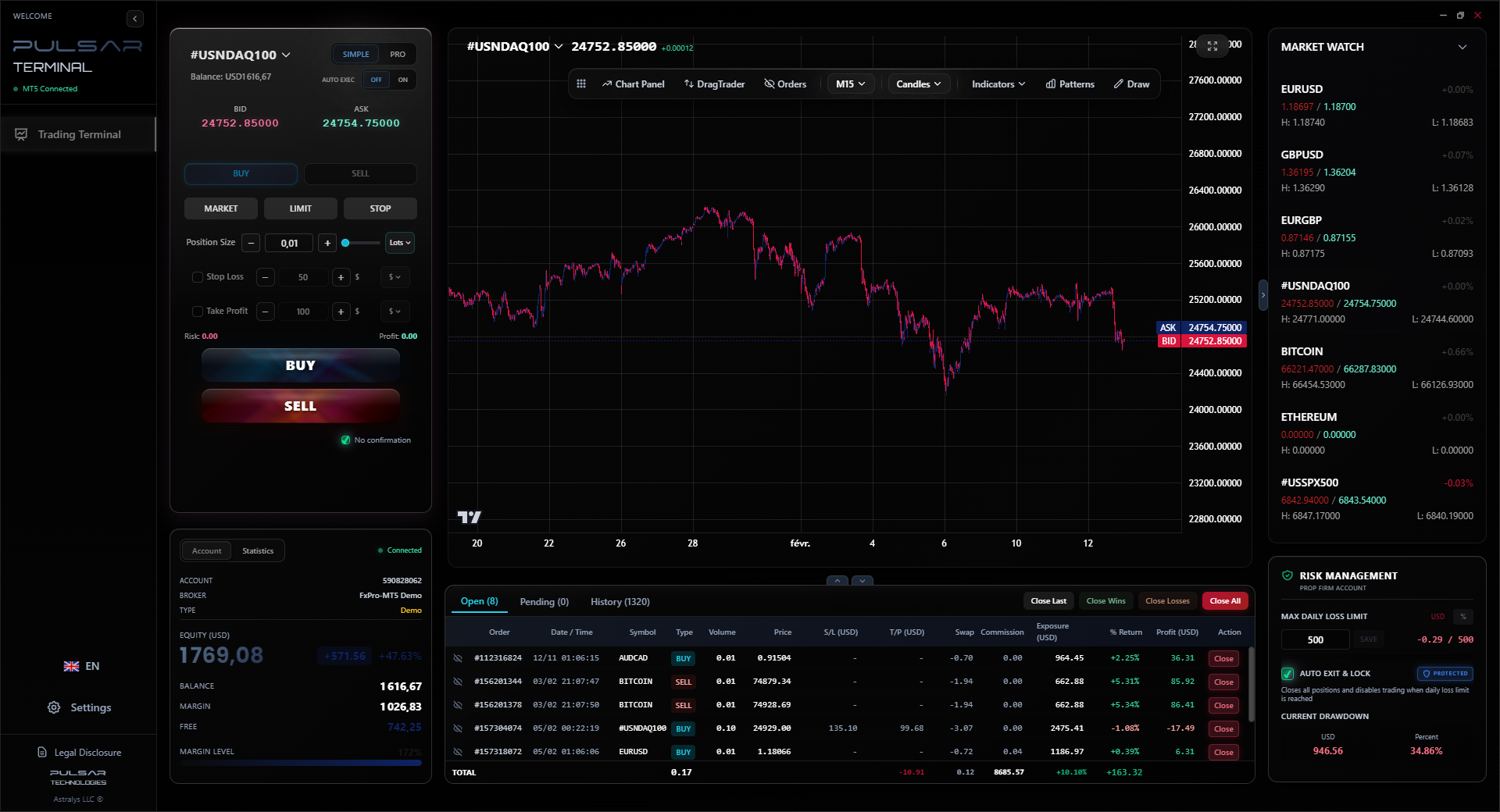
Managing these rules manually is stressful. This is where a tool's automation can be a lifesaver, setting hard stops based on equity, not just trade price. Passing a prop firm challenge requires strict loss management, which needs to be systematic, not emotional.
Managing prop firm drawdown rules manually is a recipe for stress; a tool that automates equity-based stop-losses can be the difference between passing and failing.
Pulsar Terminal
Alat MT5 all-in-one: order drag-and-drop, multi-TP/SL, trailing stop, grid trading, Volume Profile, dan perlindungan prop firm. Digunakan 1.000+ trader setiap hari.
“The drawdown rules are absolute. No warning, no second chance.”
The 5ers provides you with a MetaTrader 5 account. The trading conditions are generally good, but you need to read the fine print.
- Spreads & Commissions: They advertise tight spreads, like 0.1-0.5 pips on EUR/USD. But remember, they often add a commission. It's typically $4 per round lot for forex. So, your true cost is the spread plus the commission. Always factor this into your strategy, especially if you're considering a scalping strategy.
- use: This varies wildly by program. The High Stakes program offers 1:100 on forex, which is generous. The Bootcamp program offers only 1:10. This drastically affects your position size and what you can trade. The Hyper Growth program has very low use on indices and crypto (1:7.5 and 1:0.60 respectively). Don't assume you'll get retail-level use.
- The Simulated Environment: During the challenge, you're trading in a simulated environment. While they say it mirrors live markets, there can sometimes be differences in slippage or order execution during high volatility. Once funded, you trade a live account with real money.
The main catch? The rules force a specific style of trading. High-frequency scalping might be difficult with commissions. Swing trading is risky with daily loss limits. You need a strategy that consistently grinds out small gains while almost never having a large losing day. It's a constraint that changes everything.
💡 Tips Winston
Start with the smallest, cheapest challenge. Prove you can navigate their maze with $39 before you risk $850. Ego is the most expensive thing in trading.
“Your goal isn't to get rich from the first payout. Your goal is to prove you can operate the system consistently.”
Here's the uncomfortable truth for my fellow Americans: prop firms like The 5ers operate in a regulatory gray area. They aren't brokers regulated by the CFTC or SEC. They structure themselves as 'evaluation service' companies. You're paying a fee for a test, not for investment management.
What does this mean for you?
- Limited Recourse: If there's a dispute over a payout or a rule violation, you can't file a complaint with FINRA or the SEC. Your only option is typically arbitration per their terms of service.
- Changing Rules: They can, and sometimes do, change their challenge rules or payout policies. You have to stay on top of their announcements.
- Tax Clarity: Your profit splits are likely treated as ordinary income (self-employment income), not capital gains. Talk to a tax professional.
New SEC rules in 2024 are starting to scrutinize firms that act like 'dealers,' and the CFTC is looking at these models too. The landscape might change. For now, you are the one assuming most of the risk. Do your due diligence. Check their payout reputation on independent forums, not just their own testimonials.

Pro Tip: Before paying for any challenge, document all the rules as they are presented on the website. Take screenshots. This is your only reference point if a 'glitch' or dispute arises later.
“Your goal isn't to get rich from the first payout. Your goal is to prove you can operate the system consistently.”
After blowing a few challenges, I finally passed one by abandoning my usual style. Here’s what worked.
Forget the Profit Target at First. Your primary goal for the first two weeks is to not hit the daily drawdown. Your secondary goal is to not hit the total drawdown. Profit is a distant third. This mindset shift is everything.
Trade Tiny. Ridiculously tiny. On a $100,000 account, a 0.5% risk is $500. That sounds huge. Don't use it. Start by risking 0.1% or 0.15% per trade. That's $100-$150. Your goal is to string together 10-15 small wins to build a 2-3% buffer. This buffer is your breathing room. It protects you from a margin call scenario on a bad day.
Use Simple, High-Probability Setups. I stopped trying to catch big trends. I used a basic support/resistance strategy with the RSI indicator for confirmation on the 1-hour chart. I aimed for 1:1.5 risk-reward ratios. A 10-pip stop loss, a 15-pip target. Boring. Effective.
Track Everything in Real-Time. You must know your exact daily P&L and drawdown relative to your starting balance at all times. Don't guess. If you're up 0.5% for the day by 11 AM, consider stopping. A green day, no matter how small, is a victory. The challenge is a test of consistency, not genius.
My first successful pass looked like this: I traded the $60,000 High Stakes challenge ($329 fee). I took 47 trades over 18 trading days. My average win was $85. My average loss was $60. My largest single-day gain was 1.2%. My largest single-day loss was 0.8%. I hit the 8% target with a grind, not a grand slam. It felt nothing like 'trading,' and everything like following a strict protocol. That's the secret.

“It's a business model designed for them to win. Understanding that dynamic is key.”
Let's talk about getting paid. The 5ers offers bi-weekly or on-demand payouts once you're funded, with a minimum withdrawal of $150. The first payout requires 14 days of trading. Withdrawal fees apply: 2% for crypto, 3% for bank transfers.
Is it worth the effort? The math is personal.
The Case For It: If you have a solid, disciplined strategy but lack capital, the $545 fee for a shot at a $100,000 account is a compelling risk/reward. The scaling plan offers a clear path to more capital. It forces discipline you might not impose on yourself.
The Case Against It: The odds are heavily stacked against you. You could easily spend $2,000 on repeated challenge fees before passing, if you ever do. The psychological pressure is immense. You might trade worse under their rules than you do with your own money.
My take? Treat it like a serious business expense, not a lottery ticket. If you decide to try, start with the smallest, cheapest challenge you can ($39 for a $5,000 High Stakes account). Prove your strategy works under their rules on the smallest scale before you ever consider the $850 Hyper Growth challenge. Your goal isn't to get rich from the first payout. Your goal is to prove you can operate the system consistently. Everything else follows from that.
, The 5ers is a tool. A very specific, restrictive, and expensive tool. It can fund a talented, patient, and rule-oriented trader. For everyone else, it's an expensive lesson in risk management. Choose which one you're going to be before you click 'buy.'
FAQ
Q1Can US traders legally use The 5ers prop firm?
Yes, US traders can currently sign up and participate. However, it's crucial to understand that The 5ers is not a regulated broker like a US-based firm. It operates as an evaluation service provider. This means you have fewer legal protections, and your relationship is governed by their terms of service, not US securities laws. Always do your own due diligence.
Q2What's the easiest The 5ers program to pass?
There's no 'easy' program, as they all have strict rules. However, the Bootcamp program has no daily loss limit, which some traders find less psychologically stressful. The trade-off is a tighter maximum total loss (5%) and lower use. The 'easiest' program is the one that best fits your natural trading style and risk tolerance.
Q3How long does it take to get a payout from The 5ers?
Once you have a funded account, you can request your first payout after 14 calendar days of trading. Subsequent payouts can be requested bi-weekly or sometimes on-demand. Processing times vary by withdrawal method, with cryptocurrency often being the fastest. Remember, there's a minimum withdrawal amount of $150.
Q4Does The 5ers allow scalping and expert advisors (EAs)?
Yes, The 5ers generally allows both scalping and the use of EAs. However, you must pay close attention to the specific program rules. All trading must adhere to the drawdown limits. Also, EAs that attempt to exploit latency or manipulate the evaluation system are prohibited. The commissions per trade can also make high-frequency scalping less profitable.
Q5What happens if I hit the profit target on a weekend?
You need to check the specific rules for your program. Some programs prohibit holding trades over the weekend. If you hit the profit target on a Friday but your trades are still open over the weekend, you might be in violation. It's always safer to close all positions before the weekly close during a challenge to avoid any rule ambiguities.
Q6Can I lose more money than my challenge fee?
No. Your maximum financial loss is the one-time fee you pay to enter the challenge. You are not liable for any losses incurred in the simulated challenge account or the live funded account. This is the fundamental risk cap that makes prop firms attractive compared to trading your own capital.
Pelajaran Prof. Winston
Poin Penting:
- ✓Risk 0.1%-0.15% per trade during challenges
- ✓Daily loss limit is more important than profit target
- ✓Document all challenge rules before paying
- ✓Assume 95% of challengers fail
- ✓Start with the smallest account size
Seberapa bermanfaat artikel ini?
Klik bintang untuk menilai
Wawasan Trading Mingguan
Analisis & strategi mingguan gratis. Tanpa spam.
Tentang Penulis
James Mitchell
Analis Trading Senior
Berbasis di New York dengan lebih dari 9 tahun pengalaman trading. Fokus pada pasangan USD utama, tantangan prop firm, dan lanskap regulasi AS.
Komentar
Peringatan Risiko
Perdagangan instrumen keuangan mengandung risiko signifikan dan mungkin tidak cocok untuk semua investor. Kinerja masa lalu tidak menjamin hasil di masa depan. Konten ini hanya untuk tujuan edukasi dan tidak boleh dianggap sebagai nasihat investasi. Selalu lakukan riset Anda sendiri sebelum trading.
Anda mungkin juga suka

Cara Trading Forex Sukses: 7 Prinsip dari Trader Profesional
Cara trading forex sukses dengan 7 prinsip trader pro: manajemen modal, disiplin, journal trading, backtest. Data nyata, bukan janji profit palsu.
Jam Trading Forex Terbaik untuk Trader Indonesia: Panduan Lengkap dengan Tabel Waktu
Panduan jam trading forex untuk trader Indonesia. Tabel 4 sesi dunia, jam emas 20:00-00:00, sesi mana yang harus dihindari. Data akurat + tips dari trader berpengalaman.
Top 5 Sàn Forex Uy Tín Nhất 2026: Review Jujur dari Trader Indonesia
Top 5 sàn forex uy tín 2026 untuk trader Indonesia. Review jujur: spread, deposit, withdraw, dukungan lokal. Exness, XM, IC Markets & lebih.
Dapatkan Pulsar Terminal
Semua kalkulator ini terintegrasi dalam Pulsar Terminal dengan data real-time dari akun MT5 Anda.
Dapatkan Pulsar Terminal