


Here's a number that should keep you up at night: only about 7% of funded prop firm accounts ever receive a payout.

James Mitchell
Analis Trading Senior
☕ 10 mnt baca
Yang akan Anda pelajari:
- 1What Exactly Is Alpha Trader Prop Firm?
- 2The Real Cost (It's Not Just the Fee)
- 3Alpha Trader Rules & Challenge Breakdown: Where You'll Get Caught
- 4Profit Splits & Payouts: Reading the Fine Print
- 5Why Most Traders Fail: The Prop Firm Business Model
- 6The US Regulatory Outlook: A Looming Shake-Up (2024-2026)
- 7Should You Try Alpha Trader? A Realistic Strategy
- 8Honest Alternatives to Prop Firms

Here's a number that should keep you up at night: only about 7% of funded prop firm accounts ever receive a payout. That's not a typo. For every 100 traders who 'pass' a challenge, 93 will eventually blow up before cashing out. I've been on both sides of that statistic. The Alpha Trader prop firm model, like all the others, is a business built on precise, unforgiving math. It's not a lottery ticket; it's a high-stakes test of your risk management, and most people fail it spectacularly. Let's cut through the marketing and look at what you're really signing up for.
Alpha Trader is part of the modern wave of retail prop firms. You don't walk into a Wall Street office. Instead, you pay a fee - let's say a few hundred bucks - to take a trading challenge on a simulated account. If you hit their profit target without violating their strict loss rules, they give you a 'funded' account with their capital. You keep a big slice of the profits (they advertise up to 100%), and they take the rest.
It sounds simple. The reality is a minefield of rules designed to protect their capital, not yours. They operate in a legal gray area by using demo accounts for evaluations, which lets them sidestep some traditional financial regulations. But that's changing fast. The SEC and CFTC are circling, and by 2026, many of these firms might be forced to register as formal advisors, which will change the game entirely.
The core offer is access. For a regular Joe, getting a $100,000 trading account with a broker is tough. With Alpha Trader, you 'buy' the chance to prove you can handle it. The catch? Their rules make handling it statistically improbable for the average retail trader. Their supported platforms like MetaTrader 5 are solid, but the platform is the least of your worries.
Everyone looks at the evaluation fee. The average is around $4,270, but you can find challenges for less. That's just the entry ticket. The real cost is psychological and statistical.
Let's do the math they don't show you in the promo video. Say the average pass rate is 6%. If you pay $500 for a challenge, your expected cost to pass isn't $500. Statistically, you'll need to take that challenge about 16-17 times to pass once. That's an expected cost of $8,000+ in fees before you even get a funded account. And remember, 93% of those who get funded still blow up.
The Hidden Tax of Rule Complexity
Their rules are a hidden tax on your attention and emotional capital. You're not just trading. You're constantly monitoring a daily loss limit (often 3%), a max drawdown (around 6%), and a profit target (about 8%). One distracted afternoon, one moment of revenge trading, and you're back to square one. This mental overhead is a massive drag on performance. I've seen more traders fail from rule anxiety than from bad market analysis.

Warning: Don't think you can just 'game' the rules with a scalping strategy that avoids drawdown. The rules are designed by quants to be watertight. They've thought of your clever idea already.
“The primary revenue for prop firms isn't your profit share. It's the evaluation fees from traders who fail.”
This is where dreams go to die. You need to understand these rules like the back of your hand.
The Two-Phase Gauntlet: Most firms, Alpha Trader included, use a two-step evaluation. Phase 1: Hit a profit target (e.g., 8%) without hitting the daily or max loss limit. Phase 2: Do it again, often with a lower profit target but the same strict loss rules. It's a filter designed to eliminate anyone who got lucky once.
The Silent Killers:
- The Daily Loss Limit (e.g., 3%): This isn't just from your starting balance each day. It's usually calculated from your highest equity point during the day. You're up 2%, get cocky, take a bad trade that drops you 5% from that high? You're out. This rule kills more accounts than any other.
- Consistency Rules: Some firms require you to trade a minimum number of days. This forces you to trade when you shouldn't, just to check a box.
- The 'Simulated' Nature: Remember, you're trading a demo account during the challenge. There can be slight execution differences versus a live account, though firms using platforms like MT5 through a reputable broker like IC Markets minimize this.
My own failure was a textbook case. I passed a Phase 1 challenge for a different firm. In Phase 2, I was up 4%. I placed a trade on EUR/USD, went to make coffee, and a news spike hit. By the time I got back, the trade had moved against me and, crucially, dipped 3.1% from my daily high equity. Account failed. I'd violated a rule I understood intellectually but hadn't internalized emotionally. That $300 fee was gone in 90 seconds of inattention.

💡 Tips Winston
The prop firm's daily loss limit is your new religion. Calculate your maximum position size based on that limit, then cut it in half. Survive first, profit second.

They advertise 'up to 100% profit splits.' Sounds amazing, right? Here's what that usually means.
You start at a lower split, say 70-80%. To get to 90% or 100%, you need to hit certain milestones over several months of consistent profitability. It's a carrot on a very long stick. The average payout for a funded trader is about 4% of their account size. So, on a $100,000 account, the average successful trader walks away with $4,000 before they blow up. That's the real benchmark, not the theoretical millions.
Payout frequency is a big deal. Some firms pay weekly, some bi-weekly, some monthly. Alpha Trader gets good marks for fast payouts, which is critical. Nothing is worse than making a great trade and waiting 45 days for your money. Always check the withdrawal terms and minimum payout thresholds.

Example: You have a $50,000 funded account with an 80% split. You make a $1,000 profit in a month. Your share is $800. If the firm has a $500 minimum payout, you can request it. If they pay weekly, you might get it in days. If they pay monthly, you wait. That $800 is real, but it's a far cry from the 'get rich quick' narrative.

“If you can't trade profitably with $1,000 of your own money, you can't do it with a firm's $100,000.”
This is the uncomfortable truth. Prop firms like Alpha Trader are not charities. They are businesses with a brilliantly effective model.
Their primary revenue is not your profit share. It's the evaluation fees from traders who fail. With a 6% pass rate, 94 out of 100 traders are paying for the chance to try again. This creates a powerful incentive to design challenges that are passable, but only for a very disciplined few.
The rules aren't arbitrary. They are mathematically optimized to find traders who exhibit near-perfect risk management. A 5% max drawdown on a $100k account is $5,000. That's your entire risk budget. Most retail traders blow that in a week because they don't use a position size calculator and take positions that are 5x too large.
The firm's risk is limited to the payouts to the 7% who succeed. Their capital is protected by the daily loss and max drawdown rules, which automatically liquidate your account before you can do serious damage. It's a win-win for them. They collect fees from the masses and only pay out to the statistical outliers. Your job is to become that outlier. It requires treating their capital with more respect than you've ever treated your own.
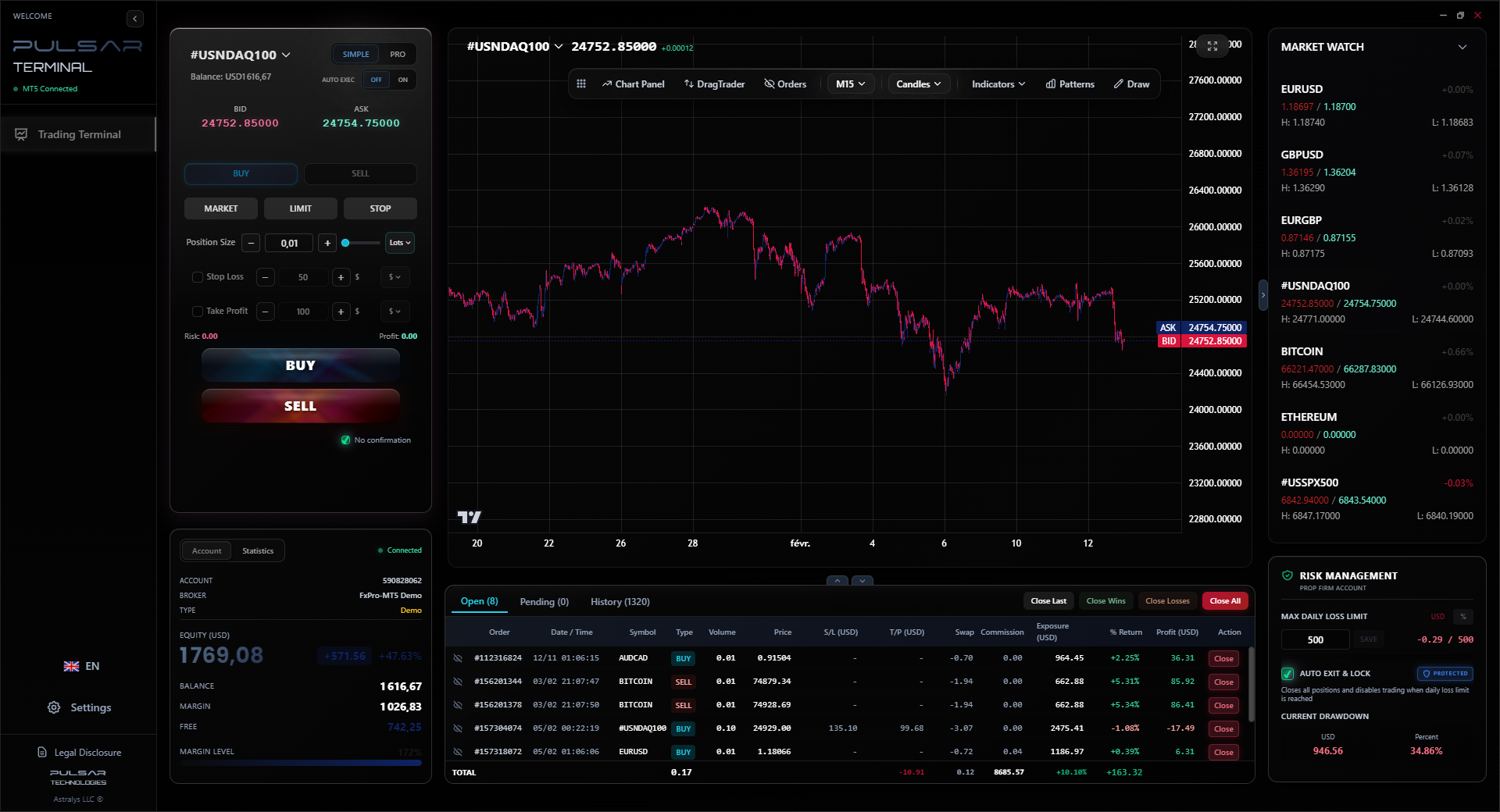
This is where a tool's automation is key. Passing a prop firm challenge requires robot-like discipline on loss limits, which a tool like Pulsar Terminal can enforce automatically on MT5.
💡 Tips Winston
If you wouldn't risk $500 of your own cash on a single trade idea, don't risk a $500 challenge fee on it. The psychology is identical.
Passing a prop firm challenge requires robot-like discipline on loss limits, which a tool like Pulsar Terminal can enforce automatically on MT5.
Pulsar Terminal
Alat MT5 all-in-one: order drag-and-drop, multi-TP/SL, trailing stop, grid trading, Volume Profile, dan perlindungan prop firm. Digunakan 1.000+ trader setiap hari.
The wild west days are ending. If you're getting into this now, you need to know the ground is shifting.
- SEC 'Dealer' Rules (2024): The SEC already passed rules that could force some prop firms to register as formal dealers, subjecting them to stricter capital and reporting rules. A court challenge has slowed this, but the direction is clear.
- The Big One: CFTC as CTA (By 2026): This is the game-changer. The CFTC is likely to rule that evaluation-based prop firms are Commodity Trading Advisors (CTAs). This means registration, audited financials, formal risk disclosures, and likely lower use offers. Overnight, the cost of running these firms goes up. That cost gets passed on to you, either in higher fees or stricter rules.
- Industry Purge (2024): About 80-100 prop firms shut down in 2024 alone. Why? Pressure from platform providers like MetaQuotes and regulatory uncertainty. We're seeing consolidation. You want to pick a firm that looks stable enough to survive the next two years. A firm that supports strong platforms like MT5 or [TradeLocker] is a good sign.
The bottom line? The regulatory noose is tightening. The model that exists today might not exist in its current form in 2027. This isn't a reason not to participate, but it's a reason to be cautious about long-term 'career' plans built solely on prop firms.
“The daily loss limit isn't a rule; it's the entire test. Most people fail it in the first week.”
Maybe. But not the way you think.
First, prove you can trade profitably with your own money. I don't mean a lucky month. I mean 6-12 months of consistent, documented returns on a live, personal account using real risk management. If you can't do that with $1,000, you absolutely cannot do it with a firm's $100,000. The pressure is magnitudes higher.
Second, treat the fee as a tuition payment, not an investment. Go in expecting to fail your first challenge, maybe your first three. Your goal is to learn the rules under fire. Use the smallest, cheapest challenge they offer. The goal isn't to pass on try one; it's to learn without blowing a huge amount on fees.
Third, build a system around the rules. Your trading plan must have the firm's limits baked in. This means:
- Your default position size must keep you well within the daily loss limit.
- You need a hard stop on every trade, no exceptions.
- You must track your daily high equity like a hawk.
I finally passed a challenge after three failures. My strategy? I traded only one instrument I knew inside out (XAU/USD), and I never risked more than 0.5% of the account on any trade. My profit target was a slow grind, not a home run. It was boring. It worked.

Pro Tip: Before you pay a prop firm, practice their exact rules on a free demo account for a full month. Mimic the profit target, daily loss, and max drawdown. If you can't do it when nothing is on the line, you won't do it when the pressure is on.
💡 Tips Winston
View the 6% pass rate as a feature, not a bug. It tells you the standard required. Your mission is to be so disciplined you become a statistical anomaly.
Prop firms aren't the only path. For many, they're the most expensive.
- Trade Your Own Capital, Smaller: This is the purest path. Start with a few thousand at a low-cost broker like Pepperstone. The use is lower, but so are the arbitrary rules. Every dollar you make is yours. Every mistake is a direct, painful lesson. This path builds real skill.
- Find a Local Trading Group or Mentor: Some small hedge funds or trading desks take on apprentices. The pay is terrible at first, but you learn from professionals, not YouTube gurus.
- Specialize in a Strategy That Works with Less Capital: Not every strategy needs $100k. Certain forms of swing trading or focused day trading can be scaled from a $10k account over time.
The prop firm promises a shortcut. In trading, shortcuts usually lead off a cliff. Building your own track record with personal capital, while slower, gives you something no prop firm can take away: verified proof of your own edge. That's worth more than any funded account.
FAQ
Q1What is the actual success rate for Alpha Trader prop firm challenges?
Industry-wide, first-time pass rates hover between 5-10%. Specific firm data is hard to pin down, but a realistic estimate for Alpha Trader and similar firms is around 6%. This means for every 100 people who try, only about 6 get a funded account on the first attempt. Of those 6, statistics show only about 7% (less than 1 person out of the original 100) will ever receive a payout before blowing the account.
Q2Does Alpha Trader prop firm offer real money trading?
During the evaluation challenge, you are trading on a simulated (demo) account. This is how they operate legally without holding client funds. Once you pass and become 'funded,' you are typically trading the firm's capital in a live market environment, and your profits are real. The payout you receive is from the firm's real capital based on your simulated performance during the challenge.
Q3What are the most common rules that cause traders to fail?
The daily loss limit is the biggest killer. It's not calculated from your starting balance, but from your highest equity point of the day. If you're up 2% and then a trade goes against you, losing 3.1% from that peak, you fail - even though you're still down only 1.1% for the day. The maximum drawdown rule (e.g., 6% from starting balance) and minimum trading day requirements are other common failure points.
Q4Is Alpha Trader prop firm regulated in the USA?
The regulatory status is complex. As a firm that uses evaluation challenges on demo accounts, they currently operate in a space that avoids direct regulation as a broker or investment manager. However, this is changing. New SEC rules and expected CFTC action by 2026 aim to classify such firms as formal entities (like Commodity Trading Advisors), which will require registration, disclosure, and compliance with financial regulations.
Q5How fast does Alpha Trader process payouts?
User reports and industry trends indicate Alpha Trader aims for fast payouts, often within 24-48 hours of a request. This is a competitive advantage for them. However, always check their specific terms for minimum withdrawal amounts, payout frequency (e.g., weekly, bi-weekly), and any processing fees before you start trading a funded account.
Q6Can I use any trading strategy with Alpha Trader?
You can use any strategy that complies with their rules. However, strategies that involve holding trades over weekends, high-frequency scalping, or using high-risk news events are often de facto ruled out by the daily loss and drawdown limits. The firm's rules strongly favor conservative, risk-averse strategies with tight stop-losses. A strategy that works on your personal account might need significant adjustment to survive their gauntlet.
Q7What happens if I pass the challenge but then have a losing month?
You will likely lose your funded account. Prop firms have ongoing risk limits (similar to the challenge rules) on funded accounts. If you hit the maximum drawdown or daily loss limit on the live account, it will be closed. There is usually no 'reset' option for a funded account. You would need to pay for and pass a new evaluation challenge to get another one.
Pelajaran Prof. Winston
Poin Penting:
- ✓Expect to spend $8,000+ in fees before passing a challenge.
- ✓The average payout is just 4% of the funded account size.
- ✓Daily loss limits kill more accounts than bad market calls.
- ✓By 2026, new CFTC rules will radically change the industry.
Seberapa bermanfaat artikel ini?
Klik bintang untuk menilai
Wawasan Trading Mingguan
Analisis & strategi mingguan gratis. Tanpa spam.
Tentang Penulis
James Mitchell
Analis Trading Senior
Berbasis di New York dengan lebih dari 9 tahun pengalaman trading. Fokus pada pasangan USD utama, tantangan prop firm, dan lanskap regulasi AS.
Komentar
Peringatan Risiko
Perdagangan instrumen keuangan mengandung risiko signifikan dan mungkin tidak cocok untuk semua investor. Kinerja masa lalu tidak menjamin hasil di masa depan. Konten ini hanya untuk tujuan edukasi dan tidak boleh dianggap sebagai nasihat investasi. Selalu lakukan riset Anda sendiri sebelum trading.
Anda mungkin juga suka

Cara Trading Forex Sukses: 7 Prinsip dari Trader Profesional
Cara trading forex sukses dengan 7 prinsip trader pro: manajemen modal, disiplin, journal trading, backtest. Data nyata, bukan janji profit palsu.
Jam Trading Forex Terbaik untuk Trader Indonesia: Panduan Lengkap dengan Tabel Waktu
Panduan jam trading forex untuk trader Indonesia. Tabel 4 sesi dunia, jam emas 20:00-00:00, sesi mana yang harus dihindari. Data akurat + tips dari trader berpengalaman.
Top 5 Sàn Forex Uy Tín Nhất 2026: Review Jujur dari Trader Indonesia
Top 5 sàn forex uy tín 2026 untuk trader Indonesia. Review jujur: spread, deposit, withdraw, dukungan lokal. Exness, XM, IC Markets & lebih.
Dapatkan Pulsar Terminal
Semua kalkulator ini terintegrasi dalam Pulsar Terminal dengan data real-time dari akun MT5 Anda.
Dapatkan Pulsar Terminal