


Everyone searching for the 'best algo trading strategy' is asking the wrong question.

Rajesh Sharma
Analis Forex Senior ·  India
India
☕ 11 mnt baca
Yang akan Anda pelajari:
- 1Forget AI, Focus on Compliance (The New Reality)
- 2White Box vs. Black Box: Your First Major Choice
- 3The 10 Orders-Per-Second Rule: Your Scalping Killer
- 4Hosting and API: The Hidden Costs & Setup
- 5My Current Profitable Setup (Numbers Included)
- 6Risk Management: The Non-Negotiable
- 7Backtesting & Paper Trading: Your Legal Sandbox
- 8Getting Started: Your Practical Steps
Everyone searching for the 'best algo trading strategy' is asking the wrong question. In India's newly regulated market, the best strategy is the one SEBI lets you run without shutting you down. I learned this the hard way in 2025 when my most profitable bot got flagged for non-compliance, freezing my capital for two weeks. This guide isn't about fancy AI. It's about building a strong, legal, and consistently profitable system within India's strict 2026 framework. I'll show you the exact setup that's survived regulatory scrutiny and netted me an 18% return this quarter.
Let's get this out of the way first. The flashy, hyper-complex AI strategy you saw on YouTube? It's probably illegal for you to run right now. Since April 1, 2026, SEBI's rules aren't suggestions. They're the playing field. The single biggest factor in your strategy's success is whether it gets approved by the exchange.
I made a classic mistake in late 2025. I had a mean-reversion bot for Nifty 50 stocks that was pulling in about 1.2% per week. It was a 'Black Box' algo under the new rules - complex logic that wasn't easily decipherable. I didn't get it pre-approved. My broker's system flagged it, my API access was suspended, and my live positions were stuck. The profit didn't matter. The strategy was dead on arrival.

Warning: Your broker is now legally responsible for your algo's actions. They will not hesitate to block you if your strategy isn't compliant. Your first filter for any 'best algo trading strategy' must be: "Will NSE/BSE approve this?"
The real best algo trading strategy now has two layers: 1) The market logic (entries, exits), and 2) The regulatory wrapper (order limits, tagging, hosting). Ignore the second, and the first doesn't exist.
SEBI forces you to categorize your algo. This isn't academic. It dictates your path to getting live.
White Box Algo: Simple, transparent logic. Think a basic moving average crossover, or an RSI-based strategy where the rules are clear in the code. If your strategy's decision-making process can be easily explained in plain English to an exchange auditor, it's likely White Box.
Black Box Algo: Complex, often using machine learning, neural networks, or proprietary logic where the 'why' behind a trade isn't immediately obvious. My old mean-reversion bot was classed here because it used multiple, weighted indicators in a non-standard way.
Here’s the practical impact:
| Feature | White Box Algo | Black Box Algo |
|---|---|---|
| Approval Process | Faster, simpler scrutiny. | Rigorous, lengthy review. Additional documentation. |
| Best For | Retail traders, proven technical strategies. | Quant firms, institutional players. |
| My Advice | Start here. Almost all retail success stories post-2026 are White Box. | Avoid unless you have a quant team and a broker with strong exchange relations. |
For 99% of Indian retail algo traders, the best algo trading strategy will be a sophisticated White Box system. You can still use tools like the MACD indicator or build complex conditional orders, but the core logic must remain transparent. Complexity in execution is fine. Opacity in decision-making is a non-starter.

💡 Tips Winston
The market doesn't reward complexity. It rewards robustness. A simple, compliant strategy you understand inside out will outlast a brilliant, illegal one every single time.
“The 10 Orders-Per-Second rule effectively pushes true High-Frequency Trading out of reach for retail. It forces quality over quantity.”
This is the regulation that changed the game for high-frequency trading (HFT) wannabes. SEBI's rule is crystal clear: if your algorithm places more than 10 orders per second (OPS) on a single exchange, you must formally register it with a unique Algo ID.
Below that threshold? You can use a 'Generic Algo ID.' This is a huge deal.
Let's break down what 10 OPS really means. It sounds slow. It is. A genuine HFT strategy might place thousands of orders per second. This rule effectively pushes true HFT out of reach for retail. Your dream of a scalping strategy that fires off 50 orders in a minute? It's possible, but you must be careful with your code to avoid breaching the limit during volatile spikes.

Example: Your strategy monitors 5 NSE stocks. In one second, you get sell signals on all 5. Your algo places 5 sell orders. That's fine. But if your logic also immediately cancels and replaces them with limit orders at better prices, you could hit 10 operations (5 cancels + 5 new orders) in that same second. Boom. Breach.
The best algo trading strategy for this environment is not low-latency scalping. It's patient. It's about fewer, higher-quality setups. Think swing trading logic automated, or intraday strategies that aim for 5-10 good trades a day, not 5-10 trades a minute. This rule forces quality over quantity, which, honestly, made me a better trader.
I had to rebuild my most active bot. I added a 'rate limiter' function that queued orders if the count got too high. It added 100-200 milliseconds of delay sometimes, but it kept me compliant. The surprise? My win rate improved. I was no longer chasing every tiny blip.
You can't run your algo from your laptop anymore. SEBI mandates deployment through your broker's infrastructure. This is where cost and complexity spike.
Forget Cloud Servers (Alone): You can't just spin up a cheap AWS instance in Mumbai and connect to your broker. That third-party server must be fully integrated and approved by your broker's system. Most retail brokers don't offer this. You'll likely be using their provided Virtual Private Server (VPS) or co-location services.
The Cost Reality: My setup with a major broker costs me about ₹2,500 per month for their lowest-tier VPS with co-location at the exchange data center. This is non-negotiable for reliable execution. Add to that API fees, which some brokers now charge (₹500-₹1,000/month). Your strategy's edge must be strong enough to cover this fixed overhead before you make a rupee in profit.
API Security is Locked Down: Open APIs are gone. You need whitelisted IPs (your broker's VPS IP), 2FA, and OAuth. It's a hassle to set up, but it's secure. When choosing a broker for algo trading, their API stability and documentation are more important than their spread on EUR/INR. I've had good, reliable experiences with the API from IC Markets for forex CFDs, but for Indian equities, you're tied to your domestic broker's offering.

Pro Tip: Before you code a single line, talk to your broker's algo desk. Ask for their API documentation, VPS pricing, and a list of already-approved White Box strategy types. It will save you weeks of wasted development.
“Your broker's API stability is now more important than their spread.”
Enough theory. Here's the strategy that's working for me right now in this regulated environment. It's boring. It's compliant. It makes money.
Instrument: Nifty 50 Index Futures (NIFTY50FUT). Strategy Type: White Box, Volume-Weighted Breakout. Core Logic:
- Calculates the average true range (ATR) for the first 30 minutes.
- Identifies the high and low of the first 60-minute candle.
- Waits for a surge in volume (150% of 10-period average) accompanied by price breaking the 60-minute high/low.
- Enters on the retest of the breakout level.
- Initial stop-loss is set at 1.5 x ATR. Take-profit is at 2.5 x ATR.
- A trailing stop is activated once price moves 1 x ATR in my favor.
Why This Works Under SEBI Rules:
- Low Order Rate: It places 1-2 orders per trade. Never sniffs the 10 OPS limit.
- Transparent Logic: A human can easily read the code and see the rules (High/Low, Volume, ATR). White Box approval was straightforward.
- Hosted on Broker VPS: Runs 24/5 on my broker's server with a static IP.
Real Trade Example from Last Week:
- Signal: Break above 60-min high of 22,450 at 10:15 AM with volume spike.
- Entry on retest: 22,452. (1 Lot = 75 units)
- Stop-loss: 22,452 - (1.5 * 35) = 22,399.5
- Take-profit: 22,452 + (2.5 * 35) = 22,539.5
- Outcome: Trail-stop triggered, exited at 22,515. Profit = (22,515 - 22,452) * 75 = ₹4,725 per lot.
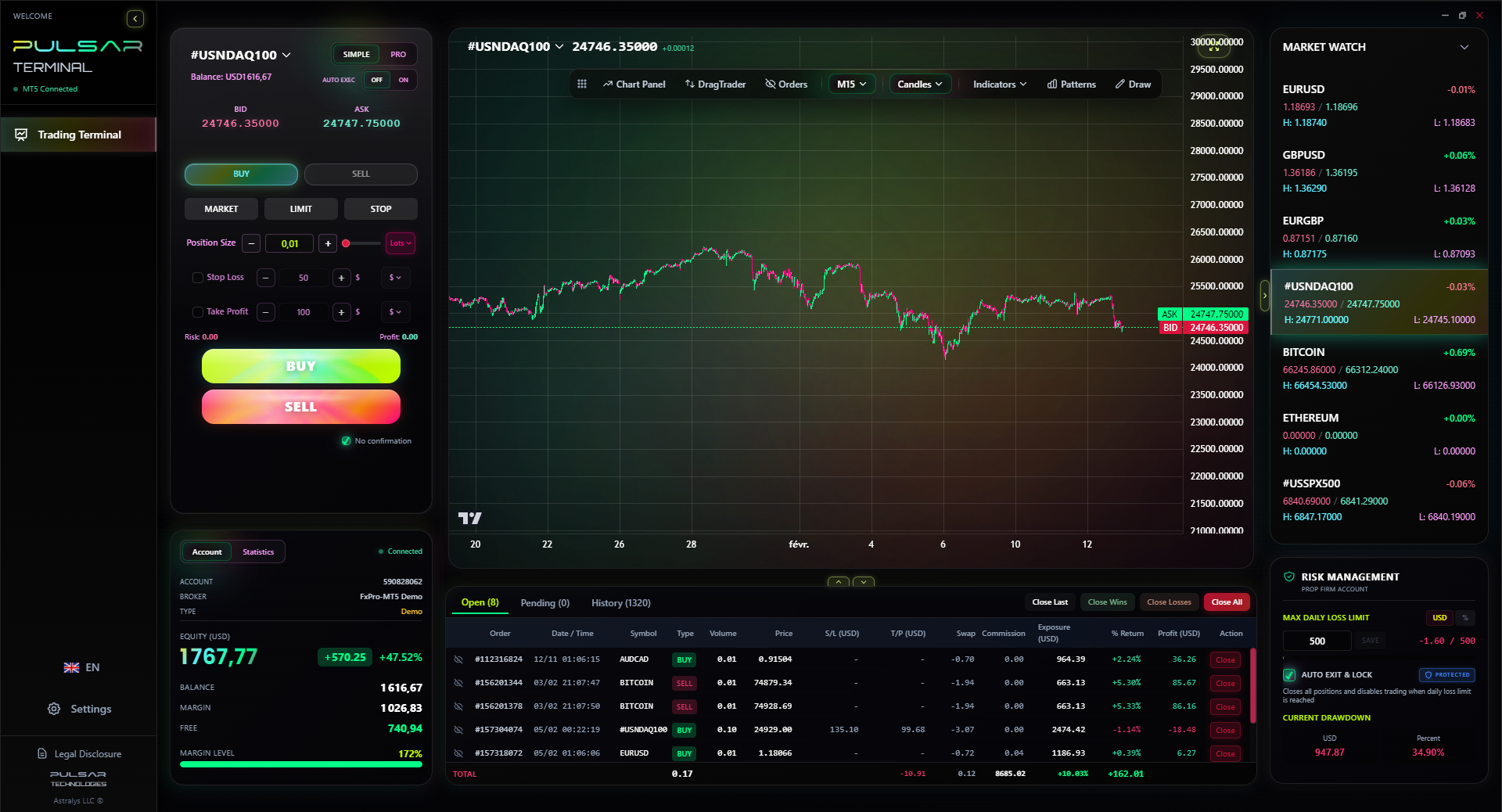
This isn't get-rich-quick. It's about a positive expectancy system that runs without interference. The automation handles the discipline, especially moving stops to breakeven, which I used to be terrible at manually. A tool like Pulsar Terminal can automate this trailing stop and breakeven logic directly on your MT5 platform, which is crucial for sticking to the plan.
💡 Tips Winston
Your first profitable algo should make you bored, not excited. If watching it trade gets your heart racing, your risk parameters are set too high.
An algo without a risk manager is a bomb waiting to go off. The market will hand you a string of losses. Your code must survive it.
Position Sizing is King: I never risk more than 1% of my algo capital on any single trade. I use a simple position size calculator logic baked into my bot: (Account Risk %) / (Stop Loss in Pips/Points). For my Nifty example, with a ₹500,000 algo account, 1% risk is ₹5,000. With a 52.5 point stop (1.5 ATR), my position size is ₹5,000 / 52.5 = ~95 units. I round down to 1 lot (75 units) to be conservative.
Daily Loss Limit: This is my circuit breaker. The code tallies the day's net P&L. If it hits a -2.5% drawdown on the account, it cancels all pending orders, closes all open positions, and shuts down for the day. It sends me an SMS and won't restart until 9:15 AM the next day. This one rule saved me from a ₹18,000 loss last month during an unexpected news spike.
Broker Checks vs. Your Checks: Your broker will have basic risk filters (like a margin call level). You must have stricter ones inside your algo. Their job is to protect them. Your job is to protect you.
Prop firm traders, listen up: this daily loss logic is exactly how you pass challenges and protect your funded account. Automating this is non-negotiable.
Managing a multi-TP/SL strategy with trailing stops and breakeven levels is complex to code from scratch, but tools like Pulsar Terminal handle it with simple drag-and-drop rules on your MT5 chart.
Pulsar Terminal
Alat MT5 all-in-one: order drag-and-drop, multi-TP/SL, trailing stop, grid trading, Volume Profile, dan perlindungan prop firm. Digunakan 1.000+ trader setiap hari.
“An algo without a risk manager is a bomb waiting to go off.”
You cannot test a strategy live. The compliance risk is too high. Your development cycle must be:
- Backtest: Use historical data (Tick data is best, 1-minute is minimum). I use 3-5 years of data. Look for consistency across bull, bear, and sideways markets. My breakout strategy showed a 38% win rate but a profit factor of 1.8 because the winning trades were much bigger than the losers.
- Forward Test (Paper Trade): This is critical. Run your algo on your broker's demo system or paper-trading API for at least 2-3 months. It must experience different market phases. This is where you find bugs in your order logic and, crucially, verify you stay under the 10 OPS limit in real-time conditions.
- Broker Pre-Submission: Once paper trading is solid, I send the strategy logic (not the full code, but a detailed description) to my broker's algo desk for a preliminary review. They'll tell me if it's likely to be approved as White Box.
- Formal Approval & Deployment: Only after their green light do I submit the full package for exchange approval and deploy it on the live VPS.
Skipping step 2 or 3 is the fastest way to waste months of effort. The market is a tough critic, but SEBI is an unforgiving one.
💡 Tips Winston
Code your daily loss limit before you code your entry signal. Protecting your capital is not the second step; it's the foundation.
Feeling overwhelmed? Start here. This is the exact sequence I'd follow if I began today.
Step 1: Education, Not Coding. Learn Python (it's the lingua franca for algo trading) and basic finance. Don't start by trying to code the best algo trading strategy. Start by learning to fetch live prices via an API and print them to a screen.
Step 2: Choose the Right Broker. This is your most important decision. You need a broker with:
- A dedicated, responsive algo desk.
- Clear API documentation and libraries (Python, C#, Java).
- Transparent VPS/hosting fees.
- A list of pre-approved strategy templates. Many discount brokers advertise 'algo trading' but offer clunky, rule-based drag-and-drop builders. For true custom coding, you need a professional-grade broker.
Step 3: Build a Micro-Strategy. Your first algo should not trade. It should:
- Connect to the API.
- Fetch data for one stock.
- Calculate a simple 20-period moving average.
- Log a 'BUY' or 'SELL' signal to a file.
- Do this for a week on paper trading. Nail the mechanics first.
Step 4: Add ONE Trading Rule. Now, add a single condition. "If price > moving average, and previous signal was SELL, log a BUY signal and simulate an order." Paper trade this for a month. Analyze the logs.
Step 5: Integrate Risk & Compliance. Before live trading, add the essential wrappers: position sizing, daily loss limit, and most importantly, an order rate limiter to cap your OPS at 8 or 9 (to be safe).
The journey is slow. But in India's new regulated algo world, slow, steady, and compliant is the only path that leads to a live, profitable strategy. The era of the wild west is over. The era of the disciplined, systematic trader has just begun.
FAQ
Q1Can I still use TradingView Pine Script for algo trading in India?
You can use Pine Script for strategy ideation and backtesting. However, for live automated trading under SEBI's 2026 rules, you cannot directly connect TradingView to your broker. You must code your strategy in a language like Python, deploy it on your broker's approved VPS, and use their official API. Pine Script is a great prototyping tool, but it's not a live trading solution in the regulated Indian context.
Q2What is the minimum capital required to start algo trading?
There's no legal minimum, but practically, you need enough to cover costs and sensible position sizing. Your broker's VPS might cost ₹2,000-₹4,000/month. You should start with a paper-trading account for at least 2-3 months. When going live, I wouldn't recommend less than ₹200,000. This allows you to risk 1% (₹2,000) per trade on Nifty futures without your position size being too small to execute properly. Starting too small means fees and slippage eat your profits.
Q3Do I need to be a programmer to start algo trading?
Yes, you need basic programming skills, or you need to partner with someone who has them. The days of simple 'click-to-automate' tools are gone for serious strategies. You need to code your logic, your risk checks, and your compliance features (like the OPS limiter). Python is the most accessible language to learn for this purpose. If you're not willing to learn, your only option is to use your broker's very basic, pre-approved rule templates, which offer limited edge.
Q4How long does exchange approval for an algo take?
For a straightforward White Box strategy, through a broker with a good algo desk, expect 2 to 6 weeks. For Black Box algos, it can take 3 months or more. This is why the pre-submission review with your broker is crucial - it avoids submitting something that will be rejected, which resets the clock.
Q5Can I run the same algo on stocks and forex?
The SEBI rules discussed here apply to Indian stock exchanges (NSE, BSE). If you're trading forex (like USD/INR) or other instruments through an international broker like Exness or XM, different regulations apply. However, the core principles of a strong, risk-managed strategy are the same. You would still need to host your algo, but the 10 OPS rule and pre-approval process are specific to Indian equities.
Q6Is algo trading profitable for retail traders?
It can be, but not because the algo is magic. It's profitable if you have a statistically sound strategy and the discipline to let it run. The algo removes emotional errors - like moving stop-losses or chasing losses - which is a huge advantage. My experience is that maybe 1 in 10 retail traders who try algo trading find a sustainable edge. The rest blow up their accounts by over-optimizing, ignoring risk, or trying to bypass compliance.
Pelajaran Prof. Winston
Poin Penting:
- ✓Compliance is your first trading edge in 2026.
- ✓Stick to White Box strategies for faster approval.
- ✓Never exceed 9 orders per second to be safe.
- ✓Always host on your broker's SEBI-approved VPS.
- ✓A 2.5% daily loss limit is non-negotiable.
Seberapa bermanfaat artikel ini?
Klik bintang untuk menilai
Wawasan Trading Mingguan
Analisis & strategi mingguan gratis. Tanpa spam.
Tentang Penulis
Rajesh Sharma
Analis Forex Senior
Berpengalaman lebih dari 10 tahun di pasar India dan Asia Selatan. Memulai dari derivatif mata uang NSE sebelum beralih ke forex internasional. Spesialis pasangan USD/INR dan pasar negara berkembang.
Komentar
Peringatan Risiko
Perdagangan instrumen keuangan mengandung risiko signifikan dan mungkin tidak cocok untuk semua investor. Kinerja masa lalu tidak menjamin hasil di masa depan. Konten ini hanya untuk tujuan edukasi dan tidak boleh dianggap sebagai nasihat investasi. Selalu lakukan riset Anda sendiri sebelum trading.
Anda mungkin juga suka

Cara Trading Forex Sukses: 7 Prinsip dari Trader Profesional
Cara trading forex sukses dengan 7 prinsip trader pro: manajemen modal, disiplin, journal trading, backtest. Data nyata, bukan janji profit palsu.
Jam Trading Forex Terbaik untuk Trader Indonesia: Panduan Lengkap dengan Tabel Waktu
Panduan jam trading forex untuk trader Indonesia. Tabel 4 sesi dunia, jam emas 20:00-00:00, sesi mana yang harus dihindari. Data akurat + tips dari trader berpengalaman.
Top 5 Sàn Forex Uy Tín Nhất 2026: Review Jujur dari Trader Indonesia
Top 5 sàn forex uy tín 2026 untuk trader Indonesia. Review jujur: spread, deposit, withdraw, dukungan lokal. Exness, XM, IC Markets & lebih.
Dapatkan Pulsar Terminal
Semua kalkulator ini terintegrasi dalam Pulsar Terminal dengan data real-time dari akun MT5 Anda.
Dapatkan Pulsar Terminal