


Let's be blunt: most 'best forex broker 2024' awards are bought, not earned.

Sarah Collins
Ahli Strategi Trading ·  Australia
☕ 11 mnt baca
Yang akan Anda pelajari:
- 1Why Broker Awards Are (Mostly) Nonsense
- 2The Only Award That Matters: ASIC Regulation
- 3Decoding Real Costs: Spreads, Commissions & Hidden Fees
- 4Execution Speed & Platform Stability: The Non-Negotiables
- 52024 Award Winners: What They Actually Got Right
- 6How to Choose Your Broker: A 5-Step Checklist
- 7The Future: Trends Beyond the 2024 Awards
Let's be blunt: most 'best forex broker 2024' awards are bought, not earned. They're marketing tools designed to separate you from your money by making a broker look prestigious. I've been trading for over a decade, and I've seen the same brokers win different 'awards' from obscure websites every single year. The real test isn't a trophy; it's whether a broker survives your first margin call without screwing you over. In Australia, we have the advantage of ASIC's tough rules, but you still need to know what to look for beyond the shiny logos. I'll show you how to decode the awards hype and pick a broker based on what actually affects your P&L: execution, costs, and whether they'll be there when you need to withdraw.
I want you to do a quick experiment. Google 'best forex broker award 2024'. You'll find dozens of sites, each with a different winner. One says Pepperstone, another says IC Markets, a third says some broker you've never heard of. How can they all be the 'best'?
They can't. The dirty secret is that many of these awards come from affiliate websites. The business model is simple: the website gives out an 'award', the broker pays for a license to display the logo, and the website earns a commission every time someone signs up through their link. It's a circle of mutual back-scratching that has very little to do with your trading success.
I learned this the hard way early on. I signed up with a broker that had 'Best New Platform 2018' plastered everywhere. The platform was flashy, but the spreads were criminal - often 3 pips on the EUR/USD when the market was quiet. When I tried to scalp, the slippage was horrific. I lost $400 in a week not from bad trades, but from terrible execution. That 'award' was for design, not for being a trader's broker.
This isn't to say all awards are worthless. Recognition from established, independent research firms like Investment Trends carries weight because it's based on surveying actual clients. When OANDA Australia tops categories for 'Overall Satisfaction' and 'Quality of Trade Execution' in their report, that's data, not decoration. The key is to ask: who gave the award, and why?

Warning: If a broker's 'About Us' page looks like a trophy cabinet but you can't easily find their ASIC license number or clear fee schedule, walk away. You're not their client; you're their marketing asset.

💡 Tips Winston
A broker's job is to provide a pipe to the market, not to be your friend. Judge them on the quality of the pipe - its width (spread), its stability (execution), and whether it leaks (hidden fees). Everything else is noise.
Forget the 'Best in Class' plaques. The only badge that matters for an Australian trader is the ASIC AFSL number. The Australian Securities and Investments Commission runs one of the toughest regulatory regimes in the world, and it's your primary line of defence.
Here’s what ASIC rules actually do for you:
1. They Protect Your Money. Brokers must hold at least $1 million in operating capital. More importantly, your client funds must be held in segregated accounts with top-tier Australian banks. This means if the broker goes bust (it happens), your money isn't part of their bankruptcy estate. It's supposed to be safe. I say 'supposed to' because you must still check your broker's trust account details.
2. They Limit Your use (For Your Own Good). Since 2021, ASIC has capped use for retail clients. You get a maximum of 30:1 on major pairs like the EUR/USD, 20:1 on minors and gold, and just 2:1 on crypto. This infuriates new traders who want 500:1 to 'get rich quick'. But as a risk manager, I'll tell you this: these caps have saved more Australian trading accounts than any strategy ever will. High use is the fastest way to a margin call.
3. They Ban Toxic Incentives. ASIC outlawed deposit bonuses and trading incentives for CFD products. Why? Because they encourage you to trade more, and risk more, than you should. A real broker doesn't need to bribe you to sign up.
The Harsh Reality of 'Global' Brokers
Many brokers offer an 'international' entity with higher use. It's tempting. Don't do it. You lose ASIC's protection. You might be dealing with an offshore regulator with lax rules. If there's a dispute, your legal recourse is complicated and expensive. The safety is worth the lower use.

Pro Tip: Always verify the ASIC license on the official Moneysmart register. Don't just trust the number on the broker's site. Check the trading name matches exactly.
“High use is the fastest way to a margin call. ASIC's caps aren't a restriction; they're a seatbelt.”
Awards don't pay your trading costs. Spreads and commissions do. This is where you move from marketing to mathematics. Let's break down the real numbers from some major ASIC-regulated players.
| Broker | Account Type | Avg. EUR/USD Spread | Commission (per lot, round turn) | Key Cost Takeaway |
|---|---|---|---|---|
| Pepperstone | Razor Account | ~0.17 pips | $7.00 | Low spread + commission. Best for high volume. |
| Pepperstone | Standard Account | ~0.77 pips | $0.00 | Simpler, no commission. Spread is the cost. |
| IC Markets | Raw Spread Account | ~0.10 pips | $7.00 | Similar to Pepperstone Razor. Ultra-tight raw spreads. |
| Fusion Markets | Zero Account | ~0.0 pips | $4.50 | One of the lowest all-in costs in the market. |
| FP Markets | Standard Account | ~1.17 pips | $0.00 | Higher spread, no commission. |
My Cost Mistake: I used to only look at the spread. I traded with a 'commission-free' broker showing a 0.9 pip spread on EUR/USD. I thought I was getting a deal. Then I started scalping and noticed my break-even was always further away than the chart suggested. I was being silently hammered with huge slippage and 'requotes' on my orders. The effective cost was over 2 pips per trade. I switched to a transparent commission model (Pepperstone's Razor) and my consistency improved immediately. I knew the exact cost upfront: spread + $3.50 per side.
Other Hidden Costs:
- Inactivity Fees: Some brokers charge if you don't trade for 3-12 months.
- Withdrawal Fees: Bank wire transfers can cost $20-$30. Many brokers now offer free withdrawals via local bank transfer.
- Currency Conversion Fees: If you deposit in AUD but trade USD pairs, your broker may add a 0.5%-1% fee on the conversion. Always check.
Use a position size calculator that includes commission. It changes your risk per trade dramatically.
This is the engine room. A broker can have all the awards on earth, but if their platform crashes during the RBA announcement or you get 5 pips of slippage on every entry, you're finished.
Execution Speed: This is the time between you clicking 'buy' and the order hitting the market. Pepperstone often wins genuine accolades here because they invest in top-tier infrastructure. For a scalping strategy, a difference of 10 milliseconds can be the difference between profit and loss. For a swing trading approach, it's less critical.
Platform Choice: Most ASIC brokers offer MetaTrader 4/5. It's the industry standard for a reason - it's reliable and supports countless indicators like the RSI and MACD. The real differentiators are:
- cTrader: Loved by many for its cleaner interface and superior order entry. Offered by Pepperstone, IC Markets, and FP Markets.
- TradingView Integration: Brokers like Eightcap and BlackBull Markets now offer trading directly on TradingView charts. This is a game-changer for chartists.
A Personal Blackout: During the 2019 GBP flash crash, I was in a short on GBP/JPY. My broker's MT4 server froze. I couldn't modify my stop loss. By the time it came back, my trade had blown through my stop and taken out 8% of my account. The broker's response? 'Exceptional market volatility.' The lesson: test your broker's platform during high volatility with a demo account. See how it holds up.

Example: If you're trading a 1-lot position on the EUR/USD, a 1-pip difference in slippage is worth $10. Get 5 pips of bad slippage on 10 trades a week, and that's $500 a month you're just giving away.
💡 Tips Winston
The 'minimum deposit' is a marketing tool. The real minimum is the amount you can afford to lose on a single trade without emotion. If a $50 minimum deposit tempts you to fund an account with $200, you're already setting up for failure.
“The dirty secret is that many 'best broker' awards come from affiliate websites. It's a circle of mutual back-scratching that has little to do with your trading success.”
Let's look past the award titles and see what these brokers genuinely excel at, based on both industry recognition and my own experience.
-
Pepperstone (Various 'Best Aus Broker' Awards): They consistently win for execution speed and technology. Their Active Trader program provides meaningful benefits like volume-based rebates and dedicated support. This is a broker built for serious traders, not just beginners. Their partnership with the Aston Martin F1 team isn't just branding; it aligns with a focus on performance and technology.
-
OANDA Australia (Investment Trends 2024 Report): Topping 'Overall Satisfaction' and 'Customer Service' across a broad client survey is significant. It tells you they're good at the basics: reliable platforms, clear communication, and helpful support. They're a solid, all-rounder choice, especially if you value customer experience.
-
FP Markets (FX Trust Score 'Best Trading Conditions' 2024): They've carved a niche with extensive asset coverage (over 10,000 instruments) and flexible platforms (MT4, MT5, cTrader, IRESS). If you want to trade ASX equities alongside your forex, they're a standout.
-
IC Markets (FX Trust Score 'Outstanding Client Support' 2024): Known for raw pricing and attracting high-volume traders. Their support has a reputation for being knowledgeable, which matters when you have a complex query about an API or a specific order type.
-
Vantage ('Best CFD Broker, Global' 2024): They offer a very balanced proposition - good platform selection, competitive fees, and a low $50 minimum deposit. They're a strong candidate for traders who want a bit of everything without a glaring weakness.
The common thread? The genuine awards highlight a specific, verifiable strength, not just vague 'excellence'.
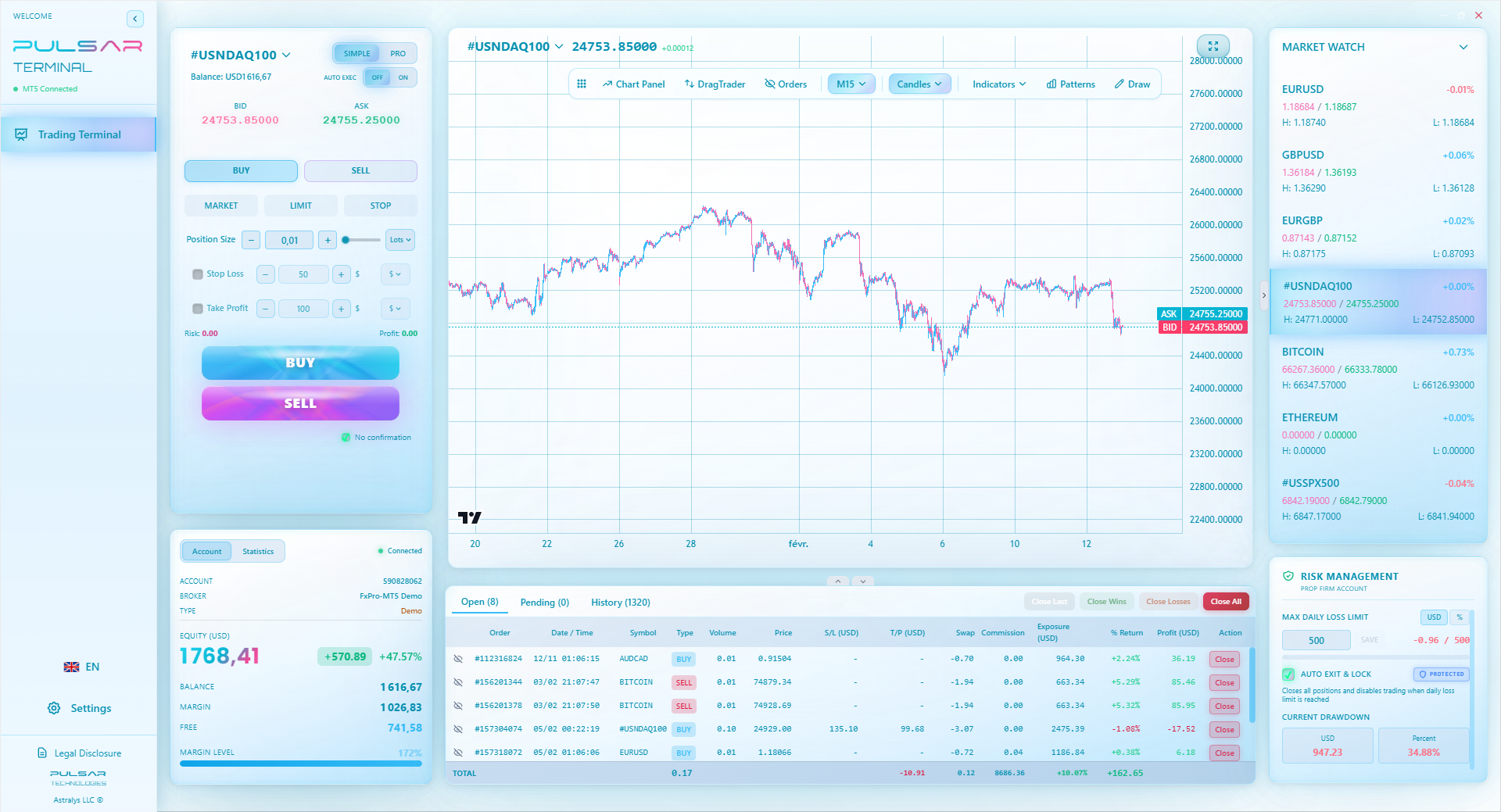
Once you've chosen a broker with a stable MT5 platform, a tool like Pulsar Terminal can supercharge your order management with features like one-click trailing stops and multi-TP/SL strategies directly on your charts.
Pulsar Terminal
Alat MT5 all-in-one: order drag-and-drop, multi-TP/SL, trailing stop, grid trading, Volume Profile, dan perlindungan prop firm. Digunakan 1.000+ trader setiap hari.
Ignore the sales pitch. Use this checklist.
- Verify the ASIC AFSL. Go to Moneysmart. Check the license is current and the business name matches. This is non-negotiable.
- Calculate Your All-In Trade Cost. Pick your most traded pair (e.g., XAU/USD or EUR/USD). For each broker, take their typical spread and add the commission. Do the math for a 1-lot trade. The lowest number isn't always best if execution is poor, but a high number is a deal-breaker.
- Test the Platform with a Demo. Open a demo account. Trade during the London open or a major news event. Does it lag? Do your orders get filled at the price you expect? Try to withdraw 'demo' money. Is the process clear?
- Contact Support with a Technical Question. Don't ask 'are you good?'. Ask something specific like, 'What is your policy on slippage during NFP?' or 'Can I set a trailing stop on MT5 that moves in partial pip increments?' Their speed and knowledge are telling.
- Read the Withdrawal Policy. Find the fees, processing times, and required documents. If it's opaque or seems difficult, imagine trying to get your real profits out.
I keep two live accounts: one with Pepperstone for my low-latency, high-frequency strategies, and one with a more general broker for longer-term positions. There's no rule saying you can only use one.
“Test your broker's platform during high volatility with a demo. See how it holds up when you need it most.”
The landscape is shifting. The 'best forex brokers 2024 awards' will be obsolete by 2025. Here's what's coming that will matter more.
AI and Hyper-Personalisation: Brokers are using AI not just for fraud detection, but to tailor pricing and services. Soon, your trading costs and available use might be dynamically adjusted based on your behavior and profitability. This could be a benefit or a nightmare - transparency will be key.
The Prop Firm Boom and Broker Integration: The rise of prop trading firms has been meteoric. Brokers are responding. OANDA launched its own prop program. Others are creating seamless integration where passing a challenge automatically funds a live account with them. This creates a new conflict of interest to be aware of.
ESG Trading: It sounds fluffy, but capital flows are following ESG ratings. Brokers are starting to offer ESG-themed currency baskets or analytics. This is moving from a niche to a mainstream factor, especially for institutional flows that move the market.
Consolidation: The cost of compliance with ASIC rules is high. We'll likely see smaller brokers get bought out or shut down. This makes choosing a well-capitalised, established broker even more important for the long term. Your broker needs to be a partner for years, not just months.
The brokers that win real respect won't be the ones with the most awards on their site. They'll be the ones that provide transparent, reliable, and technologically advanced services that adapt to these changes without compromising client protection.
FAQ
Q1Is it safe to use a broker that isn't ASIC-regulated but has won international awards?
No. For an Australian resident, ASIC regulation is the baseline for safety. International awards mean nothing if the broker is based in an offshore jurisdiction with weak client money protection rules. You are giving up mandatory segregation of funds, use caps, and legal recourse under Australian law. The risk is not worth it.
Q2What's better: a low-spread commission account or a commission-free account?
It depends on your trading style. For high-frequency trading (scalping, high volume), a low raw spread + commission account (like Pepperstone Razor or IC Markets Raw) is almost always cheaper overall. For lower-frequency or smaller-position trading, a commission-free account with a slightly higher spread can be simpler and more cost-effective. You must calculate the all-in cost per trade for your typical position size.
Q3How important is a broker's proprietary trading platform versus MT4/MT5?
For most traders, MT4/MT5 or cTrader is perfectly sufficient and offers vast community support and indicators. A broker's proprietary platform can be a bonus if it offers unique tools or superior usability, but it should not be the primary reason for choosing a broker. Reliability and execution on the standard platforms are far more critical.
Q4Can I trust broker review sites that give out awards?
Be very skeptical. Check the site's disclaimer. If it says 'we may receive compensation from companies featured on this site,' their awards and rankings are influenced by commercial relationships. Prioritise information from independent regulators (ASIC), genuine client survey firms (Investment Trends), and community forums where traders share unfiltered experiences.
Q5What should I do if my ASIC-regulated broker has poor execution or won't process my withdrawal?
First, escalate formally within the broker's complaints department. If unresolved, you have a powerful recourse: lodge a complaint with the Australian Financial Complaints Authority (AFCA). All ASIC-licensed brokers must be AFCA members. This free external dispute resolution service can make binding decisions on the broker, and they take client fund issues very seriously.
Q6Do the ASIC use caps apply if I open an account with a broker's UK or global entity?
No. The caps only apply to the broker's ASIC-licensed entity. If you open an account under their UK (FCA) or offshore license, different rules apply. However, as an Australian resident, you may be breaking the broker's terms of service by doing this, and you will lose all protections under Australian law. It is strongly discouraged.
Pelajaran Prof. Winston
Poin Penting:
- ✓Verify the ASIC AFSL on Moneysmart, not the broker's site.
- ✓Calculate all-in cost: Spread + Commission per trade.
- ✓Test execution speed with a demo during volatile markets.
- ✓Prioritise client fund segregation over any advertised award.
Seberapa bermanfaat artikel ini?
Klik bintang untuk menilai
Wawasan Trading Mingguan
Analisis & strategi mingguan gratis. Tanpa spam.
Tentang Penulis
Sarah Collins
Ahli Strategi Trading
Ahli strategi trading berbasis London dengan 12 tahun di pasar keuangan. Mantan analis di perusahaan pialang City of London. Mencakup pasangan GBP, pasar Eropa, dan trading berregulasi FCA.
Komentar
Peringatan Risiko
Perdagangan instrumen keuangan mengandung risiko signifikan dan mungkin tidak cocok untuk semua investor. Kinerja masa lalu tidak menjamin hasil di masa depan. Konten ini hanya untuk tujuan edukasi dan tidak boleh dianggap sebagai nasihat investasi. Selalu lakukan riset Anda sendiri sebelum trading.
Anda mungkin juga suka

Cara Trading Forex Sukses: 7 Prinsip dari Trader Profesional
Cara trading forex sukses dengan 7 prinsip trader pro: manajemen modal, disiplin, journal trading, backtest. Data nyata, bukan janji profit palsu.
Jam Trading Forex Terbaik untuk Trader Indonesia: Panduan Lengkap dengan Tabel Waktu
Panduan jam trading forex untuk trader Indonesia. Tabel 4 sesi dunia, jam emas 20:00-00:00, sesi mana yang harus dihindari. Data akurat + tips dari trader berpengalaman.
Top 5 Sàn Forex Uy Tín Nhất 2026: Review Jujur dari Trader Indonesia
Top 5 sàn forex uy tín 2026 untuk trader Indonesia. Review jujur: spread, deposit, withdraw, dukungan lokal. Exness, XM, IC Markets & lebih.
Dapatkan Pulsar Terminal
Semua kalkulator ini terintegrasi dalam Pulsar Terminal dengan data real-time dari akun MT5 Anda.
Dapatkan Pulsar Terminal