


I was staring at a $12,000 unrealized profit on a GBP/USD short in late 2024, funded by a prop firm.
James Mitchell
Analis Trading Senior
☕ 10 mnt baca
Yang akan Anda pelajari:
- 1The US Regulatory Minefield (It's Not What You Think)
- 2How Prop Firms Make Money (And Why You Blow Up)
- 3Evaluating Firms: The Key Metrics Beyond the Profit Split
- 4Top Firms for US Traders Right Now (2026)
- 5Passing the Challenge: A Real Strategy, Not Hype
- 6The Payout Reality & The Tax Man
- 7Final Verdict: Is It Worth It for a US Trader?
I was staring at a $12,000 unrealized profit on a GBP/USD short in late 2024, funded by a prop firm. The trade was perfect. Then the CFTC made a statement about leveraged retail products at 10 AM EST. My broker's spreads widened to 50 pips in under a second, triggering my stop-loss and wiping the entire gain. That moment crystallized the unique, fragile reality of trading with a US prop firm. You're not just battling the market. You're navigating a regulatory minefield where the rules are written in pencil. Let's talk about which firms give you a fighting chance.
Most traders think the CFTC and NFA are the big bad wolves for prop firms. The truth is more nuanced, and frankly, more precarious. These firms aren't brokers in the traditional sense. They're often structured as educational services or talent evaluators. You pay a fee to take a challenge on a simulated account. If you pass, they give you access to a larger simulated account and share a portion of the 'virtual' profits you generate. Your trades aren't hitting a live interbank market in your name. This legal sidestep is why they can offer you use beyond the standard US retail cap of 1:50.
But here's the catch that cost me early on: the liquidity behind your trades matters. Some firms route orders through offshore brokers with shaky execution, especially during news events. That 50-pip spread blowout I experienced? That was a cheap firm cutting corners. The good ones partner with established, regulated entities (even if offshore) to provide decent fills. The regulatory scrutiny is intensifying. The SEC and CFTC are asking hard questions about whether these evaluation fees constitute 'client funds' and if profit-sharing models require registration. The 2025 'MyForexFunds' ruling is pushing the entire industry toward futures-based, more compliant models. For you, this means the landscape is shifting under your feet. A firm that's solid today might be restructuring or exiting the US tomorrow.

Warning: Don't be fooled by the 'simulated' label. Your psychology must treat this as real money from day one. The firms that survive will be the ones whose simulated conditions mirror live markets as closely as possible. Your job is to find them.
“The prop firm's primary income isn't your profit share. It's the steady stream of evaluation fees from traders who fail.”
Let's cut through the marketing. A prop firm's primary income isn't your profit share. It's the steady stream of evaluation fees from traders who fail. Industry data shows only 5-10% of traders pass the initial challenge. Roughly 7% of funded accounts ever see a payout. The business model is built on your overconfidence and poor risk management.
I learned this the hard way with my first $250 challenge. I was up 8% in two days, feeling invincible. I broke my own rule and increased my position size threefold on a EUR/USD setup. A false breakout reversed, and I hit the daily loss limit. Game over. The firm made $250. I learned a $250 lesson about the importance of a position size calculator and sticking to a plan.
The rules are designed to exploit common trading flaws. Maximum daily loss limits punish revenge trading. Minimum trading day requirements encourage overtrading. Profit targets force impulsive behavior. To win, you must develop a process that is boring, consistent, and mechanically sound. It's not about the big win. It's about surviving long enough to let the profit split work in your favor.
The Psychology of the Fee
That challenge fee creates a dangerous sunk cost fallacy. You think, "I've already spent $500, I need to make it back." This leads to forced trades. The best mental shift I made was to consider the fee a tuition payment for a brutally honest assessment of my strategy. If I pass, great. If I fail, the money is gone, and I have data to improve.

💡 Tips Winston
The challenge fee is a tuition, not a ticket. If you learn nothing from failing, you wasted the money.
“A 90% split of nothing is still nothing. You need to dig deeper into the mechanics.”
Everyone looks at the profit split first. Big mistake. A 90% split of nothing is still nothing. You need to dig deeper into the mechanics.
| Feature | What to Look For | Why It Matters |
|---|---|---|
| Platform & Execution | MT5, cTrader, DXtrade, or TradeLocker via a reputable broker partner. | Stable platforms with reliable order execution prevent technical losses. Avoid firms with proprietary platforms that lack depth of market. |
| Drawdown Rules | Consistent, realistic trailing or static drawdown based on initial balance, not equity. | Equity-based drawdowns can trigger a loss during a temporary floating loss, even if your trade is sound. This is a common killer. |
| Payout Threshold & Speed | Low first-payout threshold (e.g., $100) and reliable weekly/bi-weekly processing. | You want to get paid quickly to build trust. A firm that makes you wait for a $1,000 minimum is holding your capital hostage. |
| Scaling Plan | Clear, achievable metrics for growing your account size. | The real wealth is in scaling. A plan that requires 10% profit per month is unrealistic. Look for 5-6% targets. |
| Customer Support | Responsive live chat or ticket system, not just email. | When you have a payout or rule question, you need answers fast, not in 72 hours. |
From my experience, a firm like The5ers stands out for transparent scaling (up to $4 million) and sensible rules. FTMO, while a pioneer, uses a simulated model for US traders - it's psychologically different but professionally run. For futures, Topstep is the gold standard because it's built on the regulated futures exchange infrastructure; you're trading real contracts, not simulations.

Pro Tip: Always read the FAQ and Terms of Service. The devil is in the details. Look for clauses about 'spread widening during news' or 'requotes.' If they exist, avoid that firm. You need execution you can trust, like you'd get from a broker like IC Markets.
“A 90% split of nothing is still nothing. You need to dig deeper into the mechanics.”
Based on stability, platform access, and trader feedback in this volatile climate, here are the firms I'd put my own money on. Remember, this can change.
For Forex/CFD Traders:
- FundedNext (Futures & CFDs): They reopened cTrader access to US traders in 2026, a huge deal. cTrader's execution is excellent. They offer up to 95% profit share on CFDs and, critically, 100% on futures. Their partnership with a regulated entity gives them staying power.
- ThinkCapital: Backed by the regulated broker ThinkMarkets. This broker-backing is a massive advantage for compliance and execution. They accept US customers and offer competitive, transparent pricing.
- DNA Funded: Consistently ranked highly for US traders. Partnered with DNA Markets, they offer various challenge models and up to 90% profit share. Their payout rhythm is reliable (every 14 days).
For Futures-Focused Traders (The Safer Bet):
- Topstep: This is the model others will follow. They provide real trading accounts funded by Topstep itself, connected to the futures exchange. Rules are clear, payouts are reliable (up to 90% split), and it's a compliant structure. Ideal if you trade forex via micro futures contracts.
- Apex Trader Funding: They boast a higher pass rate (15-20% first try) and offer a unique 100% split on the first $25,000. Their focus is purely on futures, which aligns with the regulatory shift.
The 'Wildcard' Worth Watching:
- The5ers: While not US-specific, they accept US traders and their long-term development focus is unmatched. Their scaling plan to $4 million is the most realistic I've seen. They've weathered the MetaQuotes storm by diversifying platforms.
I have a funded account with a futures-focused firm. The peace of mind knowing my trades are on the CME and not in some offshore broker's simulation is worth a slightly lower profit split. My first payout was $2,150 on a $50,000 account, and it hit my bank account in 36 hours. That reliability is everything.
💡 Tips Winston
Choose a firm for its scaling plan, not its starting balance. A path from $10k to $100k is more valuable than a one-time $100k account.
“In the US, payouts are typically treated as self-employment income. The tax man always gets his share.”
Forget YouTube gurus promising secret indicators. Passing is about risk management and process. Here's the exact two-phase approach I used to finally get funded.
Phase 1: The Grind (First 70% of Profit Target) Your only goal is to not lose. Use a scalping strategy or a very conservative swing trade approach. I aimed for 0.5% to 1% risk per trade, targeting 1:1.5 risk/reward. My weapon of choice was the MACD indicator on a 4-hour chart for direction, and the RSI indicator on the 1-hour for entry. I traded only the London or New York open on EUR/USD and XAU/USD. No news, no exceptions. This phase is boring. It took me 14 trading days to hit 7% profit.
Phase 2: The Lockdown (Final 30%) Once I was at 7% (target was 10%), I reduced my position size by 50%. The temptation to get greedy is overwhelming. I placed one final, small trade to close the gap and then stopped. I literally closed the platform. The remaining days were spent hitting the minimum activity requirement with microscopic, irrelevant trades. The goal is to protect capital, not maximize it.

Example: On a $100,000 challenge account with a 10% target ($10,000) and a 5% max loss rule ($5,000).
- Your Risk per Trade: No more than $500 (0.5% of account).
- Your Trade Goal: Make $750 (1.5x risk).
- Trades to Target: You need about 14 successful trades like this (allowing for some losers) to hit the target. That's it. No home runs needed.
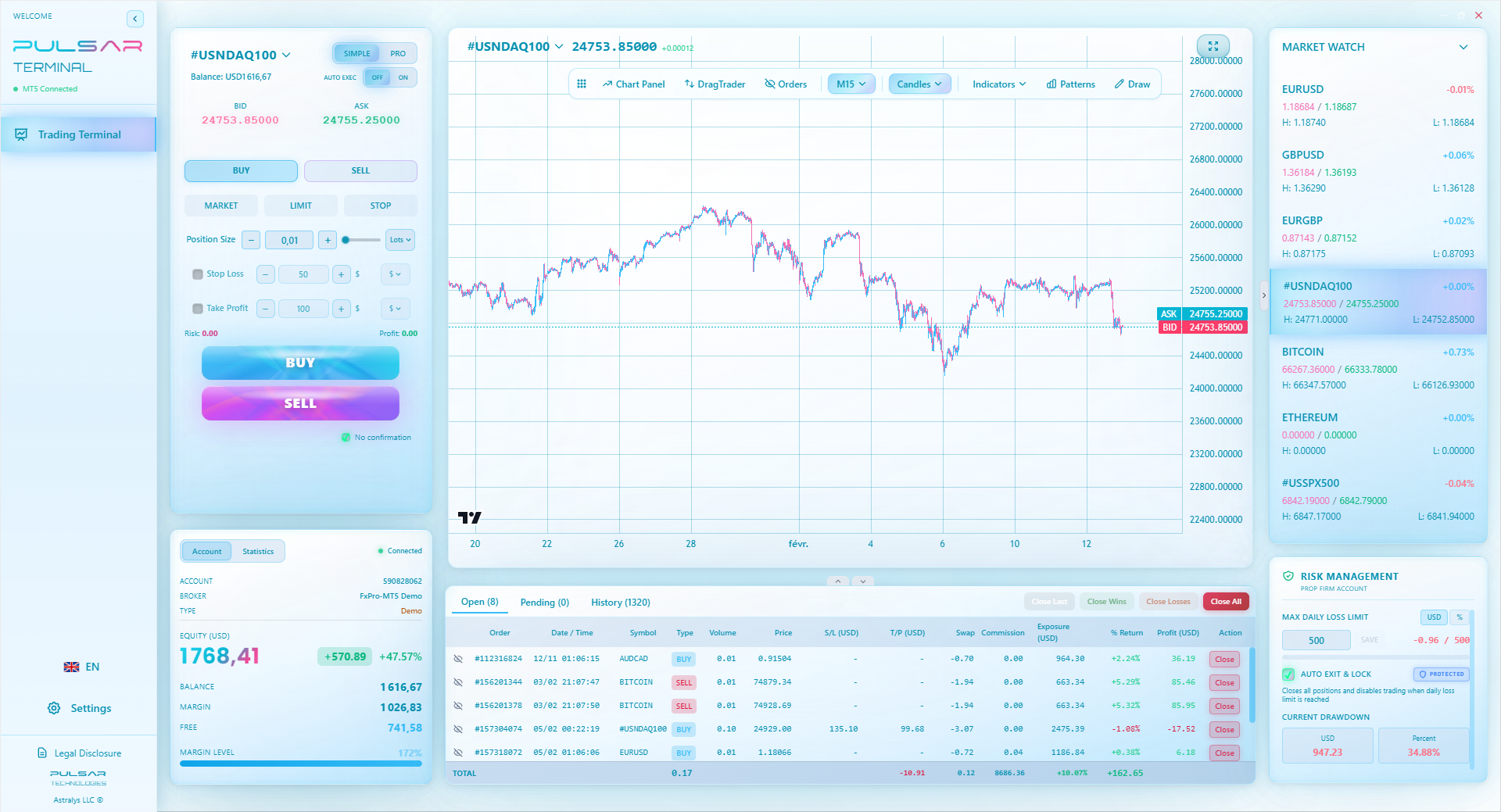
The tools you use matter. Managing these trades manually is stressful. Using a platform that can automate partial closures and trailing stops is a force multiplier. This is where a tool like Pulsar Terminal shines, letting you set multi-level take-profits and automatic breakeven stops directly on MT5, so your plan executes even if you step away.
Executing a precise challenge plan requires automated trade management, which Pulsar Terminal provides directly within your MT5 platform.
Pulsar Terminal
Alat MT5 all-in-one: order drag-and-drop, multi-TP/SL, trailing stop, grid trading, Volume Profile, dan perlindungan prop firm. Digunakan 1.000+ trader setiap hari.
“In the US, payouts are typically treated as self-employment income. The tax man always gets his share.”
You passed. You made a profit. Now comes the fun part: getting paid and dealing with the IRS.
Most firms pay via wire transfer, PayPal, or crypto. Wire transfers are safest for larger amounts. Crypto is fastest but volatile. Always take your first payout as soon as you're eligible, even if it's small. It tests the firm's payment system. My first payout with a now-defunct firm was delayed for 'verification' for three weeks. It was a red flag I ignored; they folded two months later.
Taxes are your responsibility. The prop firm will not send you a 1099. In the eyes of the IRS, this is self-employment income (or business income if you're structured as an LLC). You must report every payout. I set aside 30% of every payout immediately into a separate savings account for quarterly estimated tax payments (Form 1040-ES). If you trade futures through a firm like Topstep, the tax treatment (60/40 long-term/short-term capital gains) can be more favorable, but it's complex. Hire a CPA who understands trading. The $500 you spend will save you thousands in penalties.
Warning: Do not try to hide this income. The payment processors used by prop firms report to the IRS under certain thresholds. An audit on trading income is a nightmare you don't want.
💡 Tips Winston
Your first withdrawal isn't income. It's evidence. It proves the firm's payout system works. Take it as soon as you can.
“The peace of mind knowing my trades are on the CME and not in some offshore broker's simulation is worth a slightly lower profit split.”
Honestly? It depends. If you are a disciplined, process-oriented trader with a verified edge, prop firms offer the fastest path to trading meaningful capital. The use allows you to make real money without a six-figure bankroll. For me, it was the catalyst that forced professional discipline.
But if you're still searching for a strategy, emotionally reactive, or inconsistent, you are just donating your challenge fee. The odds are mathematically against you.
The US landscape is consolidating. The wild west days are over. Firms like Topstep and FundedNext Futures, which embrace futures or partner with regulated brokers, represent the future. They offer more security but might have stricter rules.
My advice: Start with the smallest, cheapest challenge a reputable firm offers. Consider it a paid audition. If you blow up, you've lost little and learned a lot. If you pass, you have a track record and confidence to scale up. And for goodness sake, treat the capital as if it's your own life savings - because your future payouts depend on it.
FAQ
Q1Are forex prop firms legal in the United States?
They operate in a regulatory gray area. They are not illegal, but they are not regulated like traditional brokers (e.g., by the NFA). Most structure themselves as evaluation services using simulated trading. This allows them to bypass strict retail forex rules. However, increased scrutiny from the SEC and CFTC is pushing the industry toward more compliant models, especially involving futures trading.
Q2What is the biggest mistake US traders make with prop firms?
Treating the challenge like a casino. They over-use to hit the profit target quickly, violating sane risk management. The second biggest mistake is ignoring the quality of trade execution. A firm with wide spreads and slippage will kill a good strategy. Always prioritize firms with reputable platform partners (like cTrader or DXtrade) over those just offering the biggest profit split.
Q3How are payouts from prop firms taxed?
In the US, payouts are typically treated as self-employment income (Schedule C). You are responsible for reporting all income and paying income tax plus self-employment tax (roughly 15.3%). You must make quarterly estimated tax payments. Trading through a futures-based firm may offer more favorable 60/40 tax treatment, but consult a tax professional. The firm will not provide tax documents.
Q4Can I use Expert Advisors (EAs) or trade news with US prop firms?
It depends entirely on the firm's rules. Many prohibit fully automated EAs or high-frequency trading. News trading is also commonly restricted due to the extreme volatility and potential for stop-hunting. You must read the specific terms of service. Firms like Take Profit Trader explicitly allow news trading, while most others forbid it.
Q5What happens if the prop firm goes out of business?
You lose any earned but unpaid profits, and your funded account is gone. This is a real risk, especially with smaller, newer firms. This is why choosing a firm with a long track record, broker backing, or a futures-based compliant model (like Topstep) is crucial for capital security. They are more likely to withstand regulatory and market pressures.
Q6Is the MetaTrader (MT4/MT5) delisting a problem for US prop traders?
Yes, but it's manageable. The 2024 MetaQuotes crackdown forced firms to diversify. Many now offer DXtrade, TradeLocker, or cTrader. These are often better platforms with superior execution. The key is to choose a firm that offers a stable, professional platform you can access reliably, not one clinging to a workaround for MT5.
Pelajaran Prof. Winston
Poin Penting:
- ✓Only 5-10% of traders pass the initial prop firm challenge.
- ✓Set aside 30% of every payout immediately for taxes.
- ✓Prioritize execution quality and platform stability over profit split %.
- ✓Futures-based models (Topstep) are the most compliant path for US traders.
Seberapa bermanfaat artikel ini?
Klik bintang untuk menilai
Wawasan Trading Mingguan
Analisis & strategi mingguan gratis. Tanpa spam.
Tentang Penulis
James Mitchell
Analis Trading Senior
Berbasis di New York dengan lebih dari 9 tahun pengalaman trading. Fokus pada pasangan USD utama, tantangan prop firm, dan lanskap regulasi AS.
Komentar
Peringatan Risiko
Perdagangan instrumen keuangan mengandung risiko signifikan dan mungkin tidak cocok untuk semua investor. Kinerja masa lalu tidak menjamin hasil di masa depan. Konten ini hanya untuk tujuan edukasi dan tidak boleh dianggap sebagai nasihat investasi. Selalu lakukan riset Anda sendiri sebelum trading.
Anda mungkin juga suka

Cara Trading Forex Sukses: 7 Prinsip dari Trader Profesional
Cara trading forex sukses dengan 7 prinsip trader pro: manajemen modal, disiplin, journal trading, backtest. Data nyata, bukan janji profit palsu.
Jam Trading Forex Terbaik untuk Trader Indonesia: Panduan Lengkap dengan Tabel Waktu
Panduan jam trading forex untuk trader Indonesia. Tabel 4 sesi dunia, jam emas 20:00-00:00, sesi mana yang harus dihindari. Data akurat + tips dari trader berpengalaman.
Top 5 Sàn Forex Uy Tín Nhất 2026: Review Jujur dari Trader Indonesia
Top 5 sàn forex uy tín 2026 untuk trader Indonesia. Review jujur: spread, deposit, withdraw, dukungan lokal. Exness, XM, IC Markets & lebih.
Dapatkan Pulsar Terminal
Semua kalkulator ini terintegrasi dalam Pulsar Terminal dengan data real-time dari akun MT5 Anda.
Dapatkan Pulsar Terminal