


Most reviews of the best futures prop firms are written by affiliates who've never placed a real trade.

Sarah Collins
Ahli Strategi Trading ·  Australia
☕ 13 mnt baca
Yang akan Anda pelajari:
- 1Are Prop Firms Even Legal in Australia? (The Real Answer)
- 2What Actually Makes a Good Futures Prop Firm?
- 3Top Futures Prop Firms for Aussie Traders (2026 Breakdown)
- 4The Real Costs & Profit Splits (No Sugar Coating)
- 5A Local Angle: Trading ASX Futures vs. US Futures
- 6How to Actually Pass the Evaluation (A Strategy)
- 7Red Flags & Warnings (Don't Get Scammed)
- 8Final Verdict: Is It Worth It for an Australian?
Most reviews of the best futures prop firms are written by affiliates who've never placed a real trade. They'll tell you every firm is a golden opportunity. I'm here to tell you that's rubbish. For an Australian trader, maybe one in five of these companies is worth a second look. The rest are either legally dodgy, operationally incompetent, or designed to make you fail. I've funded accounts with three different firms and blown two evaluations. I'll show you what actually works, what the real costs are, and which futures prop firms you should consider if you're trading from Sydney, Melbourne, or Perth.
This is the first question I get, and most Aussies get it wrong. The short answer is yes, but with a massive, critical caveat.
Prop firms aren't regulated by ASIC in the same way your broker is. They can't be. ASIC regulates entities that hold client money. A proper prop firm doesn't do that. You pay them an evaluation fee for a service - a skills test. They then provide you access to their capital to trade. If you pass, you're a contractor sharing profits. Your fee isn't a deposit; it's a one-time admin cost.
Where it gets murky is with firms that blur these lines. If a company starts acting like a fund manager with your 'deposit,' they're stepping into AFSL territory without a license. That's when ASIC gets interested. In fact, ASIC confirmed in 2024 they're actively monitoring the rise of these firms, especially around CFD offerings. Their surveillance is ongoing.
So, legality hinges entirely on the firm's structure. The best futures prop firms for Australians are those with a crystal-clear, service-based model. You should see the separation between your evaluation fee and the trading capital. If it feels like you're 'funding an account,' run.

Warning: Be extremely wary of any 'prop firm' that requires ongoing monthly 'management fees' from your profits or asks for more money beyond the initial evaluation. That structure can quickly veer into unlicensed financial service territory under Australian law.

💡 Tips Winston
Your first goal in an evaluation isn't to hit the profit target. It's to survive the first week without hitting the daily loss limit. Survival first, profits second.
Forget the flashy websites and fake testimonials. When you're trading futures - whether it's the ASX SPI 200 or the US-based E-mini S&P 500 - the rules of the game are different from forex. Your prop firm needs to understand that.
Realistic Trading Rules
Futures move fast. A good firm won't cripple you with rules designed for a different asset class. Look for reasonable daily loss limits (4-6% is standard) and a sensible overall drawdown (usually 8-12%). The worst firms set these thresholds so tight that normal market noise will wipe you out. I failed my first evaluation not on a bad trade, but because I hit a 3% daily loss limit on a single contract during a volatile open. The rule was absurd.
Platform & Data Fees
This is a hidden killer. Some firms give you 'free' platform access, but it's a stripped-down version. If you want real-time data, advanced charting, or a specific platform like NinjaTrader or Rithmic, you might be paying $100+ per month out of your own pocket. The best futures prop firms either include this in their package or offer very clear, upfront subsidized rates.
Scaling Plan
You don't want a $50k account forever. A serious firm has a clear, attainable path to grow your capital. Look for automatic scaling based on consistent profits, not obscure, manager-approved 'requests.'
Profit Splits & Payouts
90/10 is the industry standard for a reason. Anything less is a rip-off. Some of the best futures prop firms now offer 100% on the first chunk of profits (like the first $10k) to attract talent. Payouts should be regular (bi-weekly or monthly) and processed without drama. Delayed payments are a major red flag.

Pro Tip: Always read the 'Funded Account Agreement' before you buy an evaluation. The challenge rules are one thing; the real contract you sign after passing is where they hide the nasty stuff - like insane inactivity fees or clawback clauses.
“For an Australian trader, maybe one in five of these companies is worth a second look.”
Based on my experience and the constant chatter in trading circles from Brisbane to Adelaide, here are the firms that consistently come up. I'm not affiliated with any of them.
| Firm | Why It's Notable for Futures | Key Consideration |
|---|---|---|
| Apex Trader Funding | The OG for futures. Rules are built by traders, for futures traders. One-step evaluations, no minimum trading days. They get the volatility. | They use NinjaTrader/Rithmic. You might need to budget for data fees if you trade many markets. |
| Topstep | Very established, especially for US traders. Their 'Trading Combine' is a known quantity. Good educational resources. | Their rules can be stricter (trailing drawdown). More geared toward disciplined swing trading styles than hyper-scalping. |
| E8 Markets (was E8 Funding) | Flexible rules, decent scaling. They offer a 'No Time Limit' model which takes the pressure off. | Relatively new compared to Apex/Topstep. Some users report slower customer service during non-US hours. |
| OneUp Trader Funding | Attractive profit split (100% up to $10k, then 90%). Straightforward rules. | Evaluation fees can be on the higher side for the larger accounts. |
A Personal Experience: I funded a $50k account with Apex in late 2024. Paid a $250 evaluation fee on a discount. Passed in 7 trading days trading the MES (Micro E-mini S&P). My first payout for $1,850 profit was in my AUD bank account via Wise in 3 business days. They took their 10% cut, I got the rest. No fuss. The process worked as advertised.
Who I Avoid: I'm skeptical of any firm that primarily pushes forex/CFDs and has 'tacked on' futures. Futures trading has unique margin and volatility needs. You want a firm whose entire system is designed for it. I also avoid firms that don't explicitly state they work with Australian residents for payouts.
Remember, the best futures prop firm for your mate might be terrible for you. It depends on your scalping strategy, your preferred markets (ASX 24 vs. CME), and your tolerance for rule complexity.
Let's talk numbers, because this is where dreams get priced.
Evaluation Fees: This is your ticket to the game. For a futures account, expect to pay between AUD $80 for a tiny account to over $1,000 for a $200k+ evaluation. DNA Funded, for example, has this range. Apex runs constant sales where you can get evaluations for 80-90% off. Never pay full price. Ever. Wait for a sale, they happen monthly.
The Profit Target: To pass, you'll typically need to make 8-10% profit, but you also must avoid hitting the max drawdown (usually 10%). So your real goal is a 10% return without ever having a 10% loss from the starting balance. It's a test of consistency, not genius.
The Split: Once funded, 90% to you is standard. Some, like Prop Number One, advertise 100% splits. Read the fine print. There's almost always a cap or special condition. A 90/10 split with a reliable firm is better than a 100/0 split with a shady one.
The Hidden Costs:
- Platform Fees: As mentioned, if you need NinjaTrader Brokerage + CME data, that's ~$110 USD/month. Some firms cover part of this.
- Tax: The ATO sees your profit share as personal services income. You're a contractor. You need to report it, and you can likely claim expenses (portion of internet, software, evaluation fees). Talk to an accountant.
- Currency Conversion: Most firms pay in USD. Your bank will give you a lousy rate. Use a service like Wise to get the AUD conversion close to the spot rate.

Example: You pass a $100k evaluation. You make $5,000 profit in your first month. The firm takes 10% ($500). You receive $4,500 USD. Converted to AUD at 0.66, that's ~$6,818. Less any platform fees you pay, that's your income. It's not $5,000, but it's real money.
💡 Tips Winston
Never trust a prop firm's 'demo' platform performance. It's often on a delay. Assume the live evaluation will feel 20% faster and more slippage. Plan for it.
“A 90/10 split with a reliable firm is better than a 100/0 split with a shady one.”
As an Australian, you have a home-field advantage: the ASX 24 market. The SPI 200™ futures contract is your local index. The trading hours align with your day. So, should you trade it with a prop firm?
Maybe not. Here's the blunt truth: most international prop firms provide capital for US-based markets (CME, CBOT). Their data, their platforms, their rule sets are optimized for the E-mini S&P (ES), Nasdaq (NQ), and Micro contracts. Finding a firm that seamlessly supports active trading on the ASX 24 is harder.
The Liquidity Problem: The SPI is liquid, but not compared to the ES. The bid/ask spread can be wider, especially in the Asian session. For a prop firm managing risk across hundreds of traders, the US markets are simply deeper and more predictable.
My Approach: I use my prop account for US markets (MES and MNQ for smaller size). The liquidity is insane, the hours suit a night-owl schedule, and the rules of the firms are built for that volatility. I keep my ASX trading for my personal capital account, where I can take longer-term swings on the SPI without worrying about a prop firm's daily loss limit.
If you're dead set on trading ASX futures with prop capital, your research needs to be extra thorough. Ask the firm directly: 'Do you support live trading on ASX 24? Are there any restrictions?' Get the answer in writing.
This separation of strategies is key. Don't try to force a square peg into a round hole. Use the right tool for the job. The position size calculator you use for your personal SPI trade will have different inputs than the one you use for your prop firm's ES trade, purely because of the different contract specifications and risk limits.
Buying the evaluation is easy. Passing is where 80% fail. Here’s a boring, effective method that works.
Phase 1: The Grind (First 50% of Target) Your only goal here is not to lose. Trade tiny. If you have a $100k account, trade one Micro contract (MES). Your goal is to make 4-5% (4-5k) by scratching out 5-10 point wins consistently. No home runs. Use a hard stop loss every single time. I used a simple 10-point stop on the MES (that's $50 risk). My profit target was 5 points ($25). A measly 1:0.5 risk-reward. It's ugly, but it builds the account without volatility.
Phase 2: The Consolidation (Next 30%) Once you have a 5% buffer, you can breathe. Maybe move to two contracts. Do not change your strategy. Keep the same disciplined approach. The buffer is there to absorb a bad day, not to be risked.
Phase 3: The Finish Line (Final 20%) This is the hardest part psychologically. You're so close. This is where you become ultra-conservative. If you've made 8%, just make 2% more. Go back to one contract. Trade only your highest-probability setup. If you have a green day early in the week, consider stopping for a few days to avoid the margin call of stupidity.
The Tools: Use a platform that lets you manage this simply. You need to be able to set your stop and target and walk away. Over-analysis kills evaluations. I found the MACD indicator on a higher timeframe useful for bias, but my entries and exits were purely price-action based on the 5-minute chart.
The biggest mistake I made in my first failed attempt? I passed the profit target quickly, then gave half of it back because I didn't respect the daily loss limit. I was focused on the total, not the daily rule. Read the rules ten times. They will fail you.
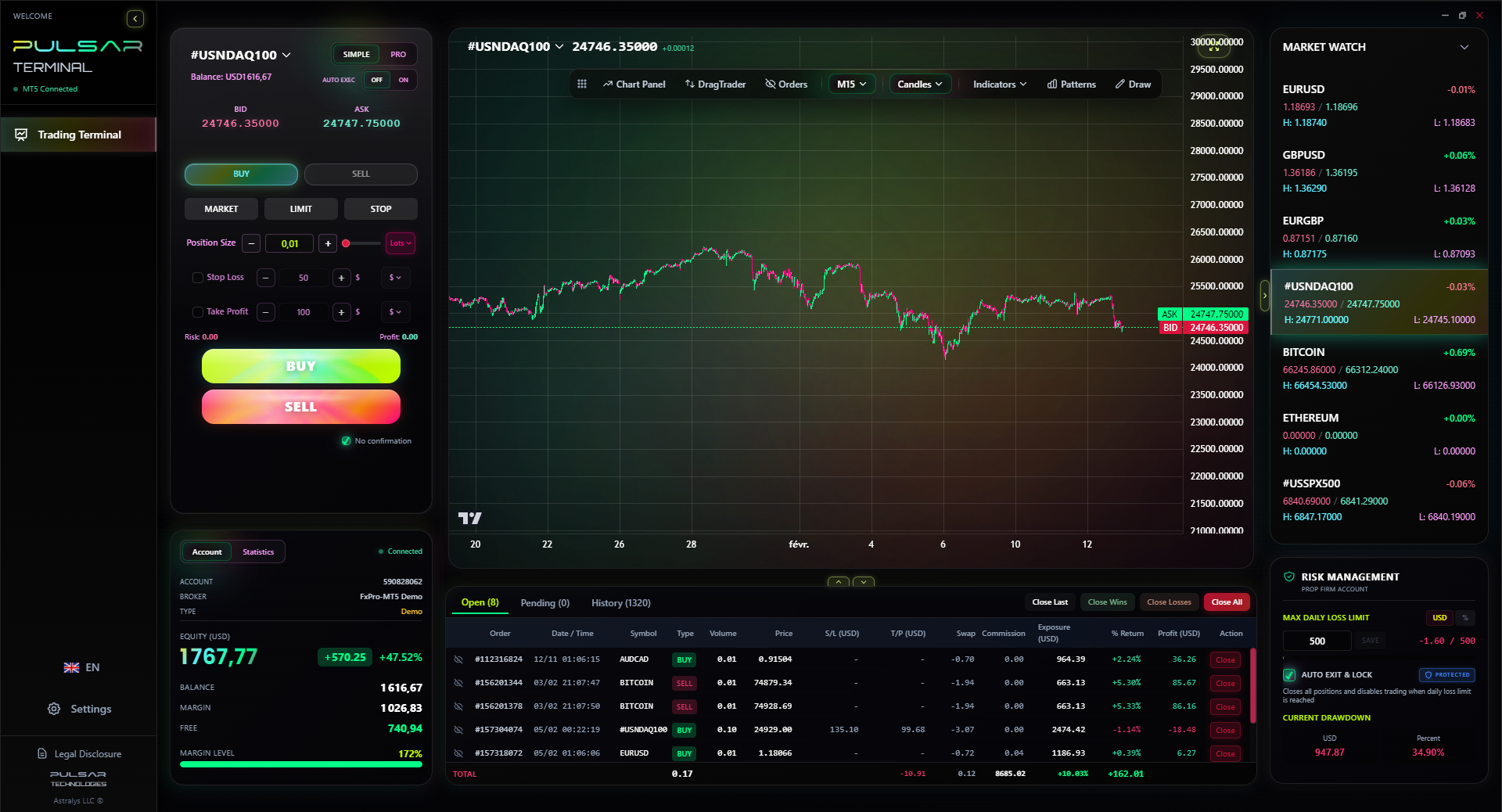
Managing the strict daily loss limits of a prop firm evaluation is stressful; Pulsar Terminal's automated trade management can set hard stop losses and partial profit targets on MT5, so you can't break your own rules in a moment of greed or fear.
Pulsar Terminal
Alat MT5 all-in-one: order drag-and-drop, multi-TP/SL, trailing stop, grid trading, Volume Profile, dan perlindungan prop firm. Digunakan 1.000+ trader setiap hari.
“Passing a $100k evaluation is easier than saving $100k, but only if you're already a profitable trader.”
The prop space has its share of cowboys. Here’s how to spot them.
- Over-the-Top Marketing: If their website looks like a casino ad, with promises of 'get rich quick' and Lamborghinis, be wary. Professional firms sell a serious business opportunity, not a lottery ticket.
- Unclear or Constantly Changing Rules: The rules should be published, clear, and stable. If you hear 'the rules are being updated' frequently, it means they're adjusting to keep people from passing.
- Poor or Slow Communication: Before you pay, test their support. Send an email with a technical question. If they take days to reply or give a canned response, imagine trying to get a payout from them.
- No Community or Track Record: The best futures prop firms have a visible community - forums, Discord servers, YouTube recaps. A firm with no public footprint is a ghost. Check reviews on independent sites (not just their own 'testimonials' page).
- Pressure to Trade: Any firm that encourages you to 'trade more' to pass is dangerous. They make money from evaluation resets. Your goal is to pass once, not buy the evaluation ten times.
A final, critical point for Australians: payment methods. A legitimate firm will offer bank wire (SWIFT) and often crypto. If they only offer sketchy e-wallets or have convoluted withdrawal processes, that's a major red flag. You should know exactly how and when you get paid before you start.
Stick with firms that have been around for a few years and have thousands of funded traders. In this business, longevity is the best indicator of legitimacy. Newer firms might have great offers, but let someone else be the guinea pig.
💡 Tips Winston
If a firm's rules document is under 5 pages, it's too vague. If it's over 30, it's designed to trap you. Look for the 10-15 page sweet spot of clear, complete detail.
So, after all that, should you bother?
It depends entirely on your skill level and bankroll. If you're a consistently profitable trader who's just capital-constrained, then yes, a prop firm is the fastest way to scale. Passing a $100k evaluation is easier than saving $100k.
If you're still learning, still blowing up your own $2,000 account, then no. A prop evaluation will be an expensive lesson. You're just donating your fee. The pressure is higher, the rules are stricter. You need to be profitable despite the constraints, not because of them.
For me, it was worth it. It provided a structured environment that forced more discipline than I had on my own. The capital allowed me to make meaningful returns without risking my family's savings. But it's not free money. It's a job. You're a contractor, and your P&L is your performance review every day.
Start small. Buy the cheapest evaluation from a reputable firm like Apex during a sale. Treat it as a paid learning experience. If you pass, you've validated your strategy under fire. If you fail, you've learned why for a few hundred dollars, not tens of thousands.
The best futures prop firms are simply a tool. A very powerful, use-providing tool. But a tool is only as good as the craftsman using it. Sharpen your skills first, then pick up the tool. Don't expect the tool to do the work for you.
FAQ
Q1Do Australian prop traders need to pay GST on their profit splits?
Generally, no. If you're operating as a sole trader (which most prop traders are), your profit share is considered personal services income. GST registration is only required if your annual business turnover (your profit splits plus any other related income) is $75,000 or more. Most traders starting out won't hit that. However, you must still declare the income in your annual tax return. Always consult with a tax accountant familiar with trading.
Q2Can I use my Australian broker account (like with Pepperstone or IC Markets) to trade for a prop firm?
Almost never. Prop firms provide you with specific trading credentials for their own broker or liquidity partner. You cannot route trades through your personal IC Markets review or Pepperstone review account. You must use the platform and data feed specified by the prop firm. Your personal broker account is for your own capital only.
Q3What's the biggest difference between a forex prop firm and a futures prop firm?
The underlying asset and the rules. Forex firms are built around currency pairs, often with rules on holding trades over weekends and dealing with spreads around news. Futures firms are built for exchange-traded contracts with set expiration dates, defined margin requirements, and often more volatility. The rules (like daily loss limits) are usually calibrated for the faster pace and larger point values of futures. A firm good for EUR/USD guide scalping might be terrible for trading the NQ futures contract.
Q4How do I handle the time zone difference trading US futures from Australia?
You adapt your schedule or your strategy. The most liquid sessions for US futures are the US open (11:30 PM - 2:00 AM AEST) and the London/US overlap (late evening AEST). Many successful Aussie traders operate on a 'night owl' schedule, trading the US session and sleeping late. Alternatively, you can trade the Asian and European session liquidity on US products, which is thinner but still present. You cannot effectively trade the US day session on a regular 9-5 Aussie schedule.
Q5If I pass an evaluation, am I legally employed by the prop firm?
No. You are an independent contractor. You will sign a contract stating this. You are not an employee, so you don't get superannuation, sick leave, or any other benefits. You are responsible for your own taxes, insurance, and equipment. The firm provides capital and a platform; you provide trading skill and assume the risk of blowing their account (which typically just means you lose the funded status, not that you owe them money).
Q6Are there any prop firms that specialise in ASX 24 futures like the SPI 200?
Very few, if any, of the major international prop firms specialise in it. Some may allow it, but it's not their focus. Your best bet is to contact the firms directly and ask. It's more likely you'll find a local Australian trading firm or hedge fund offering a proprietary trading desk role, but those are actual jobs with stricter hiring processes, not evaluation-based funding programs.
Pelajaran Prof. Winston
Poin Penting:
- ✓Legality hinges on structure: fee for service, not client funds.
- ✓90/10 profit splits are standard; less is a bad deal.
- ✓Factor in hidden platform & data fees ($100+/month).
- ✓Trade US futures for liquidity; ASX 24 support is rare.
- ✓Use a micro-grind strategy: 1 contract, small targets, survive.
Seberapa bermanfaat artikel ini?
Klik bintang untuk menilai
Wawasan Trading Mingguan
Analisis & strategi mingguan gratis. Tanpa spam.
Tentang Penulis
Sarah Collins
Ahli Strategi Trading
Ahli strategi trading berbasis London dengan 12 tahun di pasar keuangan. Mantan analis di perusahaan pialang City of London. Mencakup pasangan GBP, pasar Eropa, dan trading berregulasi FCA.
Komentar
Peringatan Risiko
Perdagangan instrumen keuangan mengandung risiko signifikan dan mungkin tidak cocok untuk semua investor. Kinerja masa lalu tidak menjamin hasil di masa depan. Konten ini hanya untuk tujuan edukasi dan tidak boleh dianggap sebagai nasihat investasi. Selalu lakukan riset Anda sendiri sebelum trading.
Anda mungkin juga suka

Cara Trading Forex Sukses: 7 Prinsip dari Trader Profesional
Cara trading forex sukses dengan 7 prinsip trader pro: manajemen modal, disiplin, journal trading, backtest. Data nyata, bukan janji profit palsu.
Jam Trading Forex Terbaik untuk Trader Indonesia: Panduan Lengkap dengan Tabel Waktu
Panduan jam trading forex untuk trader Indonesia. Tabel 4 sesi dunia, jam emas 20:00-00:00, sesi mana yang harus dihindari. Data akurat + tips dari trader berpengalaman.
Top 5 Sàn Forex Uy Tín Nhất 2026: Review Jujur dari Trader Indonesia
Top 5 sàn forex uy tín 2026 untuk trader Indonesia. Review jujur: spread, deposit, withdraw, dukungan lokal. Exness, XM, IC Markets & lebih.
Dapatkan Pulsar Terminal
Semua kalkulator ini terintegrasi dalam Pulsar Terminal dengan data real-time dari akun MT5 Anda.
Dapatkan Pulsar Terminal