


I once blew $1,200 on a 'cheap' prop firm challenge for the E-mini S&P 500.

James Mitchell
Analis Trading Senior
☕ 11 mnt baca
Yang akan Anda pelajari:

I once blew $1,200 on a 'cheap' prop firm challenge for the E-mini S&P 500. The rules looked great on paper: a $50,000 account for a $299 fee. I passed the evaluation in a week, feeling like a genius. Then I hit my first profitable week in the 'funded' account. The payout request? Denied. Their reason was a vague 'trading style violation' buried in clause 27.B of their terms. The $299 was gone, the 'funded' account was gone, and I learned a brutal lesson. The cheapest futures prop firm is often the most expensive mistake you can make.
Let's get this straight. Your goal isn't to find the cheapest futures prop firm. Your goal is to find the most cost-effective path to trading a firm's capital. There's a massive difference. A low upfront fee is just bait if the structure is designed for you to fail or if they'll never actually pay you.
I've seen firms with $99 challenges that have impossible profit targets, insane maximum daily drawdown rules, or hidden fees on every withdrawal. One popular tactic is the 'consistency rule,' where you can't have a single day of profit that exceeds 30% of your total profit target. Make one great trade early on? You've violated the rule and failed, but they keep your fee.

Warning: A firm with suspiciously low fees often makes its money from challenge re-takes, not from sharing your profits. Their incentive is for you to fail, not succeed.
The real cost includes:
- The evaluation fee (the obvious one).
- The data fees for CME, CBOT, etc. (Some firms include them, some charge $50+ monthly).
- The platform fees (if they don't cover Tradovate, NinjaTrader, or Rithmic costs).
- The profit split. An 80/90% split on a reliable firm is better than a 100% split on a scam.
- The withdrawal fees and minimums.
- The opportunity cost and emotional toll of failing a badly designed challenge.
I learned this the hard way after that $299 loss. I switched to a more reputable firm with a $500 challenge. I passed, and they've paid out over $18,000 to me in the last year. The 'cheaper' option cost me $299 for nothing. The 'expensive' one has a proven ROI.

💡 Tips Winston
The fee is the cover charge to get into the casino. The house rules determine if you ever walk out with money. Read the rulebook before you buy the ticket.

“The cheapest futures prop firm is often the most expensive mistake you can make.”
Forget the price tag for a second. These are the non-negotiables. If a firm misses on these, it doesn't matter if they pay you to take the challenge.
The Profit Split & Payout Reliability
This is king. What's the point of a cheap challenge if you only get 50% of profits or have to fight for withdrawals? Look for at least 80/20 in your favor. More importantly, research their payout reputation. Go on forums, check Trustpilot (with a grain of salt), and see if real traders are getting paid on time. A firm like Apex Trader Funding, while not always the absolute cheapest, has a long public history of payouts. That reliability is worth a higher fee.
The Evaluation Rules
This is where they get you. You must understand every rule:
- Profit Target: Is it realistic? For a $50k account, 10% ($5,000) is common. Anything much higher is a red flag.
- Maximum Daily Loss: This is usually a trailing threshold based on your starting equity or balance. Know which one! A $2,500 max daily loss on a $50k account (5%) is standard.
- Maximum Overall Loss (Drawdown): This is the big one. It's often a trailing drawdown from your starting balance or your account high. This rule alone has ended more challenges than bad trading. You must use a position size calculator religiously to stay safe.
- Other Rules: No-holdover rules for futures, consistency rules, minimum trading days. Read them all.
The Trading Platform & Data
You'll be living on this platform. Do they offer Rithmic, Tradovate, or NinjaTrader? These are the industry standards for futures. If they force you onto some proprietary, clunky platform, walk away. Also, confirm who pays for the real-time CME data feed. If it's you, add that $50-$100/month to your 'cheap' fee.
“Your goal isn't to find the cheapest futures prop firm. Your goal is to find the most *cost-effective* path to trading a firm's capital.”
Let's look at some of the biggest names. I'm using their standard E-mini S&P 500 (MES/ES) account examples. Remember, prices and rules change, so always check their site.
| Firm | Example Challenge Fee (for ~$50k) | Key Rule Snapshot | Profit Split | My Take (The Good & The Bad) |
|---|---|---|---|---|
| Apex Trader Funding | ~$300 - $500 | Trailing Drawdown from Starting Balance. One-time reset fee often offered. | Up to 100% (with scaling) | The juggernaut. Payout reputation is solid. Rules are trader-friendly (drawdown from start, not high). Their 'Eval' accounts are a popular, straightforward choice. Not always the cheapest, but reliable. |
| Topstep | ~$375 - $500 | Trailing Drawdown from Account High. Known for their 'Trading Combine'. | 80% to 90% | The original prop firm for many. Rules are stricter (drawdown from high). They have a strong educational focus. More expensive, but a proven path for many funded traders. |
| Take Profit Trader (TPT) | ~$200 - $400 | Trailing Drawdown from Starting Balance. Often has lower profit targets. | 80% to 100% | Frequently competes on price. Can be one of the cheapest futures prop firm options. Rules are generally fair. A solid budget-conscious choice, but do your own due diligence on payout speeds. |
| Leeloo Trading | ~$250 - $400 | Trailing Drawdown from Starting Balance. Often allows weekend holding. | Up to 90% | Gained popularity for flexible rules. Good for swing traders who hold positions. Another contender for lower-cost entry. |

Example: Let's say you choose a $50k account with a $3,000 profit target (6%) and a $2,500 max daily loss. If your spread definition and commission cost is $4 per RT on MES, you need to make that back before net profit. A tight scalping strategy might not work here.
The 'cheapest' on this list often shifts based on promotions. TPT and Leeloo frequently run sales. But again, price is just the entry ticket. The rules and payout reliability determine if you ever see a return.

“Your goal isn't to find the cheapest futures prop firm. Your goal is to find the most *cost-effective* path to trading a firm's capital.”
This is where they gut you. You think you've found the cheapest futures prop firm, then the nickel-and-diming starts.
Data and Platform Fees: This is the big one. Some firms' 'all-inclusive' fee is just for the challenge. Once funded, you're on the hook for your own trading platform license ($50-$100/month) and exchange data fees ($50-$150/month). A firm that covers Rithmic or provides a NinjaTrader license is often a better deal than a 'cheap' firm that doesn't.
Withdrawal Fees and Minimums: Need your money? That'll be $50 per wire transfer, please. Or you can only withdraw once a month, with a $500 minimum. These rules kill your cash flow. Look for firms with free ACH withdrawals (for US traders) and low minimums, like $50.
Reset and Extension Fees: You're 80% to your profit target and you blow your daily loss. Game over. Want to try again? A 'reset' can cost 70-90% of the original fee. Some firms offer unlimited free retries within a period (like Apex's 'One-Step' promotion), which is incredibly valuable and lowers your effective cost.
The 'Refundable' Fee Myth: Some advertise '100% refundable fee upon profit target.' Sounds great. But the fee is often double, and the profit target is higher. You're giving them an interest-free loan. I'd rather pay a lower, non-refundable fee to a trustworthy firm.
My second painful lesson was with data fees. I passed a challenge with a firm that had a $250 fee. Got funded, traded for a month, made $1,200. My first payout statement deducted $185 for 'platform and data services.' My net payout was pathetic. I hadn't read the funded account terms closely enough.
💡 Tips Winston
If you can't find a YouTube video of a grumpy trader unboxing a payout from that firm, your money is safer under your mattress.

“Chasing the lowest dollar fee is the fastest way to burn money.”
Your trading style dictates which 'cheapest' option is actually cheap for you.
Scalpers: You need low per-trade costs. The firm's commission structure is vital. A cheap challenge fee is irrelevant if they charge $7 per RT. You also need rules with a reasonable maximum daily loss that accommodates the volatility of many small trades. A firm with a tight trailing drawdown from the high (like Topstep's model) can be a nightmare for a scalper who gives back some profits intraday.
Swing Traders: You hold positions for days. You need rules that allow overnight and weekend holding. Firms like Leeloo often cater to this. Your main risk is the maximum overall drawdown. A big overnight gap can ruin you. Your position size calculator is your best friend. A cheap firm with a tiny drawdown allowance is a terrible fit.
News & Volatility Traders: You make few, high-conviction trades around events. You need a firm with a reasonable maximum daily loss that's a percentage of capital, not a fixed, tiny number. You also need to check if they have rules against trading specific news events (some do!).
For example, my main style is swing trading /ES and /NQ based on daily chart structure. I need a firm with a drawdown based on starting balance (so my running profits create a buffer), that allows weekend holds, and has no crazy consistency rules. That specific need makes one firm's $400 offer 'cheaper' for me than another's $250 offer with restrictive rules.

Pro Tip: Before buying a challenge, paper trade their exact rules for two weeks. Track every trade against their profit target, daily loss, and drawdown rules. You'll quickly see if your strategy is compatible or if you're just donating your fee.

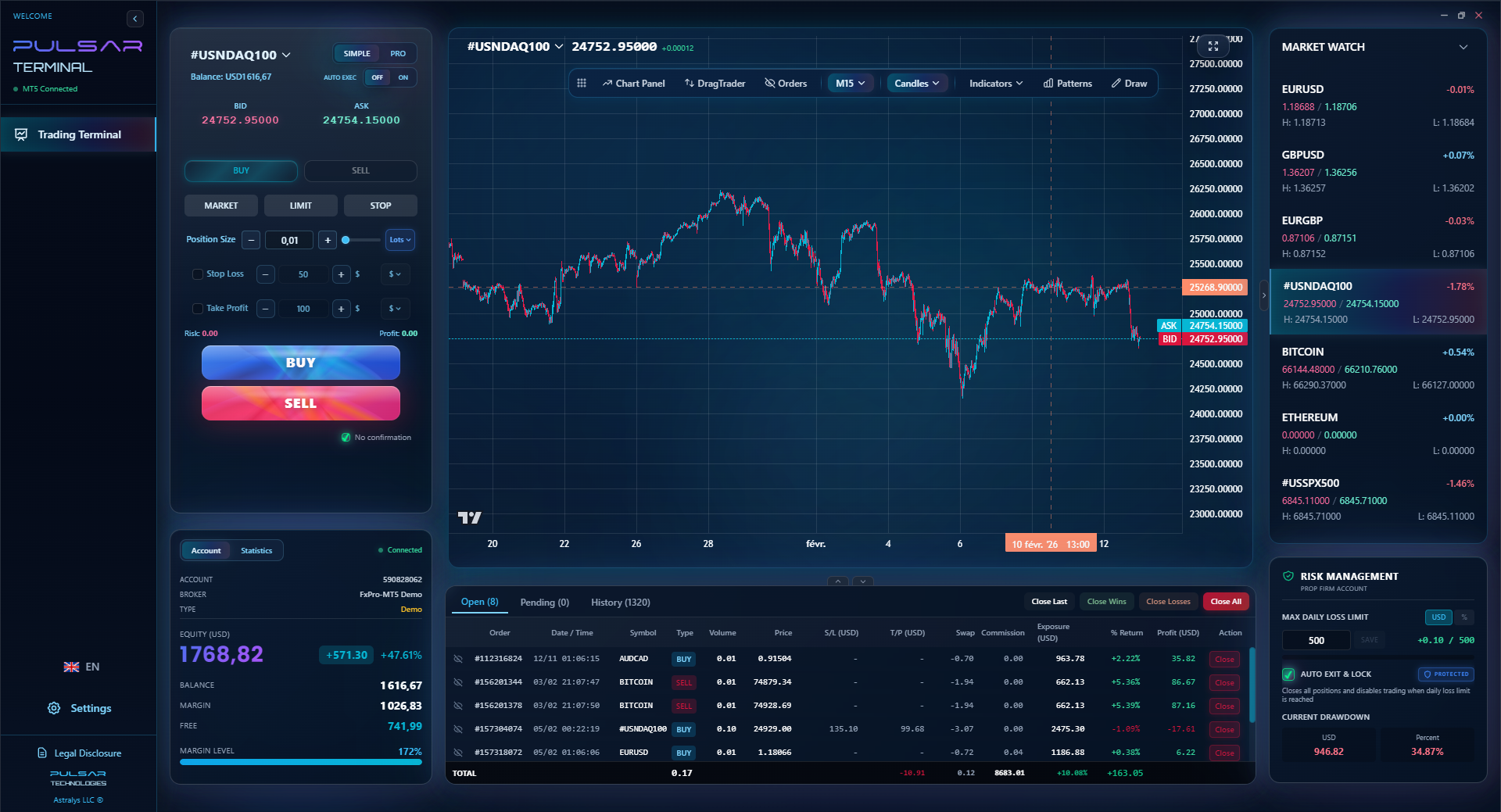
Managing a prop firm's strict daily loss and drawdown rules is stressful; Pulsar Terminal's prop firm mode automates this protection, shutting off trades before you hit their limits.
Pulsar Terminal
Alat MT5 all-in-one: order drag-and-drop, multi-TP/SL, trailing stop, grid trading, Volume Profile, dan perlindungan prop firm. Digunakan 1.000+ trader setiap hari.
“Chasing the lowest dollar fee is the fastest way to burn money.”
Trust, but verify. Here's your checklist before you enter a credit card number.
- Transparent Payout Proof: Can you find video proof or consistent forum posts from traders getting paid over many months? A firm's own testimonials are useless. Look for independent sources.
- Clear, Accessible Terms: Are the rules written in plain English on their website, or are they hidden in a PDF link in the footer? Legitimate firms are proud of their clear rules.
- Company History & Registration: How long have they been around? A firm operating since 2021 has more track record than one launched last month. Are they a registered LLC or corporation in the US or another reputable jurisdiction?
- Customer Support Response: Send them a pre-sales email with a specific question about their rules. See how long it takes to get a clear, helpful answer. Scams have terrible or non-existent support.
- Community Sentiment: Don't just read, participate. Ask in reputable trading Discord servers or subreddits (like r/FuturesTrading). 'Has anyone here been paid by X firm recently?' is a powerful question.
I almost got caught by a slick-looking new firm in 2022. Their website was beautiful, fees were 50% below market. I couldn't find a single payout video older than 2 weeks. All the 'reviews' were on affiliate blogs. I asked in a Discord, and two traders messaged me privately saying their withdrawal requests had been 'pending' for over a month. I walked away. That firm folded 4 months later.
💡 Tips Winston
Your first prop firm goal isn't a Lamborghini. It's a screenshot of a successful ACH deposit into your bank account. Celebrate that.

“In this game, reliability is the ultimate currency.”
So, what's the cheapest futures prop firm? The one you pass on the first try, and that pays you consistently.
Chasing the lowest dollar fee is the fastest way to burn money. Your search should be for the best value: fair rules you understand, a platform you can trade on, and a proven record of paying traders.
Here's my suggested path:
- Identify Your Needs: Swing or scalp? Trade /ES or grains? Need to hold over weekends? Nail this down first.
- Shortlist 2-3 Reputable Firms: From the list above, pick those known for payouts. Ignore the random Instagram-ad firms.
- Compare Total Cost of Ownership: Add up: Challenge Fee + Expected Data/Platform Fees for 3 months + any reset fees you might realistically need.
- Paper Trade Their Rules: This is non-negotiable. Do it.
- Start Small: Don't go for the $150k account first. Buy the smallest, cheapest evaluation from your chosen firm. Prove you can pass their rules and get a payout. Then scale up.
Your first goal isn't to get rich. It's to get funded and paid. Once you have a track record of receiving payouts from a firm, you've de-risked your entire journey. That confidence is worth far more than saving $100 on a challenge fee.
I made every mistake in the book early on. Now, I trade with two firms consistently. Their fees aren't the lowest, but their checks clear every month. In this game, reliability is the ultimate currency.
FAQ
Q1What is the absolute cheapest futures prop firm right now?
The 'absolute cheapest' title changes weekly due to promotions from firms like Take Profit Trader (TPT) or Leeloo. You can often find challenges for $150-$200 during sales. But I'll say it again: the cheapest fee often comes with higher hidden costs or stricter rules. A firm like Apex running a 'One-Step' promo with a $297 fee and unlimited free retries might be far cheaper in the long run if you don't pass on the first attempt.
Q2Are there any legit futures prop firms with no evaluation challenge?
Virtually all legitimate futures prop firms use an evaluation or 'combine' process. This is how they manage risk. Any firm offering instant, no-challenge funding is a massive red flag. They're either a scam, or they'll have such restrictive live trading rules and profit splits that it's meaningless. The evaluation is a filter; a necessary evil to prove you can manage risk.
Q3How much can I realistically make with a $50,000 funded futures account?
It depends entirely on your skill and risk management. A realistic, sustainable target for a skilled trader might be 5-10% per month, so $2,500 to $5,000. But that's gross profit. Remember the profit split (you might keep 80%), taxes, and data fees. Aiming for 20% a month is a great way to blow the account. Your first goal should be consistency, not huge returns. Use a position size calculator to keep risk per trade tiny (e.g., 0.5%-1% of account).
Q4What's the biggest mistake traders make when choosing a prop firm?
They only look at the evaluation fee and profit split. They ignore the funded account terms, the data fees, the withdrawal process, and the fine print on drawdown rules. They don't paper trade the rules first. They buy the biggest account size they can afford, then panic trade because the dollar-value drawdown feels too large. Start small, read every word of the terms, and practice first.
Q5Do prop firms provide trading capital, or is it simulated?
For futures, it's almost always simulated trading in a proprietary account. You're not trading on the firm's exchange seat. However, the risk is real to them because they've agreed to pay you real money based on your simulated profits. Legitimate firms have the capital to back their payouts. This model is standard and isn't a red flag in itself; the red flag is if they can't or won't actually pay out.
Q6Can I trade micro futures (MES, MNQ) in a prop firm account?
Yes, absolutely. In fact, it's the smart way to start. Most firms offer accounts sized where trading 1-2 micro contracts makes perfect sense for risk management. Trading /MES in a $25k or $50k account is a fantastic way to prove your strategy without the emotional pressure of the full-sized /ES contract. It lets you focus on the process, not the P&L.
Pelajaran Prof. Winston
Poin Penting:
- ✓The evaluation fee is less than 10% of the total cost equation.
- ✓Paper trade the firm's exact rules for 2 weeks before paying.
- ✓A 90% split on a reliable firm beats a 100% split on a ghost.
- ✓Your first funded account should be your smallest one.
Seberapa bermanfaat artikel ini?
Klik bintang untuk menilai
Wawasan Trading Mingguan
Analisis & strategi mingguan gratis. Tanpa spam.
Tentang Penulis
James Mitchell
Analis Trading Senior
Berbasis di New York dengan lebih dari 9 tahun pengalaman trading. Fokus pada pasangan USD utama, tantangan prop firm, dan lanskap regulasi AS.
Komentar
Peringatan Risiko
Perdagangan instrumen keuangan mengandung risiko signifikan dan mungkin tidak cocok untuk semua investor. Kinerja masa lalu tidak menjamin hasil di masa depan. Konten ini hanya untuk tujuan edukasi dan tidak boleh dianggap sebagai nasihat investasi. Selalu lakukan riset Anda sendiri sebelum trading.
Anda mungkin juga suka

Cara Trading Forex Sukses: 7 Prinsip dari Trader Profesional
Cara trading forex sukses dengan 7 prinsip trader pro: manajemen modal, disiplin, journal trading, backtest. Data nyata, bukan janji profit palsu.
Jam Trading Forex Terbaik untuk Trader Indonesia: Panduan Lengkap dengan Tabel Waktu
Panduan jam trading forex untuk trader Indonesia. Tabel 4 sesi dunia, jam emas 20:00-00:00, sesi mana yang harus dihindari. Data akurat + tips dari trader berpengalaman.
Top 5 Sàn Forex Uy Tín Nhất 2026: Review Jujur dari Trader Indonesia
Top 5 sàn forex uy tín 2026 untuk trader Indonesia. Review jujur: spread, deposit, withdraw, dukungan lokal. Exness, XM, IC Markets & lebih.
Dapatkan Pulsar Terminal
Semua kalkulator ini terintegrasi dalam Pulsar Terminal dengan data real-time dari akun MT5 Anda.
Dapatkan Pulsar Terminal