


Most guides on how to create a forex trading account in Nigeria are written by people who've never traded here.

Olumide Adeyemi
Pelopor Trading Afrika Barat ·  Nigeria
☕ 12 mnt baca
Yang akan Anda pelajari:
Most guides on how to create a forex trading account in Nigeria are written by people who've never traded here. They'll tell you it's simple, just pick a broker and click 'open account'. That's how you lose money before you even place a trade. The truth is, your success is decided in the 30 minutes it takes to set up your account - by the choices you make on regulation, currency, and fees. I've traded through Naira crashes, CBN crackdowns, and broker exits. This guide will walk you through the exact steps I use, including the costly mistakes I made so you don't have to.
Let's clear this up first, because the fear of doing something illegal stops many talented traders. Retail forex trading - you, trading currencies on an international platform - is not illegal in Nigeria. The Central Bank of Nigeria (CBN) hasn't banned it. Their recent firestorm of regulations, like the new BDC recapitalization rules demanding ₦2 billion for nationwide operators, is aimed at formal money changers and banks to stop Naira speculation and round-tripping.
The Nigerian Foreign Exchange (FX) Code launched in 2025 targets 'authorized dealers' (banks) and the wholesale market. It's not coming for the guy trading EUR/USD from his laptop in Lagos. However, this creates our reality: you are operating in a grey area. The CBN doesn't license or protect you if you trade with an offshore broker. Your protection comes from the broker's own international regulator. This is the single most important concept to grasp before you create a forex trading account.
What does this mean for you? You must use internationally regulated brokers. Do not, under any circumstances, use a 'local' platform promising insane Naira-based returns. They are often unregulated Ponzi schemes. Your safety net is the Financial Conduct Authority (FCA) in the UK, the Cyprus Securities and Exchange Commission (CySEC), or the Financial Sector Conduct Authority (FSCA) in South Africa. These bodies ensure client fund segregation and fair practice.

Warning: If a 'broker' contacts you via WhatsApp or Instagram with a Nigerian office address but no clear international regulation, run. I learned this the hard way in 2019, losing $500 to a slick platform that vanished when I tried to withdraw. Your broker should be a boring, well-established company, not your new best friend on social media.

💡 Tips Winston
Your first deposit is tuition, not capital. Expect to learn from losing it. The goal is to make the lessons cheap.
“Your success is decided in the 30 minutes it takes to set up your account.”
This is where most people get it wrong. They choose based on who has the flashiest ads or the highest use. use is a tool, not a benefit. Here’s my checklist, forged from 12 years of seeing brokers come and go.
1. Regulation is Everything
Your broker must be regulated by a top-tier authority. For us in Nigeria, this often means their global entity regulated by the FSCA or CySEC, while their entity serving Nigeria is licensed by the Seychelles FSA or similar. It’s okay. Check their website's footer. Look for license numbers. Brokers like Exness and XM have specific entities for African clients that are properly regulated.
2. Naira Account & Local Payments
You need a broker that accepts Naira deposits without killing you on fees. Look for brokers that offer NGN as a base currency for your trading account. This means you deposit Naira, your account balance is in Naira, and you withdraw Naira. It cuts out the hidden conversion fees. Payment methods should include direct Nigerian bank transfers, Visa/Mastercard, and maybe USDT. I use brokers that support local bank transfers; the money usually arrives in my trading account within 2 hours.
3. Realistic Spreads & Costs
Don't be hypnotized by 'zero spread' claims. They often come with high commissions. You need to calculate the total cost. For example, a broker might offer EUR/USD at 0.0 pips but charge $6 per standard lot. Another might have a 1.2 pip spread with no commission. On a $10,000 trade (0.1 lot), the first option costs you $6. The second costs you roughly $1.20. Use a position size calculator to see the real impact. For major pairs, a spread under 1.5 pips on a standard account is decent.
4. The Platform: MT4/MT5 is King
In Nigeria, MetaTrader 4 or 5 is the standard. Everyone uses it, every mentor teaches on it, and it's stable on our sometimes-shaky internet. Ensure your broker offers MT4/MT5. Some like IC Markets also offer cTrader, which is excellent, but start with the environment everyone knows.
5. Customer Support That Answers
Test their support before you deposit. Send a live chat or email asking about deposit methods for Nigeria. See how long they take and if they understand local issues. If they can't help you before you're a client, they won't help you when you have a withdrawal problem.
Here’s a quick comparison based on late-2025 conditions:
| Broker | Min. Deposit (NGN approx.) | Key Regulation for NG | Naira Account? | Avg. EUR/USD Spread |
|---|---|---|---|---|
| Exness | ~₦15,000 ($10) | Seychelles FSA | Yes | From 1.0 pip |
| OctaFX | ~₦30,000 ($25) | FSCA, CySEC | Yes | From 0.7 pips |
| HF Markets | ~₦4,000 ($5) | FSCA, Seychelles FSA | Yes | From 1.4 pips |
| FXTM | ~₦80,000 ($500) | FSC Mauritius, FCA UK | Yes | Zero spread options |
| Vantage | ~₦15,000 ($10) | FSCA, ASIC | Often | From 0.0 pips (ECN) |
“use is a tool, not a benefit. It amplifies losses faster than gains.”
Okay, let's say you've picked a broker like Pepperstone or Exness. Now, let's create that account without tripping over the fine print.
- Go to the RIGHT website. Sounds obvious, but fake broker sites exist. Type the URL directly or use a trusted link from a major review site. Don't Google 'Open Exness account' and click the first ad.
- Click 'Open Account' or 'Register'. You'll be asked for an email and a password. Use a secure, dedicated email for trading.
- Fill the application form honestly. They'll ask for your full name (as it appears on your bank account), date of birth, phone number, and country of residence (Nigeria).
- The Financial Profile. This is critical. You'll be asked about your employment, annual income, net worth, and trading experience. Do not lie to get higher use. If you're a beginner with a $500 account, your experience is 'Beginner' and your estimated net worth is 'Less than $50,000'. This determines the use they'll offer you. It's for your own protection against a margin call.
- Account Type Selection. Here you'll choose:
- Platform: Select MT4 or MT5.
- Account Type: Usually 'Standard' (commissions included in spread) or 'Raw/ECN' (tighter spread + commission). Start with a Standard account. The spread definition is easier to understand.
- Base Currency: SELECT NGN (NAIRA) IF AVAILABLE. If not, USD is your next best bet.
- use: They may offer you a slider. For a beginner, I recommend nothing higher than 1:100. Even if they offer 1:2000. Trust me.
- Verification (KYC). This is mandatory. You'll need to upload:
- A clear photo of your International Passport, Driver's License, or National ID card.
- A proof of address. This must be a utility bill (PHCN, water) or bank statement from the last 3 months, with your name and address clearly visible. Upload clear, color images. Blurry photos are the number one reason for verification delays. My first verification with a broker took 5 days because my bank statement was cropped poorly.
- Wait for Approval. This can take from a few hours to 2 business days. Once approved, you'll get an email with your login details (login number and server name).

Pro Tip: Write down your 'server' name exactly as provided. When you log into MT4 for the first time, you must select this exact server from the dropdown, or you'll log into a demo account. I've wasted 30 minutes confused by this.
“use is a tool, not a benefit. It amplifies losses faster than gains.”
This is the moment of truth. Funding should be simple, but fees can eat you alive.
Depositing: Log into your broker's client portal (not MT4 yet). Go to 'Deposit'.
- Best Method: Local Bank Transfer (NGN). If your account is in Naira, choose this. The broker will give you details for a Nigerian bank account (often with Wema, Zenith, or a payment processor). You make a transfer from your bank app. The funds, converted at a fair rate, appear in your trading account. It usually takes 1-4 hours. No extra forex conversion fees.
- Good Method: Card (Visa/Mastercard). Instant, but your bank may charge an international transaction fee (around 1-3%). Some brokers also add a fee.
- Crypto (USDT): Increasingly popular. Fast and often low-fee. You send USDT from your wallet to the broker's wallet address. Understand the process fully before using it.
My Mistake: In 2020, I funded a USD account with my Naira card. The broker charged 2%, my bank charged 2.5%, and the conversion rate was poor. I lost over 5% of my deposit before I even traded. Always fund in your account's base currency.
Withdrawing: The process is the reverse. Initiate a withdrawal to your Nigerian bank account. For verification, they might ask for a photo of your bank card or a statement. Withdrawals typically take 1-3 business days. A good broker processes them quickly with no drama.

Example: You deposit ₦100,000 into a NGN account via bank transfer. The full ₦100,000 (minus maybe a tiny processing fee) hits your trading account. You trade, grow it to ₦120,000, and withdraw. You receive roughly ₦120,000 in your bank. Simple. If you deposit $200 (₦~300,000) into a USD account using your card, you might only see $190 (₦~285,000) after fees. You start at a loss.
💡 Tips Winston
If you wouldn't walk into a dark alley in Lagos with that amount of money, don't risk it on a single trade. Risk management is self-preservation.
“Funding in Naira to a Naira account isn't just convenient, it's a strategic move to avoid hidden fees.”
You've got your login. You install MT4 or MT5. You log in. Your real-money account balance is staring at you. The urge to buy something is huge. Resist it.
- Check Your Details: Verify your use and margin requirements in the platform. Right-click on your account in the 'Terminal' window, select 'Properties'.
- Practice on This Live Account (Seriously). Place tiny, tiny trades. Your goal is not profit, but to understand the mechanics. Place a 0.01 lot trade on EUR/USD (a EUR/USD guide can help you understand the pair). Watch how the profit/loss moves. Practice setting a stop-loss and take-profit order. Close the trade. You've just paid a few cents or Naira for the most valuable lesson: how the platform works with real money on the line. The psychological shift from demo to live is real, even with 0.01 lots.
- Set Up Your Charts: Add a few key indicators. I always start with a MACD indicator and an RSI indicator. Keep it simple.
- Plan Your First Real Trade: Don't just jump in. Have a reason. Are you going to try a scalping strategy on the London open? Or are you looking for a swing trading opportunity on gold? (XAU/USD guide). Write down your plan: entry reason, stop-loss level, take-profit target. Then, and only then, consider executing it with a small position size.
Remember, the goal of your first week is not to make money. It's to not lose money stupidly. Learn the flow, the speed, the emotion.
“Funding in Naira to a Naira account isn't just convenient, it's a strategic move to avoid hidden fees.”
Let me save you some pain and lost Naira.
Pitfall 1: Chasing the Highest use. A broker offers 1:2000. You think, 'With ₦50,000, I can control ₦100 million!'. Yes, and a 0.05% move against you will wipe out your entire account. use amplifies losses faster than gains. Start with 1:50 or 1:100 max.
Pitfall 2: Ignoring the Spread. Trading exotic pairs or during off-hours when spreads widen from 2 pips to 20 pips. You buy, and you're immediately down a huge amount. Always know the typical spread for your pair.
Pitfall 3: The 'Prop Firm' Dream Before Skills. I blew $400 on prop firm challenge fees in 2021 before I was consistently profitable on my own tiny account. Prop firms are great, but they are a test of mastered skills and strict psychology, not a lottery ticket. Passing requires iron-clad risk management. If you go this route later, you need tools that enforce your rules.
Pitfall 4: No Withdrawal Test. You trade for months, build your account, and only test the withdrawal process when you need the money urgently. Withdraw a small amount (like ₦5,000) in your first month. Confirm the process works and you're comfortable with it. This builds huge confidence.
Pitfall 5: Trading Based on WhatsApp/Telegram 'Signals'. You are not trading; you are gambling on someone else's hunch with no risk management. You have no idea why they entered or when they'll exit. Build your own knowledge. It's slower, but it's the only way that lasts.
💡 Tips Winston
The market will be here tomorrow. The best trade you'll ever make is sometimes the one you don't take. Patience is a position.
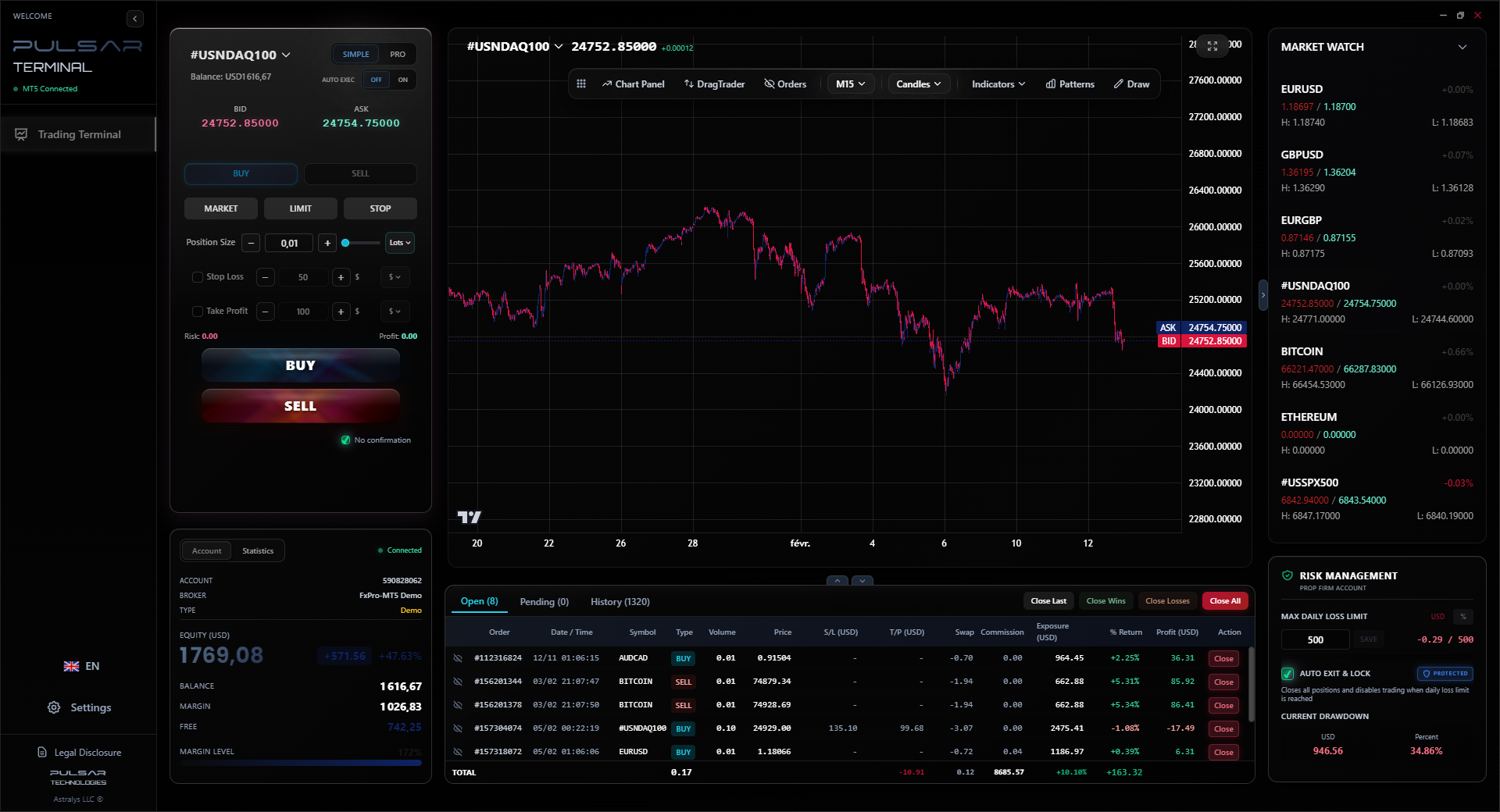
Managing the strict risk rules of a prop firm challenge is a huge psychological burden, which is why tools like Pulsar Terminal that automate daily loss limits and trailing stops directly on MT5 are a game-saver.
Pulsar Terminal
Alat MT5 all-in-one: order drag-and-drop, multi-TP/SL, trailing stop, grid trading, Volume Profile, dan perlindungan prop firm. Digunakan 1.000+ trader setiap hari.
“The goal of your first week is not to make money. It's to not lose money stupidly.”
Creating the account is just getting a shop. Now you have to run the business.
Keep Records: Use a simple spreadsheet. Date, instrument, long/short, entry price, exit price, profit/loss in Naira, and most importantly, the REASON for the trade. Review this weekly. You'll see your own stupid patterns (I used to lose every Tuesday afternoon, turns out I was trading tired after a long meeting).
Taxes: In Nigeria, as of now, there is no clear capital gains tax on individual forex trading profits, especially with offshore brokers. However, this could change. Keep clean records of all deposits and withdrawals. If large sums start moving into your Nigerian bank account, be prepared to explain the source to your bank. Consult a local accountant for the latest advice.
Continuous Learning: The market changes. The CBN rules change (remember the 2025 FX Code?). Your strategy needs to adapt. Don't get stuck in one way of thinking.
Finally, be patient. The first year is for learning, not for Lamborghinis. If you can learn to protect your capital - to not blow up your account - you're already ahead of 80% of people who create a forex trading account. The profits come later, to the disciplined. Now you're set up correctly. Go learn, practice, and trade smart.
FAQ
Q1Is forex trading illegal in Nigeria?
No, retail forex trading for individuals is not illegal. The Central Bank of Nigeria (CBN) regulates the formal banking and BDC sector. However, you are not protected by Nigerian law when using international brokers, so choosing a broker with strong foreign regulation is critical for your safety.
Q2What is the minimum amount I need to start trading forex in Nigeria?
You can start with as little as $5-$10 (approx. ₦4,000-₦15,000) with some brokers. However, I strongly recommend starting with an amount you can afford to lose completely - a minimum of ₦50,000 is more realistic to allow for proper risk management and to feel the psychological impact without panic.
Q3Can I use my Nigerian bank account to fund my forex account?
Yes, absolutely. Most reputable international brokers catering to Nigeria offer local bank transfer options in Naira. You transfer Naira to a designated Nigerian bank account, and the funds are credited to your trading account. This is the cheapest and most efficient method.
Q4Which trading platform is best for beginners in Nigeria?
MetaTrader 4 (MT4) is the undisputed standard for beginners in Nigeria. It's stable, universally used, and there's a massive amount of free educational content, indicators, and support available for it locally and online. Start with MT4.
Q5How do I avoid forex trading scams in Nigeria?
Avoid any 'broker' or 'investment manager' who contacts you first via social media or WhatsApp. Never use a platform without verifiable international regulation (check their website for FCA, CySEC, FSCA licenses). Never send money to a personal Nigerian bank account. Only deposit directly to the broker's corporate account through their official client portal.
Q6What use should I use as a beginner?
Use the lowest use your broker allows, ideally no more than 1:50 or 1:100. High use (like 1:1000 or 1:2000) is a risk amplifier, not a profit tool. A small move against you can wipe out your account. It's the fastest way beginners lose their capital.
Q7How long does it take to withdraw my profits?
With a good broker, withdrawals to your Nigerian bank account typically take 1 to 3 business days. Always do a small test withdrawal first to confirm the process is smooth before you need a large sum of money.
Pelajaran Prof. Winston
Poin Penting:
- ✓Regulation is your only safety net; verify it before depositing.
- ✓Always select NGN as your account base currency if available.
- ✓Start with use no higher than 1:100, regardless of offers.
- ✓Test the withdrawal process with a small sum in your first month.
- ✓Your first ₦100,000 is for education, not for a new car.
Seberapa bermanfaat artikel ini?
Klik bintang untuk menilai
Wawasan Trading Mingguan
Analisis & strategi mingguan gratis. Tanpa spam.
Tentang Penulis
Olumide Adeyemi
Pelopor Trading Afrika Barat
Salah satu edukator trading forex paling aktif di Nigeria. 8 tahun pengalaman trading dari Lagos. Spesialis strategi modal rendah dan tantangan prop firm untuk trader Afrika.
Komentar
Peringatan Risiko
Perdagangan instrumen keuangan mengandung risiko signifikan dan mungkin tidak cocok untuk semua investor. Kinerja masa lalu tidak menjamin hasil di masa depan. Konten ini hanya untuk tujuan edukasi dan tidak boleh dianggap sebagai nasihat investasi. Selalu lakukan riset Anda sendiri sebelum trading.
Anda mungkin juga suka

Cara Trading Forex Sukses: 7 Prinsip dari Trader Profesional
Cara trading forex sukses dengan 7 prinsip trader pro: manajemen modal, disiplin, journal trading, backtest. Data nyata, bukan janji profit palsu.
Jam Trading Forex Terbaik untuk Trader Indonesia: Panduan Lengkap dengan Tabel Waktu
Panduan jam trading forex untuk trader Indonesia. Tabel 4 sesi dunia, jam emas 20:00-00:00, sesi mana yang harus dihindari. Data akurat + tips dari trader berpengalaman.
Top 5 Sàn Forex Uy Tín Nhất 2026: Review Jujur dari Trader Indonesia
Top 5 sàn forex uy tín 2026 untuk trader Indonesia. Review jujur: spread, deposit, withdraw, dukungan lokal. Exness, XM, IC Markets & lebih.
Dapatkan Pulsar Terminal
Semua kalkulator ini terintegrasi dalam Pulsar Terminal dengan data real-time dari akun MT5 Anda.
Dapatkan Pulsar Terminal