


Here's a fact that might surprise you: when you 'trade forex' with most South African brokers, you're not actually trading currencies.

David van der Merwe
Trader Pasar Berkembang ·  South Africa
☕ 10 mnt baca
Yang akan Anda pelajari:
- 1The Core Difference: One Market vs. All Markets
- 2What You Actually Own (Spoiler: Nothing)
- 3use & Margin: The Double-Edged Sword
- 4The Real Costs: Spreads, Commissions & Overnight Fees
- 5The South African Regulatory Safety Net (FSCA)
- 6How to Choose: Should You Trade Forex or Other CFDs?
- 7Mistakes I Made (So You Don't Have To)
Here's a fact that might surprise you: when you 'trade forex' with most South African brokers, you're not actually trading currencies. You're trading a CFD on a currency pair. That subtle difference changes everything about your risk, costs, and potential. Let's clear up the confusion between CFDs and forex, because understanding what you're really buying is the first step to not getting burned.
Think of it like this: forex is a specific market. CFD is a method of trading that market (and many others).
Forex trading is purely about currency pairs. You're speculating on whether the Euro will strengthen against the US Dollar (EUR/USD), or if the Rand will weaken against the Pound (GBP/ZAR). That's it. The entire forex market revolves around these exchange rates. It's the most liquid market in the world, which means prices move smoothly and you can get in and out of trades easily.
CFD trading, which stands for Contract for Difference, is the vehicle. It's the contract you sign with your broker to speculate on a price move. The key? That contract can be written on almost anything: forex pairs, yes, but also on the JSE Top 40 index, individual shares like Naspers or Prosus, commodities like gold and Brent crude oil, even global indices like the S&P 500.
So when you log into your trading platform:
- If you're only looking at USD/ZAR and EUR/USD charts, you're in the forex mindset.
- If you're also checking the price of platinum, Tesla stock, and the DAX index, you're using CFDs.

Warning: This is where new traders trip up. They open a 'forex trading account' but don't realise it's actually a CFD account that includes forex. This matters because the rules of the game - like overnight financing charges - apply differently to CFDs than to a pure spot forex transaction (which is rarer for retail traders).
This is the philosophical heart of it. With both CFDs and the forex you trade as a retail investor, you never own the underlying asset.
I made this mistake early on. I bought a CFD on Anglo American shares during a mining rally. The price went up 8%, and I felt like a shareholder genius. Then I tried to claim a dividend. That's when I learned the hard way: I didn't own Anglo American stock. I owned a contract with my broker that mirrored its price. No dividends, no voting rights, no shareholder perks. Just the price movement.
It's the same with forex CFDs. You don't own US Dollars or Euros. You can't withdraw the currencies you 'bought'. You own a contract whose value is determined by the exchange rate. Your profit or loss is the difference between the price when you opened the contract and when you closed it. Hence, 'Contract for Difference'.
This isn't necessarily bad - it's what gives you access to these markets with relatively little capital. But you must internalise this: you are a speculator on price, not an owner of assets. Your entire thesis is directional: up or down. This changes your mindset from 'investing' to 'trading', which requires different rules, especially around position size calculator and risk management.

💡 Tips Winston
A CFD is a mirror, not an asset. Never forget you're trading a reflection of a price, which comes with extra costs like swaps. Always check the financing rate before holding.
“When you 'trade forex' with most South African brokers, you're not actually trading currencies. You're trading a CFD on a currency pair.”
This is where the rubber meets the road for South African traders, and where the difference between CFD and forex can blur, but the risks magnify. Both products are offered with use.
use lets you control a large position with a small deposit (margin). In South Africa, the FSCA has set use limits to protect traders, but they're still significant.
- For major forex pairs (like EUR/USD): Maximum use is often 1:30. That means with R1,000 margin, you can control a R30,000 position.
- For other CFDs (like indices or commodities): use is lower, typically around 1:10 or 1:20.
- For single-stock CFDs: use is lowest, often 1:5.
Here's a real example from my journal. I used 1:30 use on a USD/ZAR trade. I put down R2,000 margin to control a R60,000 position. The pair moved 50 cents (about 2.7%). Because my position was so large, that 2.7% move on R60,000 was a R1,620 profit on my R2,000 margin - an 81% return in a day. It felt incredible.
The flip side happened with a JSE Top 40 CFD. The index dropped 3% overnight. On a leveraged position, that triggered a margin call and I was closed out for a loss that was a large chunk of my account. use amplifies losses just as fast as it does gains.

Pro Tip: Don't use the maximum use your broker offers. It's a trap for new traders. Start with 1:5 or 1:10, even on forex. It forces you to be more selective with your trades and gives the market room to breathe without wiping you out.
Forget the 'zero commission' ads. Trading costs money, and the structure differs. Understanding this difference between CFD and forex costing is crucial for your bottom line.
The Spread
This is the main cost for most traders. It's the difference between the buy and sell price. Major forex pairs have the tightest spreads. For example, EUR/USD can be as low as 0.1 pips on a raw spread account. Exotic pairs like USD/ZAR will be wider, often 80-150 pips.
With CFDs on shares or indices, the spread is usually wider relative to the asset's price. A Naspers CFD might have a 10-cent spread.
Overnight Financing (Swap Rates)
This is the big one. If you hold a CFD position overnight, you pay or receive a financing charge. It's based on the interest rate differential between the two currencies (for forex) or the cost of borrowing the underlying asset (for shares/indices).
I learned this trading GBP/ZAR. I was long (buying GBP, selling ZAR). The UK interest rate was lower than SA's, so I had to pay a daily fee to hold that position. Over a week, those fees ate into a winning trade. You can check these swap rates in your platform's specification sheet. For long-term swing trading, they matter a lot.
Commissions
Some brokers, like IC Markets or Pepperstone, offer 'raw spread' accounts. They give you a tiny spread but charge a commission per lot traded (e.g., $3.50 per 100,000 units). This is often cheaper for high-volume traders.
| Cost Type | Typical Forex CFD (EUR/USD) | Typical Share CFD (Prosus) |
|---|---|---|
| Spread | 0.1 - 1.0 pip | 10 - 50 cents (ZAR) |
| Overnight Fee | Based on interest rates (can be +/-) | Usually a financing charge (often negative) |
| Commission | Sometimes $3-$7 per lot | Often built into spread |
Your strategy dictates which cost structure hurts less. A scalping strategy needs tiny spreads. A long-term position trader needs low overnight fees.
💡 Tips Winston
Your first tool should be a position size calculator, not an indicator. Risking 1% of your capital per trade works for forex and CFDs alike. It's the great equaliser.
“use amplifies losses just as fast as it does gains. It's a trap for new traders.”
This isn't just boring legal stuff. Knowing who's watching your broker is the difference between sleeping at night and worrying about your capital vanishing. In South Africa, the watchdog is the Financial Sector Conduct Authority (FSCA).
The critical point? There is no regulatory difference between CFD and forex trading here. The FSCA regulates the provider - the broker offering these derivative products. A reputable broker like Exness (which has a local FSCA license) must follow the same rules whether you're trading forex CFDs or gold CFDs.
Those rules include:
- Client Money Segregation: Your funds must be held in a separate bank account from the broker's operating money. If the broker goes under, your money should be safe (though this isn't an absolute guarantee).
- use Limits: As mentioned, the FSCA mandates maximum use levels to prevent you from blowing up your account in seconds.
- Transparent Pricing: They must clearly show costs like spreads and swaps.
- ODP License: Brokers need an Over-the-Counter Derivative Provider license. This forces them to have enough capital and report all trades, adding a layer of oversight.
My rule? Only use FSCA-licensed brokers for your main trading account. It makes deposits and withdrawals in Rand easier, and you have a local authority to complain to if something goes wrong. I've seen too many stories of traders using unregulated offshore brokers who suddenly 'restrict withdrawals' during a volatile market event.
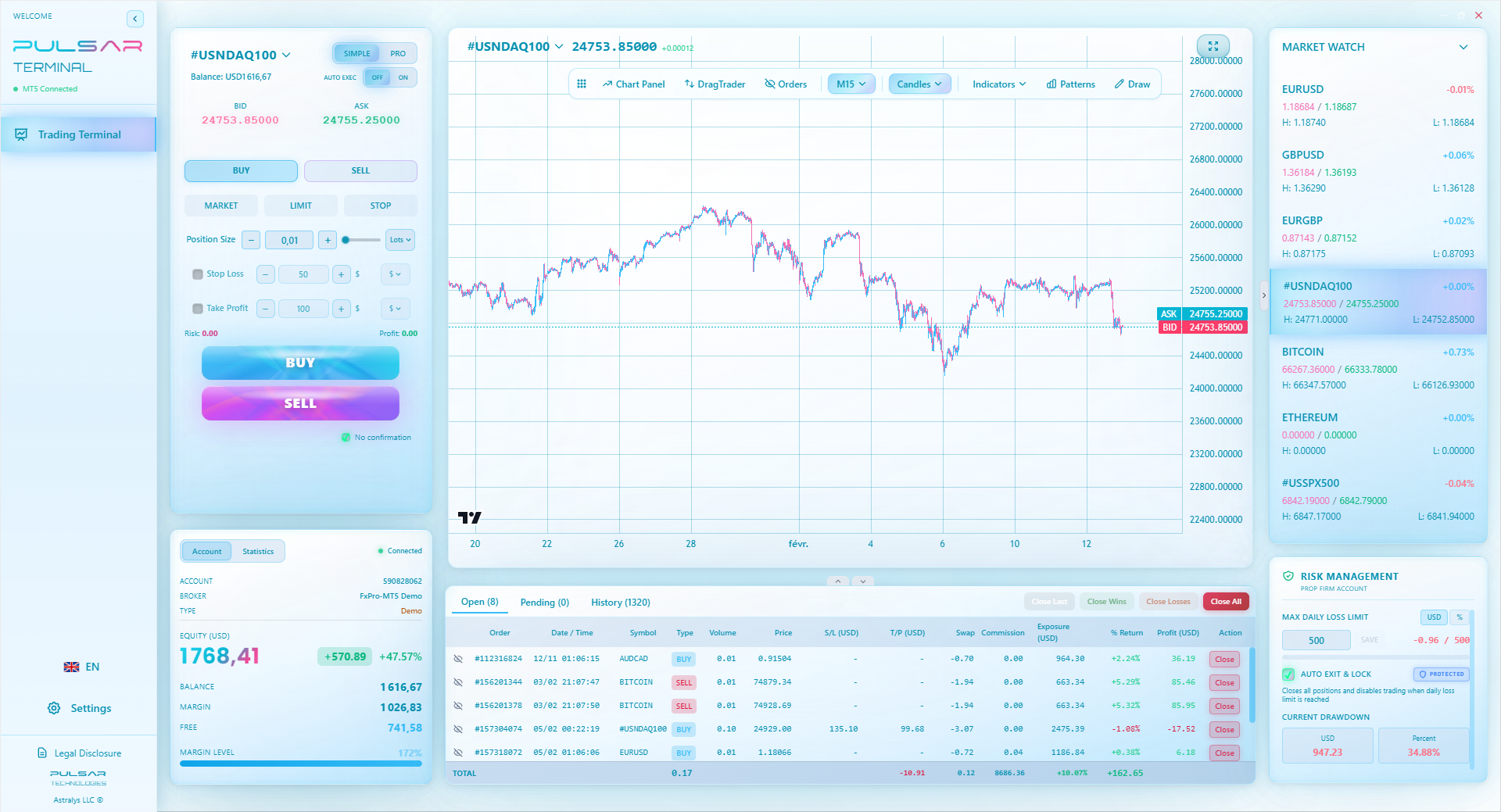
Managing the different risks of forex and CFD trades requires precise order tools, which is where a platform like Pulsar Terminal for MT5 excels with its drag-and-drop orders and multi-take-profit functions.
Pulsar Terminal
Alat MT5 all-in-one: order drag-and-drop, multi-TP/SL, trailing stop, grid trading, Volume Profile, dan perlindungan prop firm. Digunakan 1.000+ trader setiap hari.
So, with all this info, what should you trade? It's not about one being better. It's about which one fits your personality, schedule, and knowledge.
Choose Forex CFDs if:
- You're fascinated by global economics, interest rates, and geopolitics.
- You want to trade outside JSE hours (the forex market is 24/5).
- You prefer extreme liquidity and tight spreads.
- You can handle the volatility that news events like US Fed announcements bring. A good EUR/USD guide can show you how these pairs move.
Choose other CFDs (Indices, Shares) if:
- You already follow the JSE or specific companies. Your existing knowledge is a huge edge.
- You prefer trading during set market hours (JSE is 9-5).
- You want to trade the direction of the South African economy via the Top 40, or specific sectors like banking or mining.
- You're interested in commodities. South Africa is a mining giant, and trading a XAU/USD guide (gold) CFD can make sense with our market context.
I started with forex because the 24-hour market fit my night-owl schedule. But I found more consistent success with index CFDs (like the US Tech 100) because I could apply chart patterns I understood better. There's no shame in specializing.

Example: Let's say you have R10,000 capital. Trading USD/ZAR with high use might see 200-pip swings daily (over R2,000 risk). Trading a Top 40 CFD with lower use might see 500-point swings (around R1,000 risk). The volatility feels different and requires different stop-loss placements.
💡 Tips Winston
Specialise. The trader who knows everything about the ZAR's reaction to SARB meetings will outperform the dabbler in ten different CFD markets. Depth beats breadth.
“Profit comes from your strategy and risk management, not the product type. Trade the market you understand best.”
Let's get vulnerable. Here's where I lost money confusing CFDs and forex, or just misunderstanding the instrument.
- Trading Exotics Like a Major: I treated USD/ZAR like EUR/USD. The spread was 100 times wider, and sudden liquidity drops during SA public holidays caused insane slippage. My stop-loss didn't stand a chance. Exotic forex pairs are a different beast.
- Ignoring Dividend Adjustments: I was short (betting against) a share CFD just before it went ex-dividend. The dividend was deducted from my account because the holder of the actual share received it. I wasn't prepared for that overnight adjustment. It turned a winning trade into a loser.
- Overleveraging on Commodities: Gold (XAU/USD) is volatile. I used the same position size as I did for EUR/USD. A 1% move in gold is far more in dollar terms than a 1% move in EUR/USD. I was overexposed and got stopped out on normal noise. I now use a position size calculator for every trade, no exceptions.
- Chasing 'News' on Wrong Instruments: I'd hear mining news and immediately buy a mining index CFD. But the index is weighted. The news might affect a small component stock, not the giants like BHP that move the index. I was trading a narrative that didn't match the instrument.
The lesson? Before you place a trade, ask: "What specific factor moves this specific instrument?" Is it the US 10-year yield? Is it Anglo's latest production report? Is it rand liquidity? Trade the instrument you know, not the one that just moved.
FAQ
Q1Is forex trading the same as CFD trading in South Africa?
For all practical purposes as a retail trader, yes. When you trade forex with a South African broker, you are almost always trading a CFD on that forex pair. You're not buying physical currency. The platform and account are usually a 'CFD account' that includes forex, shares, and indices.
Q2Which is more profitable, forex or CFDs?
Neither is inherently more profitable. Profit comes from your strategy and risk management, not the product type. Forex pairs might offer more frequent trading opportunities (liquidity), while single-stock CFDs might offer larger trending moves. The key is to trade the market you understand best. A profitable gold trader will lose money in forex if they don't know the drivers.
Q3Do I pay tax on CFD and forex profits in South Africa?
Yes. SARS views profits from both as taxable income. If you trade frequently, it will likely be considered revenue income and taxed at your marginal rate. If your activity is more infrequent and long-term, you might argue for capital gains tax. Keep detailed records of all trades. This is non-negotiable.
Q4Can I trade the JSE with CFDs?
Absolutely. This is one of the biggest advantages for South Africans. You can trade CFDs on major JSE-listed shares (like FirstRand, MTN) and on the FTSE/JSE Top 40 Index itself. This lets you speculate on the direction of the South African market without buying the actual shares.
Q5Why does my broker charge me for holding a trade overnight?
That's the overnight financing charge (swap). For forex CFDs, it's based on the interest rate difference between the two currencies. For share CFDs, it's a fee for the broker 'lending' you the value of the shares. These charges can add up, so factor them into any trade you plan to hold for more than a day.
Q6Are CFDs on shares riskier than forex CFDs?
They have different risks. Share CFDs can gap up or down dramatically on earnings news or corporate events. Forex pairs are less prone to gaps (except over weekends) but can trend very strongly on macroeconomic news. Risk is controlled by your position size and stop-loss, not just the instrument.
Pelajaran Prof. Winston
Poin Penting:
- ✓Forex is a market; CFD is the contract you use to trade it.
- ✓You own price exposure, not the asset. No dividends, no delivery.
- ✓FSCA regulation covers all derivative providers, a must for safety.
- ✓Costs are spreads, swaps, and commissions. Swaps hurt swing traders.
- ✓Use a position size calculator before every single trade.
Seberapa bermanfaat artikel ini?
Klik bintang untuk menilai
Wawasan Trading Mingguan
Analisis & strategi mingguan gratis. Tanpa spam.
Tentang Penulis
David van der Merwe
Trader Pasar Berkembang
Trader berbasis Johannesburg dengan 11 tahun di mata uang pasar berkembang. Spesialis pasangan ZAR, trading berregulasi FSCA, dan analisis pasar Afrika Selatan.
Komentar
Peringatan Risiko
Perdagangan instrumen keuangan mengandung risiko signifikan dan mungkin tidak cocok untuk semua investor. Kinerja masa lalu tidak menjamin hasil di masa depan. Konten ini hanya untuk tujuan edukasi dan tidak boleh dianggap sebagai nasihat investasi. Selalu lakukan riset Anda sendiri sebelum trading.
Anda mungkin juga suka

Cara Trading Forex Sukses: 7 Prinsip dari Trader Profesional
Cara trading forex sukses dengan 7 prinsip trader pro: manajemen modal, disiplin, journal trading, backtest. Data nyata, bukan janji profit palsu.
Jam Trading Forex Terbaik untuk Trader Indonesia: Panduan Lengkap dengan Tabel Waktu
Panduan jam trading forex untuk trader Indonesia. Tabel 4 sesi dunia, jam emas 20:00-00:00, sesi mana yang harus dihindari. Data akurat + tips dari trader berpengalaman.
Top 5 Sàn Forex Uy Tín Nhất 2026: Review Jujur dari Trader Indonesia
Top 5 sàn forex uy tín 2026 untuk trader Indonesia. Review jujur: spread, deposit, withdraw, dukungan lokal. Exness, XM, IC Markets & lebih.
Dapatkan Pulsar Terminal
Semua kalkulator ini terintegrasi dalam Pulsar Terminal dengan data real-time dari akun MT5 Anda.
Dapatkan Pulsar Terminal