


I once tried to execute a simple USD/ZAR trade through my FNB app, thinking the convenience was worth it.

David van der Merwe
Trader Pasar Berkembang ·  South Africa
☕ 11 mnt baca
Yang akan Anda pelajari:
- 1What FNB Forex Actually Is (And Isn't)
- 2The Real Costs: A Brutal Fee Breakdown
- 3Contacting FNB Forex Customer Care: What to Expect
- 4FNB vs. Real Forex Brokers: A Trader's Comparison
- 5The Foreign Currency Account (FCA): The One Useful Tool
- 6Common Problems & How to Solve Them
- 7Final Verdict for South African Traders
I once tried to execute a simple USD/ZAR trade through my FNB app, thinking the convenience was worth it. I needed to convert R50,000 for a planned equipment purchase from the US. The rate shown seemed okay, but the final amount I received was nearly R2,000 less than the mid-market rate suggested. That's a 4% haircut before the trade even started. That experience, and dozens of conversations with traders who've made similar mistakes, is why you need to understand what FNB forex customer care really offers - and what it costs you.
Let's clear this up first. When you hear 'FNB forex,' you're not talking about a retail trading platform like MetaTrader. You're talking about a banking service for international payments and currency conversion. It's built for sending money overseas, paying for imports, or holding foreign currency, not for scalping strategy the EUR/USD.
FNB operates as an 'authorised dealer' under the South African Reserve Bank (SARB). This means they can legally sell you foreign currency within strict exchange control limits. Their 'forex trading' function in the app is a self-service window to buy or sell major currencies at their quoted rate. It's a utility, not a trading terminal.
The critical difference? Pricing transparency. A real forex broker makes money from the spread definition and maybe a small commission. You can see the bid/ask prices change in real time. With a bank like FNB, the cost is baked into the rate they offer you. That rate includes their margin, which is how they make their profit. You don't see the spread; you just get a single 'take it or leave it' price. For the casual user needing dollars for a holiday, it's fine. For a trader, it's like trying to race a Formula 1 car with the handbrake on.

Warning: Don't confuse FNB's currency conversion service with active forex trading. The spreads are wide, the execution is slow, and you have zero charting tools. It's designed for transfers, not speculation.
This is where most people get shocked. The advertised fees are just the tip of the iceberg. Let's use real numbers from their 2023/2024 fee structure.
The Official Commission Structure
If you're sending money internationally online, FNB charges a commission on top of their exchange rate margin.
- For amounts under R10,000: A fixed fee between R100 and R200.
- For amounts over R10,000: A commission of 0.55%, with a minimum of R275 and a cap of R550.
That seems manageable, right? Wrong. That's just the ticket price.
The Hidden Killer: The Exchange Rate Margin
This is the main profit center. FNB adds a margin to the interbank exchange rate. This isn't a fee you see itemized; it's just a worse rate. Their margin typically ranges from 2% to 4.5%. Let's do the math on a R100,000 transfer to USD.
Mid-market rate: 1 USD = 18.50 ZAR FNB's rate with a 3% margin: 1 USD = 19.055 ZAR (18.50 * 1.03)
At mid-market: R100,000 / 18.50 = $5,405.41 At FNB's rate: R100,000 / 19.055 = $5,247.96
Difference: $157.45 less. That's a R2,913 loss just on the rate. Now add the 0.55% commission (R550). Your total cost on a R100k transfer is roughly R3,463, or 3.46%. For smaller amounts, the fixed fee makes the percentage cost even higher. I've seen total costs creep toward 5% for sub-R50,000 transactions. Compared to specialized international money transfer services or the raw spreads from a broker like IC Markets review, this is expensive.

Example: Converting R20,000 to USD.
- Mid-rate (18.50): $1,081.08
- FNB Rate (+3%): $1,049.59
- Loss: $31.49 (R583)
- Plus Fixed Fee: R100
- Total Cost: R683 (3.4%)
Receiving money has similar fees. If someone sends you $10,000, FNB will take their cut on the conversion back to Rand, plus a receiving commission. It's a two-way toll road.
“FNB's forex service is a bridge between your South African banking life and the global financial system. It's a toll bridge.”
Need help? Your first port of call is the dedicated forex line or your relationship banker. In my experience, the service is competent for administrative issues but useless for trading.
When they can actually help:
- Clarifying your annual allowances (that R1 million discretionary, R10 million investment).
- Submitting documents for a Foreign Investment Allowance (that FIA-001 tax certificate).
- Explaining why a payment is delayed (usually a SWIFT or compliance hold).
- Helping you open a Foreign Currency Account (FCA).
When they can't help (and will tell you so):
- "Why is my rate so bad?" They'll quote policy.
- "Can I set a limit order to buy USD if ZAR hits 18.00?" No.
- "What's the spread on EUR/GBP?" They don't quote live trading spreads.
- "My trade idea based on the MACD indicator..." Blank stare.
The process is bureaucratic because it has to be. They're enforcing SARB rules. A simple query about a payment can require you to provide invoices, proof of travel, or investment documentation. It's the opposite of the 24/7, click-to-trade speed you get with an FSCA-regulated broker. If your need is urgent, forget it. These things move at banking speed, not market speed.
My advice? Have all your documents scanned and ready before you call. Know your FNB account number, the transaction reference, and the exact amounts. The more prepared you are, the smoother it goes. For anything related to live market prices or trading strategy, you're calling the wrong number. You need a broker's support desk, not a bank's forex admin team.

💡 Tips Winston
A bank's forex desk is for compliance, not alpha. Their job is to follow SARB rules, not help you beat the market. Adjust your expectations accordingly.
This is the heart of the matter. Choosing between FNB and a broker isn't about which is better; it's about what you're trying to do. They are different tools for different jobs.
| Feature | FNB Forex Services | FSCA-Regulated Forex Broker (e.g., Pepperstone review) |
|---|---|---|
| Primary Purpose | International payments, holding forex | Speculative trading, investment |
| Regulator | SARB (Exchange Controls) | FSCA (Financial Sector Conduct Authority) |
| Cost Structure | Hidden margin (2-4.5%) + commission | Transparent spread (e.g., 0.1 pips definition on EUR/USD) + possible commission |
| Platform | FNB App, Online Banking | MT4, MT5, cTrader, proprietary platforms |
| Execution | Deal-based, slow | Market execution, instant |
| use | None (you buy the physical currency) | Up to 1:30 for retail clients under FSCA rules |
| Charting & Tools | None | Advanced charts, dozens of indicators, drawing tools |
| Customer Support | Forex admin & compliance | Trading, platform, and technical support |
The Bottom Line: Use FNB to send money. Use a broker to trade money.
I made the mistake of using my bank for a 'trade' once because I was already logged in. The slippage from the time I clicked to the time I got my confirmation was hours, during which the market moved. I was filled at a worse rate than expected. On a broker's platform, that's a 200-millisecond process. If you're looking at the XAU/USD guide and planning an entry, FNB's app is literally incapable of helping you. You need a real platform.

Pro Tip: Keep them separate. Use your FNB Foreign Currency Account to receive overseas earnings or hold funds for known future expenses. Use your broker account for all active trading. This simplifies your accounting and ensures you're using the right tool for each job.
“The 'risk' with FNB forex isn't safety of funds, but cost-efficiency. You are safe from the bank collapsing, but you are not getting a competitively priced service.”
If there's a gem in FNB's forex offering, it's the Foreign Currency Account. It's a proper bank account held in USD, EUR, or GBP. And honestly, it's quite good for its specific purpose.
The Good:
- No monthly fees. Seriously. No account charges.
- Free transfers between your FNB Rand account and your FCA. This is key. You can convert your Rands to USD inside FNB (paying their margin, of course) and park it in the FCA.
- It's a real bank account with its own number. You can receive salary, client payments, or dividends from abroad directly into it.
Why a trader might use it: Let's say you're a successful swing trading and you withdraw profits from your international broker. Those profits land in your USD-denominated FCA. Now you have options:
- Leave it in USD if you think the Rand will weaken.
- Convert it to ZAR in chunks when the rate is favorable, avoiding a single large conversion at a bad time.
- Use it to pay for international expenses (software subscriptions, broker deposits, courses) without doing a new conversion each time.
I use mine as a 'forex buffer.' It helps me manage currency risk separately from my trading risk. Opening one requires the standard FICA docs plus proof of the source of foreign funds. It's not for trading, but for smart currency management, it's a valuable tool.
Remember, the FCA doesn't earn meaningful interest. It's a parking garage for foreign cash, not an investment vehicle. But for its purpose, the cost (free) is right.
💡 Tips Winston
That 3% margin on a R500,000 transfer is R15,000 gone. Ask yourself: what trading edge could that R15k have funded in a proper broker account?
After years of listening to traders, here are the classic FNB forex headaches and how to fix them.
Problem 1: "My international payment is stuck!" Likely Cause: Incomplete BoP (Balance of Payments) reporting info or a compliance flag. Every payment out needs a signed BoP form categorizing the payment (goods, services, travel). Solution: Call forex customer care immediately. Have your payment reference, the exact amount, and the beneficiary details ready. They'll tell you what document they need - often an invoice or proof of travel. Resubmit it clearly. Don't just wait.
Problem 2: "The rate on my app is terrible compared to Google!" Cause: Google shows the mid-market rate. FNB shows you the rate including their margin. That 2-4.5% difference is the cost. Solution: Understand this is the price of convenience. To check how bad it is, calculate the 'effective spread': (FNB Rate - Google Rate) / Google Rate. If it's over 3% for a major currency, it might be worth shopping around with dedicated currency transfer firms.
Problem 3: "I've hit my allowance limit." Cause: You've used your R1 million discretionary allowance for the year. Solution: For further foreign investment, you must use the Foreign Investment Allowance (up to R10 million). This requires a Tax Certificate for Foreign Investment Allowance (FIA-001) from SARS. Your relationship manager can guide you, but you need to be tax compliant. Start this process before you need the money; it's not instant.
Problem 4: "I need to trade, not just transfer!" Cause: You're using the wrong tool. Solution: Open an account with an FSCA-regulated broker. Fund it with a smaller amount to start. Use their platform for analysis and execution. Keep FNB for what it's good for: banking and large, planned currency conversions. This separation of concerns will save you money and frustration. A good position size calculator is worth more than any bank's forex desk when you're in a live trade.
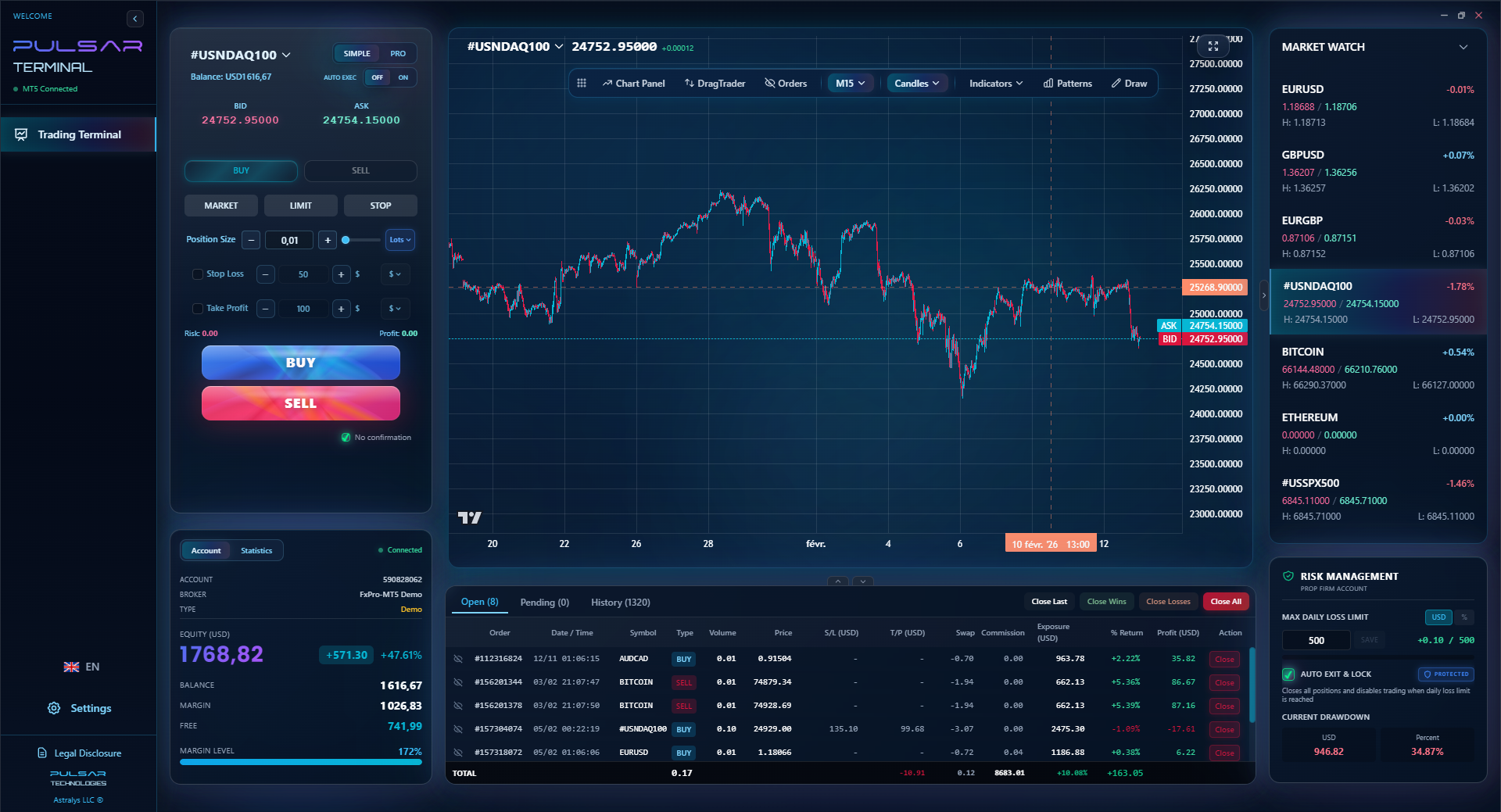
Managing separate bank and broker accounts is complex, but tools like Pulsar Terminal help you track performance and execute trades efficiently on MT5, so you only use your bank for what it's good for.
Pulsar Terminal
Alat MT5 all-in-one: order drag-and-drop, multi-TP/SL, trailing stop, grid trading, Volume Profile, dan perlindungan prop firm. Digunakan 1.000+ trader setiap hari.
“Thinking of FNB as your 'forex broker' is a fundamental error that will drain your capital through fees and poor execution.”
So, is FNB forex customer care any good? It depends entirely on your expectations.
For the everyday person needing to pay for an overseas holiday, a study fee, or an import bill, it's adequate. The fees are high but bundled into a simple process within an app they already use. The customer care will handle the paperwork.
For the active trader or serious investor, it's a costly convenience trap. The spreads are prohibitive for frequent trading. The platform offers no analytical edge. Thinking of FNB as your 'forex broker' is a fundamental error that will drain your capital through fees and poor execution.
My rule is strict: I use my FNB FCA to hold and manage foreign currency from withdrawals or overseas income. I use it to make scheduled, large transfers where the exact date is known. For everything else - every analysis, every speculative entry, every stop-loss hunt on the EUR/USD guide - I am on my professional trading platform with a reputable broker.
FNB's forex service is a bridge between your South African banking life and the global financial system. It's a toll bridge. A trader's job is to cross necessary bridges as cheaply as possible, and then get off them to run free on the open road of the markets. Don't set up camp on the toll bridge. Use it, pay the fee, and move on to where the real opportunity is.
FAQ
Q1What is the phone number for FNB forex customer care?
FNB doesn't publish a single universal forex number. Your best bet is to call the main FNB contact centre (087 575 9404) and ask to be directed to the forex or international banking department. Alternatively, if you have a private banker or relationship manager, contact them directly. They can usually escalate or connect you faster.
Q2How long does an international transfer with FNB take?
Typically 2 to 5 working days, but it can be longer. The delay isn't usually FNB's processing; it's the SWIFT network and compliance checks on both ends. If your BoP documentation is incomplete or the beneficiary bank has questions, it can stretch to a week or more. Always initiate transfers well before your deadline.
Q3Can I trade forex live with FNB like on MetaTrader?
No, not in any meaningful sense. The FNB app allows you to buy or sell currency at their quoted rate for delivery into your account. There's no live charting, no use, no order types (like limits or stops), and the spreads are very wide. It's a currency conversion service, not a live trading platform. For actual trading, you need an FSCA-regulated broker.
Q4What is the maximum amount I can send overseas with FNB?
FNB's system limit for an international transfer is generally R5 million. However, your personal limit is governed by SARB exchange controls. You can send up to R1 million per calendar year under the Single Discretionary Allowance (no tax certificate needed). For amounts beyond that, up to R10 million, you must use the Foreign Investment Allowance, which requires a valid Tax Certificate (FIA-001) from SARS.
Q5Are there any hidden fees when receiving money from abroad with FNB?
The fees are not 'hidden' but you must read the schedule. You'll pay a receiving commission (0.55% with min/max limits). Crucially, if the funds are sent to you in Rands from overseas (a 'rand-based' payment), FNB charges an additional fee of R195 for amounts over R10,000. The sender's bank may also deduct fees, which can further reduce the amount that arrives.
Q6Is my money safe using FNB forex services?
From a security and regulatory perspective, yes. FNB is a major South African bank regulated by the SARB. Your funds are protected under the same banking laws as your regular account. The 'risk' here isn't safety of funds, but cost-efficiency. You are safe from the bank collapsing, but you are not getting a competitively priced forex service compared to specialists.
Q7What do I need to open an FNB Foreign Currency Account (FCA)?
You'll need your standard South African ID, proof of residence, and FNB may require additional documents specific to forex. For foreign nationals, a valid passport and permit are needed. Most importantly, you must complete a Foreign National Declaration and provide proof of the source of the foreign funds you'll deposit. Your relationship manager can guide you through the specific list.
Pelajaran Prof. Winston
Poin Penting:
- ✓FNB forex margins cost 2-4.5% per conversion.
- ✓Use FNB for transfers, brokers for trading.
- ✓The FCA account is useful and has no monthly fees.
- ✓Always factor in the full cost: commission + margin.
Seberapa bermanfaat artikel ini?
Klik bintang untuk menilai
Wawasan Trading Mingguan
Analisis & strategi mingguan gratis. Tanpa spam.
Tentang Penulis
David van der Merwe
Trader Pasar Berkembang
Trader berbasis Johannesburg dengan 11 tahun di mata uang pasar berkembang. Spesialis pasangan ZAR, trading berregulasi FSCA, dan analisis pasar Afrika Selatan.
Komentar
Peringatan Risiko
Perdagangan instrumen keuangan mengandung risiko signifikan dan mungkin tidak cocok untuk semua investor. Kinerja masa lalu tidak menjamin hasil di masa depan. Konten ini hanya untuk tujuan edukasi dan tidak boleh dianggap sebagai nasihat investasi. Selalu lakukan riset Anda sendiri sebelum trading.
Anda mungkin juga suka

Cara Trading Forex Sukses: 7 Prinsip dari Trader Profesional
Cara trading forex sukses dengan 7 prinsip trader pro: manajemen modal, disiplin, journal trading, backtest. Data nyata, bukan janji profit palsu.
Jam Trading Forex Terbaik untuk Trader Indonesia: Panduan Lengkap dengan Tabel Waktu
Panduan jam trading forex untuk trader Indonesia. Tabel 4 sesi dunia, jam emas 20:00-00:00, sesi mana yang harus dihindari. Data akurat + tips dari trader berpengalaman.
Top 5 Sàn Forex Uy Tín Nhất 2026: Review Jujur dari Trader Indonesia
Top 5 sàn forex uy tín 2026 untuk trader Indonesia. Review jujur: spread, deposit, withdraw, dukungan lokal. Exness, XM, IC Markets & lebih.
Dapatkan Pulsar Terminal
Semua kalkulator ini terintegrasi dalam Pulsar Terminal dengan data real-time dari akun MT5 Anda.
Dapatkan Pulsar Terminal