


Here's a hard truth most 'gurus' won't tell you: over 80% of retail traders lose money speculating on crypto.

David van der Merwe
Trader Pasar Berkembang ·  South Africa
☕ 13 mnt baca
Yang akan Anda pelajari:
- 1What Exactly Is 'Forex Bitcoin' Trading?
- 2The South African Landscape: Regulations & Brokers
- 3Trading Forex Bitcoin vs. Buying Spot: The Real Difference
- 4A Practical Strategy for Managing the Chaos
- 5The Hidden Costs & Unique SA Risks
- 6Mistakes I Made (So You Don't Have To)
- 7The Tax Question (I'm Not an Accountant, But...)
- 8Your First Forex Bitcoin Trade: A Step-by-Step Walkthrough

Here's a hard truth most 'gurus' won't tell you: over 80% of retail traders lose money speculating on crypto. In South Africa, where the rand's volatility meets Bitcoin's chaos, that number might be higher. Trading forex bitcoin pairs like BTC/USD isn't investing. It's high-stakes speculation on two of the world's most unpredictable assets. I've made and lost thousands of dollars on these pairs. This guide won't sugarcoat it. We'll look at how it actually works here, the brokers that won't rip you off, and a strategy that might just keep you in the game.
When we say 'forex bitcoin,' we're not talking about buying Bitcoin on Luno or VALR. We're talking about trading cryptocurrency as a currency pair on a forex broker's platform, just like you would the EUR/USD. It's a CFD (Contract for Difference) on the price of Bitcoin quoted against a fiat currency, usually the US Dollar (BTC/USD).
You're speculating on the price difference. You never own the underlying Bitcoin. This is crucial for South Africans because it changes the tax implications and the regulatory framework you fall under. The Financial Sector Conduct Authority (FSCA) started regulating crypto assets as financial products in 2022. If your broker is licensed here (and it should be), your forex bitcoin trades fall under that umbrella for conduct, but not for protection like a bank account.
The spreads are wider, the use offered is often lower than major forex pairs, and the moves can be violent. A quiet day on the EUR/USD might be a 50-pip range. A quiet day on BTC/USD could be a $500 range. You need to adjust your entire mindset.

Warning: Trading BTC/USD CFDs is not 'buying Bitcoin.' You cannot withdraw it to a wallet. You are purely betting on price movement with all the associated CFD risks, like overnight financing charges.

💡 Tips Winston
Stop thinking in rands for a second. Your BTC/USD trade is in dollars. A $500 stop loss is a $500 stop loss, whether the rand is at R15 or R20. Calculate your risk in the instrument's currency first, then convert.
Let's cut through the noise. South Africa's regulatory scene for crypto is a work in progress, but it's moving faster than many think. The FSCA is the main player. Their declaration means any broker offering crypto CFDs to South Africans needs to be licensed. This is good for you. It weeds out the outright scams.
What This Means For You
You must check your broker's FSCA license number. Don't just trust their word; look it up on the FSCA's website. A licensed broker must adhere to conduct rules, provide clear risk disclosures, and have a complaints process. It doesn't guarantee you won't lose money, but it means you're not dealing with a bucket shop operating from a basement.
Brokers That Actually Work Here
I've traded forex bitcoin with several. You want a broker with tight spreads, reliable execution (no requotes during volatility), and a solid local support presence. Based on my experience, these are the main contenders:
| Broker | Key Point for BTC/USD | My Experience |
|---|---|---|
| IC Markets | Raw spread account, some of the lowest variable spreads I've seen. | My go-to for raw costs. Spreads can be under $10. Execution is solid. IC Markets review covers their SA offering. |
| Pepperstone | Great Razor account, strong MT4/MT5 integration. | Used them for years. Reliable during news events. Their Pepperstone review details their crypto offering. |
| Exness | Often has promotional low spreads on crypto. | Good for trying strategies with lower capital. Check the Exness review for current terms. |
| XM | Higher spreads but lots of educational resources. | Better for beginners who need hand-holding, but your costs will be higher. XM review has the details. |
I made a mistake early on using an international broker not registered here. When I had a withdrawal issue, I had zero recourse. Never again. Stick with the regulated ones.

Pro Tip: Fund your account in ZAR if possible to avoid your bank's brutal conversion fees. Most good brokers offer ZAR accounts. The broker converts internally at a decent rate, saving you 2-3% right off the bat.
“The FSCA's use caps are there for a reason. Use even less than the maximum allowed.”
This is where most new traders get confused. They're not the same animal.
Trading BTC/USD on a Forex/CFD Platform:
- You use use (e.g., 1:2, 1:5). The FSCA caps use on crypto for retail clients, which is a good thing.
- You pay a spread (the difference between buy and sell price) and possibly a commission.
- You can go short (sell) as easily as you go long (buy). This is massive.
- You're liable for overnight financing (swap) charges if you hold positions past the daily cut-off time. On crypto, these can be significant.
- Your profit/loss is in USD (or your account currency), which adds a rand volatility layer for South Africans.
Buying Spot Bitcoin on an Exchange (Luno, VALR):
- You buy the actual asset (usually with your rands).
- You pay a trading fee (often a percentage).
- Going short is complex (requires margin trading on the exchange, which is different).
- You can transfer it to your own wallet. You own it.
- No overnight fees.
I use both, for different purposes. I buy and hold a small amount of spot Bitcoin as a long-term, high-risk part of my portfolio. But for active trading, the forex bitcoin CFD is my tool. The ability to short during a crash is useful. I remember during the FTX collapse in late 2022, BTC plummeted. I was short on BTC/USD and made back some of the losses my spot holdings were taking. It's a hedge.

Example: On November 8, 2022, as FTX news broke, BTC/USD fell from ~$20,500 to ~$17,500 in hours. A 1-lot short (CFD on $100k position) with 1:2 use would have netted roughly $3,000 (minus spread). A spot holder just watched their value evaporate.
You can't trade forex bitcoin like you trade the EUR/USD. The noise is overwhelming. Here's a simplified framework I've settled on after blowing up an account trying to scalp it.
1. Timeframe is Everything: Forget the 5-minute chart. The volatility is nonsense. I use the 4-hour chart for direction and the 1-hour chart for entries. This filters out 90% of the meaningless whip-saws.
2. Use Simple, strong Indicators:
- 200-period Simple Moving Average (SMA) on the 4H chart. Is price above or below? That's your primary bias. Don't fight it.
- RSI (Relative Strength Index) on the 1H chart. I use it for divergence, not overbought/oversold. Crypto can stay 'overbought' for weeks. A bearish divergence (price makes a higher high, RSI makes a lower high) near the 200 SMA resistance is a powerful signal. Learn more about using the RSI indicator properly.
- Horizontal Support/Resistance: These are gold in crypto. Draw them at previous swing highs/lows. Bitcoin respects these levels with an almost eerie precision.
3. Position Sizing is Your Lifeline: This is the most important part. Because volatility is huge, your position size must be tiny. I risk a maximum of 0.5% of my account per trade on forex bitcoin, compared to 1% on major forex pairs. Use a position size calculator religiously. If your stop loss is $500 away from your entry, your lot size needs to be adjusted so that a $500 move against you only loses 0.5% of your capital.
4. The Entry & Management Plan:
- Bias: Price above 200 SMA on 4H = look for longs only on 1H pullbacks to support.
- Signal: 1H RSI bullish divergence at support, or a clear rejection candle (pin bar) at a key level.
- Entry: Buy on a break of the high of the signal candle.
- Stop Loss: Place it below the recent swing low (for a long). Give it room. Crypto loves to stop-hunt.
- Take Profit: Use a 2:1 Risk/Reward ratio at minimum. Take 50% off at the first major resistance, move stop to breakeven on the remainder.
This isn't a get-rich-quick scheme. It's a method to find higher-probability entries in a turbulent market. For more active styles, understand the risks of a scalping strategy in this market.
💡 Tips Winston
The 4-hour chart in crypto is the new 1-hour chart. The noise on lower timeframes is just market makers harvesting stop losses. Zoom out. Your blood pressure will thank you.
“A 10% move against you (common in crypto) wipes out 100% of your margin if you're leveraged 1:10.”
The trading screen only shows the spread. The real costs eat you alive if you're not careful.
1. The Spread: This is your instant cost. On BTC/USD, a 'good' spread is $15-$30. During high volatility (like US inflation data releases), it can widen to $100+ in a blink. If your strategy relies on 10-pip moves, you're dead. This is why we trade the higher timeframes.
2. Overnight Financing (Swap): This is the killer for hold-and-hope traders. Because you're trading a CFD, you're charged (or paid) an interest rate for holding overnight. On crypto pairs, the rate for holding a long position is often negative and significant. I once held a 0.1-lot long on BTC/USD for 5 days, trying to catch a trend. The swap charges were over $12. The trade was barely profitable, and the fees wiped out the gain. You must factor this in.
3. Rand Volatility: Your broker account might be in USD. Your bank account is in ZAR. When you withdraw, you're at the mercy of the USD/ZAR rate. A strong rand when you're withdrawing profits cuts them down. I withdrew $1000 once when the rand was at R14/$. The next month, I needed to withdraw again, and the rand was at R17/$. That R3000 difference was a harsh lesson. Consider keeping a USD account locally if you're a serious trader.
4. Liquidity & Gaps: Crypto trades 24/7, but forex broker liquidity can thin out on weekends. Prices can gap open on Sunday night. Your stop loss becomes a market order, filled at a much worse price. Always be aware of major crypto news events that can happen anytime.
The biggest risk is you. The volatility triggers greed and fear like nothing else. You'll break your rules. A margin call comes fast in this market.
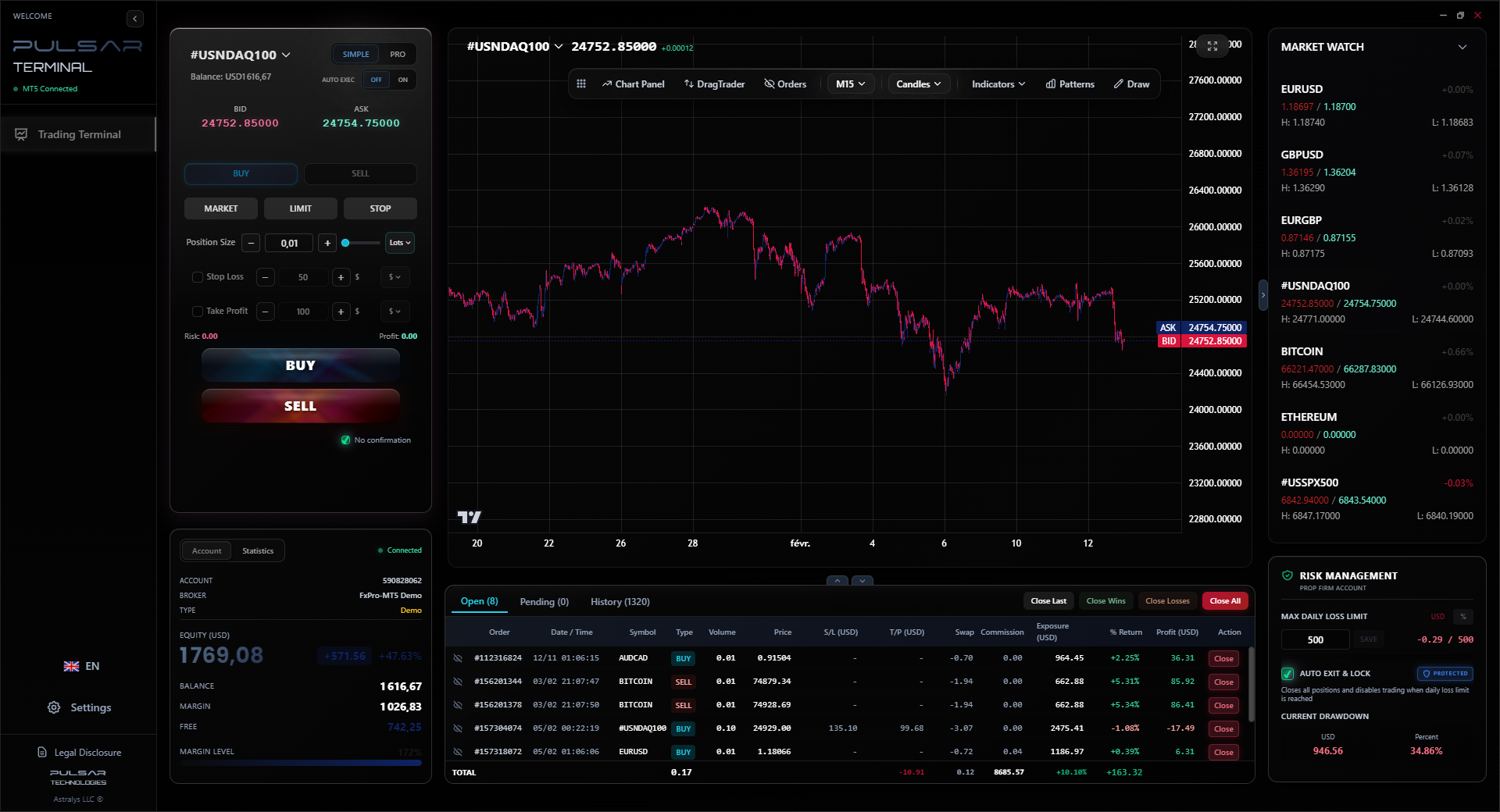
Managing multiple take-profit levels and moving stops to breakeven on volatile pairs like BTC/USD is stressful; Pulsar Terminal automates this with its multi-TP/SL and breakeven functions directly on your MT5 chart.
Pulsar Terminal
Alat MT5 all-in-one: order drag-and-drop, multi-TP/SL, trailing stop, grid trading, Volume Profile, dan perlindungan prop firm. Digunakan 1.000+ trader setiap hari.
Let me be the cautionary tale. I've lost real money on these.
Mistake 1: Trading Like It's Forex. My first big loss was trying to scalp BTC/USD like the EUR/USD. I'd set a 20-pip stop loss. Bitcoin would flash-crash 50 pips, take me out, and immediately reverse. I got chopped to pieces. The pip definition is the same, but the value and volatility are not. Stops need to be wider, based on structure, not arbitrary pip amounts.
Mistake 2: Ignoring the Swap. As mentioned, I turned winning trades into losers by holding them for days and ignoring the daily fee drain. Now, if a trade doesn't move in my direction within 24-48 hours, I re-evaluate and often just close it.
Mistake 3: Over-leveraging. The broker offered 1:10. I used it. A 10% move against you (common in crypto) wipes out 100% of your margin. The FSCA's use caps are there for a reason. Use even less than the maximum allowed. I never go above 1:5 now.
Mistake 4: Chasing the Pump. Everyone has FOMO. I bought BTC/USD at $58,000 in early 2022 because it was 'going to $100k.' It wasn't. It crashed to $30k. I averaged down, broke every rule, and took a loss that set me back months. Have a plan and stick to it. The hype on Twitter is not a strategy.
Mistake 5: Not Accounting for All Costs. I'd see a $200 profit on screen, close the trade, and wonder why my account only grew by $160. The spread, the commission, the swap - they all add up. Track your net profit after all costs.
“The biggest risk is you. The volatility triggers greed and fear like nothing else.”
This isn't formal tax advice. Go hire a South African accountant who understands crypto and trading. But here's the lay of the land from my discussions with my guy.
Trading forex bitcoin CFDs is treated as revenue from trading for tax purposes by SARS. Your net profit (after all those costs: spreads, commissions, swap, data fees) is added to your taxable income for the year. You're taxed at your marginal income tax rate. This is different from Capital Gains Tax (CGT), which might apply to your spot Bitcoin holdings if you're not a frequent trader.
Key points:
- Keep Records: Every single trade. Your broker statements are your bible. I export a CSV file monthly.
- Track All Expenses: Platform fees, internet costs for trading, education courses (if directly related), accountant fees. These are deductible against your trading income.
- Losses: Trading losses can be carried forward to offset future trading profits. You can't use them to offset your salary income.
- Prove It's Trading: If you're making hundreds of trades a year, holding positions for hours or days, it's clearly trading. If you make two trades a year, SARS might argue it's capital in nature (CGT). Frequency and intention matter.
It's a hassle, but it's the cost of doing business. Set aside about 30-35% of your net profits for tax. Put it in a separate savings account immediately. Don't get a nasty surprise in February.
💡 Tips Winston
If you can't clearly articulate the fundamental reason for a move in BTC (e.g., ETF approval, macro liquidity shift), you're just gambling on charts. Have a narrative, even if you trade technically.
Let's make this concrete. Here's exactly how I'd approach a first trade with a R10,000 account (about $530).
Step 1: Analysis (Sunday Evening) Open your charts. BTC/USD on the 4H timeframe. Where is price relative to the 200 SMA? Let's say it's above. Bias is long. Find the nearest clear support level on the 1H chart. Maybe it's at $61,500.
Step 2: Plan the Trade
- Direction: Long (Buy)
- Entry Zone: Near $61,500 support.
- Stop Loss: Below the next swing low, at $60,900. That's a $600 risk.
- Take Profit Target: First resistance at $63,500. That's a $2,000 move from entry, but we'll aim for $62,700 for a 2:1 reward ($1,200 profit on our $600 risk).
Step 3: Calculate Position Size You have R10,000 ($530). You risk 0.5% of that per trade: R50, or about $2.65. Your stop loss is $600 away from entry. Position size = (Account Risk) / (Stop Loss in $) = $2.65 / $600 = 0.0044 lots. Round down to 0.004 lots (a micro lot). This is why you start small.
Step 4: Execute & Manage Price pulls back to $61,550 on the 1H chart, shows a bullish pin bar. You enter a buy order at $61,600 (above the pin bar high). Set your stop loss at $60,900. Set your take profit at $62,800. Walk away. Don't watch it. The hard part is done.
Step 5: Review Win or lose, review the trade. Did price respect the levels? Was your stop too tight? Did you follow your plan? This review is more valuable than the profit or loss. This disciplined approach is the core of successful swing trading in any market.
FAQ
Q1Is trading forex bitcoin legal in South Africa?
Yes, but with a big caveat. It's legal to trade crypto CFDs (like BTC/USD) with a financial services provider that is licensed by the FSCA. Trading with an unlicensed international broker carries significant risk and may not offer you any legal protection.
Q2Which is better for a beginner: forex bitcoin CFDs or buying spot Bitcoin?
For a complete beginner wanting exposure to Bitcoin's price, buying a small amount of spot Bitcoin on a regulated exchange like Luno is simpler and has fewer moving parts (no use, no overnight fees). However, if you want to learn active trading with the ability to go short, a regulated CFD broker with a strict demo account practice period is the way to start. Never start with real money.
Q3What use can I get on BTC/USD in South Africa?
The FSCA has implemented use caps for retail clients. For major cryptocurrencies like Bitcoin, the maximum use is typically 1:5 or 1:2, depending on the broker's specific interpretation of the rules. This is for your protection. I recommend using even less, especially when starting.
Q4How are my profits from forex bitcoin trading taxed?
Profits from active trading of CFDs are generally considered revenue (trading income) by SARS and are taxed at your marginal income tax rate. You must declare this income and can deduct related expenses (broker fees, etc.). Always consult with a qualified tax professional.
Q5Why is the spread on BTC/USD so much higher than on EUR/USD?
The underlying crypto market, while large, is less liquid than the $7 trillion-per-day forex market. This lower liquidity means market makers and brokers face higher costs to help trades, which is passed on as a wider spread. It also compensates them for the higher risk they carry due to Bitcoin's extreme volatility.
Q6Can I use automated trading (Expert Advisors) on forex bitcoin pairs?
Technically, yes, if your broker's MT4/MT5 platform supports trading on the symbol. However, be extremely cautious. The high volatility and wide spreads can destroy most EAs built for calm forex markets. They often get whipsawed. Any EA must be specifically tested and optimized for crypto CFD conditions.
Q7What's the most important skill for trading forex bitcoin successfully?
Risk management. Full stop. It's more important than your entry strategy. Mastering position sizing, having the discipline to use stop losses every single time, and not over-leveraging will keep you alive long enough to learn how to be profitable. Greed kills accounts faster in crypto than anywhere else.
Pelajaran Prof. Winston
Poin Penting:
- ✓Trade BTC/USD on 4H charts, not lower.
- ✓Risk a maximum of 0.5% per trade on crypto.
- ✓Always factor in swap fees on overnight holds.
- ✓Use regulated brokers with FSCA licenses only.
- ✓Set aside 30% of profits for tax immediately.
Seberapa bermanfaat artikel ini?
Klik bintang untuk menilai
Wawasan Trading Mingguan
Analisis & strategi mingguan gratis. Tanpa spam.
Tentang Penulis
David van der Merwe
Trader Pasar Berkembang
Trader berbasis Johannesburg dengan 11 tahun di mata uang pasar berkembang. Spesialis pasangan ZAR, trading berregulasi FSCA, dan analisis pasar Afrika Selatan.
Komentar
Peringatan Risiko
Perdagangan instrumen keuangan mengandung risiko signifikan dan mungkin tidak cocok untuk semua investor. Kinerja masa lalu tidak menjamin hasil di masa depan. Konten ini hanya untuk tujuan edukasi dan tidak boleh dianggap sebagai nasihat investasi. Selalu lakukan riset Anda sendiri sebelum trading.
Anda mungkin juga suka

Cara Trading Forex Sukses: 7 Prinsip dari Trader Profesional
Cara trading forex sukses dengan 7 prinsip trader pro: manajemen modal, disiplin, journal trading, backtest. Data nyata, bukan janji profit palsu.
Jam Trading Forex Terbaik untuk Trader Indonesia: Panduan Lengkap dengan Tabel Waktu
Panduan jam trading forex untuk trader Indonesia. Tabel 4 sesi dunia, jam emas 20:00-00:00, sesi mana yang harus dihindari. Data akurat + tips dari trader berpengalaman.
Top 5 Sàn Forex Uy Tín Nhất 2026: Review Jujur dari Trader Indonesia
Top 5 sàn forex uy tín 2026 untuk trader Indonesia. Review jujur: spread, deposit, withdraw, dukungan lokal. Exness, XM, IC Markets & lebih.
Dapatkan Pulsar Terminal
Semua kalkulator ini terintegrasi dalam Pulsar Terminal dengan data real-time dari akun MT5 Anda.
Dapatkan Pulsar Terminal