


How much margin do you actually need to open that USD/ZAR trade? What will your profit be in Rands after spreads and commissions? If you're trading from South Africa without using a proper forex calculator, you're basically driving with your eyes closed.

David van der Merwe
Trader Pasar Berkembang ·  South Africa
☕ 11 mnt baca
Yang akan Anda pelajari:
How much margin do you actually need to open that USD/ZAR trade? What will your profit be in Rands after spreads and commissions? If you're trading from South Africa without using a proper forex calculator, you're basically driving with your eyes closed. I've seen too many local traders blow accounts because they 'eyeballed' their position size. The good news? Getting this right is simpler than you think, and it's the single biggest upgrade you can make to your trading discipline today.
Let's be blunt: trading without a calculator in South Africa is a fast track to the FSCA's warning list or a nasty chat with SARS. Our market isn't the Wild West anymore. With the FSCA capping use at 30:1 for retail traders and daily volumes hitting nearly $21.39 billion, precision is everything. A forex calculator does the heavy lifting on three critical fronts for us: risk management, regulatory compliance, and tax prep.
I learned this the hard way back in 2018. I took a large swing trade on GBP/ZAR, convinced the pound was oversold. I did some back-of-the-napkin math for my stop-loss. When the trade went against me, I got a margin call. My manual calculation was off by about R1,200 because I completely miscalculated the pip value for that exotic pair. That mistake cost me real money and shook my confidence for weeks.

Warning: The FSCA's 30:1 use limit means your margin calculations have to be spot-on. Over-leveraging by mistake is still over-leveraging, and it will get you liquidated just as fast.
Using a calculator removes emotion and guesswork. Before you enter any trade, you should know your exact risk in Rands, your required margin, and your potential profit/loss at various exit points. This isn't just theory; it's how you survive long enough to become profitable. A good position size calculator is your first line of defense.
Pip Value in ZAR
This is your foundation. For pairs like EUR/USD, the calculation is standard. But for USD/ZAR or EUR/ZAR? It changes constantly with the exchange rate. If USD/ZAR is at 18.50, the pip value for a standard lot (100,000 units) is different than when it's at 19.50. A calculator does this live. Guessing here means your risk per trade is a moving target.
Margin Requirement
With our 30:1 max use, you need 3.33% of the trade's notional value as margin. For a R185,000 USD/ZAR trade (that's $10,000 at 18.50), your required margin is about R6,160. A calculator tells you this instantly. If your account only has R6,500, you now know that one trade uses almost all your available margin – a terrible idea.
Profit & Loss (P&L)
This seems obvious, but you need to include costs. Let's say you buy USD/ZAR at 18.5000 and sell at 18.6000, a 1000 pip move. On a mini lot (10,000 units), your gross profit is R1,000. But if your broker's spread is 5 pips on USD/ZAR, you're down R50 from the start. A calculator shows your net P&L, not the fantasy number.
Swap Rates (Overnight Financing)
Holding ZAR pairs overnight? The swap can be significant. Sometimes you pay it, sometimes you earn it. For a swing trading strategy holding for days, these costs can eat into your profits or amplify losses. A good calculator will estimate this daily charge.
Currency Conversion
You deposit Rands, but your broker account might be in USD. A calculator helps you figure out exactly how much foreign allowance you're using and what your starting balance is in the account's currency. This is crucial for staying within SARS's limits (that R11 million annual allowance).

💡 Tips Winston
A calculator doesn't make you right, it makes you precise. Being precisely wrong is still wrong, but it's easier to diagnose and fix than random guessing.
“Trading without a calculator in South Africa is a fast track to the FSCA's warning list or a nasty chat with SARS.”
Broker fees here have a unique flavour. You can't just use a generic calculator; you have to plug in our local numbers.
| Cost Type | Typical Range in SA Market | Impact on Calculation |
|---|---|---|
| Spread on Majors | 0.0 - 1.5 pips | Your trade starts in a hole. Add this to your entry cost. |
| Spread on USD/ZAR | 5 - 10 pips | Massive. A 5-pip spread means you need a 5-pip move just to break even. |
| Commission (ECN Accounts) | $3 - $7 per lot | Add this per side (open & close). On a $5/lot broker, a standard lot trade costs $10 round turn. |
| Bank Transfer Fees | R250 - R2,070+ | Not in the calculator, but a cost of doing business. Capitec's endorsement can be over R2k! |
| Swap on USD/ZAR | Variable, can be high | Can add up fast for multi-day holds. Check your broker's daily rate. |
Here's a real example from last month. I used my Exness review to check their ZAR pairs. I calculated a short trade on EUR/ZAR. The spread was 14 pips. My calculator immediately showed I needed a 15-pip move just to get to a 1-pip profit. That changed my entire plan – I waited for a much better entry, which saved me from a scratch trade.

Pro Tip: Always run the calculator twice: once for your ideal entry, and once with a 'worst-case' entry accounting for slippage and the widest spread you've seen. If the trade still makes sense, you're on solid ground.
Also, remember that 'zero deposit fee' from a broker doesn't mean your bank won't charge you. That international payment fee comes straight out of your trading capital.
Let's walk through a live scenario so you can see how it all ties together. This is exactly how I plan a trade now.
The Setup:
- Account Balance: R20,000 in a USD-denominated account (approx. $1,081 at USD/ZAR = 18.50)
- Strategy: I'm looking at a scalping strategy on EUR/USD.
- Broker: A tight-spread broker like IC Markets (ECN account).
- Risk Rule: I risk 1% of my account per trade (R200 or ~$10.81).
The Trade Plan:
- Signal: I get a buy signal on EUR/USD at 1.08500.
- Stop Loss: I place my stop loss at 1.08400 (10 pips risk).
- Calculate Position Size: This is where the calculator is king.
- Pip Value Needed: My risk is $10.81. I'm risking 10 pips. So, I need a pip value of $1.081 ($10.81 / 10 pips).
- For EUR/USD, a standard lot (100,000) has a ~$10 pip value. So, I need 0.1081 lots ($1.081 / $10).
- I round down to 0.10 lots (a mini lot). My actual risk is now $10.00.
- Calculate Margin: 0.10 lots = 10,000 units. At 30:1 use, margin = (10,000 * 1.08500) / 30 = $361.67. My calculator confirms I have enough equity.
- Calculate Costs: My broker has 0.0 pip spread + $7 per lot commission. To open 0.10 lots, I pay $0.70. I'll pay another $0.70 to close. Total commission: $1.40.
- Net Profit Target: I aim for 15 pips (1.08650). Gross profit on 0.10 lots = 15 pips * $1 = $15.00. Minus $1.40 commission = $13.60 net profit (about R251).
See how the calculator transformed a vague idea ('I'll buy here and sell there') into a precise plan with known risk (R185), known cost (R26), and a clear profit target (R251)? That's the power. Without it, I'd just be hoping.
💡 Tips Winston
The FSCA gave you a 30:1 leash. Your job isn't to run to the end of it on every trade. Use the calculator to see how much slack you have, and keep most of it in hand.
“The FSCA's 30:1 use limit means your margin calculations have to be spot-on. Over-leveraging by mistake is still over-leveraging.”
You've got options, from basic to professional.
1. Broker Platform Calculators: Most platforms like MT4/MT5 have a built-in calculator. Right-click on the chart, select 'Trading', then 'New Order'. A window pops up showing estimated margin and pip value based on your lot size. It's okay for quick checks, but it's clunky. You have to manually reverse-engineer your position size from your desired risk.
2. Online Forex Calculators: These are my go-to for initial planning. You input account currency (ZAR), pair (EUR/ZAR), account balance, risk percentage, and stop-loss distance. It spits out your exact lot size. The best ones let you add commission and calculate swap. Just google 'forex position size calculator' – but make sure it handles exotics.
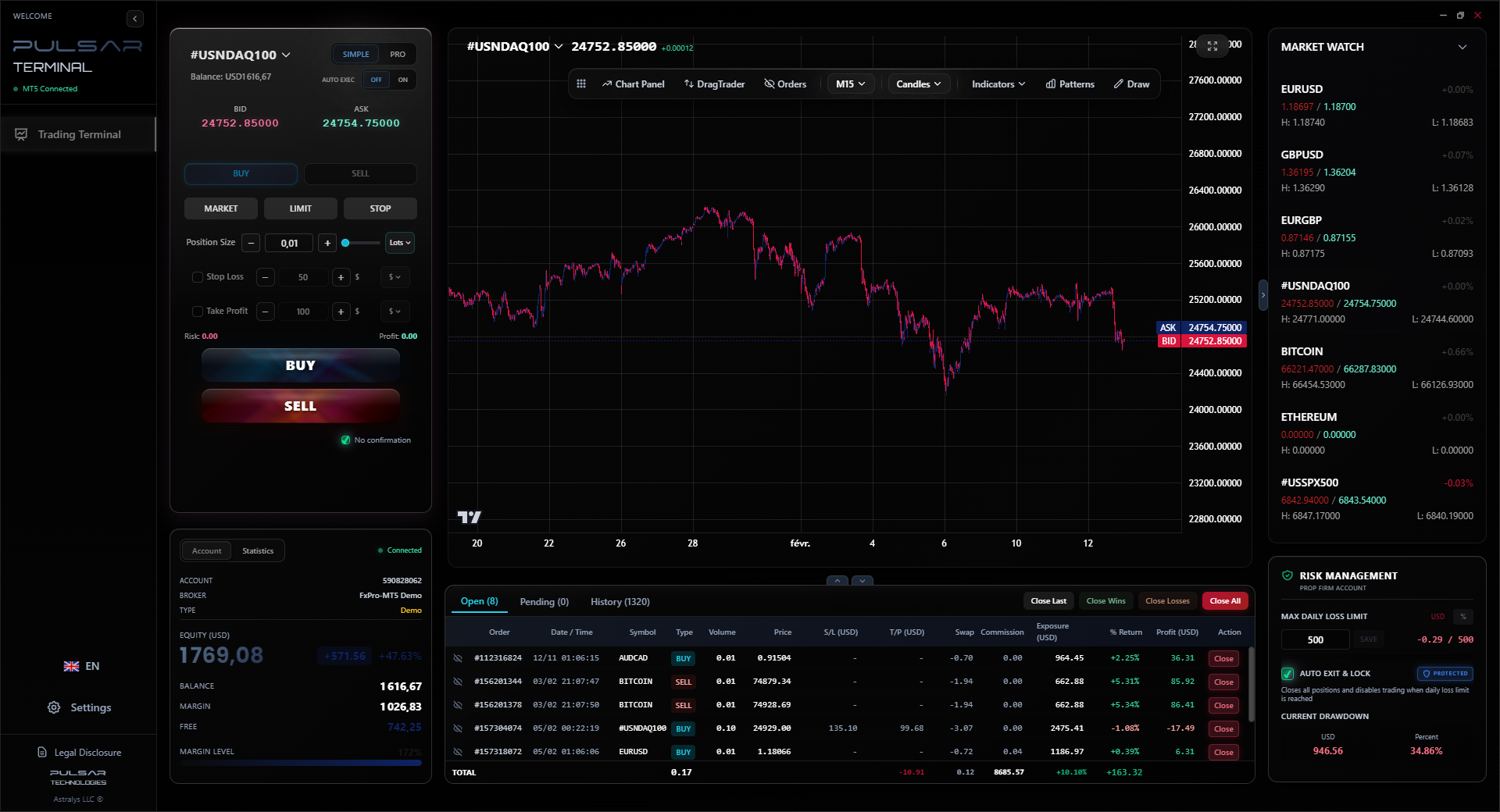
3. Advanced Trading Terminals: This is where it gets serious for full-time traders. Tools like Pulsar Terminal for MT5 bake risk calculation directly into the order ticket. You can set your stop loss in pips or Rands, and it automatically calculates and sets the correct position size. This eliminates a huge layer of manual error, especially when you're stressed.
4. The Old-School Spreadsheet: I built one in Google Sheets years ago. I had formulas for pip value based on live USD/ZAR rate pulled from an API. It worked, but maintaining it was a chore. I don't recommend it unless you really love spreadsheets.
My advice? Start with a strong online calculator. Bookmark it. Use it for every single trade idea, even the ones you don't take. It builds the habit. As you grow, you'll naturally seek out more integrated tools that save time and reduce errors.
Manually recalculating position size after a partial close is error-prone; Pulsar Terminal automates this and manages multi-TP/SL orders directly on your MT5 chart.
Pulsar Terminal
Alat MT5 all-in-one: order drag-and-drop, multi-TP/SL, trailing stop, grid trading, Volume Profile, dan perlindungan prop firm. Digunakan 1.000+ trader setiap hari.
Alright, let's talk about the party no one wants to attend: tax. In South Africa, your forex profits are taxable as income. SARS doesn't care about your brilliant MACD indicator crossover; they care about accurate numbers. Your calculations form the bedrock of your tax return.
What You Need to Calculate and Keep:
- Gross Profit/Loss per Trade: The difference between your open and close price, in Rands.
- Total Trading Costs: This is critical. You can deduct your actual costs from your gross profit. This includes:
- All broker commissions (get a statement!).
- Spreads (the difference between your executed price and the ideal price).
- Data subscription fees, internet costs used for trading, even a portion of your home office if you're serious.
- Bank charges for deposits/withdrawals.
- Net Profit/Loss: Gross Profit minus Total Costs. This is your taxable income (or deductible loss).

Example: You make a gross profit of R50,000 in a tax year. Your broker statements show R5,000 in commissions and spreads. Your bank fees for transfers total R1,500. Your deductible costs are R6,500. Your net taxable profit is R43,500.
How Calculators Help: A detailed trading journal, powered by your pre-trade calculations, makes this a breeze. If you know you risked R200 per trade at 1%, and you took 100 trades, you can quickly cross-reference your journal with your broker's annual statement. Discrepancies? You catch them early.
Some local brokers are starting to offer tax reports, which is helpful. But the most reliable record is your own. Calculate every trade, log every cost. When SARS comes knocking (and they might), a folder of clear, calculated records is your best defense. Guessing your annual P&L is a sure way to get into trouble.
💡 Tips Winston
Your most important calculation happens before the trade opens: 'If I'm wrong, what does it cost me?' Everything else is secondary.
“Guessing your annual P&L for SARS is a sure way to get into trouble. Calculate every trade, log every cost.”
Let me save you some pain and money by sharing where I've tripped up.
Mistake 1: Forgetting the USD/ZAR Conversion in Pip Value. Early on, I used a calculator set to a USD account. I traded GBP/USD, and it was fine. Then I jumped into USD/ZAR. The calculator gave me a pip value in USD. I forgot to convert that final P&L back to Rands in my head to understand my real profit. The disconnect between my account currency and the pair's quote currency messed me up.
Mistake 2: Ignoring the Wide Spread on Exotics. I treated EUR/ZAR like EUR/USD. I'd place a 20-pip stop, not realizing the 14-pip spread meant I was effectively only 6 pips away from a stop-out. The market barely had to move against me. Now, I add the spread to my stop distance in my risk calculation.
Mistake 3: Not Recalculating After a Partial Close. This is an advanced error. Let's say you open 1 lot on USD/ZAR and set a 50-pip stop (R500 risk). You then close 0.5 lots at a 20-pip profit. Your remaining position is 0.5 lots, but your stop is still 50 pips away. Your risk on the remaining trade is no longer R500; it's R250. If you don't recalculate, your risk-to-reward ratio is now completely different. Tools that manage multi-part trades automatically are a lifesaver here.
Mistake 4: Using use as a Crutch, Not a Tool. The FSCA's 30:1 limit is there for a reason. I used to see it as a ceiling to hit. 'I have R10,000, so I can control R300,000!' That's a surefire way to get a margin call. The calculator's margin output is a warning, not a challenge. Now, I use maybe 5:1 or 10:1 of the allowed use. The calculator shows me how much breathing room that gives me, and I sleep much better.
The thread through all these mistakes? Laziness and ego. Taking 60 seconds to run a proper calculation forces humility and clarity. It's the best 60 seconds you'll spend on a trade.
FAQ
Q1Is forex trading legal in South Africa, and how does regulation affect my calculations?
Yes, it's completely legal through FSCA-regulated brokers. The key regulatory impact on your calculations is the 30:1 use limit for retail clients. Your margin calculator must use this maximum to determine the minimum required funds. Always verify your broker's FSP number on the FSCA website.
Q2What's the most important thing to calculate for a beginner in SA?
Your position size based on a fixed percentage risk. Before you even think about profit, use a calculator to determine how many lots or units to trade so that if your stop loss hits, you only lose 1-2% of your account. This is non-negotiable for survival.
Q3How do I calculate profit on pairs like USD/ZAR?
You need a calculator that handles the quote currency (ZAR) differently. For a ZAR-based account: Profit (in ZAR) = (Pips Gained) x (Trade Size in Lots) x (Pip Value for ZAR Pairs). The pip value changes with the USD/ZAR rate. A good online calculator updates this automatically.
Q4Are there free forex calculators that work for South Africans?
Absolutely. Many reputable trading websites offer free calculators. Just ensure they allow you to set your account currency to ZAR (or your broker's base currency) and have fields for exotic pairs and commissions. The one on our position size calculator page is built with SA traders in mind.
Q5How do swap rates affect my calculations for long-term holds?
Significantly. If you're swing trading and holding for days or weeks, the daily swap fee (or credit) can add up. When planning a trade, use a calculator that includes swap to see your estimated overnight costs over your planned holding period. It can turn a seemingly profitable trade into a loser.
Q6Do I need to calculate taxes manually, or do brokers help?
Some FSCA-regulated brokers provide annual tax statements summarizing your trading activity. However, you should still maintain your own records based on your pre-trade calculations. This is your responsibility for SARS. Your calculated logs are your best proof of income and deductible costs.
Q7What's a realistic starting capital for using a calculator effectively in SA?
While you can start a micro account with R150, a calculator becomes truly meaningful with at least R5,000. This allows you to take sensible position sizes on major pairs after accounting for spreads. With less than R1,500, spreads and minimum position sizes often force you to risk too high a percentage of your account.
Pelajaran Prof. Winston
Poin Penting:
- ✓Always calculate position size from risk (1-2% of capital), not from hoped-for profit.
- ✓For USD/ZAR, add the 5-10 pip spread directly to your stop-loss distance in your risk math.
- ✓Use the 30:1 use as a safety buffer, not a target to be maxed out.
- ✓Your trading log, built from calculations, is your primary defense in a SARS audit.
Seberapa bermanfaat artikel ini?
Klik bintang untuk menilai
Wawasan Trading Mingguan
Analisis & strategi mingguan gratis. Tanpa spam.
Tentang Penulis
David van der Merwe
Trader Pasar Berkembang
Trader berbasis Johannesburg dengan 11 tahun di mata uang pasar berkembang. Spesialis pasangan ZAR, trading berregulasi FSCA, dan analisis pasar Afrika Selatan.
Komentar
Peringatan Risiko
Perdagangan instrumen keuangan mengandung risiko signifikan dan mungkin tidak cocok untuk semua investor. Kinerja masa lalu tidak menjamin hasil di masa depan. Konten ini hanya untuk tujuan edukasi dan tidak boleh dianggap sebagai nasihat investasi. Selalu lakukan riset Anda sendiri sebelum trading.
Anda mungkin juga suka

Cara Trading Forex Sukses: 7 Prinsip dari Trader Profesional
Cara trading forex sukses dengan 7 prinsip trader pro: manajemen modal, disiplin, journal trading, backtest. Data nyata, bukan janji profit palsu.
Jam Trading Forex Terbaik untuk Trader Indonesia: Panduan Lengkap dengan Tabel Waktu
Panduan jam trading forex untuk trader Indonesia. Tabel 4 sesi dunia, jam emas 20:00-00:00, sesi mana yang harus dihindari. Data akurat + tips dari trader berpengalaman.
Top 5 Sàn Forex Uy Tín Nhất 2026: Review Jujur dari Trader Indonesia
Top 5 sàn forex uy tín 2026 untuk trader Indonesia. Review jujur: spread, deposit, withdraw, dukungan lokal. Exness, XM, IC Markets & lebih.
Dapatkan Pulsar Terminal
Semua kalkulator ini terintegrasi dalam Pulsar Terminal dengan data real-time dari akun MT5 Anda.
Dapatkan Pulsar Terminal