


Most Aussies think forex capital trading is about picking the right broker and the perfect pair.

Sarah Collins
Ahli Strategi Trading ·  Australia
☕ 8 mnt baca
Yang akan Anda pelajari:
Most Aussies think forex capital trading is about picking the right broker and the perfect pair. They're wrong. The real game is navigating a regulatory cage designed to protect you from yourself. Since ASIC slammed the door on crazy use in 2021, the playbook has completely changed. I've traded through it all, and I'll show you how to work the system, not get crushed by it.
Forget everything you've heard about 500:1 use from offshore YouTube gurus. In Australia, you're playing in ASIC's house, and they set the rules. The 2021 product intervention order wasn't a suggestion; it was a wall. The 30:1 cap on majors like the EUR/USD is the single biggest factor shaping your potential profits and losses now.
It forces a fundamental shift in mindset. You can't rely on insane use to turn a $500 account into a Lamborghini. It's a grind, not a lottery. The AUD $1 million minimum capital requirement for brokers and mandatory segregated accounts are the good news - your money is safer than ever from broker collapse. The bad news? The training wheels are welded on.

Warning: Any broker 'offering' you higher use than the ASIC caps to an Australian resident is operating illegally or is an unregulated offshore entity. Your funds have zero protection there. Stick with the big names like Pepperstone or IC Markets who follow the rules.
The bonus ban is another killer. No more 'deposit $1000, get $500 free' traps. This actually cleans up the industry, forcing brokers to compete on spreads, execution, and service - which is where they should have been competing all along.

💡 Tips Winston
The 30:1 use cap isn't a limit; it's a governor on a powerful engine. It stops you from blowing the engine in the first mile. Learn to drive smoothly with the power you have.
Let's talk numbers, because this is where dreams get budgeted. With use capped, your position size is your primary weapon. You can't just crank it up to make up for a small account.
Spreads & Commissions: The Silent Tax
Brokers scream about 'zero pip spreads!' but forget to mention the commission. On a Razor account with Pepperstone, you're paying $3.50 AUD per lot, per side. That's $7 round turn. On a $10,000 account aiming for a 2% risk per trade ($200), that commission eats a meaningful chunk. You need a wider stop just to cover costs, which means a smaller position size. It's a vicious circle.
I learned this the hard way in 2022. I was scalping the AUD/USD on a 'tight spread' account, going for 5-8 pips. After 20 trades, I was up 85 pips on paper. My P/L? Barely positive. The spreads and sneaky commissions had taken nearly 70% of my gross gains. I switched to a strategy that aimed for 25+ pip moves immediately.
The 95% Loss Statistic is Real (And Why)
Those warnings that 70-95% of retail accounts lose money? They're not scaremongering. With 30:1 use, a mere 3.3% move against you wipes out 100% of your margin. On the volatile AUD/USD, that can happen in a single news event. Most traders blow up because they use too much capital per trade, treating 30:1 like it's 'low.' It's not low; it's still a power tool. You must use a position size calculator for every single entry. No exceptions.

Example: You have a $5,000 account. You want to buy AUD/USD at 0.6650 with a stop at 0.6620 (30 pips risk). At 30:1 use, your maximum position size is about $165,000 (33 mini lots). But if you risk 1% of your account ($50), your position size should only be about $16,667 (1.6 mini lots). The difference is survival versus suicide.
“The 30:1 cap forces a fundamental shift: it's a grind, not a lottery.”
The market has consolidated around a few key models. Here’s the lay of the land.
| Broker Type | Key Feature | Best For | Watch Out For |
|---|---|---|---|
| Raw Spread/ECN (e.g., IC Markets, Pepperstone Razor) | Tight spreads + commission. | Scalping, high volume traders. | Commissions murder small, frequent gains. |
| Standard/No Commission (e.g., AvaTrade, some XM accounts) | Wider spread built-in. | Newer traders, swing trading with fewer entries. | The 'all-in' cost can be higher on majors. |
| Proprietary Platform (e.g., CMC, IG) | Advanced charts, integrated research. | Traders who want everything in one place. | Can be less flexible than MT4/MT5. |
Minimum deposits are mostly a marketing trick. A 'no minimum' broker like Fusion Markets is great, but depositing $100 is a fast track to a margin call. I recommend a functional minimum of at least $2,000 AUD to trade properly with sane risk under the 30:1 rule.
Platform choice is critical. MT4 is still the king for scripting and familiarity, but MT5 and cTrader are where the innovation is. Your broker choice might lock you into one. Do your homework on our XM review or others to see what they offer.

Pro Tip: Don't get seduced by platform features you'll never use. Focus on execution speed, slippage reports (if they provide them), and whether the platform reliably handles your orders during high volatility. A fancy charting tool is useless if your stop loss gets ignored.
💡 Tips Winston
Your first $10,000 in trading isn't for profits. It's tuition. The goal is to learn, make mistakes, and keep most of it. If you finish with $8,000 and a solid strategy, you got a bargain.
If you're trading in AUD, you're trading iron ore, coal, and China's economic health. The AUD/USD isn't just a forex pair; it's a commodity ETF with a central bank. This gives you an edge if you pay attention.
I made one of my best trades in late 2023 shorting AUD/USD. Iron ore prices were tanking on worries about Chinese construction, and the RSI indicator on the daily chart was showing a clear bearish divergence. I entered at 0.6520, placed a tight stop, and rode it down to 0.6280. The macro story gave me the conviction to hold through the noise.
Key AUD Pairs & Their Personalities
- AUD/USD (The Aussie): The main event. Moves on US-China relations, commodity prices, and the RBA vs. Fed interest rate dance. Liquidity is superb.
- AUD/JPY (The Carry Trade): Highly sensitive to risk sentiment. When markets are calm and greedy, it rallies. When fear hits, it collapses. Watch the Nikkei and the VIX.
- AUD/NZD (The Tasman): A relative value play. Less about absolute direction, more about which central bank (RBA or RBNZ) is more hawkish/dovish. Spreads can be wider.
Your economic calendar is your best friend. Chinese PMI data, Australian employment reports, and US inflation numbers are the three pillars that will move your P/L.
“Your economic calendar is your best friend. The chart is the only truth that pays.”
The old 'martingale' or grid strategies that relied on unlimited use to average down are extinct. Good riddance. You need precision now.
Scalping is harder, but not impossible. You need a broker with razor-thin raw spreads and lightning execution. Your profit targets must be realistic enough to overcome the commission tax. I found focusing on the London-Asian session overlap for AUD pairs gave me cleaner, more predictable ranges to work with.
Swing trading is the new sweet spot. The use cap rewards patience. Instead of trying to catch 10-pip moves, you're forced to look for 50-200 pip trends. This aligns with higher-probability setups using daily and weekly charts. Tools like the MACD indicator on higher timeframes become more valuable than a 1-minute stochastic.
Risk management is non-negotiable. With limited use, you cannot afford a single blow-up. A 2% max risk per trade is not a guideline; it's the law. Use a trailing stop to lock in profits as a trend develops - it's the only way to build a position without adding more risk.
Here's a personal failure: I tried to adapt an old volatile strategy to XAU/USD (gold) after the caps came in. Gold moves in $20-$50 swings daily. With the old 100:1, I'd use a tiny position. With 20:1, I subconsciously used the same wide stop but a much larger position to try and get the same dollar gain. A $30 spike against me in 2021 wiped out 40% of my account in one go. I was using the new use with an old, reckless brain. Don't be me.
💡 Tips Winston
The market doesn't care about your rent, your ego, or your 'sure thing.' Trade the price on the screen, not the story in your head. The chart is the only truth that pays.
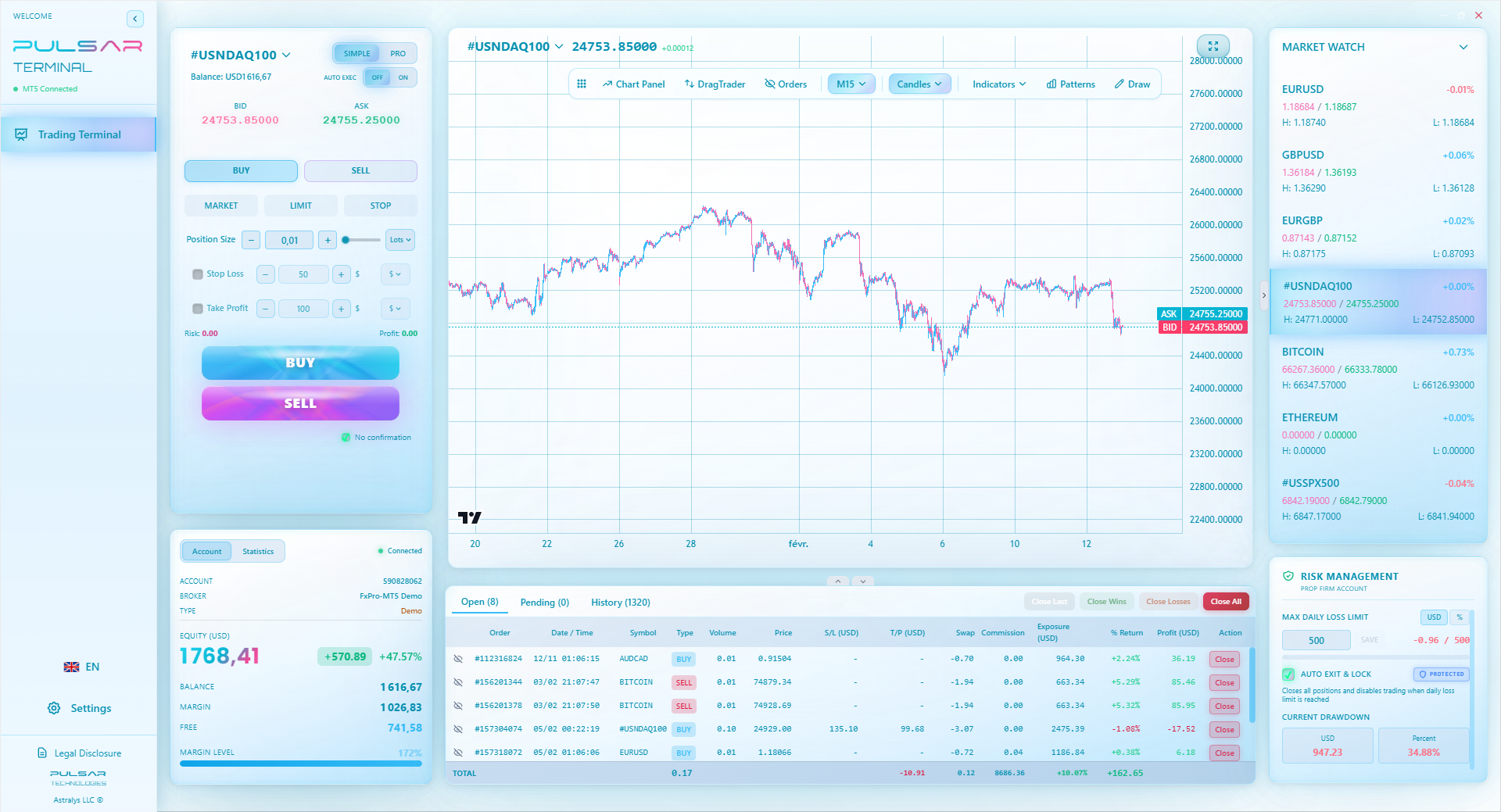
Managing multiple trades and precise exits in a 30:1 leverage environment is critical, which is why tools like Pulsar Terminal that offer multi-TP/SL and trailing stops directly on MT5 are game-changers for disciplined execution.
Pulsar Terminal
Alat MT5 all-in-one: order drag-and-drop, multi-TP/SL, trailing stop, grid trading, Volume Profile, dan perlindungan prop firm. Digunakan 1.000+ trader setiap hari.
Cut through the noise. Here's your action list.
- Pick a Top-Tier ASIC Broker: Start your research with our deep Exness review or IC Markets review. Verify their AFSL number on the ASIC website. This is step zero.
- Deposit Your 'Functional Minimum': Forget the broker's minimum. If you can't start with at least $1,000-$2,000, save up. Trading with $200 is a expensive simulation, not a business.
- Define Your Pip Value & Risk Immediately: Before you place one trade, know what 1 pip means for your account size on your chosen pair. Use a calculator. Set your platform to show risk in dollars, not just pips.
- Practice with a Demo, Then Go Live Small: Demo trade for a month to learn the platform. Then go live with the smallest possible position (0.01 lots) for another month. The psychology is different when real money is on the line, even if it's $5.
- Journal Relentlessly: Write down every trade: entry, exit, why you took it, emotional state. My biggest breakthroughs came from reviewing journals and seeing my own stupid patterns repeat.
- Ignore the 'Prop Firm' Hype (For Now): Passing a prop firm challenge requires insane risk-adjusted returns under strict drawdown rules. It's a specialist skill. Master trading your own capital in the ASIC environment first. The discipline required is similar, but the pressure cooker is different.
FAQ
Q1Can I still use high use with an Australian broker?
No. Not legally. Any ASIC-licensed broker must enforce the use caps (30:1 on majors, 20:1 on gold). If you find one offering more, they are either breaking the law (and your funds are at risk) or you are dealing with an unregulated offshore entity they own. Stick to the caps; they exist because 95% of people blow up with higher use.
Q2What's the best forex trading platform in Australia?
There's no single 'best.' MetaTrader 4 (MT4) is the most common and has endless custom indicators. MetaTrader 5 (MT5) is more modern and handles more asset types. cTrader is loved for its clean interface and superior order execution. Most major brokers like Pepperstone or IC Markets offer all three. Choose based on your strategy and which interface you find intuitive.
Q3How much money do I realistically need to start forex trading in Australia?
Realistically, at least $2,000 AUD. While brokers like Fusion Markets have no minimum, starting with less than $1,000 forces you to use unsustainably high risk per trade to see meaningful gains, thanks to the 30:1 use limit. $2,000 allows you to risk 1% ($20) per trade with sensible position sizes and survive the inevitable losing streaks.
Q4Why are spreads important, and what's a good spread for AUD/USD?
The spread is the immediate cost of entering a trade. You start in a hole. For AUD/USD, a 'good' raw spread is 0.0-0.3 pips on an ECN account (plus commission). On a standard no-commission account, an 'all-in' spread of 0.8-1.2 pips is competitive. Anything consistently over 1.5 pips is eating too much of your potential profit.
Q5Is forex trading taxable in Australia?
Yes. The Australian Tax Office (ATO) considers forex trading profits as taxable income. If you trade frequently, you'll likely be considered a 'trader' and profits are assessable as business income. If it's more incidental, it may be treated under capital gains tax rules. Keep careful records of all trades, wins, and losses. Talk to an accountant who understands financial markets.
Q6What's the most common mistake new Australian traders make?
Two things, tied together: over-leveraging and poor position sizing. Even with the 30:1 cap, people use 90% of their margin on one trade. They confuse 'maximum allowable' with 'sensible.' They don't use a position size calculator. A 2% loss feels okay, but a 20% loss destroys your capital and your confidence. Risk management isn't sexy, but it's the only thing that keeps you in the game.
Pelajaran Prof. Winston
Poin Penting:
- ✓ASIC's 30:1 use cap is the #1 factor in your strategy.
- ✓70-95% lose because they ignore position sizing.
- ✓AUD/USD is a commodity trade, not just a currency pair.
- ✓You need a $2,000 'functional minimum' to start properly.
- ✓Swing trading is now more viable than reckless scalping.
Seberapa bermanfaat artikel ini?
Klik bintang untuk menilai
Wawasan Trading Mingguan
Analisis & strategi mingguan gratis. Tanpa spam.
Tentang Penulis
Sarah Collins
Ahli Strategi Trading
Ahli strategi trading berbasis London dengan 12 tahun di pasar keuangan. Mantan analis di perusahaan pialang City of London. Mencakup pasangan GBP, pasar Eropa, dan trading berregulasi FCA.
Komentar
Peringatan Risiko
Perdagangan instrumen keuangan mengandung risiko signifikan dan mungkin tidak cocok untuk semua investor. Kinerja masa lalu tidak menjamin hasil di masa depan. Konten ini hanya untuk tujuan edukasi dan tidak boleh dianggap sebagai nasihat investasi. Selalu lakukan riset Anda sendiri sebelum trading.
Anda mungkin juga suka

Cara Trading Forex Sukses: 7 Prinsip dari Trader Profesional
Cara trading forex sukses dengan 7 prinsip trader pro: manajemen modal, disiplin, journal trading, backtest. Data nyata, bukan janji profit palsu.
Jam Trading Forex Terbaik untuk Trader Indonesia: Panduan Lengkap dengan Tabel Waktu
Panduan jam trading forex untuk trader Indonesia. Tabel 4 sesi dunia, jam emas 20:00-00:00, sesi mana yang harus dihindari. Data akurat + tips dari trader berpengalaman.
Top 5 Sàn Forex Uy Tín Nhất 2026: Review Jujur dari Trader Indonesia
Top 5 sàn forex uy tín 2026 untuk trader Indonesia. Review jujur: spread, deposit, withdraw, dukungan lokal. Exness, XM, IC Markets & lebih.
Dapatkan Pulsar Terminal
Semua kalkulator ini terintegrasi dalam Pulsar Terminal dengan data real-time dari akun MT5 Anda.
Dapatkan Pulsar Terminal