


I remember my first 'big' trade after a local course.

David van der Merwe
Trader Pasar Berkembang ·  South Africa
☕ 9 mnt baca
Yang akan Anda pelajari:
- 1The SA Forex Scene: What You're Really Up Against
- 2Course Types: From Scams to The Serious Stuff
- 3The Non-Negotiables: What a Worthwhile Course MUST Cover
- 4Red Flags & How to Spot a Scam a Mile Away
- 5The Self-Education Path: What You Can Learn for Free
- 6Making the Final Decision: Your Due Diligence Checklist
I remember my first 'big' trade after a local course. The guru said to go long on USD/ZAR at R14.80, promising a move to R15.20. I put R20,000 on it. The trade went south instantly, hitting my stop at R14.65. I lost R1,500 in minutes. The course cost R8,000. That's R9,500 gone before I even understood what a spread was. That painful lesson is why you need this guide. We're cutting through the marketing fluff to show you which forex courses in South Africa actually teach you to trade, and which just teach you to lose money.
Trading here isn't like trading in London or New York. You've got unique hurdles. First, the rand is a wild animal. It reacts violently to local politics, load-shedding rumours, and SARB statements in ways the euro just doesn't. A course that only teaches you EUR/USD patterns is setting you up to fail on our home turf.
Then there's regulation. The FSCA caps use at 30:1 for retail traders. That's sensible, but it means you can't just copy some American YouTuber using 500:1 use. Your position size calculator inputs need to be different from day one. You also need to understand tax. SARS sees your trading profits as income. I learned that the hard way in 2018, getting a nasty letter because I hadn't kept proper records of my scalping profits. A good local course should hammer this home.

Warning: If a 'guru' promises you can bypass the 30:1 use limit by signing up with an offshore broker, run. You're sacrificing all FSCA protection, and your funds are at far greater risk.
The market is huge and growing - over 200,000 active traders and daily volumes pushing $21 billion. That's liquidity, which is good, but it also means there's a massive audience for snake oil salesmen. Your first job isn't to find a strategy, it's to find a legitimate teacher.

💡 Tips Winston
A course that doesn't make you calculate position size for a ZAR pair on Day 1 is teaching theory, not South African trading.
Let's categorize the jungle of offerings. Knowing what you're looking at is half the battle.
The 'Get-Rich-Quick' Seminar (Avoid at All Costs) These are usually free hotel ballroom events or expensive weekend intensives (R15,000+). They're heavy on motivation, Lamborghini pictures, and light on actual mechanics. The end goal is to upsell you a 'platinum mentorship' for R50,000 or more. They'll show you a few cherry-picked trades but never teach you about margin calls or consecutive losses. I've seen them. They're predators.
The Online Video Library (Hit or Miss) These are pre-recorded video modules you buy once. Price range: R1,500 to R10,000. The value is entirely in the content. Some are brilliant, structured paths from basics to advanced swing trading concepts. Others are a disorganized mess filmed on a webcam. The key differentiator? Does it have a clear curriculum and real trade examples with entries, exits, and - critically - losers?
The Live Mentorship (The High-Stakes Option) This is where you pay for direct access to a trader. Costs can soar from R20,000 to over R100,000 for a few months. This can be phenomenal if the mentor is legitimate and engaged. It can also be a colossal waste if they just give you generic advice and disappear. You're not just paying for knowledge, you're paying for accountability and personalized feedback. I did one early on with a UK-based trader. It was expensive, but him pointing out my reckless over-use on one trade saved me more than the course fee.
The Prop Firm 'Challenge' Prep Course (A New Breed) These are hyper-focused courses designed to teach you the specific rules and psychology needed to pass a proprietary trading firm's evaluation. Given the rise of prop firms, these have become popular. They often focus intensely on strict risk management and consistency over home runs. This is a practical niche if that's your goal.
“If the sales page has more photos of beaches and cars than charts, it's selling a dream, not an education.”
If the course syllabus doesn't explicitly cover these South African specifics, close the tab.
The Regulatory and Tax Foundation
It must explain the FSCA, the 30:1 use limit, and why trading with a regulated broker like those we review (Exness, IC Markets) matters here. It must dedicate a module to SARS. How do you log trades? What constitutes taxable income? What records do you need? This is boring but essential.
Rand-Specific Market Mechanics
A module on USD/ZAR, EUR/ZAR, and GBP/ZAR. What moves these pairs? How do commodity prices (gold, platinum) interact with the rand? How does political volatility show up on the chart? A course that only teaches EUR/USD is teaching you to trade a calm lake when you'll be swimming in the ocean.
Practical, Localized Risk Management
This is the core. It's not just 'risk 2% per trade.' It's: 'With a R10,000 account and 30:1 use, here’s exactly how many lots you can trade on USD/ZAR without getting a margin call on a 50-pip move.' They should use local broker spreads in their examples (e.g., 'Assuming a 2-pip spread on USD/ZAR from your broker...').
From Theory to Platform
A good course walks you through placing a trade, setting a stop-loss, and taking profit on a South African broker's platform (MT4/MT5). It should explain deposit methods (how to get your rands into the account), withdrawal times, and costs.

Example: Let's say a course teaches a gold (XAU/USD) strategy. A SA-focused course would then show how movements in XAU/USD often precede or correlate with moves in USD/ZAR, because gold is a major SA export. That's connective tissue you won't get elsewhere.
💡 Tips Winston
The most valuable lesson any course can teach is how to lose well. If it only shows winning trades, it's a fantasy.
I've reviewed dozens of these. The bad ones have tell-tale signs.
1. The Guarantee: 'Guaranteed profits,' '90% win rate,' 'no losing months.' Trading has no guarantees. Anyone offering one is lying. Full stop.
2. The Lifestyle Overload: If the sales page has more photos of beaches, watches, and cars than charts or curriculum details, it's selling a dream, not education.
3. Vague on Costs: If the price isn't clearly stated upfront, or if it's 'R999 today only, tomorrow R9,999,' it's using pressure tactics, not providing value.
4. No Evidence of Real Trading: The instructor should have a verifiable, long-term track record (not just a 3-month MyFxBook that can be manipulated). Can they explain a losing trade in detail? If they only show winners, they're hiding reality.
5. Too Good to Be True Stats: Be wary of claims like 'turn R5,000 into R50,000 in 3 months.' Do the math. With 30:1 use and sane risk, that's virtually impossible without gambling-sized risk.
Here’s a quick test: Email the course seller before buying. Ask a specific, technical question like, 'How does your strategy adjust entry zones for USD/ZAR during high volatility around SARB MPC announcements?' If you get a vague, motivational reply, or no reply at all, you have your answer. If you get a detailed, nuanced response about waiting for the initial spike to settle and using the RSI indicator on a 15-minute chart to gauge exhaustion, you might be onto something.
“Your goal for the first six months isn't to double your money. It's to not blow it up.”
You don't have to pay for a course. I built my first profitable year on free resources, but it was slower and I made more mistakes. Here's a structured free path for a South African.
Phase 1: The Absolute Basics (1-2 Months) Learn the terminology: pips, lots, use, margin, long/short. Use the FSCA's website to understand your rights. Read SARS's guide on taxable income. Familiarize yourself with MT5 by opening a demo account with a broker like Pepperstone or XM.
Phase 2: Market & Strategy (3-6 Months) Don't jump into a strategy. First, learn how to read price action. Then, pick ONE major pair (EUR/USD) and ONE rand pair (USD/ZAR) and just watch them. Every day, write down why you think they moved. Follow SA financial news. Then, learn one or two core indicators deeply, like the MACD or RSI. Paper trade a simple strategy.
Phase 3: Risk & Psychology (Ongoing) This is where most fail. Devour everything on risk management. Use a demo account to practice losing. Seriously. Place trades with the sole goal of practicing cutting losses quickly. Your goal is to make risk management automatic before you risk a single cent.

Pro Tip: The best free practice? Open a demo account and pretend it's real. Give yourself a 'salary' of R20,000. Your goal for 6 months isn't to double it. Your goal is to not blow it up, and to end the period with more than you started. That's the real challenge.
💡 Tips Winston
Your first R10,000 is better spent on a demo account and books than on a flashy course. Prove you have the patience first.
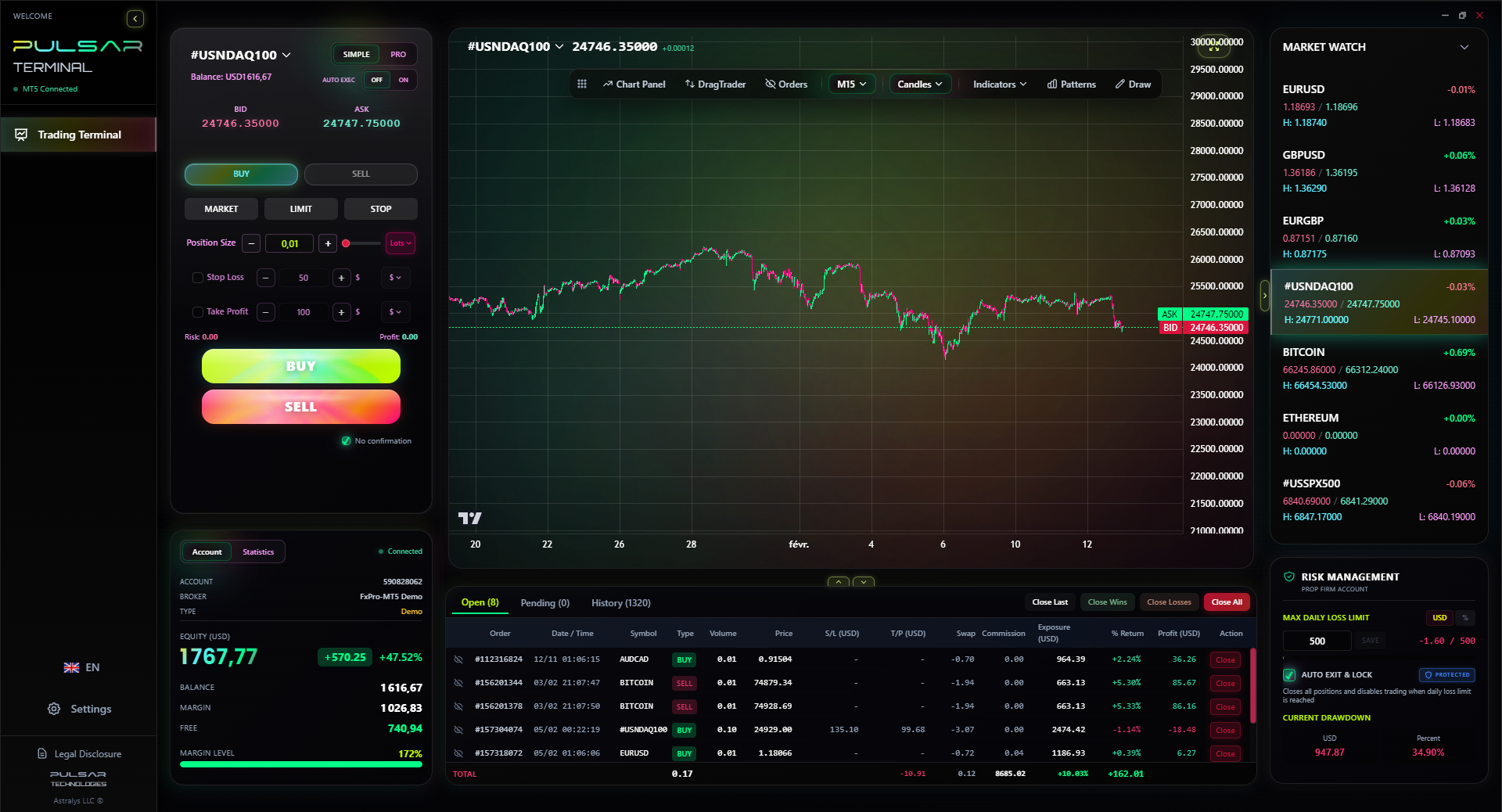
When you're ready to move from demo to live trading, managing multiple trades and strict risk rules on MT5 becomes critical, which is where a tool like Pulsar Terminal automates the process.
Pulsar Terminal
Alat MT5 all-in-one: order drag-and-drop, multi-TP/SL, trailing stop, grid trading, Volume Profile, dan perlindungan prop firm. Digunakan 1.000+ trader setiap hari.
Before you enter any credit card details, run through this list.
| Check | What to Look For |
|---|---|
| Instructor Credibility | Real name, verifiable trading history (3+ years), presence on professional networks like LinkedIn. Can you find them outside their own website? |
| Curriculum Transparency | Detailed module list available before purchase. Does it cover SA regulation, tax, and rand pairs? |
| Pricing Clarity | One clear price. Beware of hidden 'mastermind' upsells. |
| Support Offered | Is there Q&A, a community, or email support? For the price, what do you get post-purchase? |
| Refund Policy | A reasonable, no-questions-asked refund period (e.g., 30 days). If there's no refund, it's a major red flag. |
| Student Reviews | Look for reviews on independent sites (Trustpilot, HelloPeter), not just testimonials on their site. |
My final piece of advice: The course is just the start. It gives you the map, but you still have to walk the path. The best course in the world won't help if you don't put in the screen time, manage your emotions, and stick to your rules. I've seen students of great courses fail, and self-taught grinders succeed. The difference was always discipline, not information.
FAQ
Q1What is the best forex trading course in South Africa?
There's no single 'best' course. The right one depends on your learning style and budget. Look for a course with a transparent curriculum covering SA regulation, tax, rand pairs, and real risk management examples. Avoid any course making guaranteed profit claims.
Q2Are free forex trading courses any good?
Some free introductory content is decent for learning basic terms and platform navigation. However, complete, structured education that covers South African specifics (FSCA rules, SARS, ZAR pairs) almost always comes at a cost. Free resources are a great start, but be prepared for gaps in knowledge you'll need to fill later.
Q3How much do forex courses cost in South Africa?
Prices vary wildly. You can find basic video libraries for R1,500-R10,000. Live mentorship or intensive programs typically range from R20,000 to over R100,000. Be extremely wary of 'free seminars' that are just high-pressure sales pitches for expensive platinum packages.
Q4Can I learn forex trading without a course?
Yes, absolutely. It's a longer, harder path with more trial and error. You'll need immense discipline to work through free resources on basics, platform use, strategy, and - most importantly - risk management. Many successful traders are self-taught, but they treat it like a serious study regimen.
Q5What should I look for in a forex trading mentor?
Look for a verifiable track record of several years, not just a few months. They should be able to openly discuss both wins and losses. Their primary focus should be on teaching you risk management and discipline, not just a 'secret indicator.' For South Africans, they must understand and teach within the constraints of FSCA use limits.
Q6Is forex trading taxable in South Africa?
Yes. The South African Revenue Service (SARS) generally views profits from frequent trading as taxable income, subject to your marginal income tax rate. A legitimate course should teach you how to maintain the proper trade logs and records you'll need for tax compliance.
Pelajaran Prof. Winston
Poin Penting:
- ✓FSCA use is capped at 30:1 for retail traders.
- ✓SARS taxes forex profits as income. Keep records.
- ✓A good course must cover USD/ZAR and local regulation.
- ✓Avoid any course guaranteeing profits or a high win rate.
- ✓Practice on a demo account for at least 3-6 months first.
Seberapa bermanfaat artikel ini?
Klik bintang untuk menilai
Wawasan Trading Mingguan
Analisis & strategi mingguan gratis. Tanpa spam.
Tentang Penulis
David van der Merwe
Trader Pasar Berkembang
Trader berbasis Johannesburg dengan 11 tahun di mata uang pasar berkembang. Spesialis pasangan ZAR, trading berregulasi FSCA, dan analisis pasar Afrika Selatan.
Komentar
Peringatan Risiko
Perdagangan instrumen keuangan mengandung risiko signifikan dan mungkin tidak cocok untuk semua investor. Kinerja masa lalu tidak menjamin hasil di masa depan. Konten ini hanya untuk tujuan edukasi dan tidak boleh dianggap sebagai nasihat investasi. Selalu lakukan riset Anda sendiri sebelum trading.
Anda mungkin juga suka

Cara Trading Forex Sukses: 7 Prinsip dari Trader Profesional
Cara trading forex sukses dengan 7 prinsip trader pro: manajemen modal, disiplin, journal trading, backtest. Data nyata, bukan janji profit palsu.
Jam Trading Forex Terbaik untuk Trader Indonesia: Panduan Lengkap dengan Tabel Waktu
Panduan jam trading forex untuk trader Indonesia. Tabel 4 sesi dunia, jam emas 20:00-00:00, sesi mana yang harus dihindari. Data akurat + tips dari trader berpengalaman.
Top 5 Sàn Forex Uy Tín Nhất 2026: Review Jujur dari Trader Indonesia
Top 5 sàn forex uy tín 2026 untuk trader Indonesia. Review jujur: spread, deposit, withdraw, dukungan lokal. Exness, XM, IC Markets & lebih.
Dapatkan Pulsar Terminal
Semua kalkulator ini terintegrasi dalam Pulsar Terminal dengan data real-time dari akun MT5 Anda.
Dapatkan Pulsar Terminal