


Here's a fact that should sober you up: over 80% of retail traders in Nigeria lose money in their first year of forex currency trading.

Olumide Adeyemi
Pelopor Trading Afrika Barat ·  Nigeria
☕ 11 mnt baca
Yang akan Anda pelajari:
- 1What is Forex, Really? (Forget the Hype)
- 2The Nigerian Trader's Reality: Challenges & Solutions
- 3Core Mechanics: Pips, Lots, and the use Trap
- 4Analysis: It's Not Magic, It's a Process
- 5Choosing a Trading Style That Fits Your Nigerian Life
- 6Risk Management: The Sacred Rulebook
- 7Building Your First Simple Strategy
- 8Your Next Steps (And How to Avoid the Scams)

Here's a fact that should sober you up: over 80% of retail traders in Nigeria lose money in their first year of forex currency trading. It's not a get-rich-quick scheme; it's a professional skill where the market is designed to transfer wealth from the impatient to the patient. I've been trading for over a decade, and I've lost more money than I care to admit learning the hard way. This guide isn't about selling you a dream. It's about giving you the unvarnished truth about trading currencies from Lagos to Port Harcourt.
Forex currency trading is simply the simultaneous buying of one currency and selling of another. The 'FX' or 'foreign exchange' market is where this happens. It's the largest, most liquid market in the world, with over $7 trillion traded daily. Forget the Instagram flexers with rented Lambos. The real market is a brutal, efficient machine where banks, hedge funds, and now retail traders like us, all try to outsmart each other.
In Nigeria, you're mostly trading CFDs (Contracts for Difference). You don't own the actual dollars or pounds. You're speculating on the price movement. This is crucial to understand because it introduces use, which is both your greatest weapon and your most likely executioner. The most common pairs you'll deal with are the majors: EUR/USD, GBP/USD, USD/JPY, and USD/CHF. For us, any pair with the USD is key because of our economy's deep ties to the dollar. You can learn the specific dynamics of a pair like EUR/USD to understand what moves it.

Warning: The 'Naira pairs' (like USD/NGN) you see on some international platforms are often synthetic or have massive spreads. They don't reflect the true parallel market rate in Alade Market. Trading them is a surefire way to get ripped off on the spread alone.
Trading from Nigeria isn't the same as trading from London or New York. We face unique hurdles that can kill your account before you even see a good setup.
The Internet & Power Problem
Your trading career ends the moment your inverter beeps and your data runs out during a live trade. I learned this the expensive way in 2018. I was in a nice short trade on GBP/USD, up about 45 pips. Then, NEPA took light, my router died, and by the time I got my generator humming and mobile data back, the trade had reversed and hit my stop loss. That was a $350 lesson. Solution? Redundancy. Have a primary ISP, a mobile hotspot as backup, and a UPS for your router and PC. Trade only when you have stable power.
The Broker Minefield
This is the biggest trap. Unregulated brokers promising 'instant withdrawals' and 'Naira accounts' are a plague. Your first job isn't to pick a strategy; it's to find a broker that won't disappear with your deposit. I strictly use globally regulated brokers with a solid track record. I've written detailed reviews on platforms like Exness and IC Markets that are accessible here. Always fund your account in USD, not Naira, to avoid hidden conversion fees that can eat 5-10% of your capital right away.
Psychology in a Volatile Economy
When your country's inflation is 30%+, the temptation to trade huge to 'beat inflation' is immense. This leads to over-leveraging. You're not trading to buy a mansion in Banana Island next month. You're trading to build capital consistently, preserving what you have from the eroding effects of our local economy. Greed, fueled by economic pressure, is the number one killer of Nigerian trading accounts.

💡 Tips Winston
Your first profitable month on a demo account is a trap. It builds false confidence. The market hasn't tested you yet. Aim for three consecutive months, including a month where you have a string of 5 losses. That's when you learn.
“use of 1:500 means you can control a $50,000 position with just $100. It's also how you lose that $100 in 60 seconds.”
Let's get technical, but keep it simple.
A pip is the smallest price move a currency pair can make. For most pairs, it's 0.0001. If EUR/USD moves from 1.0850 to 1.0851, that's 1 pip. Understanding the pip definition is non-negotiable.
A lot is your trade size. A standard lot is 100,000 units of the base currency. Thankfully, we have mini (10,000) and micro (1,000) lots. If you're starting with less than $1000, you should only be trading micro lots.
Now, use. This is where dreams go to die. use of 1:500 means you can control a $50,000 position with just $100 in your account. Sounds great, right? Here's the reality check. That same 1-pip move that would make or lose you $0.10 on a micro lot without use now has a magnified effect. With high use, a small move against you can wipe out your entire account - a margin call.

Example: You deposit $200, use 1:500 use, and buy 1 mini lot (10,000 units) of EUR/USD. Your margin used is about $20. A move of just 20 pips against you (a common intraday fluctuation) would be a $20 loss. That's 10% of your capital gone in minutes. Without that insane use, the same move on a sensible micro lot would be a $2 loss (1%).
My rule? For beginners, never use more than 1:10 use. Even with experience, I rarely go above 1:30. It forces you to be right about direction and timing, not just hope a huge position saves you. Always, and I mean always, use a position size calculator before every single trade.
You have two main schools of thought: technical and fundamental analysis. You need both.
Technical Analysis is reading the price chart. It assumes all known information is already in the price. You're looking for patterns, levels, and momentum. Start with support and resistance. These are price levels where the market has historically reversed. Drawing these levels is more art than science. Then, add one or two indicators. I'm a fan of the RSI indicator for spotting overbought/oversold conditions and the MACD indicator for trend momentum. Don't clutter your chart with 10 indicators; they'll all tell you the same thing and paralyze you.
Fundamental Analysis is understanding why the price moves. For forex currency trading, this means central bank interest rates, inflation data (like US CPI or UK CPI), employment numbers, and geopolitical events. As a Nigerian trader, you MUST watch the US Federal Reserve and the European Central Bank. Their statements move every major pair. When the Fed hints at raising rates, the USD usually strengthens. I missed this early on and got crushed shorting the USD right before a hawkish Fed announcement.
The sweet spot? Use fundamentals to get your bias (is the overall trend up or down?). Then use technicals to find your precise entry and exit points. For example, if the Fed is in a hiking cycle (bullish for USD), wait for EUR/USD to rally up to a strong technical resistance level on the chart. That's your potential sell signal.
“Your first live account's goal isn't to make money. The goal is to survive for 6 months without blowing it up.”
Your lifestyle dictates your style. Don't try to be a scalper if you have a 9-5 job in Victoria Island.
Scalping aims to profit from tiny price movements, holding trades for seconds to minutes. It requires intense screen focus, a broker with razor-thin spreads (check the spread definition), and nerves of steel. It's stressful. If you have a stable, fast internet connection and can dedicate focused hours, a scalping strategy might work. I tried it for 6 months. My win rate was high, but one bad trade would wipe out 10 good ones. The psychological toll wasn't worth it for me.
Day Trading involves entering and exiting all positions within the same day. You're looking at bigger moves than a scalper, holding for hours. This is more manageable for someone who can check charts during lunch breaks. The London session (8 AM - 5 PM Nigerian time) is the most liquid and best for this.
Swing Trading is my personal preference and what I recommend for most people here. You hold trades for days to weeks, capturing larger market swings. You don't need to stare at screens all day. You do your analysis in the evening, set your orders, and manage them with stop losses. It fits perfectly around a job. You can learn the core principles of swing trading to see if it suits you. It requires more patience but is far less stressful.

Pro Tip: Match your trading style to your personality and schedule. A restless person will fail at swing trading. A busy professional will fail at scalping. Be honest with yourself.
💡 Tips Winston
When you feel the urge to move your stop loss further away 'just this once,' close your trading platform immediately. Go for a walk. That urge is the market about to take your money.
This is the only chapter that matters. Your strategy can be mediocre, but with impeccable risk management, you'll survive. A brilliant strategy with poor risk management will blow up your account. Guaranteed.
The 1% Rule: Never, ever risk more than 1% of your trading capital on a single trade. If you have a $1,000 account, your maximum loss per trade should be $10. This is non-negotiable. It protects you from a string of losses, which will happen to everyone.
Stop Losses Are Your Best Friend: A stop loss is an order that closes your trade at a predetermined loss level. It's an admission that you might be wrong. Not using one is like driving without a seatbelt. You must place it the moment you enter the trade. In 2020, I broke this rule on a gold (XAU/USD) trade. I was 'sure' it would bounce. It didn't. I watched, paralyzed, as a $200 drawdown turned into $800. I finally closed it, sick to my stomach. That mistake set me back months. Always know your XAU/USD guide and respect its volatility.
Take Profit & Reward-to-Risk: Your take profit (TP) should be set based on a minimum reward-to-risk ratio. I aim for at least 1.5:1. Meaning, if my stop loss is 20 pips away (risking $20), my take profit should be at least 30 pips away (aiming for $30). This means you can be wrong half the time and still break even or profit.
Journal Every Trade: Write down the pair, entry/exit, reason for entry, outcome, and most importantly, your emotional state. This is how you find your personal edge and your fatal flaws.

“A stop loss is an admission that you might be wrong. Not using one is professional suicide.”
Let's build a basic swing trading strategy you can start with. Keep it stupid simple.
Step 1: Find the Trend. Use the daily chart. Is the price making higher highs and higher lows (uptrend)? Or lower highs and lower lows (downtrend)? Only trade in the direction of the daily trend. In an uptrend, look for buys. In a downtrend, look for sells.
Step 2: Wait for a Pullback. The price won't go straight up or down. It will 'pull back' against the trend. Switch to the 4-hour chart to spot this. In an uptrend, wait for the price to pull back to a visible area of support (a previous swing low, a moving average).
Step 3: Look for a Reversal Signal. On the 1-hour or 4-hour chart, at that support area, look for a bullish candlestick pattern (like a hammer or bullish engulfing) or for the RSI to move out of oversold territory (back above 30).
Step 4: Execute with Discipline. Enter a buy order. Place your stop loss immediately a few pips below the recent swing low of the pullback. Set your take profit at a minimum 1.5 times the distance of your stop loss.
Step 5: Manage. If the trade goes in your favor by the amount of your initial risk, move your stop loss to your entry price (break-even). This turns a risky trade into a risk-free one. Then, you can let it run to your TP. This is a foundational concept. Automating this 'breakeven' move removes emotion and is a key feature of professional tools.

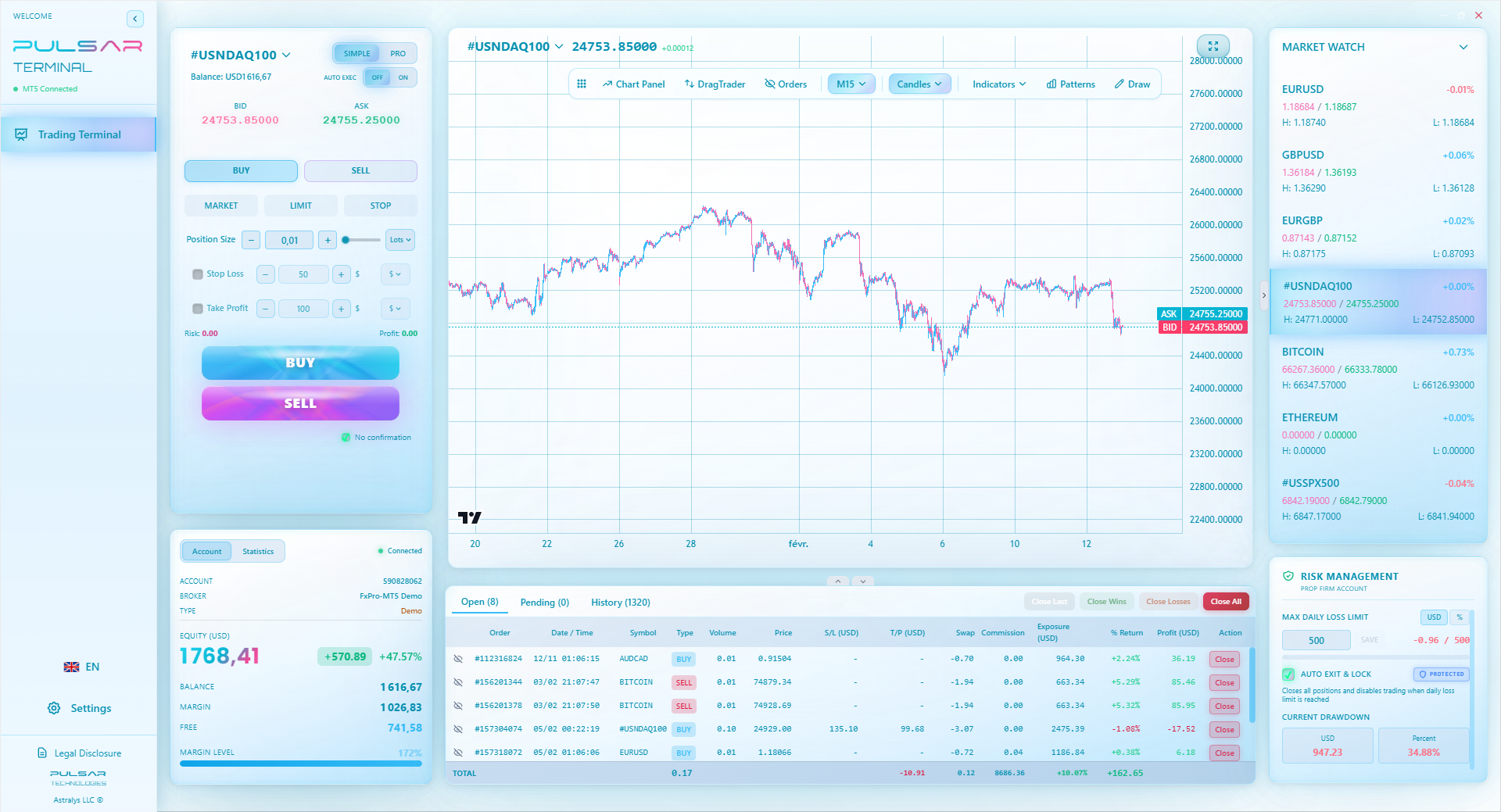
Executing a multi-take-profit strategy and moving stops to breakeven requires precision that's hard to manage manually, which is where a tool like Pulsar Terminal automates it directly on your MT5 platform.
Pulsar Terminal
Alat MT5 all-in-one: order drag-and-drop, multi-TP/SL, trailing stop, grid trading, Volume Profile, dan perlindungan prop firm. Digunakan 1.000+ trader setiap hari.
You now have more real knowledge than 90% of people who start forex currency trading in Nigeria. Here's what to do next.
- Open a Demo Account: Not for a week. For at least 3-6 months. Treat the virtual $50,000 like it's your real life savings. Practice the strategy above. Your goal isn't to double the account; your goal is to have 3 consecutive profitable months without violating your 1% risk rule.
- Fund a Live Account Slowly: Start with an amount you are 100% comfortable losing. I'm talking about $100-$200. The goal of this first live account is not to make money. The goal is to survive for 6 months without blowing it up. The psychological pressure is completely different from a demo.
- Ignore the Noise: You will be bombarded with WhatsApp signals, 'mentors' selling N500,000 courses, and forex prophets on YouTube. 99% are scams. If their strategy was so good, they'd be trading with it, not selling it. Your education should come from reputable sources, books, and your own journal.
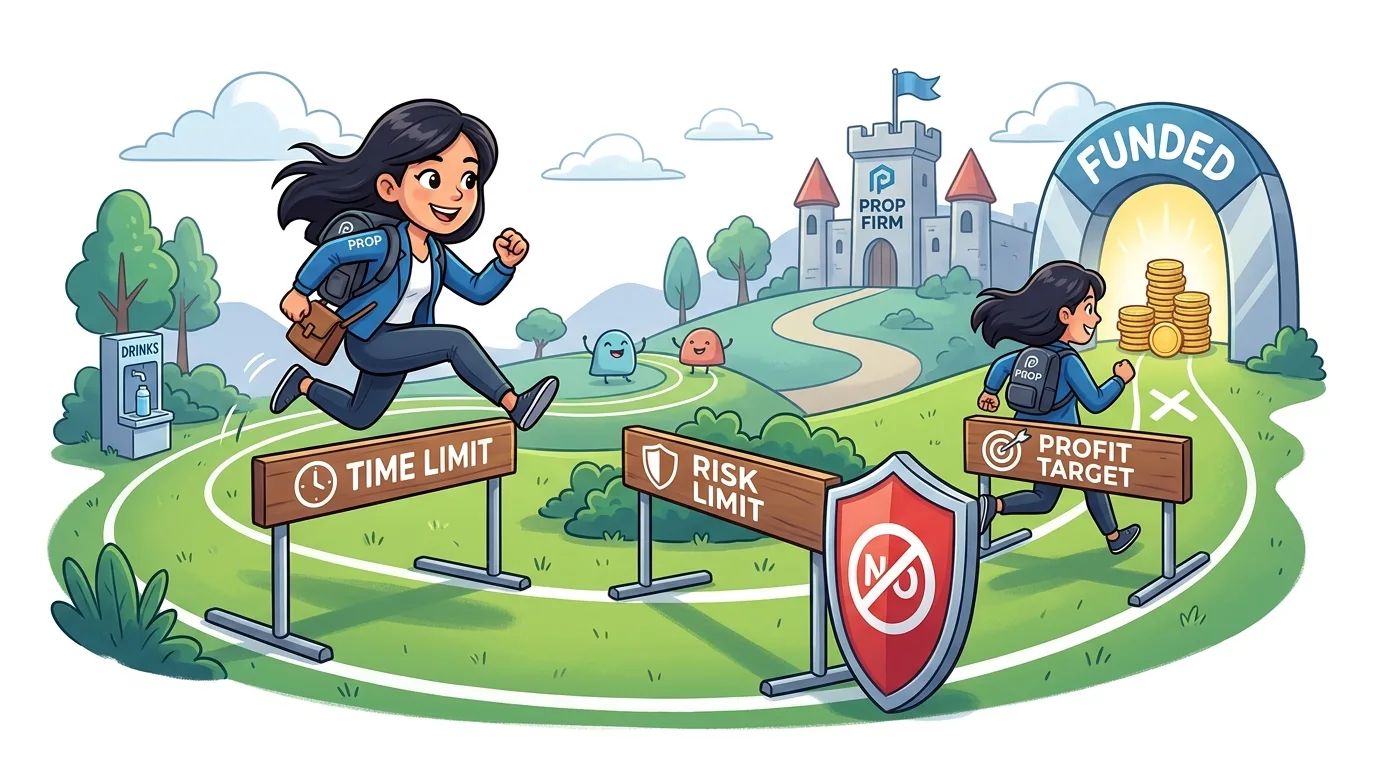
- Consider a Prop Firm Path: Once you have a proven, disciplined track record on your own small account, consider a prop firm challenge. They give you a larger simulated account to trade; you keep most of the profits. The key is their strict risk rules, which enforce the discipline you should already have. Passing their challenge requires iron-clad daily loss limits - something that can be managed automatically with the right trading toolkit, removing the emotional burden from you.
Forex currency trading is a marathon on a path littered with the wreckage of sprinting accounts. Be the tortoise. Be patient. Be disciplined. That's the only edge you need.

FAQ
Q1How much money do I need to start forex trading in Nigeria?
Technically, some brokers let you start with as little as $10. Practically, I wouldn't start a live account with less than $200. This allows you to trade micro lots (1,000 units) and properly implement the 1% risk rule without your position size being absurdly tiny. Your first deposit should be money you can afford to lose completely.
Q2What is the best time to trade forex in Nigeria?
The most liquid and volatile sessions overlap with our daytime. The London session opens at 8 AM Nigerian time, and the US session joins at 1:30 PM. The period from 8 AM to 5 PM Nigerian time is typically the most active, offering the best opportunities for day traders. The Asian session (late night for us) is usually quieter.
Q3Is forex trading taxable in Nigeria?
As of now, the Federal Inland Revenue Service (FIRS) does not have a specific, clear tax framework for individual retail forex trading profits. However, this is a grey area that could change. It's always wise to consult with a Nigerian tax professional for the most current advice, especially if you become consistently profitable.
Q4Can I trade forex with my Nigerian bank account?
Directly, no. Nigerian banks are not forex brokers. You will need to use an international broker. You fund your broker account via bank wire transfer (in USD, which your bank will convert from Naira) or through credit/debit cards (Mastercard/Visa) or approved cryptocurrency transfers. Always fund in USD to avoid hidden fees.
Q5Why do most Nigerian forex traders fail?
Three main reasons: 1) Using excessive use, wiping out accounts on small market moves. 2) No risk management - trading without stop losses and risking too much per trade. 3) The psychological pressure to 'make it' quickly in a tough economy, leading to impulsive, revenge trading after losses. Discipline is the rarest commodity.
Q6Should I use a signal service from a 'guru'?
Absolutely not. If they could reliably predict the market, they'd be trading for themselves, not selling signals. You never learn, you become dependent, and you have no idea of the risk management behind their calls. It's the fastest way to lose money while making someone else rich. Your education is your only true signal service.
Pelajaran Prof. Winston
Poin Penting:
- ✓Never risk more than 1% of capital per trade.
- ✓Use use under 1:30, always.
- ✓Match your trading style to your lifestyle.
- ✓The London session (8 AM Nigerian time) is prime.
- ✓Demo trade for 3-6 months minimum.
Seberapa bermanfaat artikel ini?
Klik bintang untuk menilai
Wawasan Trading Mingguan
Analisis & strategi mingguan gratis. Tanpa spam.
Tentang Penulis
Olumide Adeyemi
Pelopor Trading Afrika Barat
Salah satu edukator trading forex paling aktif di Nigeria. 8 tahun pengalaman trading dari Lagos. Spesialis strategi modal rendah dan tantangan prop firm untuk trader Afrika.
Komentar
Peringatan Risiko
Perdagangan instrumen keuangan mengandung risiko signifikan dan mungkin tidak cocok untuk semua investor. Kinerja masa lalu tidak menjamin hasil di masa depan. Konten ini hanya untuk tujuan edukasi dan tidak boleh dianggap sebagai nasihat investasi. Selalu lakukan riset Anda sendiri sebelum trading.
Anda mungkin juga suka

Cara Trading Forex Sukses: 7 Prinsip dari Trader Profesional
Cara trading forex sukses dengan 7 prinsip trader pro: manajemen modal, disiplin, journal trading, backtest. Data nyata, bukan janji profit palsu.
Jam Trading Forex Terbaik untuk Trader Indonesia: Panduan Lengkap dengan Tabel Waktu
Panduan jam trading forex untuk trader Indonesia. Tabel 4 sesi dunia, jam emas 20:00-00:00, sesi mana yang harus dihindari. Data akurat + tips dari trader berpengalaman.
Top 5 Sàn Forex Uy Tín Nhất 2026: Review Jujur dari Trader Indonesia
Top 5 sàn forex uy tín 2026 untuk trader Indonesia. Review jujur: spread, deposit, withdraw, dukungan lokal. Exness, XM, IC Markets & lebih.
Dapatkan Pulsar Terminal
Semua kalkulator ini terintegrasi dalam Pulsar Terminal dengan data real-time dari akun MT5 Anda.
Dapatkan Pulsar Terminal