


The screen was a sea of red.

Olumide Adeyemi
Pelopor Trading Afrika Barat ·  Nigeria
☕ 11 mnt baca
Yang akan Anda pelajari:
- 1Why Entry and Exit Matters More Than You Think
- 2The Three Pillars of a Solid Entry
- 3Building Your Exit Framework: Profit and Loss
- 4Advanced Exit Tactics: Partial Closes and Trailing
- 5Putting It All Together: A Trade Example
- 6Common Pitfalls (And How I Fell Into Them)
- 7Tailoring Your Strategy to Your Trading Style
- 8Your Action Plan to Start Today

The screen was a sea of red. It was March 2020, and USD/NGN forwards were going haywire. My finger hovered over the sell button on EUR/USD at 1.0980, convinced it would crash. I entered. It ripped up 50 pips against me in minutes. I didn't have a plan. No predefined stop loss, no target, just panic. That loss, over $800 on a single lot, wasn't about analysis. It was a total failure of strategy. That day in my Lagos apartment forced me to rebuild my entire approach to a forex entry and exit strategy from the ground up.
Most new traders in Nigeria, myself included years ago, get obsessed with the entry. We hunt for the perfect indicator, the magic signal that gets us in at the very bottom or top. It's a trap. The entry is just the ticket to the ride. The exit strategy is what determines if you get off with profit or get thrown off with a loss.
I used to think a 50-pip profit was great. Until I realized I'd left 150 pips on the table because I got scared and exited early. Other times, I watched a 30-pip profit turn into a 100-pip loss because I had no rule for when to get out. Your profit and loss are decided at the exit, not the entry. A mediocre entry with a brilliant exit plan will beat a brilliant entry with no plan every single time. This is the core of a sustainable forex entry and exit strategy.

Warning: The biggest mistake I see from traders at seminars in Abuja or Port Harcourt is focusing 90% of their effort on finding entries. Flip that. Spend 60% of your time planning your exit before you even consider clicking buy or sell.

💡 Tips Winston
Your first profit target should often be to cover your risk. Closing half at 1:1 Risk/Reward turns the rest of the trade into a free roll. Psychology is 80% of this game.
Your entry isn't a guess. It's a calculated decision based on confluence. I look for at least two, preferably three, of these factors aligning.
Price Action & Structure
This is your foundation. Forget fancy indicators for a second. Is price at a clear support or resistance level? Has there been a breakout and retest? I trade simpler now. For a buy, I want to see a higher low established on the chart. For a sell, a lower high. My worst trades were always when I tried to pick tops and bottoms against a strong trend, ignoring this basic structure.
Momentum Confirmation
Here's where an indicator like the RSI indicator or MACD indicator comes in. But don't use them in a vacuum. If I see price at support and the RSI is showing oversold conditions (below 30) and starting to curl up, that's a signal. If the MACD histogram is above zero and making higher lows in an uptrend, that's confirmation. I lost money for months using RSI divergences alone. They need the context of price structure.
The Catalyst (News & Volume)
This is especially crucial for pairs like EUR/NGN or GBP/NGN. Is there a Central Bank of Nigeria (CBN) announcement coming? US Non-Farm Payrolls? I don't trade the news directly (it's too volatile), but I use it to understand why a level might break. A strong support level holding during a high-impact news event becomes a much more significant level. I always check an economic calendar. Getting stopped out because you didn't know the Fed was speaking is an amateur mistake I've made too many times.
“A blown account from one bad trade is a rite of passage you can avoid.”
This is where you get paid. Your exit framework has two non-negotiable parts: the stop loss (SL) and the take profit (TP).
Stop Loss: Your Life Raft Your stop loss is not a suggestion. It's a hard exit. I place mine beyond the recent swing high/low or a key support/resistance level. Why beyond? To avoid getting taken out by normal market noise. If my analysis says support is at 1.0650 on EUR/USD, I'll place my stop at 1.0630, giving it a 20-pip buffer. You must know your exact risk in Naira before entering. Use a position size calculator religiously. I risk no more than 1-2% of my account on any single trade. A blown account from one bad trade is a rite of passage you can avoid.
Take Profit: The Art of Taking Money Off the Table There are two main schools of thought, and I use both depending on the market.
- Fixed Risk/Reward: This is the safest for beginners. Before the trade, you decide your reward will be 1.5x, 2x, or 3x your risk. If you risk 50 pips, your target is 75, 100, or 150 pips away. It's mechanical and removes emotion. This saved me during my first profitable year.
- Technical Exits: This is more advanced. You exit when price hits a major opposing resistance (for a long trade) or when your momentum indicator (like the MACD) shows signs of reversal. You often capture bigger moves, but you also risk giving back profits. I use this more for swing trading setups.

Example: Let's say you have a ₦500,000 account with a broker like Exness or IC Markets. You decide to risk 1% (₦5,000) on a USD/JPY trade. Your stop loss is 50 pips away. Since 1 pip on a standard lot of USD/JPY is roughly $10 (depending on rate), you can only trade a mini lot (0.1) to keep your risk within ₦5,000. Your position size is dictated by your stop loss. Never the other way around.
Once you're comfortable with basic SL and TP, these tactics can significantly boost your profitability. They're about managing a winning trade, which is psychologically harder than managing a loser.
Partial Closures (Scaling Out) This changed my game. Instead of one take-profit target, I set multiple. For example, on a long trade aiming for a 100-pip move, I might close 50% of my position at +50 pips. This covers my initial risk and some profit. I then move my stop loss on the remaining position to breakeven. Now, the rest of the trade is risk-free. I can let it run to my final 100-pip target or even further. The peace of mind this gives you is incredible. You've already banked profit, so you're not sweating the pullbacks.
Trailing Stop Losses A trailing stop automatically follows the price at a set distance. If you buy at 1.0800 with a 30-pip trailing stop and price moves to 1.0850, your stop moves up to 1.0820. It locks in profit as the trend continues. The key is setting the trail distance correctly. Too tight (10 pips), and you'll get stopped out by noise. Too wide (80 pips), and you give back most of your profit. I found a 20-25 pip trail works well for me on the 15-minute chart when scalping.

Pro Tip: Don't get fancy too early. Master a simple 1:2 risk-reward exit first. I added partial closures only after 6 months of consistent profit with my basic system. Adding too many variables at once is a recipe for confusion and loss.
💡 Tips Winston
If you can't draw your entire strategy - entry, stop, target - on the chart before you click, you have no strategy. You have a wish.

“Adding too many variables at once is a recipe for confusion and loss.”
Let me walk you through a real trade I took on XAU/USD (Gold) in Q4 2023. This shows the entire forex entry and exit strategy in action.
The Setup: Gold had been in a strong uptrend. It pulled back to a clear support zone around $1815, which was also a previous resistance-turned-support level (Pillar 1: Price Structure). The RSI indicator dipped near 40 and started turning up, showing the pullback momentum was fading (Pillar 2: Momentum). No major US news was due for hours (Pillar 3: Catalyst check).
The Entry & Risk: I entered a buy at $1817.50. The recent swing low was at $1814, so I placed my initial stop loss at $1813, a 4.5 pip risk ($4.50 per mini lot). My account risk was 1%, so I sized my position accordingly using my calculator.
The Exit Plan: My initial take-profit target was the previous high near $1835, about 175 pips away. That's a risk-reward of almost 1:4. However, I planned to use a partial close. I set a limit order to close half my position at $1828 (+105 pips). Once that hit, I moved my stop loss on the remaining half to breakeven ($1817.50).
The trade hit my first target. I then manually trailed a stop behind the rising price, eventually getting stopped out on the second half at $1832. Total result: First half: +105 pips. Second half: +145 pips. Averaged out, a very strong win. The pre-planned exit strategy meant I didn't have to make a single emotional decision once the trade was on. For more on trading gold, the XAU/USD guide breaks down its unique behavior.
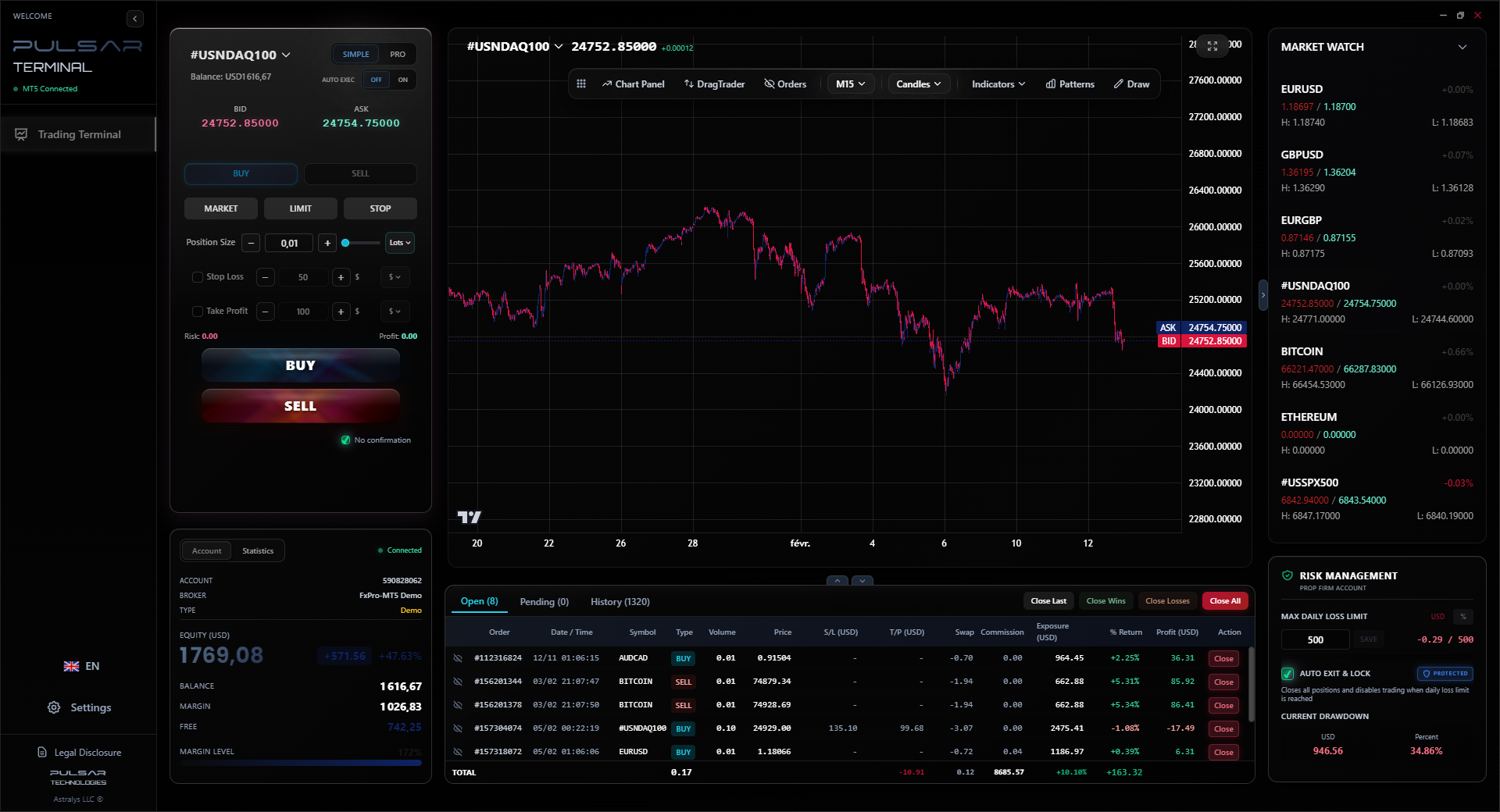
Managing multiple take-profit levels and moving stops to breakeven manually is stressful and error-prone; Pulsar Terminal automates this entire partial closure and risk-freeing process directly on your MT5 chart with a single click.
Pulsar Terminal
Alat MT5 all-in-one: order drag-and-drop, multi-TP/SL, trailing stop, grid trading, Volume Profile, dan perlindungan prop firm. Digunakan 1.000+ trader setiap hari.
You will make these mistakes. The goal is to make them once, learn, and never repeat them.
Moving Your Stop Loss Deeper: This is the number one account killer. Your trade goes 20 pips against you, and you think, 'It'll come back, I'll just widen the stop.' That's not managing a trade, that's hoping. I turned a $200 loss into a $1,200 loss on GBP/USD doing this. Your stop is sacred. If it gets hit, your analysis was wrong. Accept it and move on.
Taking Profit Too Early (FOMO Exit): You're in profit, price stalls for a second, and you panic-sell to 'lock it in.' This leaves massive money on the table. This stems from not trusting your system. If your target is 50 pips away and you exit at 15, you've just ruined your risk-reward math. Your system needs wins to cover future losses.
Revenge Trading: After a loss, you immediately jump into another trade to 'make it back.' Your emotions are in charge, not your strategy. This leads to even bigger losses. My rule now: After two consecutive losses, I shut down the platform for the day. Go for a walk, have a suya. The market will be there tomorrow.
Ignoring the Spread: When you're scalping for 5-10 pips, a 2-pip spread from a bad broker eats half your potential profit. This is why choosing a broker with tight, consistent spreads like Pepperstone or XM is a strategic decision, not just an administrative one.
“Your stop loss is not a suggestion. It's a hard exit.”
A forex entry and exit strategy for a scalper looks completely different from a swing trader's. You must fit the strategy to your personality and schedule.
For the Scalper (M5, M15 Charts):
- Entry: Needs ultra-precise triggers. I use 1-2 minute candles for final confirmation, often around key round numbers or liquidity zones.
- Exit: Tight stops (5-15 pips). Quick take-profits (10-30 pips). Risk-Reward can be lower (1:1 or 1:1.5) because win rate needs to be high. Partial closes are less common. It's a sprint. You need a broker with lightning execution and raw spreads.
For the Swing Trader (H4, Daily Charts):
- Entry: More patience. Wait for the full candle to close above/below a key level for confirmation. Confluence is key.
- Exit: Wider stops (50-200 pips). Larger profit targets (150-500+ pips). Risk-Reward should be higher (1:3 minimum). Partial closures and trailing stops are extremely effective here. This is a marathon. You check charts maybe twice a day.
I started as a scalper, thinking fast money was the way. The stress was immense and my results were inconsistent. I found my rhythm in swing trading on the H4 chart. It suited my analytical nature and didn't tie me to the screen. Be honest with yourself about which style fits your life.
💡 Tips Winston
The best traders are not right most often. They are wrong expensively less often than they are right profitably. It's about the size of your wins versus your losses.
Don't just read this and do nothing. Here's how to build your own strategy this week.
- Backtest, Don't Guess: Take your idea (e.g., 'Buy when RSI is oversold at daily support'). Go to your MT4/MT5, open the historical chart for EUR/USD, and go back 6 months. Scroll forward, candle by candle. Mark every time your entry condition occurred. Did price go up? How far? Where would a sensible stop loss have been? Write down the results for 20-30 instances. This is how you find out if an idea has an edge, before risking a single kobo.
- Define Your Rules in Writing: In a notebook or Google Doc, write down your exact entry criteria (all pillars). Write down your exact stop loss rule (e.g., 'Place SL 15 pips beyond the swing low'). Write down your exact take profit rule (e.g., 'TP1 at 1:1.5 RR, close 50%, move SL to breakeven. TP2 at next resistance level').
- Demo Trade for One Month: Execute this written plan on a demo account for a full month. No deviations. Your goal is not profit, but to follow your plan 100%. Track every trade in a journal: entry, exit, reason, emotion.
- Review and Refine: At the month's end, review your journal. Where did you deviate? Why? Did your rules work? Tweak only one small thing at a time, then demo for another two weeks.
This process is boring. It's not glamorous. But it's the only thing that separates the consistent traders from the perpetual losers. I wish someone had given me this action plan 12 years ago. It would have saved me thousands of dollars and countless sleepless nights in Lagos.

FAQ
Q1What's the most important part of a forex entry and exit strategy?
The exit, specifically your stop loss. A perfect entry is useless if you don't know when you're wrong. Defining and respecting your stop loss protects your capital, which is your only tool for trading. Everything else builds from that foundation of survival.
Q2How do I know where to place my stop loss?
Place it at a price level that, if hit, proves your trade idea wrong. Technically, that's usually just beyond a recent swing high (for a short trade) or swing low (for a long trade), or beyond a key support/resistance zone. Never place it based on how much money you're willing to lose. The market doesn't care about your wallet. Use the chart to decide, then use a position size calculator to adjust your lot size to fit your risk tolerance.
Q3Is a 1:1 risk-to-reward ratio good enough?
It can be, but it's a tough way to live. A 1:1 ratio means you need to win more than 50% of your trades just to break even after accounting for the spread. Most successful strategies I've seen and used aim for a minimum of 1:1.5 or 1:2. This allows you to be wrong more often than you're right and still be profitable, which is a more realistic psychological position.
Q4I keep moving my stop loss. How can I stop?
This is an emotional discipline problem, not a strategy one. Two fixes: 1) Use a broker platform that allows 'Stop Loss Only' orders, so you can't modify it once the trade is live without canceling the entire order. 2) Mentally, treat the stop loss as part of the trade's cost. Once you click buy/sell, consider that money already lost if the stop is hit. Your job is to manage the potential profit, not try to avoid a loss that's already been budgeted for.
Q5Can I use the same entry and exit strategy for all currency pairs?
Not exactly. The core principles (confluence, defined exits) apply everywhere. But you need to adjust for a pair's personality. A strategy that works on slow-moving EUR/CHF might get shredded on volatile GBP/JPY. Your stop loss distances and profit targets will need to be wider for more volatile pairs. Always test your specific strategy on the pair you intend to trade.
Q6How do I handle news events with my strategy?
My rule is simple: I don't hold trades through high-impact news events (like NFP, CPI, CBN meetings) unless I'm already in significant profit with a stop at breakeven. The volatility can easily blow through your technical stop loss, causing a larger loss than you planned (slippage). Either close your trade before the news or widen your stop significantly understanding the increased risk. Better yet, just stay out and watch how the market reacts - it gives you cleaner levels to trade afterward.
Q7What should I do if I'm constantly stopped out before price reverses in my favor?
This usually means your stop loss is too tight relative to the pair's normal volatility. Go to a higher time frame (e.g., from M15 to H1) and place your stop based on those swings. Also, ensure you're placing your stop beyond obvious liquidity points where everyone else has their stops clustered, as markets often hunt for those orders before reversing.
Pelajaran Prof. Winston
Poin Penting:
- ✓Define your exit before your entry. Every time.
- ✓Risk a maximum of 1-2% of your capital per trade.
- ✓Aim for a minimum 1:1.5 risk-to-reward ratio.
- ✓Test any strategy with 20+ historical examples first.
- ✓After two losses, walk away for the day.
Seberapa bermanfaat artikel ini?
Klik bintang untuk menilai
Wawasan Trading Mingguan
Analisis & strategi mingguan gratis. Tanpa spam.
Tentang Penulis
Olumide Adeyemi
Pelopor Trading Afrika Barat
Salah satu edukator trading forex paling aktif di Nigeria. 8 tahun pengalaman trading dari Lagos. Spesialis strategi modal rendah dan tantangan prop firm untuk trader Afrika.
Komentar
Peringatan Risiko
Perdagangan instrumen keuangan mengandung risiko signifikan dan mungkin tidak cocok untuk semua investor. Kinerja masa lalu tidak menjamin hasil di masa depan. Konten ini hanya untuk tujuan edukasi dan tidak boleh dianggap sebagai nasihat investasi. Selalu lakukan riset Anda sendiri sebelum trading.
Anda mungkin juga suka

Cara Trading Forex Sukses: 7 Prinsip dari Trader Profesional
Cara trading forex sukses dengan 7 prinsip trader pro: manajemen modal, disiplin, journal trading, backtest. Data nyata, bukan janji profit palsu.
Jam Trading Forex Terbaik untuk Trader Indonesia: Panduan Lengkap dengan Tabel Waktu
Panduan jam trading forex untuk trader Indonesia. Tabel 4 sesi dunia, jam emas 20:00-00:00, sesi mana yang harus dihindari. Data akurat + tips dari trader berpengalaman.
Top 5 Sàn Forex Uy Tín Nhất 2026: Review Jujur dari Trader Indonesia
Top 5 sàn forex uy tín 2026 untuk trader Indonesia. Review jujur: spread, deposit, withdraw, dukungan lokal. Exness, XM, IC Markets & lebih.
Dapatkan Pulsar Terminal
Semua kalkulator ini terintegrasi dalam Pulsar Terminal dengan data real-time dari akun MT5 Anda.
Dapatkan Pulsar Terminal