


Most Nigerian traders waste their time on the wrong currency pairs.

Olumide Adeyemi
Pelopor Trading Afrika Barat ·  Nigeria
☕ 11 mnt baca
Yang akan Anda pelajari:
Most Nigerian traders waste their time on the wrong currency pairs. They chase exotic combos or local Naira crosses without understanding the liquidity, spreads, and predictable patterns that actually make money. I made that mistake for years, burning through capital on volatile pairs before realizing the simple truth: mastering just a few forex major pairs is enough to build consistent returns. In this guide, I'll show you exactly which pairs work for our market, break down the real costs (including that 10% tax hit), and share the hard lessons from my own trading journal.
When traders talk about forex major pairs, they usually mean the seven most liquid pairs globally: EUR/USD, USD/JPY, GBP/USD, USD/CHF, AUD/USD, USD/CAD, and NZD/USD. These are the heavyweights, where the US dollar is always one side of the trade.
But here's the Nigerian reality. While you can technically trade all of them, only a handful behave in ways that are predictable enough for our trading hours and market knowledge. According to broker data, about 80% of Nigerian forex traders focus on just two: EUR/USD and USD/JPY. That's not a coincidence.
Let me tell you why I eventually settled on these. Early on, I tried trading GBP/USD during the London session. Sounds good, right? Except I was placing trades at 2 PM Nigerian time, right when volatility often spiked. Without a solid understanding of UK economic data releases, I got stopped out constantly. I lost $420 in one week on GBP trades before I admitted I was out of my depth.
EUR/USD became my workhorse. It's the most liquid pair in the world, which means tighter spreads (more on that later) and cleaner technical patterns. For Nigerian traders, the European session overlaps with our late morning and afternoon, making it accessible. USD/JPY is the other key player. It reacts strongly to US Treasury yields and Bank of Japan rhetoric, which is widely reported and easier to follow.

Warning: Don't confuse global majors with local Naira pairs. USD/NGN, EUR/NGN, and GBP/NGN are a completely different beast. They're heavily influenced by Central Bank of Nigeria (CBN) policies, local liquidity, and can be difficult to access with competitive spreads through international brokers. Stick to the global majors for your core strategy.
The other majors like AUD/USD and USD/CAD are tradeable, but they require understanding specific commodity economies (iron ore for Australia, oil for Canada). They're a step up in complexity. For now, build your foundation on EUR/USD and USD/JPY. You can learn more about the specific dynamics of trading the Euro in our EUR/USD guide.

💡 Tips Winston
Stop looking for the 'next' pair. Master EUR/USD first. Understand how it reacts to ECB speeches, US inflation data, and daily liquidity flows. One mastered pair is worth ten half-understood ones.
“Mastering just a few forex major pairs is enough to build consistent returns.”
Everyone talks about profits. Let's talk about costs, because that's where many Nigerian traders get blindsided. Your profit isn't just entry minus exit. It's entry, minus exit, minus spread, minus potential commission, minus 10% to the taxman.
Spreads: Your Silent Partner (Who Takes a Cut)
The spread is the difference between the buy and sell price. It's how many brokers make their money. On a major pair like EUR/USD, this cost can vary wildly. On a standard account with a broker like XM or Exness, you might see an average spread of 0.9 to 1.6 pips. On a raw spread account (where you pay a commission per trade), it can be as low as 0.0 pips plus a $3.50 commission per lot.
Here's a real comparison from my testing in 2024:
| Broker & Account Type | EUR/USD Avg. Spread | Minimum Deposit | Best For |
|---|---|---|---|
| Exness Standard | ~1.0 pip | $10 | Beginners, low capital |
| XM Zero Account | 0.0 pips + $3.5/lot commission | $5 | High-volume traders |
| IC Markets Raw Spread | 0.1 pips + $3.5/lot commission | $200 | Serious scalpers |
I started on a standard account. Seemed cheaper, no commission. But when I started scalping, those 1-pip spreads killed my edge. A 5-pip target suddenly needed a 6-pip move just to break even. Switching to a raw spread account with a broker like IC Markets was a game-changer for my short-term strategy.
The 10% Tax You Can't Forget
This is non-negotiable. The Nigerian government requires a 10% capital gains tax on your gross trading profits. Let's say you make a profit of ₦500,000 in a year. You owe ₦50,000 in tax. It applies whether you use a local platform or an international broker like Pepperstone or AvaTrade. Keep careful records. I set aside 10% of every profitable withdrawal into a separate account. It's not my money; it's the taxman's.
use: A Double-Edged Sword
Brokers offer high use to Nigerian clients - sometimes up to 1:2000. This is incredibly dangerous. use amplifies both gains and losses. Using our position size calculator is non-optional. On a $500 account with 1:100 use, a 1% move against you wipes out 100% of your margin. I learned this the hard way in 2019 on a USD/JPY trade. I was over-leveraged, a news spike hit, and I got a margin call that closed my position for a $180 loss. That was over a third of my account at the time.

Pro Tip: For trading major pairs, start with use no higher than 1:30. It forces you to use sensible position sizes and survive the normal volatility of these markets. You can read more about managing this risk in our XM review, which details their use offerings and protections.
“Your profit isn't just entry minus exit. It's entry, minus exit, minus spread, minus commission, minus 10% to the taxman.”
You can have the best strategy in the world, but if your broker has unreliable execution or hidden fees, you'll lose. For trading forex major pairs from Nigeria, you need a broker that checks these boxes: tight spreads on EUR/USD/USD/JPY, reliable Naira deposit/withdrawal options, and a platform you can trust.
Most successful Nigerian traders I know use internationally regulated brokers. The local regulatory scene for online retail forex is still developing. We rely on authorities like the UK's FCA, Cyprus's CySEC, or South Africa's FSCA to keep brokers honest.
Payment methods are critical. You need a broker that accepts local bank transfers, USSD, or fintech wallets like Opay or Moniepoint. The days of struggling with international cards are fading. Brokers like Exness and HF Markets have integrated these local options seamlessly. I fund my Exness account directly from my bank app; it reflects in minutes.
Platform is everything. MT4 and MT5 are the undisputed kings in Nigeria. Their familiarity, customizability, and the vast library of indicators and Expert Advisors (EAs) make them the only choice for serious analysis. Some brokers, like Pepperstone, offer fantastic additional tools, but MT5 is my home base. I use it for all my charting and order placement for major pairs.
A quick note on safety: Always verify the broker's regulatory license on the regulator's website. Don't just trust the logo on their homepage. I once nearly deposited with a "broker" that had a fake FCA number. A two-minute check on the FCA register saved me.
“Complex strategies fail under pressure. For majors, I use a stripped-down approach focusing on structure and momentum.”
Complex strategies fail under pressure. For majors, I use a stripped-down approach focusing on structure and momentum. Here's the framework that turned my trading around.
1. The Daily Chart Defines the Battlefield. Before I even look at a 1-hour or 15-minute chart, I spend 10 minutes on the daily. I'm asking one question: what's the broader trend? I draw the most recent clear swing highs and lows. If price is making higher highs and higher lows, my bias on lower timeframes is to look for buys. I only sell if I see a very clear rejection or break of structure. This one habit stopped me from trying to pick tops and bottoms, which was a massive leak in my early account.
2. Use Two Indicators, Not Ten. Indicators should confirm price action, not confuse it. I use the RSI indicator (set to 21 periods) to gauge momentum and potential overbought/oversold conditions within the trend. I combine it with the MACD indicator on the 4-hour chart to confirm trend direction and strength. If the daily trend is up, I look for the RSI to pull back to 40-50 on the 4-hour chart and start curling back up, with the MACD histogram above its zero line.
3. Entry and Risk on the 1-Hour Chart. This is where I place my trade. I look for a clear price action signal - like a bullish engulfing candle or a pullback to a previous support level - that aligns with my daily bias and indicator setup.
Here's a real trade from my journal:
- Pair: EUR/USD
- Date: March 15, 2024
- Daily Trend: Bullish (higher highs/lows)
- 4H Setup: RSI pulled back to 45, MACD still positive.
- 1H Entry: Bullish pin bar at 1.08850 (a prior resistance turned support).
- Stop Loss: Placed at 1.08600 (250 pips / $25 risk on a 0.1 lot).
- Take Profit: 1.09500 (650 pips / $65 target).
- Result: Hit TP in 36 hours. A clean 2.6:1 risk-to-reward trade.
The key was patience. I waited two days for that 1-hour setup to align with the higher-timeframe story. This is the essence of swing trading the majors.
💡 Tips Winston
Your weekly loss limit is your lifeline. Write it down. Tell a trading friend. When you hit it, walk away. The market will always be there tomorrow. Your capital might not be if you revenge trade.
“Complex strategies fail under pressure. For majors, I use a stripped-down approach focusing on structure and momentum.”
Let's get painfully honest. My path to profitability with major pairs was paved with errors. Here are the big ones.
Mistake 1: Trading During Low Liquidity. I used to try and trade the EUR/USD at 11 PM Nigerian time. That's the late New York session/Asian morning. Spreads widen, and price can drift erratically. I'd get filled at a bad price and then watch the market sit still for hours. Now, I focus on the London open (8 AM-12 PM our time) and the London/New York overlap (1 PM-4 PM our time). Liquidity is high, spreads are tight, and moves are more reliable.
Mistake 2: Ignoring Economic Calendars. Major pairs move on data. I once held a long USD/JPY position into a US Non-Farm Payroll (NFP) announcement out of greed. The number was a huge miss against expectations. The pair dropped 80 pips in 10 seconds, blew through my stop loss (slippage), and turned my potential winner into my biggest loss of the month. I now clear all major pair positions before high-impact news events unless I'm intentionally trading the news (which is a whole other skill).
Mistake 3: Chasing After a Big Move. You see EUR/USD rocket up 100 pips. The fear of missing out (FOMO) kicks in. You buy at the top. Then it retraces 50 pips, you panic and sell. I've done this more times than I care to admit. The major pairs trend well, but they don't go straight up or down. They breathe. Wait for the pullback, the consolidation. Entering after a explosive move is a recipe for getting caught in a reversal. Discipline to wait is the hardest skill to learn.

Example: Let's say you're trading Gold (XAU/USD) alongside your majors. The same principles apply, but the volatility is higher. Check our XAU/USD guide for the specific nuances of trading precious metals.
“Entry is easy. Management is where careers are made or broken.”
Entry is easy. Management is where careers are made or broken. Here's my system.
1. The Breakeven Shift. Once a trade moves in my favor by 1.5 times my initial risk (e.g., my stop was 20 pips away, price moves 30 pips in my favor), I move my stop loss to my entry price. This turns a risky trade into a risk-free one. It protects you from those vicious reversals that turn winners into losers. I automate this where possible.
2. Partial Profits are Real Profits. I rarely hold a full position to one target. On a 0.2 lot trade, I might close 0.1 lot at a 1:1 risk-to-reward ratio. This banks some profit and pays for the trade's risk. I then move the stop on the remaining half to breakeven and let it run. This psychologically frees you up to aim for larger gains on the runner.
3. Have a Weekly Loss Limit. This saved my account. I set a hard rule: if I lose 3% of my total capital in a week, I stop trading. I close the platform. I go for a walk. I review my trades on Monday. This prevents the emotional "revenge trading" spiral that follows a bad loss. In February, I hit my 3% limit on a Tuesday after two bad USD/JPY trades. Stopping saved me from what would have been a 10% down week, as the market chopped sideways for the next three days.
Managing multiple orders and adjusting stops quickly is crucial. Doing it manually on a fast-moving pair like GBP/USD is stressful. This is where having the right tools makes all the difference.
💡 Tips Winston
That 10% tax isn't a suggestion. Open a separate savings account and transfer 10% of every single profitable withdrawal into it immediately. Future you will thank present you for the discipline.
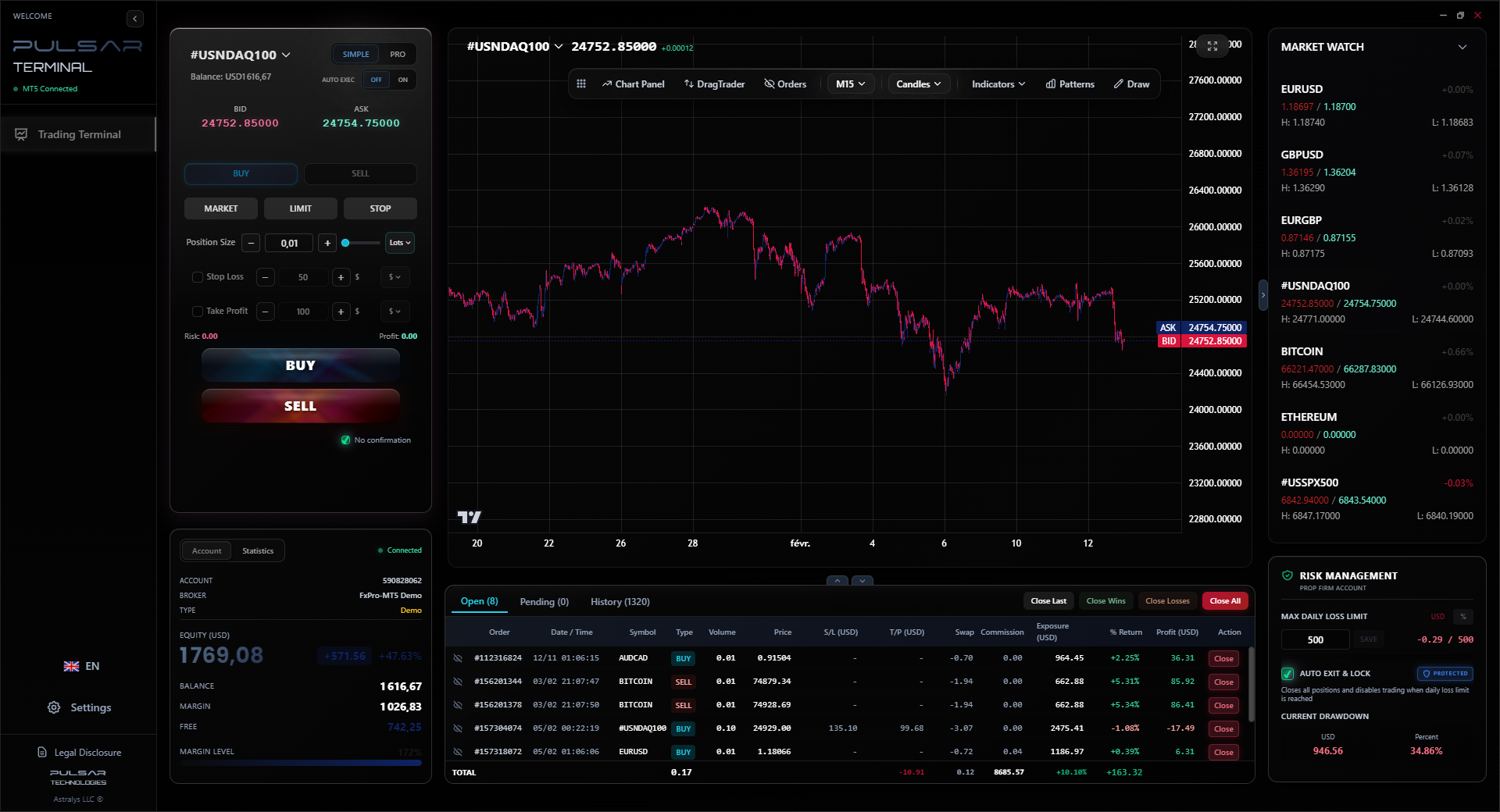
Managing multiple orders and adjusting stops quickly is crucial, and Pulsar Terminal automates breakeven shifts, partial closures, and trailing stops directly on your MT5 charts.
Pulsar Terminal
Alat MT5 all-in-one: order drag-and-drop, multi-TP/SL, trailing stop, grid trading, Volume Profile, dan perlindungan prop firm. Digunakan 1.000+ trader setiap hari.
FAQ
Q1Is forex trading legal in Nigeria?
Yes, forex trading is legal for individuals in Nigeria. You can use your personal funds to trade with both local and international brokers. However, the online retail forex space is still developing its specific regulations. The Central Bank of Nigeria (CBN) oversees the broader FX market, and you must pay a 10% capital gains tax on all profits.
Q2Which forex major pair is best for beginners in Nigeria?
EUR/USD is the best starting point. It has the highest liquidity, which means the lowest and most stable spreads. It moves in predictable trends and reacts to well-publicized European and US economic news, which is easier to follow. Avoid starting with more volatile pairs like GBP/USD or commodity-dependent pairs like AUD/USD.
Q3How much money do I need to start trading major pairs?
You can start with a very small amount. Brokers like XM and Exness allow minimum deposits as low as $5-$10. However, to trade sensibly with proper risk management (e.g., risking no more than 1% per trade), a starting capital of at least $200-$500 is more realistic. This allows you to withstand normal market volatility without being wiped out by a few losing trades.
Q4What is the 10% capital gains tax on forex profits?
It's a tax levied by the Nigerian government on your gross profits from trading. If you make ₦1,000,000 in profit in a year, you owe ₦100,000 in tax. This applies regardless of whether you use a Nigerian or international broker. You are responsible for declaring this income and paying the tax.
Q5Can I trade forex major pairs with Naira?
While your broker account might be denominated in USD, EUR, or GBP, many brokers now offer direct Naira (NGN) deposit and withdrawal methods. You fund your account in Naira, it's converted by the broker, and you trade the standard major pairs like EUR/USD. Some brokers, like HF Markets, even offer Naira as a base currency for your trading account.
Q6Should I use MT4 or MT5 for trading majors?
Both are excellent. MT4 is slightly simpler and has a larger library of old custom indicators and EAs. MT5 is more modern, allows more pending order types, and has better backtesting capabilities. For trading major forex pairs, either is fine. I prefer MT5 for its depth of market feature and improved charting tools. Most Nigerian traders are on MT4, but MT5 is the future.
Q7Why do spreads matter so much for major pairs?
Spreads are a direct transaction cost. On a pair like EUR/USD, you might aim for a 10-pip profit. If the spread is 2 pips, the market has to move 12 pips in your favor just for you to break even. If the spread is 0.5 pips, it only needs to move 10.5 pips. Over dozens of trades, lower spreads significantly increase your potential profitability, especially for strategies like scalping.
Pelajaran Prof. Winston
Poin Penting:
- ✓Focus on EUR/USD & USD/JPY; they offer the best liquidity for Nigerian traders.
- ✓Always factor in the 10% capital gains tax on gross profits.
- ✓Use use of 1:30 or less to survive normal market volatility.
- ✓Move your stop to breakeven after a 1.5x risk move.
- ✓Set a hard weekly loss limit of 3% of your capital.
Seberapa bermanfaat artikel ini?
Klik bintang untuk menilai
Wawasan Trading Mingguan
Analisis & strategi mingguan gratis. Tanpa spam.
Tentang Penulis
Olumide Adeyemi
Pelopor Trading Afrika Barat
Salah satu edukator trading forex paling aktif di Nigeria. 8 tahun pengalaman trading dari Lagos. Spesialis strategi modal rendah dan tantangan prop firm untuk trader Afrika.
Komentar
Peringatan Risiko
Perdagangan instrumen keuangan mengandung risiko signifikan dan mungkin tidak cocok untuk semua investor. Kinerja masa lalu tidak menjamin hasil di masa depan. Konten ini hanya untuk tujuan edukasi dan tidak boleh dianggap sebagai nasihat investasi. Selalu lakukan riset Anda sendiri sebelum trading.
Anda mungkin juga suka

Cara Trading Forex Sukses: 7 Prinsip dari Trader Profesional
Cara trading forex sukses dengan 7 prinsip trader pro: manajemen modal, disiplin, journal trading, backtest. Data nyata, bukan janji profit palsu.
Jam Trading Forex Terbaik untuk Trader Indonesia: Panduan Lengkap dengan Tabel Waktu
Panduan jam trading forex untuk trader Indonesia. Tabel 4 sesi dunia, jam emas 20:00-00:00, sesi mana yang harus dihindari. Data akurat + tips dari trader berpengalaman.
Top 5 Sàn Forex Uy Tín Nhất 2026: Review Jujur dari Trader Indonesia
Top 5 sàn forex uy tín 2026 untuk trader Indonesia. Review jujur: spread, deposit, withdraw, dukungan lokal. Exness, XM, IC Markets & lebih.
Dapatkan Pulsar Terminal
Semua kalkulator ini terintegrasi dalam Pulsar Terminal dengan data real-time dari akun MT5 Anda.
Dapatkan Pulsar Terminal