


Here’s a number that should make you pause: only about 30% of forex traders consistently make money.

David van der Merwe
Trader Pasar Berkembang ·  South Africa
☕ 9 mnt baca
Yang akan Anda pelajari:
- 1Forex 101: The South African Reality Check
- 2Building Your Edge: Strategy Over Hype
- 3Risk Management: The Only Non-Negotiable
- 4Brokers, Platforms, and the Tools You Actually Need
- 5The Psychology Battle: Your Mind is Your Biggest Enemy
- 6The Boring Stuff (That Saves You): Tax & Legalities
- 7Your Action Plan: From Zero to Consistent
Here’s a number that should make you pause: only about 30% of forex traders consistently make money. That means 7 out of 10 people funding the market are losing. In South Africa, with unemployment pushing 43%, the dream of trading your way out is powerful. I get it. I’ve been there. But what most ‘gurus’ sell as a forex masterclass is just a shortcut to donating your capital. This isn’t that. This is a real, grounded guide to building skill, not just hope, in the ZAR market.
Let's clear the air first. Forex trading here isn't the wild west, but it's got its own unique rules. The Financial Sector Conduct Authority (FSCA) is your watchdog. Any broker you seriously consider must be licensed by them. This isn't a nice-to-have; it's your first line of defense for fund safety.
The biggest local quirk? You can't directly speculate against the Rand (ZAR) from within South Africa. That means no shorting USD/ZAR hoping the Rand crashes. The South African Reserve Bank's exchange controls block it. So, your playground is major pairs like EUR/USD, GBP/USD, and commodities like gold (XAU/USD). This actually simplifies things - you're trading global markets, not getting tangled in local politics.

Warning: If a platform or 'mentor' on Telegram promises insane returns on ZAR pairs and isn't FSCA-licensed, run. The FSCA recently fined someone over R1 million for running an unlicensed signals service. That's the risk you avoid by sticking to the rules.
Your use is capped at 30:1 for retail traders. After seeing friends get wiped out with 500:1 use in the early days, I can tell you this limit is a blessing in disguise. It forces you to use proper position size calculator and stops you from blowing an account in one bad trade. Professional status for higher use requires serious proof of experience and capital - most beginners won't qualify, and that's okay.

💡 Tips Winston
The market's job is to make you feel stupid. Your job is to not act stupid in response. Write your trading plan when you're calm, and follow it when you're not.
“Your use is capped at 30:1 for retail traders. After seeing friends get wiped out, I can tell you this limit is a blessing in disguise.”
An edge is simply a repeatable reason to be right more often than wrong. It's not a secret indicator. For most South Africans starting out, your edge comes from discipline and understanding one thing really well.
Start With Price Action
Forget the 10 indicators on your screen. I spent two years overcomplicating charts before a mentor made me delete everything but candlesticks and support/resistance lines. Price action - reading the story of supply and demand through bars and swings - is universal. It works on EUR/USD at 3 AM just as well as it does on the JSE Top 40. Focus on identifying clear swing highs and lows, and understanding what a breakout or rejection really looks like.
Find Your Timeframe Personality
Are you patient or impulsive? If you're checking your phone every 5 minutes, maybe scalping strategy isn't for you. I'm a swing trader at heart. My most profitable trade last year was on GBP/JPY. I bought at 178.50 based on a weekly chart support bounce, set a stop at 177.80 (70 pips), and walked away for a week. I closed half at 180.00 and let the rest run to 182.20. That 370-pip win on half the position didn't require me to stare at a screen. It required patience. Swing trading fits a lot of South Africans who have day jobs.

Pro Tip: Paper trade your strategy for at least 100 trades. Not 10, 100. Log every entry, exit, and your reasoning. Until you can show a consistent profit over those 100 simulated trades, your real money isn't safe. This is the most skipped step in any forex masterclass.
“Paper trade your strategy for at least 100 trades. Not 10, 100. Until you can show a consistent profit over those 100 simulated trades, your real money isn't safe.”
This is where the 70% fail. They focus on profit targets and ignore the downside. My rule is brutal: never risk more than 1% of your trading capital on a single trade. On a R20,000 account, that's R200. If your stop loss is 50 pips away, your position size calculator should tell you the exact lot size that makes a 50-pip loss equal to R200.
I learned this the hard way. In 2016, I was convinced the ECB would be dovish. I put 5% of my account on EUR/USD right before the press conference. The news was hawkish. The pair dropped 80 pips in minutes, and I lost 4% of my entire account in one go. It took me six weeks of careful trading just to dig back to even. That one emotional decision erased six weeks of work.

Example: You have a R15,000 account. 1% risk = R150. You want to buy GBP/USD at 1.2600 with a stop at 1.2570 (30 pips). R150 / 30 pips = R5 per pip. On GBP/USD, a standard lot is about $10 per pip (ZAR ~R185). So, you'd trade a micro lot (0.01) which is about R1.85 per pip. R1.85 * 30 pips = R55 risk. That's actually under your limit. You could size up slightly to a 0.02 lot (R3.70/pip) for a R111 risk. See how the math dictates the trade?
Always know your exit before your entry. A stop loss isn't a suggestion. A margin call is what happens when you treat it like one.
💡 Tips Winston
If you can't explain your trade setup in one simple sentence ('price bounced off the weekly support'), it's too complicated. Complexity is the enemy of execution.
“Paper trade your strategy for at least 100 trades. Not 10, 100. Until you can show a consistent profit over those 100 simulated trades, your real money isn't safe.”
Choosing a broker isn't about who offers the highest use. It's about reliability, costs, and execution. For South Africans, FSCA regulation is the baseline. Beyond that, look at the spread - the difference between the buy and sell price. It's your immediate cost.
Let's compare a few major players:
| Broker | FSCA Regulated? | Min. Deposit (ZAR Approx.) | Avg. EUR/USD Spread | Key Note |
|---|---|---|---|---|
| IG | Yes | ~R5,700 | 0.98 pips | Top-tier, great for beginners & education. |
| XM | Yes | ~R90 | 0.6-0.8 pips | Very low barrier to entry. |
| Exness | Yes | ~R180 | From 0.0 pips | Popular for raw spread accounts. |
| IC Markets | Yes (via global entity) | ~R900 | 0.1 pips | Favorite among serious scalpers. |
I've had accounts with XM and IC Markets. XM's platform was rock-solid for my swing trades, and their customer service, based in Cape Town, was surprisingly helpful. IC Markets' raw spreads are fantastic for when I test more active strategies.
For platforms, MetaTrader 5 (MT5) is the industry standard for a reason. It's strong, widely supported, and the charts are excellent. Don't get distracted by flashy alternative platforms until you've mastered MT5. All your energy should go into reading the chart, not learning new software buttons.
A simple toolset is best: learn the RSI indicator to spot overbought/oversold conditions, and the MACD indicator for trend momentum and potential reversals. Use them to confirm what price action is already telling you.
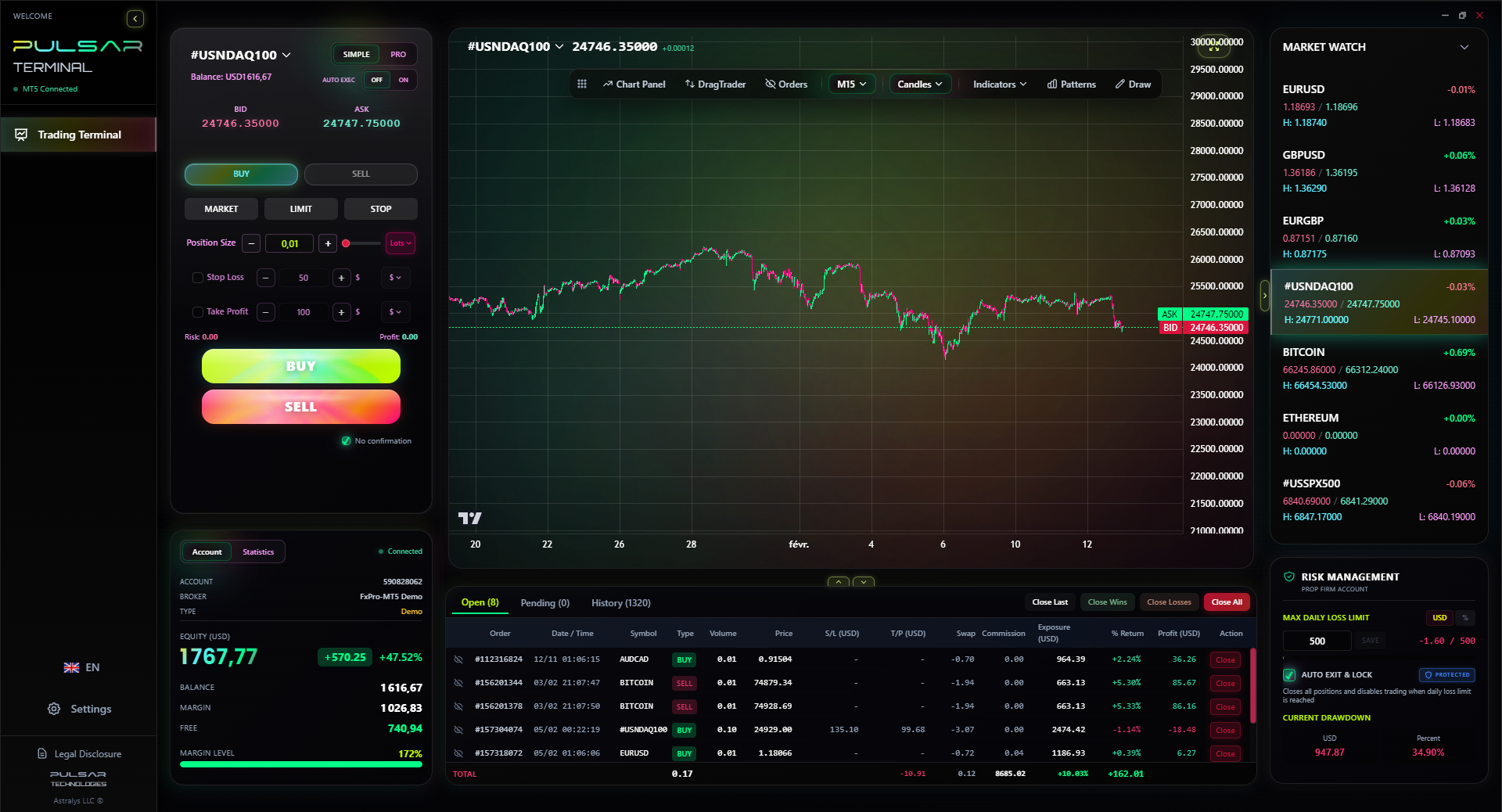
Managing multiple trades and setting precise stops and targets is critical, and tools like Pulsar Terminal automate this directly on your MT5 platform.
Pulsar Terminal
Alat MT5 all-in-one: order drag-and-drop, multi-TP/SL, trailing stop, grid trading, Volume Profile, dan perlindungan prop firm. Digunakan 1.000+ trader setiap hari.
“A good trade is one with a solid plan and managed risk, not necessarily one that wins. Sometimes the market just moves against you. That's okay.”
This is the true forex masterclass - the one that happens between your ears. Greed makes you let winners run into losers. Fear makes you cut winners short. Ego makes you revenge trade after a loss.
I have a post-it note on my monitor: 'Am I trading the chart, or my P&L?' If you're constantly watching the floating profit/loss, you're not trading the chart anymore. You're trading an emotion. I set my trade, set alerts for my stop and target, and minimize the platform. Out of sight, out of mind.
Another hard lesson: you will have losing streaks. Statistically, even a 60% win rate strategy will have 4-5 losses in a row sometimes. If you change your strategy after 2 losses, you've broken your system. You need a trading journal. Not just for trades, but for your mood. 'Felt rushed before school run, took a setup that wasn't perfect.' That note teaches you more than any losing trade ever will.
Accept that you can't control the market. You can only control your reaction to it. A good trade is one with a solid plan and managed risk, not necessarily one that wins. Sometimes the market just moves against you. That's okay. Protecting capital is the win on those days.
💡 Tips Winston
Your first profit target should always be to move your stop loss to breakeven. Making money is secondary to protecting your capital. Survive first, thrive later.
“A good trade is one with a solid plan and managed risk, not necessarily one that wins. Sometimes the market just moves against you. That's okay.”
Ignorance here will cost you more than a bad trade. SARS views your net forex trading profits as taxable income. It doesn't matter if your broker is in Cyprus or the Seychelles; if you're a South African tax resident, you declare it.
Keep careful records. Your broker statements are your bible. You need a record of every trade for the tax year. You can deduct certain expenses directly related to generating that income - think data costs for trading, a portion of home office expenses if you trade professionally, and platform fees. Get an accountant who understands trading. It's worth the fee.
Funding your account? Remember your allowances. You can move up to R1 million abroad per year under the Single Discretionary Allowance without tax clearance. For larger amounts, you'll need to use the Foreign Investment Allowance (up to R10 million) and get a Tax Compliance Status from SARS. Plan your deposits accordingly; you can't just wire R500k to an offshore broker on a whim.
Finally, see trading as a business. Open a separate bank account for it. Pay yourself a 'salary' from profits monthly or quarterly. This formal separation makes tracking everything cleaner and reinforces the professional mindset you need to succeed.
“Your goal isn't to get rich tomorrow. Your goal is to still be here, trading wisely, in five years.”
So, where do you start tomorrow?
- Education First, Money Last: Spend a month learning. Read this guide twice. Understand what a pip definition and spread definition really mean. Watch market hours (London open at 10:00 SAST is often volatile).
- Open a Demo Account: Choose an FSCA-regulated broker like Pepperstone or Exness and open a demo. Practice the 1% risk rule religiously, even with fake money.
- Choose ONE Pair: Start with EUR/USD. It's the most liquid, has the tightest spreads, and moves predictably during sessions. Learn its personality. My EUR/USD guide breaks down its typical ranges.
- Define ONE Strategy: Maybe it's buying when price pulls back to a key moving average on the 4-hour chart, with your RSI indicator showing oversold. Keep it simple.
- Journal for 100 Trades: Execute your one strategy on your one pair in your demo account. Log everything. Analyze what works.
- Go Live Small: When you're consistently profitable in demo, fund a live account with money you can afford to lose completely. Start with a tenth of your intended capital. The psychology changes with real money - ease into it.
The market isn't going anywhere. There's no rush. The slow, disciplined learner who protects their R10,000 account will outlast the gambler who blows through R100,000 in six months chasing the 'forex masterclass' dream. Your goal isn't to get rich tomorrow. Your goal is to still be here, trading wisely, in five years.
FAQ
Q1Can I really make a living from forex trading in South Africa?
Some do, but it's the minority and it takes years. The stats show only about 30% are consistently profitable. Realistic intermediate earnings might be R10,000 to R50,000 per month, but that's after significant screen time and education. Don't quit your job. Start as a serious side hustle and let the profits prove it can scale.
Q2What's the minimum amount I need to start trading forex?
With brokers like XM, you can start a live account with about R90. However, with the 30:1 use limit, a very small account is extremely fragile. Realistically, to apply proper risk management (the 1% rule) and not be wiped out by a few losses, a minimum of R10,000 is a more practical starting point to learn seriously.
Q3Do I pay tax on forex profits if my broker is overseas?
Yes, absolutely. Your tax residency is in South Africa, so SARS requires you to declare your worldwide income, including net profits from any offshore trading account. Keep all your broker statements. The onus is on you to declare it.
Q4Why can't I trade USD/ZAR like I see on international sites?
South African exchange control regulations, managed by the Reserve Bank, prohibit residents from speculating on the Rand for investment purposes. You can trade major foreign currency pairs (like EUR/USD, GBP/USD) and commodities, but direct speculation on ZAR pairs is restricted to authorized dealers (like banks).
Q5What's more important: a good strategy or good psychology?
Psychology, by a mile. You can have a mediocre strategy with iron-clad discipline and risk management and survive. A brilliant strategy with poor psychology (overtrading, revenge trading, no stops) will blow up every time. The mental game is 80% of long-term success.
Q6How do I know if a forex course or mentor is legitimate?
Major red flags: promises of guaranteed returns, pressure to sign up, no discussion of risk, and no verifiable track record of their own live trading. A legitimate educator focuses on teaching you how to think, not what to think. They'll talk endlessly about risk management and psychology. Check if they are registered as a financial services provider with the FSCA if they're providing signals or managing funds.
Pelajaran Prof. Winston
Poin Penting:
- ✓Risk only 1% of capital per trade. No exceptions.
- ✓Master one currency pair (start with EUR/USD) before adding others.
- ✓Trade the chart, not your floating profit/loss.
- ✓Log 100 demo trades before going live.
- ✓Declare all profits to SARS; keep every statement.
Seberapa bermanfaat artikel ini?
Klik bintang untuk menilai
Wawasan Trading Mingguan
Analisis & strategi mingguan gratis. Tanpa spam.
Tentang Penulis
David van der Merwe
Trader Pasar Berkembang
Trader berbasis Johannesburg dengan 11 tahun di mata uang pasar berkembang. Spesialis pasangan ZAR, trading berregulasi FSCA, dan analisis pasar Afrika Selatan.
Komentar
Peringatan Risiko
Perdagangan instrumen keuangan mengandung risiko signifikan dan mungkin tidak cocok untuk semua investor. Kinerja masa lalu tidak menjamin hasil di masa depan. Konten ini hanya untuk tujuan edukasi dan tidak boleh dianggap sebagai nasihat investasi. Selalu lakukan riset Anda sendiri sebelum trading.
Anda mungkin juga suka

Cara Trading Forex Sukses: 7 Prinsip dari Trader Profesional
Cara trading forex sukses dengan 7 prinsip trader pro: manajemen modal, disiplin, journal trading, backtest. Data nyata, bukan janji profit palsu.
Jam Trading Forex Terbaik untuk Trader Indonesia: Panduan Lengkap dengan Tabel Waktu
Panduan jam trading forex untuk trader Indonesia. Tabel 4 sesi dunia, jam emas 20:00-00:00, sesi mana yang harus dihindari. Data akurat + tips dari trader berpengalaman.
Top 5 Sàn Forex Uy Tín Nhất 2026: Review Jujur dari Trader Indonesia
Top 5 sàn forex uy tín 2026 untuk trader Indonesia. Review jujur: spread, deposit, withdraw, dukungan lokal. Exness, XM, IC Markets & lebih.
Dapatkan Pulsar Terminal
Semua kalkulator ini terintegrasi dalam Pulsar Terminal dengan data real-time dari akun MT5 Anda.
Dapatkan Pulsar Terminal