


I remember watching the USD/ZAR chart in April 2025, my cursor hovering over the sell button as it touched 19.93.

David van der Merwe
Trader Pasar Berkembang ·  South Africa
☕ 12 mnt baca
Yang akan Anda pelajari:
- 1What 'Forex Merchandise' Really Means for a South African Trader
- 2The FSCA Rulebook: What You Can and Can't Do
- 3Breaking Down the Real Costs: Spreads, Commissions & Hidden Fees
- 4The Reality of Funding & Withdrawals in ZAR
- 5Choosing Your Broker: Local vs. International
- 6The Taxman Cometh: Trading Profits and SARS
- 7Your Action Plan: Getting Started the Right Way
I remember watching the USD/ZAR chart in April 2025, my cursor hovering over the sell button as it touched 19.93. I didn't pull the trigger, thinking it couldn't go higher. That was a R40,000 lesson in respecting the Rand's volatility. That moment, more than any other, taught me that trading in South Africa isn't just about charts - it's about navigating a unique set of rules, costs, and local quirks that most international guides completely miss. What we're really talking about here is the entire environment of forex merchandise: the brokers, the regulations, the hidden fees, and the very real struggle of getting your money in and out.
When you hear 'forex merchandise,' don't think of t-shirts or mugs. In our context, it's the whole package of services and products that make trading possible here. It's the broker's platform (your shop), the regulatory license (your guarantee), the spreads and commissions (your costs), and the banking infrastructure that lets you move Rands offshore. It's everything you buy into when you decide to trade.
The quality of this merchandise varies wildly. A broker with an FSCA license is selling a different class of product than an unregulated offshore entity, even if their website looks the same. Your choice determines your protection, your tax reporting headaches, and how easily you can sleep at night. I learned this the hard way early on, using an international broker that offered crazy 500:1 use. When a trade went south, my account was liquidated in minutes with zero recourse. With an FSCA-regulated broker, that use would have been capped at 30:1, potentially saving that account.

Warning: If a broker's offer seems too good to be true - like ultra-high use or guaranteed profits - it's probably not FSCA-regulated. You're likely looking at counterfeit merchandise that offers no real protection.
The core components of your forex merchandise suite are the broker, their regulatory status, their fee structure, and their compatibility with South African payment methods. Getting this foundation wrong makes profitable trading almost impossible, no matter how good your strategy is.

💡 Tips Winston
Your first R10,000 in the market is for paying tuition, not for buying a car. Expect to learn costly lessons with it. If any survives, consider yourself ahead.
The Financial Sector Conduct Authority (FSCA) isn't just a logo on a broker's website. It's the rulemaker, and ignoring its playbook is the fastest way to get into trouble. Their main job is to protect you, the retail investor, from yourself and from shady operators.
The Big One: No Direct Rand Speculation
This is the rule that catches most newcomers off guard. As a South African resident, you are not allowed to speculate directly against the Rand (ZAR). This means you can't simply open a USD/ZAR trade hoping the Rand will weaken. The logic from the SARB's perspective is about protecting the currency. You can, however, trade major pairs like EUR/USD or GBP/USD through a regulated broker.
use is Capped at 30:1
Since 2021, the FSCA has limited use for retail traders to 30:1 on major forex pairs. This is a protective measure. It might feel restrictive compared to the 500:1 some offshore brokers dangle, but it's there to prevent you from blowing up your account in one bad trade. You need to adjust your position size calculator inputs to reflect this lower use.
The Licensing is Everything
A broker operating here must have an FSP (Financial Services Provider) license from the FSCA. This isn't optional. It means they have to segregate client funds from their own operating capital, submit to regular audits, and have a physical presence in South Africa you can complain to. Always, always verify the license number on the FSCA's website.
Getting Your Money Out There
You can fund an international trading account, but there are limits. You have a R1 million annual single discretionary allowance and a R10 million foreign capital allowance. For most retail traders starting out, the R1 million allowance is the relevant one. Transfers under R1 million are straightforward through your bank. Over that, and you're in for a paperwork marathon. Remember, any profits you make, even in an offshore account, are taxable income for SARS.
“Choosing a broker based on high use is like choosing a car based on how fast it can crash.”
This is where the rubber meets the road. Your profitability isn't just about your trading skill, it's about your cost base. Let's get specific with numbers from the local market.
Spreads: This is the difference between the buy and sell price. It's your most immediate cost. Here's how some FSCA-regulated brokers stack up on the EUR/USD, the world's most traded pair:
| Broker | Account Type | Avg. EUR/USD Spread | Commission |
|---|---|---|---|
| Tickmill | Raw Account | 0.11 pips | $3 per side |
| HFM | Zero Spread Account | 0.1 pips | Commission-based |
| Khwezi Trade | Standard | From 0.4 pips | Zero |
| IG | Standard | 0.98 pips | Zero |
| AvaTrade | Standard | Fixed from 0.9 pips | Zero |
Notice the trade-off? Tickmill and HFM offer razor-thin spreads but charge a commission. Khwezi Trade, a local broker, has slightly wider raw spreads but no commission. Which is better? It depends on your trade size. For a standard lot (100,000 units), a 0.4 pip spread with no commission costs you $4. A 0.1 pip spread with a $3 commission costs you $3 + $1 = $4. They're equal. But for smaller scalping strategy trades, the commission-based model can get expensive fast.
The Hidden Fee Menace:
- Inactivity Fees: Leave your account dormant and it'll start costing you. AvaTrade charges $50 after 3 months. Markets South Africa charges $10 per month. I once forgot about a small demo-turned-live account with Alfa Financials and got hit with a 1500 ZAR fee after 30 days. Ouch.
- Currency Conversion: If your broker account is in USD but you deposit in ZAR, you'll pay a conversion fee, often around 1.2%. That's R1200 on a R100,000 deposit, gone before you place a single trade.
- Withdrawals: Some brokers charge up to $25 for an international withdrawal. Your South African bank will also charge a fee, typically R100-R250.

Pro Tip: Always do the math on the 'all-in' cost per trade. A low spread with a high commission can be more expensive than a slightly wider spread with no commission, especially for smaller trade sizes. Use a demo account to see the real fees in action before funding.
This is the most practical, and often most frustrating, part of the South African forex merchandise experience. Moving money isn't as simple as a card payment.
Most FSCA-regulated international brokers (like Exness or IC Markets) will accept a direct EFT from your South African bank account into their nominated USD or EUR account. Your bank handles the conversion. The funds typically clear in 1-3 business days. The catch? You're at the mercy of your bank's exchange rate and their international transfer fee.
Local brokers like Khwezi Trade simplify this because you can fund in Rands directly. No conversion fee from the broker's side, and the money reflects almost instantly. It's a huge advantage for managing your cash flow.
Withdrawals are the real test. International brokers can take 3-5 business days to process, plus another 1-2 for the bank to post it. You need to plan your finances around this lag. I once had a withdrawal from Pepperstone hit a snag because my bank's details on file were slightly outdated. It took two weeks of emails to resolve. The lesson? Keep your banking details carefully updated.
Remember the allowances: Your R1 million discretionary allowance is per calendar year. If you deposit R800,000, trade it up to R1.2 million, and withdraw it all, you've technically used R1.2 million of your allowance. Keep records. SARS might ask.

Example: You want to deposit $1000 (approx. R16,337). Your broker doesn't charge a deposit fee, but your bank uses a 1.2% conversion premium and a R200 transfer fee. Your actual cost: R16,337 + (R16,337 * 0.012) + R200 = R16,734. You've lost R397 before you even start.
💡 Tips Winston
The spread isn't just a cost, it's a signal. If it widens dramatically during SA bank hours, big local players are moving. Watch and learn, don't just trade.
“Your trading profit is what's left after spreads, commissions, bank fees, and tax. Most beginners only calculate the first part.”
This is the most critical decision in your forex merchandise shopping list. Do you go with a globally branded broker like IG or a local champion like Khwezi Trade? There's no perfect answer, only trade-offs.
The Case for FSCA-Regulated International Brokers (e.g., IG, Tickmill):
- Global Reputation & Technology: They often have more advanced trading platforms, deeper liquidity, and a wider range of instruments (like more exotic CFDs).
- Established Track Record: Many have been operating for decades across multiple jurisdictions.
- Research & Tools: Their educational and analytical resources can be top-tier.
The catch? You're a small fish in a massive global pond. Customer support might not be South Africa-specific, and funding/withdrawals involve currency conversion.
The Case for Proudly South African Brokers (e.g., Khwezi Trade, iFX Brokers):
- ZAR-Based Accounts: Eliminate currency conversion fees. Your profit in USD is immediately visible in Rands.
- Local Understanding: They get the regulatory landscape, tax questions, and banking quirks. Their support speaks your language, literally and figuratively.
- Faster Local Payments: EFTs between South African banks are instant.
The potential downside? Their platform offerings and global asset range might not be as extensive as the giants.
My personal approach? I split my capital. I use a local broker for my core ZAR-based, longer-term swing trading where fast execution isn't critical. I use a top-tier international broker like XM for scalping major pairs where I need the tightest possible raw spreads and ultra-fast execution. This diversification also spreads my regulatory risk.
Warning: Never choose a broker based solely on the use they offer. The FSCA's 30:1 cap is there for a reason. A broker offering 500:1 is likely unregulated for the South African market and is taking a massive risk with your money.
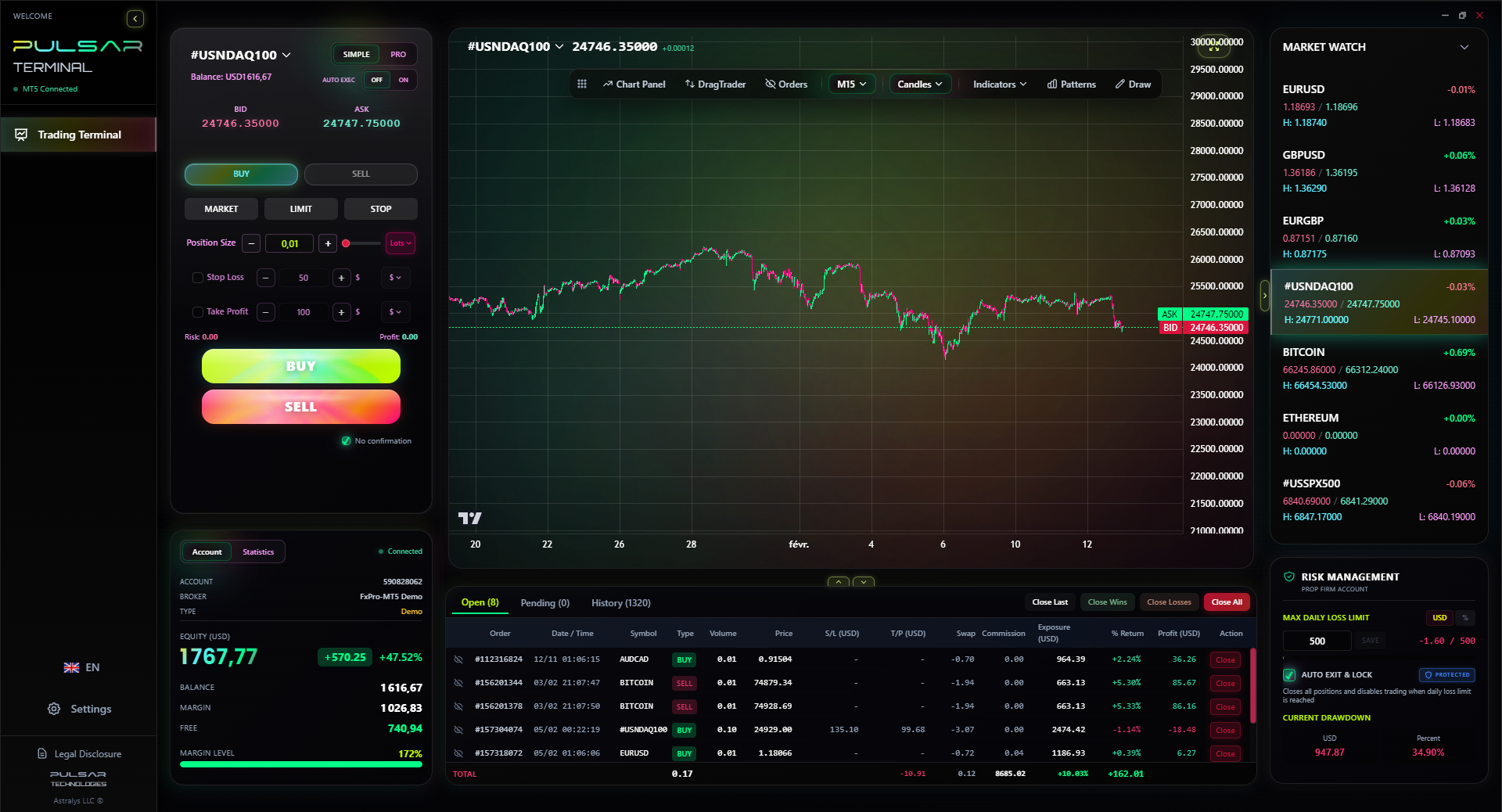
Managing multiple trades and risk across different brokers is complex, but tools like Pulsar Terminal unify your strategy with features like multi-TP/SL and trailing stops directly on MT5.
Pulsar Terminal
Alat MT5 all-in-one: order drag-and-drop, multi-TP/SL, trailing stop, grid trading, Volume Profile, dan perlindungan prop firm. Digunakan 1.000+ trader setiap hari.
Let's be blunt: SARS is better at tracking money than most traders are at making it. The idea that profits in an offshore account are invisible is a dangerous fantasy.
Forex trading profits are not classified as capital gains for individuals (unless you're a registered financial institution). They are considered ordinary revenue income. This means your net profit (total gains minus total losses, minus allowable expenses) gets added to your other income (salary, rental income, etc.) and taxed at your marginal income tax rate, which can go up to 45%.
What are 'allowable expenses'? This is crucial. You can deduct the direct costs of generating your trading income. This includes:
- Broker spreads and commissions (the data from your statement).
- Platform or data subscription fees.
- A portion of your internet and electricity costs (pro-rated for trading use).
- Education costs related to improving your trading (courses, books).
- Bank charges for funding and withdrawing.
You must keep careful records: trade statements, bank statements, invoices for expenses. I use a simple spreadsheet logging every trade, the spread definition cost, commission, and the net P&L. At tax year-end, it's a 30-minute job to tally it up.
The biggest mistake I see? Traders only report their withdrawals as income. That's wrong. You report the net profit generated in the account for the tax year, regardless of whether you withdrew it or not. If you made R100,000 in profit but only withdrew R50,000, you still owe tax on R100,000.
If you're consistently profitable, consider consulting a tax practitioner who understands trading. The few thousand Rand in fees can save you from a nasty audit and penalties later.
💡 Tips Winston
Open a separate savings account called 'Tax'. Every time you make a profitable withdrawal, put 30% of the profit straight into it. Future you will thank present you profoundly.
“The FSCA's 30:1 use cap feels like a restriction, but it's a seatbelt for your capital.”
Okay, let's move from theory to practice. Here's a step-by-step plan to acquire your forex merchandise without getting scammed or overwhelmed.
- Education Before Registration: Don't even look at a broker website yet. Spend a month learning. Understand what a pip definition is, how use works, what a margin call is. Paper trade a simple strategy using the RSI indicator or MACD indicator on a free platform.
- Shortlist FSCA Brokers: Based on your trading style, make a shortlist of 3-4 brokers from the list in this guide. If you're a beginner who wants simplicity, a local broker with ZAR accounts is a great start. If you're tech-savvy and want to scalp, look at Tickmill or HFM's raw accounts.
- Open a Demo Account: Open a demo with your top two choices. Test everything. Place trades, check the execution speed, see how the spreads behave during news events (like SA CPI data releases). Try withdrawing 'demo' funds. Get a feel for their platform.
- Start Small for Real: Once comfortable, open a live account with your chosen broker. Start with the absolute minimum deposit. Your goal in the first 6 months is not to get rich, it's to not blow up. Trade micro lots. The market will be here tomorrow.
- Implement Risk Management from Day One: This is non-negotiable. Never risk more than 1-2% of your account on a single trade. Use stop-losses on every position. This single habit separates those who survive from those who become a statistic.
- Keep a Trading Journal: Note every trade: entry, exit, why you took it, your emotional state. Review it weekly. This is how you improve. My journal showed me I lost 70% of my trades taken after 8 PM when I was tired. I now have a hard rule: no trading after 7:30 PM.
The South African forex market is growing, projected to hit nearly $7 billion by 2033. The opportunity is real. But the opportunity is only for those who treat trading as a serious business, not a lottery ticket. Buy the right merchandise, understand the local rules of the road, and you give yourself a fighting chance.
FAQ
Q1Is forex trading legal in South Africa?
Yes, absolutely. It's legal and regulated by the Financial Sector Conduct Authority (FSCA). However, you must trade with an FSCA-licensed broker and adhere to specific rules, like not speculating directly against the South African Rand (ZAR).
Q2What is the maximum use I can use?
For retail traders, the FSCA caps use at 30:1 on major currency pairs. Some unregulated offshore brokers may offer more, but using them means forfeiting all regulatory protection, which is a massive risk not worth taking.
Q3How do I get my money into a forex trading account?
You can use your annual R1 million single discretionary allowance to send funds internationally via your bank to an FSCA-regulated broker's account. Alternatively, use a locally regulated broker like Khwezi Trade that accepts direct ZAR deposits via EFT, which is faster and avoids currency conversion fees from the broker.
Q4Do I pay tax on my forex trading profits?
Yes. The South African Revenue Service (SARS) treats net forex trading profits as ordinary revenue income. You must declare it on your annual tax return and pay income tax on it at your marginal rate. Keep detailed records of all trades and expenses.
Q5What's the difference between a spread and a commission?
The spread is the built-in difference between the buy and sell price. A commission is a separate fee charged per trade. Some brokers offer low spreads but charge a commission (e.g., $3 per lot). Others have slightly wider spreads but no commission. You need to calculate the total cost per trade to compare fairly.
Q6Can I trade Gold (XAU/USD) from South Africa?
Yes, you can. Gold against the USD (XAU/USD) is a popular CFD instrument offered by most FSCA-regulated brokers. It's not considered speculation against the Rand, so it's perfectly legal. Just be aware it can be highly volatile. We have a dedicated XAU/USD guide that covers strategies for trading it.
Q7What happens if my broker goes bankrupt?
If your broker is FSCA-regulated, they are required to keep client funds in segregated accounts at top-tier banks. This means your money is separate from the broker's operating funds. In a bankruptcy, your funds should be protected and returned to you, not used to pay the broker's debts. This is a key reason to only use regulated brokers.
Pelajaran Prof. Winston
Poin Penting:
- ✓Verify FSCA license before depositing a single cent.
- ✓Calculate the ALL-IN cost: spread + commission + conversion fee.
- ✓Never risk more than 2% of your account on one trade.
- ✓SARS taxes your net profit, not your withdrawals.
- ✓Use a demo account to test broker execution for 2 weeks minimum.
Seberapa bermanfaat artikel ini?
Klik bintang untuk menilai
Wawasan Trading Mingguan
Analisis & strategi mingguan gratis. Tanpa spam.
Tentang Penulis
David van der Merwe
Trader Pasar Berkembang
Trader berbasis Johannesburg dengan 11 tahun di mata uang pasar berkembang. Spesialis pasangan ZAR, trading berregulasi FSCA, dan analisis pasar Afrika Selatan.
Komentar
Peringatan Risiko
Perdagangan instrumen keuangan mengandung risiko signifikan dan mungkin tidak cocok untuk semua investor. Kinerja masa lalu tidak menjamin hasil di masa depan. Konten ini hanya untuk tujuan edukasi dan tidak boleh dianggap sebagai nasihat investasi. Selalu lakukan riset Anda sendiri sebelum trading.
Anda mungkin juga suka

Cara Trading Forex Sukses: 7 Prinsip dari Trader Profesional
Cara trading forex sukses dengan 7 prinsip trader pro: manajemen modal, disiplin, journal trading, backtest. Data nyata, bukan janji profit palsu.
Jam Trading Forex Terbaik untuk Trader Indonesia: Panduan Lengkap dengan Tabel Waktu
Panduan jam trading forex untuk trader Indonesia. Tabel 4 sesi dunia, jam emas 20:00-00:00, sesi mana yang harus dihindari. Data akurat + tips dari trader berpengalaman.
Top 5 Sàn Forex Uy Tín Nhất 2026: Review Jujur dari Trader Indonesia
Top 5 sàn forex uy tín 2026 untuk trader Indonesia. Review jujur: spread, deposit, withdraw, dukungan lokal. Exness, XM, IC Markets & lebih.
Dapatkan Pulsar Terminal
Semua kalkulator ini terintegrasi dalam Pulsar Terminal dengan data real-time dari akun MT5 Anda.
Dapatkan Pulsar Terminal